
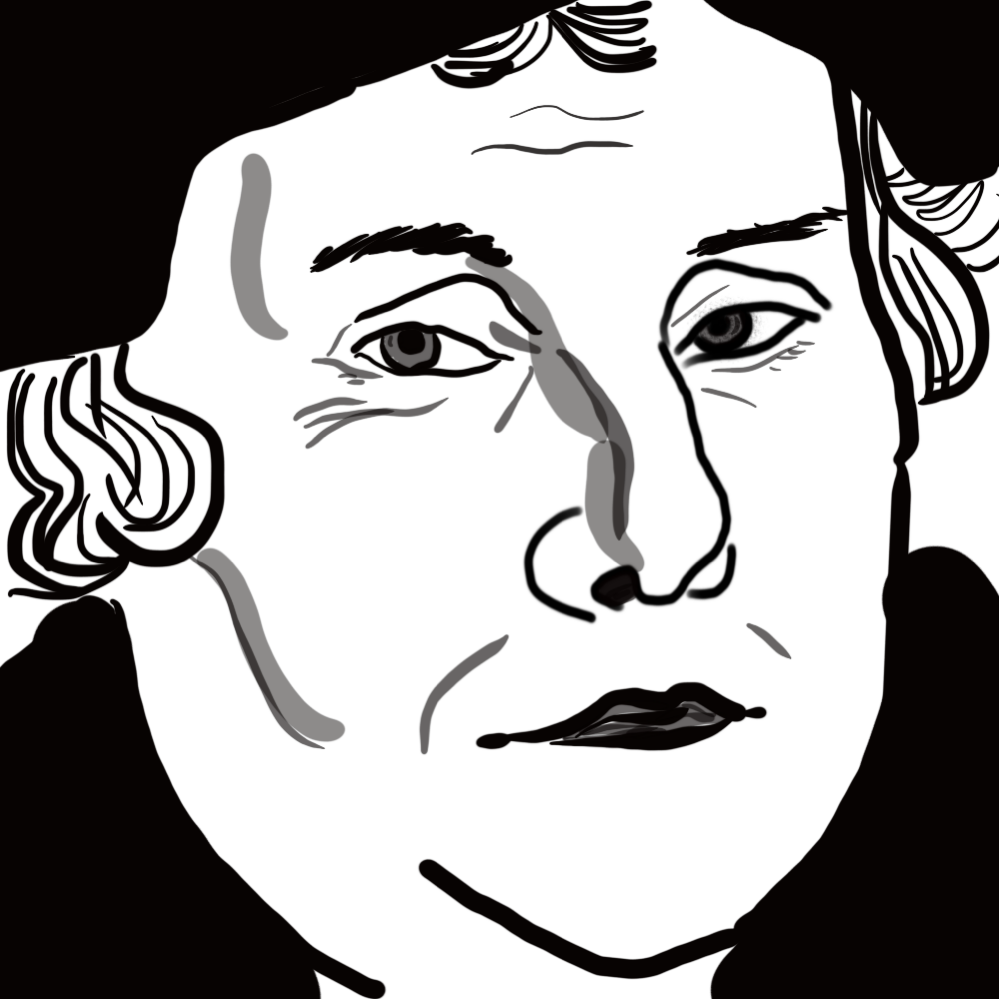

There are few people in the history so studied as Martin Luther. He is certainly a complex figure, and his legacy is as divisive as it is broad. Still, a sympathetic look at a few objective facts about his life give us a picture of a sincere Christian with a troubled childhood and firm conviction. Among Protestants, his story can illustrate important lessons. Above all, it is the fruits of Martin Luther’s scrupulosity that show the tension between hope and despair, humility and pride, and continuity and rupture within the struggle for Christian unity.
Every family has fights. It’s part of family life. When those times come, we are torn between hope and despair. We despair not only over the people in our family, but even the institution itself. We want to ‘run away from home.’ Martin’s troubled childhood led to an excruciating scrupulosity. It drove him to terror and doubt over the love of God, His acceptance, and forgiveness—all things which were communicated to him through the Catholic doctrine and praxis. In many ways this intense spiritual depression reflects the deeper groan of Europe through centuries of plague, schism and clerical abuse. The Christian family was doubting if the institutions that made them a family—the Papacy, the Sacraments, the Priesthood—were worth it. Would they be better off without them? Should they run away from home? Some did.
But young Martin struggled with a hope that the Church would give him the answers. He followed his confessor’s instructions, even though they did not seem to help. He read the mystics, and received absolution in confession—“Go in peace, the Lord hath put away thy sins”—but still, these things did not penetrate his scrupulosity. In the struggle for a family to ‘work it out,’ there is always the voice of the aged, encouraging us: “It’s OK. It’ll work out.” Ultimately something deep inside Martin’s spirit refused to listen to the wisdom of the elders. Nothing helped.
Martin never found the answers in the Church. He was still wrestling when he found his own revelation in his doctrine of ‘Faith Alone.’ Ultimately he felt that he had to reject the counsel of the Church authorities and make his own authority. His scrupulosity had caused him to involuntarily reject the affirmations of others, and in forming his own opinion, he found it was his only solution. This represents for us when we give in to despair and give up on reconciling the family. We now decide to make our own way, because we think it is the only solution. We run away from home.
This, however, is the difference between humility and pride. In a spiritual irony, the depth of our despair becomes a fountain of pride, because in our despair we choose to reject the answers given to us from wisdom (that is, the family structure itself), and choose to make our own. But humility is rooted in love, which “bears all things,” and is willing to go to the cross for the sake of reconciliation. Martin made his own doctrine which he believed was that of the early church. But this in fact was an antiquarianism of his own making, which could not find any living connection with the past. When faced the struggle to bear all things patiently, he chose to try to convince others to run away from home too.
This led ultimately to rupture. When Catholic reformer Erasmus broke with Luther, he did so over the teaching on free will. When Luther rejected free will, Erasmus realized that Luther did not desire to patiently endure the family in order to reform it, but rather to break from it, and from the tradition that holds it together. Luther’s scrupulosity had driven him to despair, and his only solace was his own teaching, no matter what the cost.
In this way, Luther projected his own spiritual struggles upon the whole Church and caused a most unfortunate prejudice and misunderstanding about Catholic doctrine which is shared by Protestants to this day. When he ran away from home, many ran with him, but they ran in all directions. It would have been better if the Protestant movement became just one other communion. Instead, because Luther had based his doctrine on his own authority, so did everyone else, and instead of the terrible schism of three popes, there were now so many self-made popes that Europe was past the point of no return.
The foundation of all Christian unity must first be love. It must be willing to bear all things and seek to be humble towards one another, in the hope that unity can be restored somehow. We must reverse the scrupulosity of Martin with our own childlike confidence in the mercy of God through the prayer of our Lord to His Father that cannot fail. “May they be one as we are one.” Do we really believe this? And are we willing to be crucified for it? A servant is not above his master.