


The Church’s Prayer Book: the Holy Psalter
Holy Psalter Prayer Plans
Note: one of these plans is meant to complement the Advanced Bible Reading plan shown here.
Audio Psalter
The entire Psalter, Challoner-DR version, is contained in the iPieta app. This is helpful because you can play the Psalter on audio using your phone while doing chores, etc., which helps get through the Psalter. That can be utilised for any of the following plans.
Beginner: Twice Annual Psalter
Begin with Psalm 1 and pray each psalm daily as a preparation for reading the Holy Scriptures with the intention of worshipping God and gaining wisdom. You can easily break up longer ones too, especially Psalm 118 (119).
- The advantage of this method is that it is easily doable and reads through the whole Psalter twice per year.
- The downside is it’s disconnected from any liturgical consideration.
Intermediate: Monthly Psalter
If you pray the modern Liturgy of the Hours, which includes a four week Psalter.
- The advantages are that this is both doable for laity and liturgical. It takes about 30 minutes per day between all the sevens offices of the day and night. You can also skip hours that repeat Psalms, like Terce, Sext and None.
- The disadvantage is that the four week Psalter does not include all the Psalms, and some verses are “censored” due to being too violent. This is an unfortunate misunderstanding of the spirituality of the Psalter, which is a militant prayer against the world, the flesh and devil. See below for the meaning of each Psalm.
The other thing is that this modern office follows the new calendar and thus excludes things like Embertide and Septuagesima, which might pose difficulties.
Advanced: Weekly Psalter
This plan follows one of the traditional versions of the divine office which prays the entire Psalter every week. This is modified for weeks with feast days, which include different Psalms.
- The advantage is that praying the weekly Psalter introduces you to the whole spirituality of the Psalter and allows the maximum spiritual benefit from these prayers of Christ. It is also completely liturgical and includes all the traditional feasts and seasons.
- The disadvantage is it is much more complicated and difficult for a layman. The whole eight hours of night and day take somewhere between 60 to 90 minutes for the entire day, with the morning offices taking up the bulk at 40 to 50 minutes:
Morning
- 20-25 min. Matins
- 15 min Lauds
- 10 min Prime
Daytime
- 5 min Terce
- 5 min Sext
- 5 min None
Evening
- 10-15 min Vespers
- 5 min Compline
It will also take longer for those starting out.
To get the proper texts for this, you need to decide between the Roman and Monastic/Benedictine breviary. The Roman is slightly shorter, and also more common among Traditional Catholics, so that is slightly easier. You can try both by going to divinumofficium.com and using “Rubrics 1960” (Roman) or “Monastic” (Benedictine) version.
Once you decide that, you can purchase a hard copy of the Roman from Baronius Press, or try to find one used. You see the disadvantage of the Roman immediately because it is rather expensive. If you want to go Monastic, you can purchase the St. Michael’s Abbey version of the Monastic Diurnal. The downside with this is that is excludes Matins (“Diurnal” refers to the offices of the day, from Lauds to Compline), so you have to access that through the aforementioned website or buy a hard copy new or used. Another downside to this version is that it is the Monastic rubrics of 1963, which removes feasts from the 1955 reform and also reduces commemorations from Vespers.
The best hard copy version of the Monastic Breviary, in my opinion, is the Lancelot Andrewes version (Diurnal and Matins). The plus here is that it has all the old rubrics and old feasts. The downside is it has no Latin, and the Psalter is the Coverdale translation, which can lose Christological references, such as in Psalm 109 (110).
The Byzantine Psalter
Another alternative for the weekly Psalter is to use the Byzantine version. This is the easiest form of the weekly Psalter, because it doesn’t change any week. The Psalter is divided into 20 “kathismata” or sections, which are then divided between morning and evening prayer. The version I have used which is good is the one translated by Holy Transfiguration Monastery (Old Calendarist Orthodox) which has a pocket version but is also available online. In the back of this text it shows the arrangement for the hours of the weeks.
The Meaning of Every Psalm
- Psalm i.Beatus vir. The happiness of the Church and the evil state of the wicked.
- Psalm ii.Quare fremuerunt. The vain efforts of the persecutors against Christ and His Church.
- Psalm iii.Domine, quid multiplicati. The passion and resurrection of Christ.
- Psalm iv.Cum invocarem. Christ teaches us to flee to God in tribulation, with confidence in him.
- Psalm v.Verba mea auribus. Christ’s prayer to God against the iniquities of men.
- Psalm vi.Domine, ne in furore. Christ in His Body prays under the scourging of God
- Psalm vii.Domine, Deus meus. Christ in His Body prays for God’s help against His enemies.
- Psalm viii.Domine, Dominus Noster. God is wonderful in His works; especially in mankind, singularly exalted by the incarnation of Christ.
- Psalm ix.Confitebor tibi, Domine. The Church praises God for His protection against her enemies.
- Psalm x.In Domino confido. The confidence of Christ in the Father in the midst of persecutions.
- Psalm xi.Salvum me fac. Christ calls for God’s help in the midst of persecutions.
- Psalm xii.Usquequo, Domine. A prayer of the Church in tribulation.
- Psalm xiii.Dixit insipiens. The general corruption of man before our redemption in Christ.
- Psalm xiv. Domine, quis habitabit. What kind of men shall dwell in the heavenly sion.
- Psalm xv. Conserva me, Domine. Christ’s future victory and triumph over the world and death.
- Psalm xvi. Exaudi, Domine, justitiam. Christ’s prayer in tribulation against the malice of His enemies.
- Psalm xvii. Diligam te, Domine. The triumph of the Christian Church over all enemies.
- Psalm xviii. Coeli enarrant. The works of God show forth His glory: the spread of the Gospel.
- Psalm xix. Exaudiat te Dominus. Supplication of the Christian for deliverance in Christ.
- Psalm xx. Domine, in virtute. Praise to God for Christ’s exaltation after His Passion.
- Psalm xxi. Deus Deus meus. Christ’s Passion, Resurrection, and the conversion of the Gentiles.
- Psalm xxii. Dominus regit me. God’s spiritual benefits for faithful souls.
- Psalm xxiii. Domini est terra. Who are they that shall ascend to heaven: Christ’s triumphant ascension thither.
- Psalm xxiv. Ad te, Domine, levavi. Christ’s prayer for His Church against her enemies.
- Psalm xxv. Judica me, Domine. Christ’s prayer during His passion for the triumph of his Church.
- Psalm xxvi. Dominus illuminatio. Christ’s prayer before His passion.
- Psalm xxvii. Ad te, Domine, clamabo. Christ’s prayer during His passion with confidence in his resurrection.
- Psalm xxviii. Afferte Domino. Exhortation to worship God commemorating His mighty works.
- Psalm xxix. Exaltabo te, Domine. Christ’s thanksgiving in His resurrection.
- Psalm xxx. In te, Domine, speravi. Christ’s prayer in His passion.
- Psalm xxxi. Beati quorum. The repentance of the Church and the words of comfort from Christ.
- Psalm xxxii. Exultate, justi. Exhortation to praise God and trust in Him.
- Psalm xxxiii. Benedicam Dominum. Exhortation to the praise and service of God.
- Psalm xxxiv. Judica, Domine, nocentes me. Christ prays against His persecutors, prophesying their punishment.
- Psalm xxxv. Dixit injustus. The malice of sinners and the goodness of God.
- Psalm xxxvi. Noli aemulari. An exhortation to despise this world. The short prosperity of the wicked and the trust in God’s providence.
- Psalm xxxvii. Domine, ne in furore. Christ prays for the remission of sins for His Church.
- Psalm xxxviii. Dixi custodiam. Christ in His passion before His death, intercedes for the sins His Church.
- Psalm xxxix. Expectans expectavi. Christ’s coming and redeeming mankind.
- Psalm xl. Beatus qui intelligit. The happiness of him that shall believe in Christ; notwithstanding his humble poverty: the malice of Christ’s enemies, especially the traitor Judas.
- Psalm xli. Quemadmodum desiderat. The prayer of the Church for union with Christ.
- Psalm xlii. Judica me, Deus. The prayer of the Church for resurrection.
- Psalm xliii. Deus auribus nostris. The Church commemorates former favors and present afflictions, under which she prays for deliverance.
- Psalm xliv. Eructavit cor meum. The excellence of Christ’s kingdom, the endowments of His Church and the glory of the Mother of God.
- Psalm xlv. Deus noster refugium. The Church in persecution trusts in the protection of God.
- Psalm xlvi. Omnes gentes, plaudite. The gentiles are invited to praise God for the establishment of the kingdom of Christ.
- Psalm xlvii. Magnus Dominus. God is greatly to be praised for the establishment of His Church.
- Psalm xlviii. Audite, omnes gentes. The fate of those who live on in sin without thought of death or hell.
- Psalm xlix. Deus deorum. The coming of Christ who prefers virtue and inward purity above the blood of victims.
- Psalm l. David’s repentance after his sin.
- Psalm li. Quid gloriaris. Christ’s prophesy of the future punishment of the wicked and exaltation of His Church.
- Psalm lii. Dixit inspiens. The general corruption of man before the coming of Christ.
- Psalm liii. Deus in nomine tuo. Prayer of Christ for help in distress.
- Psalm liv. Exaudi, Deus. Christ persecuted by the Jews and betrayed by Judas.
- Psalm lv. Miserere mei, Deus. Prayer of the Church under distress.
- Psalm lvi. Miserere mei, Deus. Prayer in affliction and praise for deliverance.
- Psalm lvii. Si vere utique. Christ reproves the wicked and foretells their destruction.
- Psalm lviii. Eripe me. Christ persecuted by the Jews.
- Psalm lix. Deus, repulisti nos. After many afflictions, the Church of Christ shall prevail.
- Psalm lx. Exaudi, Deus. Prayer for the coming of the Kingdom of Christ which shall have no end.
- Psalm lxi. Nonne Deo. Encouragement to trust in God and serve Him.
- Psalm lxii. Deus, Deus meus ad te. The thirsting of the Church for Christ.
- Psalm lxiii. Exaudi Deus orationem. Confidence of Christ that God will bring to naught the machinations of persecutors.
- Psalm lxiv. Te decet. God is to be praised in His Church, to which all nations are called.
- Psalm lxv. Jubilate Deo. A psalm of the resurrection of Christ.
- Psalm lxvi. Deus misereatur. Prayer for the propagation of the Church.
- Psalm lxvii. Exurgat Deus. The glorious establishment of the Church prefigured in Israel. The Ascension of Christ.
- Psalm lxviii. Salvum me fac, Deus. Christ in His passion declares the greatness of His sufferings and the malice of His persecutors the Jews; He foretells their reprobation.
- Psalm lxix. Deus in adjutorium. Prayer of Christ in persecution.
- Psalm lxx. In te, Domine. Prayer of the Church for perseverance.
- Psalm lxxi. Deus, judicium tuum. The coming of Christ and His kingdom.
- Psalm lxxii. Quam bonus Israel Deus. Christ lifts up the weak who are tempted to despair by the contemplation of His justice.
- Psalm lxxiii. Ut quid, Deus. The prayer of the Church under grievous persecution.
- Psalm lxxiv. Confitebimur tibi. The just judgment seat of Christ.
- Psalm lxxv. Notus in Judaea. God is known in His Church and exerts His power in protecting her.
- Psalm lxxvi. Voce mea. Prayer of the Church in affliction.
- Psalm lxxvii. Christ recalls the mercies of God to Israel, notwithstanding their ingratitude.
- Psalm lxxviii. Deus, venerunt gentes. The Church in time of persecution prays for relief.
- Psalm lxxix. Qui regis Israel. A prayer for the Church in tribulation, commemorating God’s former favors.
- Psalm lxxx. Exultate Deo. Exhortation to the praise of God.
- Psalm lxxxi. Deus stetit. The words of Christ the King to the Pharisees and other leaders.
- Psalm lxxxii. Deus, quis similis. Prayer against the enemies of Holy Church.
- Psalm lxxxiii. Quam dilecta. Longing for eternal life; rejoicing in Holy Communion.
- Psalm lxxxiv. Benedixisti, Domine. The coming of Christ, to bring peace and salvation to man.
- Psalm lxxxv. Inclina, Domine. Prayer of Christ at His passion.
- Psalm lxxxvi. Fundamenta eius. The glory of the Church of Christ.
- Psalm lxxxvii. Domine, Deus salutis. Christ’s passion, death, and burial.
- Psalm lxxxviii. Misericordias Domini. The perpetuity of the Church of Christ, notwithstanding her most grievous afflictions.
- Psalm lxxxix. Domine, refugium. A prayer for the mercy of God considering the shortness of life.
- Psalm xc. Qui habitat. The just man is secure under the protection of God.
- Psalm xci. Bonum est confiteri. God is praised for His wondrous works.
- Psalm xcii. Dominus regnavit. The glory and stability of the Kingdom of God in Christ.
- Psalm xciii. Deus ultionum. God shall judge and punish the oppressors of His Church.
- Psalm xciv. Venite exultemus. Exhortation to praise God and hear His voice.
- Psalm xcv. Cantate Domino. Exhortation to praise God for the coming of Christ.
- Psalm xcvi. Dominus regnavit. Exhortation to rejoice at the coming of Christ.
- Psalm xcvii. Cantate Domino. Praises for the victories of Christ.
- Psalm xcviii. Dominus Regnavit. The reign of Christ.
- Psalm xcix. Jubilate Deo. The Church rejoices in the mercies of God.
- Psalm c. Misericordiam et judicium. The perfection and judgment of Christ.
- Psalm ci. Domine, exaudi. Prayer in affliction.
- Psalm cii. Benedic, anima. Thanksgiving to God for His mercies.
- Psalm ciii. Benedic, anima. God is to be praised for His mighty works and wonderful providence.
- Psalm civ. Confitemini Domino. Thanksgiving to God for His benefits to the Church.
- Psalm cv. Confitemini Domino. A confession of the manifold sins and ingratitude of Israel.
- Psalm cvi. Confitemini Domino. Thanksgiving to God for His mercies.
- Psalm cvii. Paratum cor meum. Praise to God for benefits received.
- Psalm cviii. Deus, laudem meum. Christ against His persecutors, foretelling the just punishment for the traitor Judas.
- Psalm cix. Dixit Dominus. Christ’s exaltation and everlasting priesthood.
- Psalm cx. Confitebor tibi, Domine. God is praise for His graces to His Church.
- Psalm cxi. Beatus vir. The happiness of the just man.
- Psalm cxii. Laudate, pueri. God is praised for His regard for the poor and humble.
- Psalm cxiii. In exitu Israel. God has shown His power in delivering Israel. The vanity of idols.
- Psalm cxiv. Prayer of Christ in affliction with confidence in God.
- Psalm cxv. Christ praises the Father and confesses He is the son of Mary.
- Psalm cxvi. Laudate Dominum. All nations praise the Lord.
- Psalm cxvii. Confitemini Domino. Praise to God for His mercies and the coming of Christ.
- Psalm cxviii. Beati immaculati. The perfection of Christ.
- Psalm cxix. Ad Dominum. Prayer of Christ in tribulation.
- Psalm cxx. Levavi oculos. The voice of Christ speaks to comfort His Church.
- Psalm cxxi. Laetatus sum in his. The desire of the Church for union with Christ in eternal life.
- Psalm cxxii. Ad te levavi. Prayer in affliction with confidence in God.
- Psalm cxxiii. Nisi quia Dominus. The Church gives glory to God for deliverance from enemies.
- Psalm cxxiv. Qui confidunt. The just are always under the protection of God.
- Psalm cxxv. In convertendo. The Church rejoices at her deliverance from Christ.
- Psalm cxxvi. Nisi Dominus. The absolute necessity of the grace of God.
- Psalm cxxvii. Beati omnes. The fear of God is the way of beatitude.
- Psalm cxxviii. Saepe expugnaverunt. The Church of God is invincible; all her enemies come to nothing.
- Psalm cxxix. De profundis. The sinner trusting in the mercy of God.
- Psalm cxxx. Domine, none est. The humility of Christ.
- Psalm cxxxi. Memento, Domine. Prayer for the coming of Christ.
- Psalm cxxxii. Ecce quam bonum. The happiness of fraternal charity in the Church.
- Psalm cxxxiii. Ecce nunc benedicite. Exhortation to praise God continually.
- Psalm cxxxiv. Laudate nomen. Exhortation to praise God. The vanity of idols.
- Psalm cxxxv. Confitemini Domino. God is praised for His wonderful works.
- Psalm cxxxvi. Super flumina. Lamentation in this valley of tears; the need to immediately banish evil thoughts against the rock of Christ.
- Psalm cxxxvii. Confitebor tibi. Thanksgiving to God for His deliverance in tribulation.
- Psalm cxxxviii. Domine, probasti. The providence of God governing the Church to eternal life.
- Psalm cxxxix. Eripe me, Domine. Prayer for deliverance from the old man.
- Psalm cxl. Domine, clamavi. Prayer of the just man against the malice of the old man.
- Psalm cxli. Voce mea. Prayer in the extremity of danger.
- Psalm cxlii. Domine, exaudi. Prayer of Christ in His passion.
- Psalm cxliii. Benedictus Dominus. David against Goliath. Christ against the world, the flesh, and the devil.
- Psalm cxliv. Exaltabo te, Deus. Praise to the infinite majesty of God.
- Psalm cxlv. Lauda, anima. We are not to trust in man, but God alone.
- Psalm cxlvi. Laudate Dominum. Praise God for His benefits.
- Psalm cxlvii. Lauda, Jerusalem. The Church praises God for His graces to His people.
- Psalm cxlviii. Laudate Dominum de caelis. Let all things praise the Lord.
- Psalm cxlix. Cantate Domino. The Church is bound to praise the Lord and will triumph over her enemies.
- Psalm cl. Laudate Dominum in sanctis. Let all things praise the Lord.
Adoration – Worship God for Who He Is
- Psalm viii. Domine, Dominus Noster. God is wonderful in his works; especially in mankind, singularly exalted by the incarnation of Christ.
- Psalm xxviii. Afferte Domino. Exhortation to worship God commemorating his mighty works.
- Psalm xxxii. Exultate, justi. Exhortation to praise God and trust in him.
- Psalm xxxiii. Benedicam Dominum. Exhortation to the praise and service of God.
- Psalm xliv. Eructavit cor meum. The excellence of Christ’s kingdom, the endowments of his Church and the glory of the Mother of God.
- Psalm xlvi. Omnes gentes, plaudite. The gentiles are invited to praise God for the establishment of the kingdom of Christ.
- Psalm xlvii. Magnus Dominus. God is greatly to be praised for the establishment of his Church.
- Psalm lxv. Jubilate Deo. A psalm of the resurrection of Christ.
- Psalm lxxv. Notus in Judaea. God is known in His Church and exerts His power in protecting her.
- Psalm xcii. Dominus regnavit. The glory and stability of the Kingdom of God in Christ.
- Psalm xciv. Venite exultemus. Exhortation to praise God and hear His voice.
- Psalm cix. Dixit Dominus. Christ’s exaltation and everlasting priesthood.
- Psalm cxxxiii. Ecce nunc benedicite. Exhortation to praise God continually.
- Psalm cxxxiv. Laudate nomen. Exhortation to praise God. The vanity of idols.
- Psalm cxliv. Exaltabo te, Deus. Praise to the infinite majesty of God.
- Psalm cxlviii. Laudate Dominum de caelis. Let all things praise to the Lord.
- Psalm cl. Laudate Dominum in sanctis. Let all things praise the Lord.
Confession and Penance
- Psalm vi.Domine, me in furore. Christ in His Body prays under the scourging of God.
- Psalm xxiv. Ad te, Domine, levavi. Christ’s prayer for his Church against her enemies.
- Psalm xxxi. Beati quorum. The repentance of the Church and the words of comfort from Christ.
- Psalm xxxvii. Domine, ne in furore. Christ prays for the remission of sins for His Church.
- Psalm xxxviii. Dixi custodiam. Christ in his passion before his death, intercedes for the sins his Church.
- Psalm l. Miserere. David’s repentance after his sin.
- Psalm ci. Domine, exaudi. Prayer in affliction.
- Psalm cxxix. De profundis. The sinner trusting in the mercy of God.
- Psalm cxxxix. Eripe me, Domine. Prayer for deliverance from the old man.
- Psalm cxl. Domine, clamavi. Prayer of the just man against the malice of the old man.
- Psalm cxlii. Domine, exaudi. Prayer of Christ in His Passion.
Thanksgiving to God for His benefits
- Psalm ix. Confitebor tibi, Domine. The Church praises God for his protection against her enemies.
- Psalm xvii. Diligam te, Domine. The triumph of the Christian Church over all enemies.
- Psalm xviii. Coeli enarrant. The works of God show forth his glory: the spread of the Gospel
- Psalm xx. Domine, in virtute. Praise to God for Christ’s exaltation after his Passion.
- Psalm xxii. Dominus regit me. God’s spiritual benefits for faithful souls.
- Psalm xxix. Exaltabo te, Domine. Christ’s thanksgiving in his resurrection.
- Psalm lxii. Deus, Deus meus ad te. The thirsting of the Church for Christ.
- Psalm lxv. Jubilate Deo. A psalm of the resurrection of Christ.
- Psalm lxvii. Exurgat Deus. The glorious establishment of the Church prefigured in Israel. The Ascension of Christ.
- Psalm lxxv. Notus in Judaea. God is known in His Church and exerts His power in protecting her.
- Psalm lxxx. Exultate Deo. Exhortation to the praise of God.
- Psalm lxxxiii. Quam dilecta. Longing for eternal life; rejoicing in Holy Communion.
- Psalm lxxxvi. Fundamenta eius. The glory of the Church of Christ.
- Psalm xci. Bonum est confiteri. God is praised for His wondrous works.
- Psalm xcv. Cantate Domino. Exhortation to praise God for the coming of Christ.
- Psalm xcvi. Dominus regnavit. Exhortation to rejoice at the coming of Christ.
- Psalm xcvii. Cantate Domino. Praises for the victories of Christ.
- Psalm xcviii. Dominus Regnavit. The reign of Christ.
- Psalm xcix. Jubilate Deo. The Church rejoices in the mercies of God.
- Psalm cii. Bendic, anima. Thanksgiving to God for His mercies.
- Psalm ciii. Benedic, anima. God is to be praised for His mighty works and wonderful providence.
- Psalm civ. Confitemini Domino. Thanksgiving to God for His benefits to the Church.
- Psalm cvi. Confitemini Domino. Thanksgiving to God for His mercies.
- Psalm cvii. Paratum cor meum. Praise to God for benefits received.
- Psalm cx. Confitebor tibi, Domine. God is praise for His graces to His Church.
- Psalm cxii. Laudate, pueri. God is praised for His regard to the poor and humble.
- Psalm cxv. Credidi. Christ praises the Father and confesses He is the son of Mary.
- Psalm cxvi. Laudate Dominum. All nations praise the Lord.
- Psalm cxvii. Confitemini Domino. Praise to God for His mercies and the coming of Christ.
- Psalm cxxiii. Nisi quia Dominus. The Church gives glory to God for deliverance from enemies.
- Psalm cxxv. In convertendo. The Church rejoices at her deliverance from Christ.
- Psalm cxxxv. Confitemini Domino. God is praised for His wonderful works.
- Psalm cxxxvii. Confitebor tibi. Thanksgiving to God for His deliverance in tribulation.
- Psalm cxlv. Lauda, anima. We are not to trust in man, but God alone.
- Psalm cxlvi. Laudate Dominum. Praise God for His benefits.
- Psalm cxlvii. Lauda, Jerusalem. The Church praises God for His graces to His people.
Supplication in Affliction
- Psalm iii.Domine, quid multiplicati. The passion and resurrection of Christ.
- Psalm v.Verba mea auribus. Christ’s prayer to God against the iniquities of men.
- Psalm vii. Domine, Deus meus. David, trusting in the justice of his cause, prays for God’s help against his enemies.
- Psalm xi.Salvum me fac. Christ calls for God’s help in the midst of persecutions.
- Psalm xii.Usquequo, Domine. A prayer of the Church in tribulation.
- Psalm xix. Exaudiat te Dominus. Supplication for the Christian for deliverance in Christ.
- Psalm xxi. Deus Deus meus. Christ’s Passion, Resurrection, and the conversion of the Gentiles.
- Psalm xxiv. Ad te, Domine, levavi. Christ’s prayer for his Church against her enemies.
- Psalm xxv. Judica me, Domine. Christ’s prayer during his passion for the triumph of his Church.
- Psalm xxvi. Dominus illuminatio. Christ’s prayer before his passion.
- Psalm xxvii. Ad te, Domine, clamabo. Christ’s prayer during his passion with confidence in his resurrection.
- Psalm xxx. In te, Domine, speravi. Christ’s prayer in his passion.
- Psalm xxxiv. Judica, Domine, nocentes me. Christ prays against his persecutors, prophesying their punishment.
- Psalm xliii. Deus auribus nostris. The Church commemorates former favors and present afflictions, under which she prays for deliverance.
- Psalm xlv. Deus noster refugium. The Church in persecution trusts in the protection of God.
- Psalm liii. Deus in nomine tuo. Prayer of Christ for help in distress.
- Psalm liv. Exaudi, Deus. Christ persecuted by the Jews and betrayed by Judas.
- Psalm lv. Miserere mei, Deus. Prayer of the Church under distress.
- Psalm lvi. Miserere mei, Deus. Prayer in affliction and praise for deliverance.
- Psalm lviii. Eripe me. Christ persecuted by the Jews.
- Psalm lix. Deus, repulisti nos. After many afflictions, the Church of Christ shall prevail.
- Psalm lxiii. Exaudi Deus orationem. Confidence of Christ that God will bring to naught the machinations of persecutors.
- Psalm lxvi. Deus misereatur. Prayer for the propagation of the Church.
- Psalm lxviii. Salvum me fac, Deus. Christ in His passion declares the greatness of his sufferings and the malice of his persecutors the Jews; He foretells their reprobation.
- Psalm lxix. Deus in adjutorium. Prayer of Christ in persecution.
- Psalm lxx. In te, Domine. Prayer of the Church for perseverance.
- Psalm lxxiii. Ut quid, Deus. The prayer of the Church under grievous persecution.
- Psalm lxxvi. Voce mea. Prayer of the Church in affliction.
- Psalm lxxviii. Deus, venerunt gentes. The Church in time of persecution prays for relief.
- Psalm lxxix. Qui regis Israel. A prayer for the Church in tribulation, commemorating God’s former favors.
- Psalm lxxxii. Deus, quis similis. Prayer against the enemies of Holy Church.
- Psalm lxxxv. Inclina, Domine. Prayer of Christ at His Passion.
- Psalm lxxxvii. Domine, Deus salutis. Christ’s Passion, Death, and Burial.
- Psalm lxxxviii. Misericordias Domini. The perpetuity of the Church of Christ, notwithstanding her most grievous afflictions.
- Psalm xciii. Deus ultionum. God shall judge and punish the oppressors of His Church.
- Psalm cviii. Deus, laudem meum. Christ against His persecutors, foretelling the just punishment for the traitor Judas.
- Psalm cxviii. Beati immaculati. The perfection of Christ.
- Psalm cxix. Ad Dominum. Prayer of Christ in tribulation.
- Psalm cxxii. Ad te levavi. Prayer in affliction with confidence in God.
- Psalm cxxxvi. Super flumina. Lamentation this valley of tears; the need to immediately banish evil thoughts against the rock of Christ.
- Psalm cxxxvii. Confitebor tibi. Thanksgiving to God for His deliverance in tribulation.
- Psalm cxxxix. Eripe me, Domine. Prayer for deliverance from the old man.
- Psalm cxl. Domine, clamavi. Prayer of the just man against the malice of the old man.
- Psalm cxli. Voce mea. Prayer in the extremity of danger.
- Psalm cxlii. Domine, exaudi. Prayer of Christ in His Passion.
- Psalm cxliii. Benedictus Dominus. David against Goliath. Christ against the world, the flesh, and the devil.
Wisdom and Confidence in God
- Psalm i.Beatus vir. The happiness of the Christ and the Church and the evil state of the wicked.
- Psalm ii.Quare fremuerunt. The vain efforts of the persecutors against Christ and his Church.
- Psalm iv.Cum invocarem. Christ teaches us to flee to God in tribulation, with confidence in him.
- Psalm x.In Domino confido. The confidence of Christ in the Father in the midst of persecutions.
- Psalm xiii. Dixit insipiens. The general corruption of man before our redemption in Christ.
- Psalm xiv. Domine, quis habitabit. What kind of men shall dwell in the heavenly sion.
- Psalm xv. Conserva me, Domine. Christ’s future victory and triumph over the world and death.
- Psalm xxiii. Domini est terra. Who are they that shall ascend to heaven: Christ’s triumphant ascension thither.
- Psalm xxvi. Dominus illuminatio. Christ’s prayer before his passion.
- Psalm xxvii. Ad te, Domine, clamabo. Christ’s prayer during his passion with confidence in his resurrection.
- Psalm xxx. In te, Domine, speravi. Christ’s prayer in his passion.
- Psalm xxxv. Dixit injustus. The malice of sinners and the goodness of God.
- Psalm xxxvi. Noli aemulari. An exhortation to despise this world. The short prosperity of the wicked and the trust in God’s providence.
- Psalm xxxix. Expectans expectavi. Christ’s coming and redeeming mankind.
- Psalm xl. Beatus qui intelligit. The happiness of him that shall believe in Christ; notwithstanding his humble poverty: the malice of his enemies, especially the traitor Judas.
- Psalm xli. Quemadmodum desiderat. The prayer of the Church for union with Christ.
- Psalm xlii. Judica me, Deus. The prayer of the Church for resurrection.
- Psalm xlv. Deus noster refugium. The Church in persecution trusts in the protection of God.
- Psalm xlviii. Audite, omnes gentes. The follow of those who live on in sin without thought of death or hell.
- Psalm xlix. Deus deorum. The coming of Christ who prefers virtue and inward purity above the blood of victims.
- Psalm li. Quid gloriaris. Christ’s prophesy of the future punishment of the wicked and exaltation of His Church.
- Psalm lii. Dixit inspiens. The general corruption of man before the coming of Christ.
- Psalm lvii. Si vere utique. Christ reproves the wicked and foretells their destruction.
- Psalm lx. Exaudi, Deus. Prayer for the coming of the Kingdom of Christ which shall have no end.
- Psalm lxi. Nonne Deo. Encouragement to trust in God and serve him.
- Psalm lxiii. Exaudi Deus orationem. Confidence of Christ that God will bring to naught the machinations of persecutors.
- Psalm lxiv. Te decet. God is to be praised in His Church, to which all nations are called.
- Psalm lxxi. Deus, judicium tuum. The coming of Christ and His kingdom.
- Psalm lxxii. Quam bonus Israel Deus. Christ lifts up the weak who are tempted to despair by the contemplation of His justice.
- Psalm lxxiv. Confitebimur tibi. The just judgment seat of Christ.
- Psalm lxxvii. Attendite. Christ recalls the mercies of God to Israel, notwithstanding their ingratitude.
- Psalm lxxxi. Deus stetit. The words of Christ the King to the Pharisees and other leaders.
- Psalm lxxxiv. Benedixisti, Domine. The coming of Christ, to bring peace and salvation to man.
- Psalm lxxxviii. Misericordias Domini. The perpetuity of the Church of Christ, notwithstanding her most grievous afflictions.
- Psalm lxxxix. Domine, refugium. A prayer for the mercy of God considering the shortness of life.
- Psalm xc. Qui habitat. The just man is secure under the protection of God.
- Psalm c. Misericordiam et judicium. The perfection and judgment of Christ.
- Psalm cv. Confitemini Domino. A confession of the manifold sins and ingratitude of Israel.
- Psalm cxi. Beatus vir. The happiness of the just man.
- Psalm cxiii. In exitu Israel. God has shown His power in delivering Israel. The vanity of idols.
- Psalm cxiv. Dilexi. Prayer of Christ in affliction with confidence in God.
- Psalm cxv. Credidi. Christ praises the Father and confesses He is the son of Mary.
- Psalm cxviii. Beati immaculati. The perfection of Christ.
- 1Psalm cxx. Levavi oculos. The voice of Christ speaks to comfort His Church.
- Psalm cxxi. Laetatus sum in his. The desire of the Church for union with Christ in eternal life.
- Psalm cxxii. Ad te levavi. Prayer in affliction with confidence in God.
- Psalm cxxiv. Qui confidunt. The just are always under the protection of God.
- Psalm cxxvi. Nisi Dominus. The absolute necessity of the grace of God.
- Psalm cxxvii. Beati omnes. The fear of God is the way of beatitude.
- Psalm cxxviii. Saepe expugnaverunt. The Church of God is invincible; all her enemies come to nothing.
- Psalm cxxx. Domine, none est. The humility of Christ.
- Psalm cxxxi. Memento, Domine. Prayer for the coming of Christ.
- Psalm cxxxii. Ecce quam bonum. The happiness of fraternal charity in the Church.
- Psalm cxxxiv. Laudate nomen. Exhortation to praise God. The vanity of idols.
- Psalm cxxxviii. Domine, probasti. The providence of God governing the Church to eternal life.
- Psalm cxliii. Benedictus Dominus. David against Goliath. Christ against the world, the flesh, and the devil.

The Fellowship of St. Anthony
The Meaning of Catholic Guild has formed a lay sodality of fasting to offer up penances on behalf of the clergy. This group is called the Fellowship of St. Anthony, operating under his patronage as he fasted and supported the clergy during the Arian crisis. We do this to offer corporate penance to turn away the wrath of God that has punished the world and the Church with bad clergy. May God, through the intercession of St. Anthony, help all priests and bishops fulfill their duties for the sake of souls and let the lay and clerical orders work together for God’s greater glory. To access this group, join the Guild community by donating or joining the Guild. If you can’t afford this, contact us and we can work something out. All new Guild members will receive an email with a link to join the Fellowship. -T. S. Flanders
OPTIONAL Bible Reading group: if you have committed to the penance of the Fellowship, you may join those who are taking on the annual Bible reading plan as well. Access the plan here or find it in the book (free eBook will be send to all Fellowship members). You also need to choose a Holy Psalter Prayer plan.
What follows is the Lenten rule, but scroll down for our rule for the rest of the year. The bare minimum is slightly above the bare minimum enjoined on all Catholics by canon law.
Rule of Lenten Fasting for the Fellowship
All members of this sodality agree to commit to the level One Tier from Ash Wednesday to Holy Saturday. Members may also privately commit to Tier Two or any add-ons at their own or their spiritual director’s discretion. We also agree to offer our penances for all Priests and Bishops.
Tier One
ABSTINENCE
- Vegetarian Diet is to be consumed Monday, Wednesday, and Friday. (Vegetarian here is defined as no flesh meats. Fish, crustaceans, molluscs, dairy, and eggs are permitted though not necessary.)
- Drinks allowed are sugar-free coffee or tea, and water. Milk may be consumed at principal meal or as a collation
- No wine is to be consumed for the duration of Lent (excludes Sundays)
- No sweets for the duration of Lent (Sweets include: cake, cookies, pie, candies, gummies, chocolate/candy bars, pastries, cupcakes, chocolate muffins, pudding/custard, ice cream, Nutella, fudge, truffles, pralines, bonbons, mochi,)
FASTING
- Fasting is to be observed on each Wednesday and Friday (Fasting here is defined as one principal meal, with 2 optional collations)
PRAYER – DAILY
- Morning Our Father for help in our Fast and Evening Our Father in Thanksgiving
- Prayer to avert God’s Wrath (included in resources section of this document), especially for priests
PRAYER – WEEKLY
- A weekly Stations of the Cross is to be prayed (preferably on Friday)
- A weekly Rosary is to be prayed
READING
- Read the Daily Mass readings (Epistle and Gospel) daily from the Traditional 1962 Missal (or earlier)
- Read Life of St. Anthony at your own pace (audio options below)
ALMS
- Commit to giving alms at least once during Lent
SECRET
- Do not announce your fast to anyone except spiritual director and spouse/parent (especially if said person cooks your meals)
Exceptions
- If you have health conditions, you may consume food or liquid per your special diet (Ex. bone broth)
- If your job requires something special or extra, you may proceed with what you need (It is better to eat rather than faint at work)
- Charity is of the first order. If you are in a situation where a “banned” food is offered to you and it would be impolite or an insult to your host to decline, then accept the food. It is also better to accept a small portion than to reveal your fast publicly
Tier Two
- Tier Two includes Tier One points plus the following:
- Vegan diet is to be assumed for the duration of Lent (includes Sundays)
- Fasting is to be maintained Monday, Wednesday, and Friday
- Daily Rosary is to be prayed
- Read all the mass readings (Epistle, Gospel, Collect, Secret, Postcommunion)
Add-Ons
- Black Fast (no food only water/coffee for all daylight hours, one vegan meal after sunset) for Ash Wednesday and Good Friday
Resources
Prayer to Avert God’s Wrath
O God, Who by sin art offended, and by penance appeased, mercifully regard the prayers of Thy people making supplication to Thee, and turn away the scourges of Thine anger, which we deserve for our sins.
Audio Version of Life of St. Anthony
Online Version of the Life of St. Anthony (also accessible on the iPieta app)
Hard copy of Life of St. Anthony
Daily Mass Readings can be easily accessed with a Missal or the iPieta app on ios or android.
PENANCE RULE FOR THE REST OF THE YEAR
Paschaltide
- Tier 1: Abstinence only on Fridays in Paschaltide (except Easter Friday which is optional, current canon law allowing meat on Solemnities such as Easter Friday)
- Tier 2: Additional Fasting on Fridays
After Pentecost
- Tier 1: Abstinence Wed / Friday
- Tier 2: Additional Fasting on Friday
Advent
- Tier 1: Abstinence Wed / Friday / Saturday
- Tier 2: Additional Fasting on Friday, St. Martin’s Lent abstinence from 11/11 to 12/24 including Sundays.
After Epiphany
- Same as After Pentecost
The Logos of Music
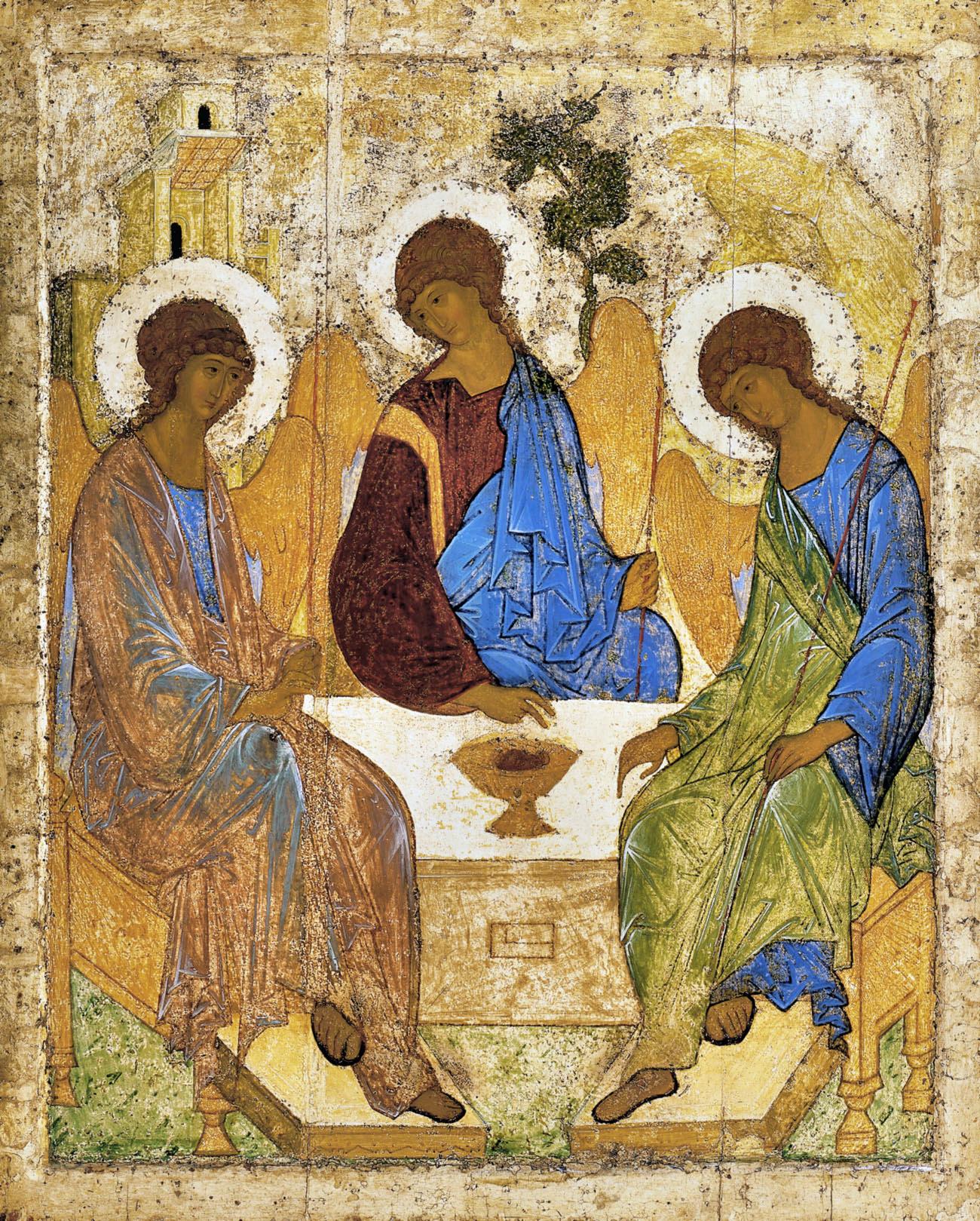
This icon, which shows an invitation to the chalice of divine communion, seems to be the most fitting to visually describe music, the “most spiritual of all arts,” for music, insofar as it is according to Logos, is such a manifestation and invitation.
By Timothy S. Flanders
I have been a musician for most of my life. My mother is a music therapist and was also my piano teacher from ages five to ten, and after this I studied percussion through my first year in college. Over some twenty years I have studied and performed a variety of musical styles from around the world including chant, polyphony, Classical, Romantic, Modern Classical, march/drum line, Blues, Bebop, Afro-Cuban, Latin, funk, swing, folk, trad/country, rock, hip-hop and also hard rock, grunge and punk rock. For many years I would have considered myself a music enthusiast who was able to appreciate literally all forms of music in some way, even so-called “noise music.”
Yet I was a music “relativist,” meaning that I never thought that one form of music was objectively superior to another form. In other words, I believed that musical beauty was relative. There was no objective truth about the beauty of music. By extension, this meant that beauty itself is relative.
But I have realised that this is a philosophical error. If beauty itself is an aspect of God, that meant that God Himself – Eternal Truth – was relative in some way.
This view of beauty and of music is generally held by people today, including many Catholics, and so I held this view when I became Catholic in 2013.
Since that time however, I have slowly come to realise that this “universalist” view of music misses the mark. Especially after I came to realise the nature of the liturgical crisis and was brought to understand what natural law is, I have changed my views significantly to accord with what I believe to be the understanding of the Church and her saints. I’ve also experiecned this effect of this truth in my personal spiritual life. This essay will attempt to summarise this view point in an attempt to be faithful to Catholic Tradition.
Having said all this, as with all my intellectual work, this is merely a hypothesis which I am continually testing to verify its truth or falsehood. Therefore I invite the reader to take all this as merely one man’s opinion, albeit attempting, by grace, to be a faithful Catholic. I invite your feedback which can be sent by using the contact page.
Finally, I must offer one more disclaimer and that is the fact that in this essay it seemed necessary to exhibit certain forms of music which I am arguing are spiritually harmful. However, I believe they can be studied objectively if the listener only takes in a small bit and keeps one’s heart detached from the audio that is studied. Having said this, there are a few videos and musical examples which may be disturbing for readers, and are noted in the text of this essay. Please be advised to use the virtue of caution and avoid listening to certain of these examples if you are particularly susceptible to their power.
Logos
First, if you are unfamiliar with the concept of “logos” and “Logos,” we need to define these things first. When we say “logos” (lower-case) we refer to the rational order of the universe. It was more or less universally understood by all societies that the world possessed some sort of rational order.[1] The Greek word λόγος can mean order, word, reason, peace, logic, and collection and is related to binding, rest, and law. Logos has synonyms in the Sanskrit ऋत [Ṛta] and the Chinese 道 [Tao].
The ancients of every religion believed that this was the truth about the world. We participate in this order by means of conforming our behaviour to logos, and this is known as morality. So we’ve got logos as truth and logos as goodness. But besides these first two there was something known by ancients as more mystical and mysterious that reflected logos in an unspeakable way, and this was known as beauty. It was something that people could intuit by means of their own rational nature as persons.
So we have truth, goodness, and beauty, the three transcendentals.
We might break it down and say that truth is the logos of what man knows.
Goodness is the logos of what man does.
Beauty is the logos of what man sees and hears in the natural order or makes if he creates beauty himself.
All of this is a participation in the universal logos which is that rational order of the universe. All of this can be understood by natural reason without any sort of supernatural intervention.
But in revelation, God reveals Himself as both the origin of logos and the Logos Himself. This is where we have “Logos” with a capital “L” as the Second Person of the Holy Trinity. Thus we can put our three transcendentals another way:
Truth is the Logos of the reality of God. Truth is the Logos: Who God is.
Goodness is the Logos of God’s will.
Beauty is the Logos of what God makes.
So there is a divine Logos and a created logos. Everything that is created has a logos, a rational order which reflects the universal logos and ultimately Logos Himself.
The Seven Note Scale
If we accept all this, we must conclude that music itself has a logos which is a reflection of this order. Its beauty can be a reflection of the divine by means of its logos which reflects the Logos. It has its own inner order.
An easy aspect of this to understand is the seven-note scale. Do you remember “Do-Re-Mi” from The Sound of Music? That’s the seven-note scale. It’s one fundamental logos of music.
This is an ordering of music which is built into its very nature. Moderns like Schönberg actually tried to change this logos of music and create a different scale, called the twelve tone system, which only produced ugly music. For example, try listening to this music which intentionally tried to change the logos of the seven-note scale and create something different:
Because this music departs from the very logos of music, it invokes in the listener a feeling of disorientation. Listening to these sounds the listener intuitively understands that something is not right. It is chaotic. If the intention is to produce the reaction of revulsion to ugliness, then this music succeeds. This music would be fitting to score a scene in a film where the villain triumphs over the protagonist. But Schönberg himself apparently sought to make this music as an act of rebellion against Logos Himself, but we will return to this historical narrative below.
But the seven note scale can be described as an intrinsic logos in music. We will touch on a few other such intrinsic elements in this essay, like rhythm, melody and harmony. But first, let’s look at what we might call an extrinsic logos of music: natural law and custom. For we can note a few things about music from what has been passed down to us, but first let’s look at a Catholic’s obligations to natural law and custom.
Assent to Natural Law and Custom
First, it is important to understand how the Church reveres custom and natural law. These are important sources to understand the nature of music and the Church’s Tradition. What is custom? It is something that is established in ancient times and passed down (mostly) orally between generations. It binds them together in common ways of life. Examples of customs include cuisine, dance forms, clothing, and of course, music. So how should Catholics revere customs?
St. Thomas quotes St. Augustine as saying:
The customs of God’s people and the institutions of our ancestors are to be considered as laws. And those who throw contempt on the customs of the Church ought to be punished as those who disobey the law of God.[2]
St. Thomas argues that custom has the force of law because:
a thing is done again and again… seems to proceed from a deliberate judgment of reason. Accordingly, custom has the force of a law, abolishes law, and is the interpreter of law.[3]
OK, so we should generally respect custom. What about evil customs? We will return to this question below.
First, let’s add natural law here. What is that? Natural law is that which is observed “at all times and among all nations” as something inherent in human nature.[4] Human nature itself is made through Logos (Jn. 1:1-2), so natural law is something deeper and more fundamental than custom, since it is according to logos by its definition. It is moral in its orientation. Custom may or may not be according to logos, or it might be so indirectly to morals as to appear indifferent to them.
For example: it is not a question of morals whether Chinese dress like Chinese or Europeans dress like Europeans. But it is a question of custom. And further, the importance of revering the local custom is an obligation of natural law. So we see that custom and natural law are related and overlap, but aren’t exactly the same thing. This is how Catholics should view these things, and this is the aspect of piety (the virtue by which we revere our ancestors) comes into play. This is how we approach the question of music. If we look at it with the reverence for custom and the orientations of natural law, what can we learn about the logos of music?
Most generally, that we must revere the music that was passed down to us by our ancestors. We should receive this with the virtue of piety and this is a general obligation on all Catholics. So popular music has already gone astray on the extrinisic logos of music when it uses music socially as a revolution against the wisdom of the ancestors. But the problem was that at the moments of these historical revolutions, they were also rebelling against actually evil customs. But we will treat that in its proper place below.
The Magisterium
Some Catholics ask the question: where did the Magisterium define the logos of music? Not finding such a decretal, they think a Catholic is free to have his own view on the matter regardless of custom and natural law.
There are a few problems with this approach. First, it ignores the historical fact that most doctrines of the Church are passed down orally long before they are written down or defined by the Magisterium (see my book on this topic). This oral tradition is authoritative before any Magisterial act would confirm that authority. In fact, the oral tradition is its own Magisterium, known as the “universal and ordinary Magisterium.” It was this Magisterium to which St. John Paul II appealed when he definitively closed the door on women’s ordination.[5]
Second, this view of Magisterial obligations promotes a view of the Church which is clericalist and a modern innovation. For centuries, our fathers received the faith, lived it, and passed it down. This included innumerable Catholic and natural customs – including music. No one was asking the Magisterium what sort of folk ballad they should sing to their children. They just sang the folk ballad of their fathers.
The historical fact is that these innumerable customs have been overthrown in our own day by enemies of the Church. In response to this, a Catholic is confused if he thinks he should ask the extraordinary Magisterium whether or not he should restore the music of his forefathers and promote such music. This assumes that he does not posses the basic virtue of piety and reason that all his forefathers did for centuries and that now the Magisterium should take on the role to arbitrate such matters.
Thus it is the wrong question to ask what the Magisterium has said, but rather look to the ordinary Magisterium of the customs of the faithful. If we are guided by the ordinary Magisterium which blends natural law and custom with the revelatory depositum fidei, it is superfluous to look for a modern Magisterial decretal on this matter. Just conform yourself to the inner obligation to assent to Tradition in general. Mine the Tradition, and pass it down. You don’t need anyone’s permission to do this and further, you are obliged to do this as a Catholic by your baptism.
Pre-Christian Customs
Another proof of this approach is in observing the way the ecclesiastical authority has spread the Gospel in every nation. Without exception, the pre-Christian customs in all nations which are according to logos – language, dance, clothing, cuisine, music – are retained and transfigured in Christ. This proves clearly that the Church asks Catholics to revere the customs of their fathers, even if those fathers were not Christian!
Now of course it is otherwise if any traditional custom of a pre-Christian nation has any demonic content or is in any way against logos. All of these are removed, over time if necessary (in the case of ingrained, intrinsically immoral behavior like slave-trading).[6] But all that is according to logos is retained, revered, and continues to be passed down.
In this way Catholic missionaries (unlike the heretical Protestants) saved and preserved cultures, and one of the most conspicuous elements of this preservation is of course music.
Thus we can look at numerous cultures and the greatest of pre-Christian philosophers to discern the nature of music as interpreted by the mind of the saints. So what is the logos of music? We’ve discussed the seven-note scale, let’s unpack more of the central theme of this essay.
The Logos of Music
Fr. Ripperger in his important treatise Introduction to the Science of Mental Health summarises the logos of music according to natural law and custom, which is confirmed by all the great philosophers from Plato and Aristotle, to Augustine, Aquinas, and even moderns like Schopenhauer and Nietzsche, and harmonises with what we know about music from the depositum fidei. This excerpt will provide a Thomistic basis to begin to unpack this logos (we will augment this analysis with the Augustinian phenomenology of Hildebrand):
The soul of a person is directed by music in three ways. The first is that it tends to strengthen the soul and directs it in the right thing… Plato observes that, if one never listens to music, it makes one hard and savage and yet, if one listens to music too much, it make one soft and gentle. The pleasure of music can have a tempering effect, not only on men but women. Yet, due solicitude must be taken to ensure that the pleasures of music neither make men effeminate nor cause lack of temperance in women.
We can begin to see why Plato said that it is false that the standard for good music is whether it causes pleasure. Rather, music, which is part of the divine providential plan, is ordered toward the good of the soul, i.e. towards rectitude and strength of soul (virtue). The criteria for good music and bad music cannot be based purely upon the fact that a particular form causes pleasure. Such a position is nothing short of hedonism.
Rather, good and bad music must be judged based on two distinct criteria. The first is its artistic merit, i.e. some music is more beautiful than others and some music is more capable of directing the appetitive life [i.e. governing the emotions with reason] than others. The second is the moral character: those forms of music which tend to erode moral virtue, either because of their lyrics or because of their melody and musical quality constitute a danger to people’s souls and their psychological health. Those forms of music which tend to build moral virtue are good insofar as their lyrics and musical style promote what is noble in man and in God’s creation. Insofar as it contributes to moral virtue and even intellectual virtue, music aids psychological health.
The second way in which music directs the soul, according to St. Thomas, is that it draws one up into the heights. By this, St. Thomas means that it tends to lift the soul to the considerations of those things which are above him. In this respect music can lift the soul away from earthly things to heaven. Music incites one to devotion and in this respect is good for weak souls[.]…
Yet, because music can aid us in attaining our final end, we can see why St. Thomas says that the third way that music directs the soul is by sweetness and delight… Since music affects the various faculties of the soul, it has an ability to cause spiritual joy (by lifting one’s mind and heart to the Object of joy which is God) and delight of the soul (by seeing the goodness of God as reflected in the perfections of the harmony of the music).[7]
Here is an excellent summary of the logos of music, meaning the rational order that God created within music itself, which reflects His Nature since in the beginning was Logos, and the Logos was with God and the Logos was God… all things were made through Him and without Him nothing was made (Jn. 1:1, 3).[8] This means that music itself, as we have said, was made by God through Logos and music has its own logos created by God for the good of man’s soul. Ripperger notes a few important points in breaking down this logos, and he particularly emphasises the view of all the philosophers that musical quality itself (not just the lyrics) can have an effect on the soul, good or bad. But if this is true, why is there such a disconnect between musical “taste” and this objective quality? To answer this question, we need to bring in the “Doctor of the Church in the Twentieth Century,” Dietrich von Hildebrand.
Objective Beauty vs. Subjective Satisfaction
Hildebrand is, in my view (and Pius XII’s, apparently) a doctor of the Church because he forwarded a unique philosophy which might be called “Augustinian Phenomenology.” He used this philosophy (together with his late wife) to combat all the errors of this age – Liberalism, Communism, Nazism and Feminism – and demonstrate the beauty of Catholicism as the one true faith.
But more than this, his work helped (and will help) to balance the dominance of the neo-Thomism which grew out of the post-Tridentine era and became acute after Vatican One. In particular, we note his restoration of the centrality of the heart in Christian philosophy, which is central to the Holy Scriptures. He wrote a whole book just on the heart.
This centrality of the heart can help balance some of neo-Thomism’s excesses, namely an abstract and excessive emphasis on the intellect to the neglecting of the heart as the spiritual center of man. The Scriptures, in their continual reference back to the heart, shows this spiritual center to be of fundamental importance.
So what does this have to do with music? Simple: music moves the heart. But this movement can be positive or negative. With the structure formulated by Ripperger above, we can begin to see a good Thomistic plumb line for evaluating the movements of the heart in regards to music. In short, a good standard is this: where does this music lead my heart? Does it lead it to God? to my neighbour? to the joy and peace of beauty? or does it lead me to addiction? passion? sin?
But there’s something more here, and this is where Hildebrand really helps. He makes the crucial distinction between the objective content of beauty as such and the subjectively satisfying thing. This is summarised well by Julia Miller:
[Hildebrand] makes the distinction between the merely subjectively satisfying and the objectively valuable. That means that beauty is objective but whether it is subjectively satisfying to us changes. So to the question, “is beauty is in the eye of the beholder?” the answer is no, it is not. It is like saying truth is in the mind of the beholder, which is more obviously false because truth is something that is objectively there. If beauty is a thing, and it is truth, it has to be objective. There must be things that are beautiful and things that are not.
But we see differing opinions in what is beautiful everyday. A peer may think that a piece of artwork is beautiful and I may not think it to be such. Is one of us wrong? Well, the answer is yes. In this case it is not a matter of its actual beauty that cannot be argued or changed, it is a matter of it being either subjectively satisfying or not.
It is also important to consider that it is often a matter of mere taste, and is to some degree grounded in our human nature. It is okay that we find different things to be satisfying that are in our nature as unique individuals. If there is a discrepancy in what two people find beautiful it doesn’t change its nature; it is purely taste and what is subjectively satisfying to them.
The objectively valuable is not something that is contained or changed by any subjective ideas. It is not our own subjectivity that gives something value. Our own taste and subjectivity can never determine the nature of a thing (J. Miller, “The Breadth and Depth of Beauty,” emphasis in the original).
So the point is that a musical piece might be objectively beautiful, like Beethoven or Mozart. But that piece might not be subjectively satisfying.
For me personally, I prefer Beethoven to Mozart, but that does not change the fact that Mozart is objectively beautiful. I merely find Beethoven more subjectively satisfying than Mozart. This distinction is critical because as Miller shows, the definition of beauty in the dictionary in our modern world is literally whatever is subjectively satisfying.
Hildebrand’s final book, a thousand-page treatise on Aesthetics (vol I and vol II), was devoted to debunking and correcting this philosophical error.
This confusion has led even Catholics to adopt philosophical errors regarding beauty, confusing that which is subjectively satisfying with objective beauty, and thus the error of “beauty is in the eye of the beholder.” In the subjective sphere, beauty can be in the eye of the beholder, but that is not what makes a thing beautiful or not objectively understood.
Further, as Hildebrand shows in his Ethics, what is subjectively satisfying is not a reflection of its moral value or even its truth or falsehood. In the same way, the subjective satisfaction that any music gives is not necessarily related to its aesthetic value. Rather, a person must have a virtuous formation in order to properly perceive beauty. Just as sin has a metaphysical ugliness, a sinful person may find ugly things subjectively satisfying. And just as virtue is beautiful, a virtuous person is more capable of perceiving what is objectively beautiful. However, numerous counter-examples (such as composers of beautiful music that lead sinful lives) attest to the fact that this is by no means a necessary conclusion in every person. Musical talent alone can also allow a sinful man to perceive and create musical beauty.
Thus the factors that determine beauty are difficult to pin down. The fact remains, however, that Catholics today have their various preferences for music, but this does not determine if that music is beautiful or not. Rather, an objective analysis of that music according to logos will determine its beauty. To an attempt at that analysis we now turn. We will attempt to apply now our philosophical plumb line, trying to follow natural law and custom and the perception of logos from the philosophers: given that music moves the heart, where does that movement lead the heart? Does it lead the heart according to Logos and logos? or does it move the heart according to the aims of the world, the flesh and the devil?
We will begin with an analysis of music according to logos and contrast that with music against logos. Central to this analysis is a thorough treatment of the unique properties of African music, which will be treated below.
Music According to Logos: Sacred
As Ripperger observed already, summarising the Tradition, music is an eminently spiritual force. Hildebrand calls music “the most spiritual of all the arts.”[9] The Holy Scriptures testify to the spiritual power of music in the story of David and Saul. After Saul is rejected as king of Israel, the sacred writer indicates that an evil spirit tormented Saul as punishment, but he was soothed by music from David (I Kngs. 16:14-16, 22-23). Here we see the first universal form of music, that of sacred music. This is the form of music which most potently expresses the spiritual reality of Logos by means of its exquisite and sublime logos.
St. Pius X says that every culture should be able to recognise sacred music when they hear it:
[W]hile every nation is permitted to admit into its ecclesiastical compositions those special forms which may be said to constitute its native music, still these forms must be subordinated in such a manner to the general characteristics of sacred music that nobody of any nation may receive an impression other than good on hearing them.[10]
The saint identifies these general characteristics of sacred music as “sanctity and goodness of form… to the highest degree,” “holy” and “exclude all profanity” (meaning secular or popular music) and must be “true art.” These are the musical qualities which “draw one up into the heights” as noted by Ripperger. We must understand the context of this document in 1903, when Gregorian chant was being revived as even in Rome for the previous few generations theatrical, operatic and orchestral music was the norm across Europe.[11] Liturgical music had degenerated even in 1900 towards secular, emotional music (imagine!).
When we take these words of the saint and go to every culture in history, we find every culture possessing some form of chant and sacred music for their religious rites. The universal quality of this sacred music is certainly self-evident: it represents the most beautiful and sacred sounds that a given people think possible. It is often chanted by a sacred office, but can also be participatory. It indicates by its very auditory quality something sacred which is unlike anything in daily life. This is why every people has a sacred music, and its sacred character is self-evident to all, even foreigners.
A few decades after St. Pius X wrote these words, Pius XII observed that the same emotionalism was going on in 1955 and cautioned once again toward a proper use of sacred music:
Which music finds itself in religious ritual must not be based upon the pleasure it gives the congregation but upon whether it lifts the minds and souls of the congregation to God. It is very easy for musicians who are not properly refined or educated to assume that eliciting emotions from people is the same as causing a “religious experience.” This is why pastors of souls must be very careful about the kinds of instruments and music allowed in church.[12]
Note the bolded text, which will become crucial when we discuss Shamanic music below. But we see this distinction being made in the sacred music between the emotions and the intellect. Sacred music in particular must not only be “sacred” in the sense that it is unlike anything in daily life, but it must not be primarily about provoking emotions, which are in the appetites and are connected with this earth. But the intellect is the highest faculty in man’s soul. When the heart is properly ordered, the will is guided by the higher intellect which contemplates truth, and the emotions are drawn up to the heights as well. The result is joy and peace of heart. It leads one’s heart up to the divine and away from this earth.
Thus sacred music according to Logos truly lifts man up to the heights. We see this clearly in the fact that Gregorian chant and polyphony—two styles which are very different musically—both achieve the same affect in the listener, which is to raise the intellect to the divine. In the life of Palestrina, we see his pious mind which is one of penance, and it certainly shows in his music:
This piece of polyphony helped convert me to Catholicism:
The polyphony of Spain seems to show its particularly robust spirituality and national temperament:
Finally, the heretical Anglican regime (like Bach in his Lutheran context) sought to imitate the beauty of the sacred music contained in the Holy Mass, and succeeded to the degree that their heretical rites imitated the true rite of the Blessed Sacrament contained only in the Catholic Church. This is the collect for the Third Sunday after Epiphany set to music:
Put another way, we can consider the hortatory phrase in the Roman Rite: sursum corda “Lift up your hearts.” This is what sacred music does. If we consider the heart as the “spiritual center” of the person (according to the phrase of Hildebrand) where the intellect, will, and passions meet, we can see that sacred music has this quality of lifting the heart to God. Sacred music truly moves the heart but lifts it up to God Almighty. This is not merely an emotional experience, but a lifting of the heart outside of one’s self. When something moves your emotions, it tends to make you self-absorbed about your emotions. Lifting your heart, by contrast, points you outside of yourself. The emotions themselves are lifted up to God as well. The result is not emotional self-absorption, but a heart that weeps at the beauty of God. It is an experience that includes your emotions deeply, but is not primarily about your emotions.
The same thing is present in the other musical styles in the Church’s Tradition: the Slavonic chant and its Russian variant, with the Greek, Coptic, Ethiopian and Syriac chant. We may observe how the Muhammadans chant their Qur’an in imitation to the Greek chant, and it still retains its sacred quality despite being heretical.[13] The Jews too have a sacred chant which exhibits the same qualities from a purely musical standpoint.
Here is one of the beautiful chants of the east, dedicated to Our Lady (or listen to the same in English):
This Coptic Trisagion chant utilises the percussion of the “liturgical cymbals” (English then Coptic):
Here is the traditional Church slavonic, Russian chant, known today as “Old Believer chant” which in preserved in the very ancient Russian rites:
When one listens to chant from around the world, the common musical qualities become apparent: they all illicit an opening in the heart for the divine. Even if one hears a foreign chant, it is clear that what is happening is sacred.
Music According to Logos: Folk
We will distinguish sacred music for various forms of “folk music” which serves a different purpose within cultures. We use the term “folk” in the German sense of volk, i.e. a defining thing about a people or an ethnic group. This is essential to understanding the logos of folk music, for this form of music is deeply embedded in every culture and serves a cultural purpose.
We may say the main distinguishing factor between sacred and folk music is that the primary purpose of all folk music is focused on the community with or without a religious character. Sacred Music may be called “vertical music” and folk music may be termed “horizontal music.” In this sense this two fold distinction is a fulfillment of the Two Great Commandments of our Lord: love of God and neighbour. Sacred Music is an act of charity toward God, and folk music, as we will see, is primarily an act of charity toward our brother.
The most common form of folk music is usually called “traditional folk music.” These are songs that a culture has passed down from generations which are cherished by a people. These songs, far more than sacred music, are sung by a group of people. Hildebrand says this type of folk music “contains a unitive element, creates communal atmosphere, and brings people together.”[14] The primary purpose of this music, therefore, is a social purpose, not primarily aesthetic, expressing that love of neighbor.
The highest form of this traditional folk music is undoubtedly the religious folk song. Think of the tradition of Christmas caroling in the Latin Church. Caroling is not the same as the highest form of sacred music, but a strongly religious celebration of singing with joy together. Hymns can be sacred hymns and sung at Mass (or especially the Divine Office where they are appointed) and thus perform a role in sacred music. But there is also a strong tradition of religious folk songs outside the context of the rite. There is great value in singing pious songs together as this not only “brings people together,” but directs them up to God. The religious folk song is a means whereby man helps uplift his brother toward God.
Closely related to this type of folk music is the patriotic song. This is also sacred in the sense of the virtue of piety, whereby a man reveres his parents and the country of his birth.[15] This type of music can also be associated with the war song or marching song, which is also meant to stir up the virtue of fortitude in the irascible appetite in the context of war and keep up the morale of the soldiers, all important rational purposes.[16] As such we see this traditional folk music as serving an eminently rational purpose and having a strong communal character. Here’s a famous patriotic song from the United States:
Here’s a marching song that exhibits that jubilant, Irish fighting spirit:
Here’s a crusader chant which functions as a marching song to stir up the irascible emotions to fight the enemies of Christendom:
The power of this type of music is perhaps best illustrated by the life of St. Maximilian Kolbe. One biographer mentions what this saint did just as his train pulled away to the death camp:
The 320 prisoners in his transport were packed into freight cars that were bolted from the outside. As soon as the train began to move, someone intoned religious and national songs. It was Fr. Kolbe. Despite the crowded, suffocating conditions, and the realization that most of them were heading toward a cruel death, the songs helped them to forget their sad lot.[17]
When the time to obtain his glorious crown arrived, the saint was thrown naked into a cell with others to starve to death. What did he do? The power of music had a massive effect.
When the ten condemned of Block 14 arrived at the dark, dank “hole” where they were to die, there were already twenty prisoners who lay in torment in the next cell. The thick walls could not stifle their screams, moans and curses. As the heavy door slammed shut on the condemned, some began to sob. One of the heartless S.S. jailers sneered, “You will dry up like tulips.”
The Nazi jailers soon realized, however, that this time things would be different—the difference between night and day. Whereas, in the past, howling and curses reverberated from the starvation bunkers like a scene of the damned in hell, this time the condemned prisoners did not curse and tear at each other, but sang and prayed. Soon the condemned in the other cells joined in the singing of hymns to Our Lady. What had formerly been a place of torment and bedlam became a place of divine worship. As if in choir, they answered one another from cell to cell with prayers and hymns. The major cause for the difference? This time a priest, a holy priest, was with them to share their immolation, to counsel, encourage, and administer the Sacrament of Reconciliation [Confession].[18]
We see in these two scenes the power of traditional folk music whether religious or patriotic to bind a people together in the midst of the worst of times. This above all illustrates the religious folk song as an act of charity toward our brother.
But besides these forms of the traditional folk music, Hildebrand notes others with a less communitarian but still very rational nature of charity toward each other: lullabies, children’s songs, and also love songs.[19] These songs all have a rational purpose: soothing a child to sleep, teaching children to sing, and lastly, expressing the mystery of the human heart in love. An entire book of the Word of God is a love song which is a mystical type of Christ and the Church. But love songs abound in every culture. Here’s a beautiful love song from Sinéad O’Connor:
Another great form of folk is the folk ballad, which often tells a story. Here’s a traditional folk ballad from 19th century Ireland:
Eutrapelia
Besides the primary purpose of folk song being charity for our brother, the main elements of this music which distinguishes it from sacred music is that it utilises the virtue of eutrapelia. This virtue is an act of emotional pleasure for the sake of a rational purpose. St. Thomas explains that eutrapelia is “recreation” which helps us rest from our labors of the intellect.[20] Sacred music is primarily about the intellect or “lifting the heart,” and can even involve a struggle to focus on prayer and humility within the rite. As we have said it does not focus on pleasure, although it can include great spiritual joy.
Folk music, on the other hand, is about producing a moderated pleasure in the emotions for the rational purpose of recreation. In all of these examples, folk music brings people together to experience the joy of singing for some rational purpose. Folk music refreshes our brother who sings with us (charity) and also refreshes us with joy for the music (eutrapelia). There is a certain “fun” in it, but it is not irrational and chaotic, but leads to that peace and joy of heart with one’s brother.
We may further note that these songs have certain musical elements: often many verses of lyrics which are easily sung (or a story is told), an ordered rhythm which serves to emphasise the melody, and a pleasant and enjoyable tune that is memorable. These are the aspects of the folk music which have a musical quality in accord with logos.
Music According to Logos: Folk Dance and High Art
We may distinguish the “folk music” of the prior kind, which is primarily lyrical with these final types which are primarily instrumental: folk dance and ensemble music.
Folk dance music is primarily instrumental performed by a small group of musicians. It may set the context for actual dancing or merely clapping along. Americans are familiar with the fiddle, banjo or guitar employed at a “square dance” or the bouzouki (guitar-like), bodhran (drum), pipe or fiddle used in Irish music. This is the music which is used by a people to express their heritage and their culture with joy. The Irish used this music to help them in their struggle against the heretical regime of Anglicanism. At one point, it said, the heretics actually tried to outlaw the Irish owning instruments for this very purpose.
And here’s a tune from the United States from two great folk masters:
Folk dance music also serves a modest context for the courtship between unmarried individuals. All cultures have forms of social interaction which involve modest physical touch and a properly ordered dance tradition between members of the opposite sex to provide the rational context for courtship. Thus it too forms the purpose of eutrapelia but does so with primarily an instrumental sound rather than singing.
Finally we must note the ensemble music, which is the special inheritance of Christendom, as even after the Protestant revolt, European music developed from Renaissance polyphony (lyrical) to Baroque, Classical and Romantic (with modern forms as well). These are the famous symphonies, sonatas and concertos of Vivaldi, Bach, Mozart, Beethoven and others. This music is performed by a large ensemble of highly trained musicians.
This form of music is unique to Europe since it represents the highest form of purely rational beauty, and thus all peoples throughout the globe learn and perform this music, implicitly showing its superiority on the purely aesthetic level:
We may note the logos present in this music which makes it different than every other culture: its unique complexity and depth with many layers of sound; its difficulty, requiring weeks of rehearsal; its incredibly rich melodies, rhythms and general atmosphere. This music is a testament to the cultural superiority of Europe to the rest of the world solely because of the Logos present in the One True Church.[21] When the Church permeates society, this is the beauty that results even after it rebels against Christ.
Having reviewed some of the music forms which seem to be passed down through custom according to logos, let us now to turn to the phenomenon of evil customs. This is that form of music that the fallen angels themselves have used over the centuries.
Music against Logos: Shamanic
For here we come to explain why and how our modern world is dominated by ugly music, and why I was converted from being a “musical universalist” to a more traditional form of musical theory in accord with what seems to be the Tradition of the Church. For I hope you will see above, all of the forms of music we have discussed so far not only have a rational purpose (whether sacred, communitarian, or simply pure beauty), but are also according to logos in their very form. Each of these types of music exhibits great order in the arrangement of sounds from the melody, harmony and rhythm. The key factor for this rational music is that it provokes great emotion, but this is subordinated to the intellect, and it is thus formed by logos. It moves the heart, but it lifts the hearts outside the person, to God and/or neighbour.
But there is another form of music which is very ancient but does not act according to logos. This is the form of music used in the cultic rituals of Shamanism. Shamanism is universal and can be found in all cultures throughout the earth. However, the music used in these religions has the same purpose against reason: to induce an emotional state in which reason is abandoned in favor of passions. It means to move the heart in order to make it absorbed with itself. Shamans in every culture use chaotic drones and repetitive drum beats to produce a state of “trance” or “hypnosis.” This form of music is used to provoke emotion and produce these states of mind and heart. This is what Pius XII referred to when he discussed provoking emotions and calling it a religious experience. Unfortunately, it is a religious experience for some, but not of the divine.
Voodoo music is a form of Shamanism which obtained in west Africa and was spread to the Caribbean and the American South after our forefathers succumbed to the poison of the Muhammadan slave trade. In the practice of Voodoo music, drumming is employed to be “possessed” by the “spirits” in an ecstatic state. The purpose of this state is to abandon the will to a “higher consciousness.” This “state” of course is in fact a surrendering to fallen angels or else one’s base passions, and not anything regarding natural law or God.
The biography of Marcel Lefebvre mentions his encounters with this form of African Shamanism and its use of music:
On some nights [in African] tom-toms and other deep drums beat out a diabolical rhythm, and the men who gorged themselves on warthog and palm wine held their secret meetings, their faces covered with masks, and then began to dance in the flickering light, contorting their bodies and leaping over the fire, as their wide-eyed audience grew in number… Behind the façade of these shady and unhealthy traditions that were sometimes frankly lewd, [Fr. Lefebvre] saw the power of the devil too clearly to have the least desire to start “dialoguing.”[22]
We notice here that these forms of music are a form of the vice of excess. Eutrapelia uses a moderate from of enjoyment for the sake of logos, whereas the forms of music employed by the demons are designed to induce a maximum amount of pleasure in order to suspend reason itself. This state is similar to the mortal sin of drunkenness, since the emotional passions then rule one’s will instead of one’s intellect. One’s heart is then completely absorbed with its own emotional experience, disregarding God and man. We see hints of this form of music in the Scripture (III Kngs. 18:29, Dan. 3:5), but the most conspicuous element in this music is beating and droning to the disorder of melody, harmony and rhythm. We will explain this in a moment.
First, we can see in this short video documentary of Haitian Voodoo rites the elements of music contained therein. As described by the narrator, this is an actual ceremony of voodoo in which “spirits” are invoked so that participants can become possessed by these spirits. As we know, these spirits are actually fallen angels, who deceive pagans into this bondage. But note the elements of music: rational folk melodies and folk dancing with chaste and beautiful colours are mixed with evil customs of musical urgency in invoking spirits and demonic possession. This shows a blend of both logos and anti-logos like oil and water. There is also the presence (later in the ritual) of commemorating the just rebellion of the Haitians (with led by Catholic Toussaint Louverture) against the tyranny of the French, which, like the Civil Rights movement discussed below, mixed a true revolt against evil customs with the evil of demonic Voodoo (Ven. Pierre Toussaint, who was perhaps more devout than Louverture, nevertheless honoured him by taking “Toussaint” as a surname).
Note how the ritual seems almost rational (although a bit chaotic) until (at 8:20) one of the participants gets possessed by a demon which causes personal chaos. In contrast to the others, this possessed person appears drunk. Her heart seems to be consumed with her own emotional experience and she thus disregards the other dancers and crashes into them. We must note this unholy blend of logos and anti-logos, a mixture which can only be untangled by divine grace, which we will discuss below.
“Beating” vs. Rhythm
Here we draw a distinction between what we term “beating” and rhythm. We use the term beating to specifically refer to an overwhelming percussive sound which becomes the central focus in the music. By contrast, rhythm refers here to an ordered arrangement of tempo and emphasis in music which finds a hierarchical place supporting the whole of the music.
Beating is a method to emphasise a throbbing sound above all, whereas rhythm integrates with the rest of the music. Rhythm is specifically the ordering of what notes happen at what time in the music. If the timing is chaotic or “off,” there is no rhythm. But notice this: rhythm is the fundamental basic element of music upon which the “higher” elements are built: melody and harmony, and the most rational: lyrics. Thus since the Shamanic music is designed to suppress reason, it emphasises above all beating to the exclusion of melody, and harmony. Kwasniewski puts it this way:
Rhythm is the most basic element of music, the most primitive. This is why the music of some primitive cultures consists mostly of drumming. More advanced cultures, presupposing the framework of rhythm, develop beautiful melodies above it. The most advanced, presupposing both rhythm and melody, develop a system of harmony. When you listen to a piece by (e.g.) Palestrina, Bach, Mozart, Tchaikovsky, or Pärt, the rhythm, although discernible, is subordinated to the melody and harmony, which take “center stage.”[23]
To illustrate this point, listen to the first sixty seconds of Beethoven’s Fifth Symphony, First Movement:
Notice the rhythm here. Very forceful, dynamic, changing. The crescendo of the first melodic line is emphasised by the timpani when it reaches its apex, but the drumming and rhythm do not overwhelm the sound, but rather support it and form a structure upon which the rest of the instrumentation “floats” as it were.
Now listen to this “Hip-Hop” rendition of the same piece:
Notice the difference. The “beating” overwhelms the rest of the elements in the music, which quickly takes a back seat to the loud, repetitive beat. We will discuss Hip-Hop music further below.
Droning
The other element in this anti-logos music is droning. We use this term to distinguish it from melody, which is more rational. Droning is simply making various pitches which are very simple and designed to induce an emotional attachment of some sort, but not achieve any rational purpose. The greater the emotional effect of the sounds and pitches, the greater these sounds are properly “drones,” and not melody. The most effective form of droning is a simple pitch arrangement which “gets in your head” in order to repeat over and over as a form of the trance and suspension of reason. Then it is this droning that gets into your heart – it does not have the effect of lifting your heart outside itself. It makes your heart absorbed with its own emotions.
Again let’s notice a simple contrast in a traditional folk melody with a Shamanic sort of melody. Listen to Mo Ghille Mear:
This melody is simple for many voices to sing in a truly folk experience, but also complex enough to house a complicated lyrical lament with due honour to His Majesty, Bonnie Prince Charlie. This folk melody is deep and truly moves the heart of any listener.
Now compare this with a recent hit song in its melodic content (warning: the shallow addiction of this track can be powerful for listeners):
Notice how the melody of this song is extremely “catchy” but lacks any depth of heart. It’s just something that creates an emotional attachment. This is droning. It creates a shallow emotion, adds intense beating, and ultimately provokes a state of hypnosis similar to Shamanic rites. I remember when my kids heard this song once, they immediately wanted to hear it again and again, and then they would sing it over and over. It did not create a communitarian experience of joy and peace, but an emotional attachment.
Repetition
This leads us to our final aspect of this irrational music, which is its repetitive character. All forms of music repeat, but like the excess of beating, Shamanic music repeats endlessly in an effort to induce the trance. Over and over it spins the listener in an emotional high which produces the desired effect: the suspension of reason, the self-absorption of the heart, and the surrender of the will to “the music.”
Traditional music of all kinds has a proper form of repetition which is often something like ABACADA (like Mo Ghille Mear above) or else ABCADEFA (like Beethoven above) or such things as that. This type of formal repetition creates a musical story where the listener is carried outside himself, through the music, to the rational purpose for the song. It can also facilitate chaste, traditional dancing.
Now compare this type of form with the following hit song (warning for the same reason above):
This song repeats endlessly, designed to create an emotional state of rapture so that the dancers have nothing of form to their haze, but only surrendering to passions. Even the seemingly-repetitive Cuban dancing style (shown below) has a highly-skilled traditional dance attached to it, unlike the beating and droning of Shamanic forms.
Forms used in Shamanism and the Virtuous Mean
One can see how the Shamanic and Voodoo musical styles have been used by fallen angels in various cultures to seek to oppress the human race in bondage to Satan. For these musical styles affect the human mind in the same way as temptation: provoke the lower passions against the use of reason, so that the will is overcome by the force of emotion instead of Logos.
However, having said that there is a spectrum between full Shamanic possession by demons and the innocuous eutrapelia of traditional folk music. Elements of both sides overlap each other. A moderate amount of heavy drumming and a repetitive melody is certainly not intrinsically evil, as Archbishop Lefebvre notes. Even these pop songs linked above are not intrinsically evil in their music, but rather an immoderate use of this music can lead to emotional attachments or worse. Ripperger cautions:
Because music gives pleasure, if one gives oneself over to it without restraint, it tends to take on a life of its own. In other words, license regarding the pleasure of music leads to license in other areas of one’s life. As a result, those who seek to restrict one’s license are judged with contempt, e.g. those in authority and laws themselves. Parents will often find that a teenager who listens to music without restriction becomes difficult to handle and unruly.[24]
I only first began to see these things after I stopped listening to popular music for a period of time. Try doing that yourself, and perhaps you will have a similar experience as I did. I found that I had more silence in my heart wherein I could pray more throughout the day instead of having endless melodies “in my head.” I found I could grow easier in my prayer life without these monotonous melodies. Now when I listen to them I can more objectively notice the effect they seem to have on the listener, grabbing my emotions and trying to get me “hooked.” But like I said, it seems a very moderate use of some forms of popular music can be used for eutrapelia (we will discuss this more below). The problem is that much of it is designed for a Shamanic purpose. Therefore I avoid popular music if I can, but I also don’t trouble my conscience if I am forced to hear it at times, like at a wedding reception. I just pray for God to give me silence and that these forms of music may not penetrate into my heart. This is my approach right now and it seems to be effective for me.
In any case, I think there is a virtuous mean within that spectrum of music, especially when we consider certain forms of African high music.
African High Music vs. African Shamanism
Here we need to note a few things about African higher musical styles in contrast to the African Shamanism. As we said, Shamanic music has existed in every culture. However, certain aspects of African music made the later infusion of African Shamanic music in European cultures particularly potent.
First, we note that in African music there is a predominance of drums. This is probably due to the fact that the climate in Africa hosts an abundance of wild life, and thus an abundance of skins to make drums. However, due to this abundance of drums a unique sound seems to have been created in Africa more than on any other continent, and that is rhythm as a melody.
Notice here in the drum masters of Senegal how the blending of various rhythms in this drum orchestra form a much higher form of rhythm than merely the basis of melody. This rhythm is layered to include many different sounds, tempos, and pitches.
There is a strong rhythm here obviously, but it is also highly complex and changes throughout, guiding the listener into a rhythmic melody with traditional communitarian dancing instead of an emotional trance.
When I was in high school, I played in a percussion ensemble which worked to replicate this legacy and uniqueness of the African sound. We used these layers of rhythm to form a melody out of a complex rhythm.
In higher forms of African music, like in the use of the kora, this can include more complex melodies:
In the Ethiopian sacred music, drums and other instrumentation form the basis for chant and hymnody:
In Missa Luba, a distinctly African sound emerges for the Kyrie:
Notice, however, in these examples the use of rhythm is of a rational character. The heart is lifted out of itself in these musical selections. It is not drawn into a consuming relationship with the music, and closed in on itself in an emotional trance.
The point to emphasise here is that the Africans developed a unique and high musical style through the various African civilisations, like the Ethiopian or the Mali. But this seems to have had a much greater use of drums and rhythm than any other musical style in the world. Thus too it is fair to say that the African Shamanic music had a higher use of beating than other forms.
By the time African Shamanic music encountered European civilisation, this encounter proved to be particularly powerful. Since the European civilisation had marginalised its own Shamanic music, and was a more advanced civilisation due to Christianity, the stronger beating in the African form became a strong musical power which could affect the burgeoning European civilisation in the Americas. In addition, the higher drumming content in the African music – though it may have no Shamanic content to an African – could make a European hear Shamanism and experience its effects.
The Africans were no doubt acclimated to a strong use of drums. The Europeans were not. This caused the Europeans to develop an unhealthy fascination for African drumming, in a way that would bring about the birth of popular Shamanism as we will see.
New Orleans and the Caribbean
The Church authorities condemned the slave trade, but they were not able to stop individual Catholics from practicing it nonetheless. As a result the Europeans worked with powerful African nations to prey upon weak African tribes and capture people for slavery across the Atlantic. The Africans captured for slavery would have been more influenced by Shamanic music because they were not of the higher African civilisations, but rather less civilised tribes.[25]
Nevertheless, due to the influence of the Church, the slaves of the Americas were baptised and catechised, given rest days on Sundays and Holy Days, and slave children were set free, creating a whole nation of Free People of Colour in the Catholic areas of the Americas (no such thing existed in the Protestant areas). As a result, an organic blend of European and African styles of music was allowed to germinate and grow. By the divine grace of the Sacraments, the Shamanic content of this music was being cleansed over generations. The oil-and-water mix of logos and anti-logos in Shamanic music was being separated and subordinated to logos. Thus we see a number of unique styles grow in this time, which do not have a Shamanic purpose but are a new form of music according to Logos.
Below is the unique Afro-Cuban sound, illustrating melodic use of rhythm:
In this piece we see the unique Afro-Cuban rhythm which is a 6/8 base which is a repetition but particularly complex.
The dance is not a surrender to emotion, but a very difficult, rational process, which mimics the high African styles:
Compare this dance to something similar out of Africa:
Note there is a rational order to these dances, making them communitarian, and capable of eutrapelia, not the mob “dancing” of chaotic Shamanism shown in the video of Haitian Voodoo.
This Haitian folk tune combines African and European elements as well:
The New Orleans sound seems to have had been the product of the greatest Catholic influence in the history of this city, developing a unique processional style as seen in the jazz band march:
Notice how these forms do not show the same “let-yourself-go” Shamanic quality, but have a highly folk quality which brings people together for eutrapelia and even includes communal singing. Compare these in their rational musical content to an offertory procession from Sudan:
One can observe here the beautiful combination of reverence and jubilation. The dancing here is of a very rational nature, complex and coordinated, not like the false ecstasy of Shamanic music. We note here how Archbishop Lefebvre supported the use for the African Church of certain elements contained within the Shamanic music which were per se logos, not demonic, which could be incorporated into certain rites “especially funerals and weddings.”[26] He favoured a study of the Voodoo music in order to separate the logos from the anti-logos and “Christianize” the former.
Now to a European, this African use of rhythm is difficult to comprehend, much less participate in. If you study percussion academically, it may make it easier for a Euro-American or other Europeans to perceive these things objectively. To an African, it is almost as if the rhythm is in their blood, but their cultural upbringing is so steeped in rhythm that very few Africans seem to be without it.
In any case, we can still observe the rational character of this music, and in the history of Catholicism in the Americas, a certain blending were beginning over the generations to form Afro-European styles which were civilised, not Shamanic. This was the action of divine grace, not the result of central planning or any such thing.
Nevertheless, the strong practice of African Voodoo continued and was not eradicated. Since Catholics had succumbed to the slave trade, they had poisoned their own civilisation with the love of filthy lucre, and thus their influence to convert the African population was greatly tempered. By 1803, when Catholic New Orleans came under the dominion of the American Empire, there was a strong French African Catholic legacy in music and culture, but a strong Voodoo attachment remained. The Protestant influence on the city was to inject anti-Christian racial theories and further divide the Africans from Europeans, stifling the organic development of French-African Catholic musical styles, not to mention racial reconciliation. Meanwhile, heretics and other enemies of the Church were beginning to plot to use and abuse Africans and African culture for their own evil ideas.
The Unique African-American Logos of Music
Yet by God’s mercy, the slaves in the United States, although deprived of the one true faith under the regime of heretics, largely received the Protestant Gospel, which mitigated the destructive effects of slavery. These slaves were not able to raise themselves to the degree of civilisation as the Catholic slaves or the free people of colour, but their development continued nonetheless. Due to the influence of Christianity, a new form of African music emerged, just as it had in the Black Catholic areas of New Orleans and the Caribbean. When we consider the evil of Shamanism present among the western Africans and their slave descendants, the emergence of this new logos cannot be attributed to anything except the salutary effect of Christianity and the logos present in the rational nature of man.
This unique musical style is known as the Spiritual. These were folk songs with a Christian theme of both lamentation and hope, as the slaves placed their hope in “King Jesus” for succour in their misery. This then developed into a unique logos known as the “blues scale,” which combined the minor keys, expressing sorrow and evil, with a certain determination and hope filled with a Christian intention. Because of the great logos of this genre, these spirituals could not only be sung very simply, but could be arranged in immense choral arrangements as well. Listen to the lyrics and hear the blues scale in this arrangement of a classical spiritual:
Now notice the Gospel version, which uses a basic rhythm and dance pattern that is rational and non-Shamanic:
This very communitarian dance feel mimics the high African styles shown above, and even the offertory procession. When we compare this to the Haitian Shamanic ritual shown above, the chaotic nature of the latter is easily seen, both musically and in bodily movements.
This Blues scale and its unique logos of lamentation and spirituality in heard in this ballad of the old man addressed to death itself. The use of the Blues scale in this piece exhibits what many call “soul,” which sonically shows the depth of the spiritual topic in the lyrics. Listen to this peace and hear the heart of the singer and his meditation on death. It very much reminds the listener of the words of the Holy Ghost contained in Ecclesiastes:
Out of the spirituals was developed the Blues genre, as the Black community in the United States suffered from secuarlisation and industrialisation following Abolition. The Blues showed far more secular themes in lyrical content (thought with mostly innocuous lyrical themes of lamentation and heartbreak), but the logos of the music itself continued to show a very rational character in its basic form. This form still had great affinity with the high African styles of the African fatherland and some artists have explored this, such as Mamadou Diabate and Corey Harris.
But within a generation of Abolition, an unholy alliance was quickly being formed between lascivious Anglos and greedy Blacks. But in order to understand that, we need to take a step back and look at 19th century Europe.
The European Fascination with “the African”
The disintegration of western music gained ground in the 19th century with the popular anti-clerical songs of the Liberal revolutions which exalted man against the old order of Christendom. But this rebellion happened mainly on the level of lyrical content, not musical style. The rebellion gained momentum with Richard Wagner exalting adultery using his excellence in Tristan und Isolda (Hildebrand and Eugenio Pacelli loved this piece, showing its musical genius).[27]
But the movement started to gain speed with Friedrich Nietzsche. Nietzsche believed that Logos should be attacked with the power of emotion and will and thus sought out the type of Shamanic music we are referring to here, especially in a fascination with “the African.” He was an intellectual genius, but he was truly an “evil genius” because he used his great intellect to create very convincing arguments to promote his ideas. By the time of Nietzche’s death in 1900, there was a growing obsession among Euro-American Liberals with “the African” because they believed that this culture was “primitive” and “sexually liberated.”[28]
Since the African slaves had suffered from a great deal of Shamanism, there was a half-truth to this stereotype. At the same time, because of Darwin’s racist theories, there was also a scientism in vogue when statedd the Africans were more primitive by nature. Any logos contained in African music was ignored, and a fixation on African Shamanic music was born among lascivious Anglos and other Europeans.
This unholy fascination was particularly prevalent in the United States, which combined the highest population of heretics with the highest population of Africans in the world and English economic theories as we will see. We see the Anglo-Abolitionists already using African abolition to promote sexual revolution in 1848.[29] Lamentably, a strong but secret legacy of white and black fornication (the “shadow families”) had obtained in the United States, which only coming out into the open after Abolition (see Malcolm X, Autobiography).
The Church has always been solicitous for the mitigation and abolition of African slavery as Leo XIII notes.[30] But after the abolition of slavery in the United States this unholy fascination by heretics for “the African” began to gain more momentum toward using African culture for the sake of their own ends. Moreover as we said above, the descendants of the slaves in the United States did not come from the high civilisations of African empires. As such, the musical styles passed down to the descendent Africa-Americans, besides the fact that their families were disrupted by the evil of slavery, were not culturally refined like the advanced African civilisations.[31] Nevertheless, the African-American “spiritual” and “blues” styles helped to produce an organic folk style for the former slaves who had been baptised. These could mimic the logos of the French-African Catholic styles in terms of logos.
The Beauty and Potency of Jazz
When Jazz was first developed, it exhibited this potential to blend organically a logos-based cultural music in the United States, based on the unique logos of the Christianised Black music aforementioned. In the Catholic context of New Orleans, as in the video above, this form of music had a rational content and purpose. The same was true for the higher forms of Jazz as they developed out of true musicians, both Anglo and African, developing the musical beauty by blending the European and African as in the Catholic gulf region.
Here’s an example of the beauty of Jazz which imitates the same New Orleans processional style, organically grown into “big band” sound of Count Basie’s piano:
Note the complex swing between the melodious lines of different parts of the band, from the piano and flute introduction to the punches of the horns. In Jazz, eutrapelia is most conspicuously on display through the use of improvisation within a complex rhythmic and melodic framework based on the Blues scale. Jazz allows performers and listeners to “have fun” by means of the music, in complex form of sonic eutrapelia.
Here’s a classic piece from the Anglo (and later Catholic convert) Dave Brubeck which utilises a unique 5/4 time signature. This piece features that unique African musical element, the “melodic rhythm” in a drum solo:
Here’s another classic tune from one of Jazz music’s greatest musicians. This piece emphasises the immaterial beauty of the unique logos contained in the Blues scale as improvised by each musician. This piece can rightly be called poetic in the sense the Hildebrand uses it in his Aesthetics. In the same way as the literary poet expresses his heart in the words of his poem, each musician in turn expresses their heart in this tune on their respective instruments. This sound has a particularly calming effect on the listener, and is thus used in film or for commercial purposes to relax people.
We also need to highlight Charlie Parker, the unquestionable master of the saxophone in the Bebop style. The Bebop style is another similar style to the “swing band” above, except that it exhibits a form of eutrapelia which is particularly exciting, fun and interesting. Like swing, this style is conducive to a chaste dance routine, but is characterised by its complexity which is particularly fast paced and “busy.”
Finally, this far-too-short trip through the greatness of Jazz would not be complete without that unquestioned master of the African “rhythmic melody” (though himself being an Anglo): Buddy Rich. This piece is one of his best. This is nothing short of a Jazz symphony, complete with movements of its own. The sound quality on this video is less than ideal (click here for the recorded version) but it is important to actually see this performance as well.
These pieces showcase the higher art forms present within Jazz, which catered to a refined artistic taste among Jazz enthusiasts. These do not lend themselves to a mob Shamanism, as in other forms. Nevertheless, the “swing” elements of these pieces were identified by nefarious forces early.
The Regime of Shamanic Music in the 20th Century
However, taken out of the Catholic New Orleans culture (or the Jazz enthusiast and his refined musical taste), this form could be seen by others unfamiliar with French-African styles as a form of Shamanic sexualisation. The marketeers in Jazz music immediately felt this power, and promoted it in dance halls as a form of Shamanism in the context of the malaise following the Great War in 1919. Because of the spectrum from full-blown Shamanic Jazz to more refined styles, people realised that if they invested in the most Shamanic elements of Jazz music, it could make a lot of money.
Play Shamanic-filled Jazz music. Add alcohol. Add immodesty. Add fornication.
And you make a massive profit.
Suddenly we had a new industry of Shamanic music by twisting the organic folk sound of New Orleans out of its cultural context and into a context of sin.
By the 1920s, cities across the United States and western Europe were in the grip of a “Jazz craze” which was simply a sexual revolution. The old legacy of black-white fornication and adultery from the slave era burst out in all its ugliness, mixing with the European obsession with “the African.”
Harlem became a mecca for Anglos to use African music for sexual exploitation. Rich Anglos were funding Africans to, in the words of Langston Hughes, “be primitive.”[32] Jazz music was capable of great beauty and rational content, but because of the influence of the love of money, these elements in the music were not emphasised by the marketers of Jazz. They wanted all of the most primitive elements of beating and droning emphasised above all else, and because of the free market and a loss of Christian culture, the most base and lascivious music was mass-produced and sold around the world. Thus began the commercialised Shamanic music that is popular music. By the 1930s and 40s, recounts Malcolm X, the Jazz musical and sexual revolution spread until Harlem, “swarmed nightly with white people from all over the world.”[33]
What Hildebrand observed in 1927 in general about the marketeers of art could certainly be applied to those making money on Shamanic Jazz music as well:
They do not possess a sensibility for true art and its authentic worlds of beauty… [I]nstead they respond especially to poor works of art that are bearers of triviality – the quality in the artistic sphere that can be described as analogous to “evil” in the moral sphere. Like people who love vulgar, nauseating perfumes and are insensitive to the fragrance of flowers, such inartistic, tasteless people take particular delight in artistically negative values.
Naturally, the emotional life of such a person, unlike someone with [an] artistic disposition, is marked by many negative qualities. These are trivial people, who are marked by sentimentality rather than depth of feeling in their lives as a whole, who are tactless and tasteless in their expressions and feelings… Let us not delude ourselves about the fact that in all spheres of art, by the far the majority that is produced is characterized by triviality, sentimentality, cheap and superficial effects, sensationalist titillation, saccharine tastelessness, and that a large part of these qualities are consciously intended and expressly aimed at satisfying these inartistic desires.[34]
The history of Jazz music, driven by the love of money, increasingly was “consciously intended and expressly aimed at satisfying these inartistic desires.” The forms of Jazz that were the most Shamanistic were promoted for profit, together with the moral depravity of Shamanism: sexual perversion. The higher forms of Jazz beauty were increasingly side-lined, until they are what they are today: still studied and performed by Jazz enthusiasts, but only in a niche market.
The Creation of the Backbeat
Central to this Shamanisation of popular music in the 20th century is the creation of the “backbeat.” This is a specific rhythm which inverts the natural order of rhythm in order to emphasise the beating of Shamanic music over and against any melody or harmony. We saw this conspicuously with the Hip-Hop Beethoven above.
By the use of the backbeat, this beating comes to the forefront of the music, and all other elements fade to the “background” of the sound, as it were. In the counting of a 4/4 time signature, the backbeat is bolded below:
One-TWO-Three-FOUR | One-TWO-Three-FOUR | One-TWO-Three-FOUR |
Here’s an early backbeat from 1938:
In this way the listener can “let go” to the emotion of the rhythm and enter into some form of Shamanic “trance” whether that’s almost-innocuous emotional attachment to the beating, or a full-on surrender to emotion and passion, with sinful results. Here’s another example in 1950:
In this example the drums enter in to emphasis this backbeat. Note the difference between this and big band swing sound of Count Basie above. The monotonous beating through this tune by Fats Domino creates the sort of repetition necessary to stir up a Shamanistic experience. Count Basie, on the other hand, utilised some swing backbeat, but with the complexity of melody and harmony which reflects a higher art, achieving beauty in eutrapelia. Count Basie’s tune does not lend itself to swing dancing for five minutes straight with alcohol as a preparation for fornication, like Fats Domino. Finally, the utilisation of improvised solos (with band accompaniment) focuses the listener on the soloist’s handling of the tune, not an intoxicating experience of emotion. Basie’s example is analogues to the New Orleans sound of celebration and communal eutrapelia than the grinding beating of these backbeats.
(Now again, we can see that in our context in 2022, these swing tunes are hardly sexual. In their own context in the 40s and 50s, they were. But because their Shamanic content is much less than our popular forms in our own day, they can be used for a chaste swing dancing today and still are.)
What is interesting about this is that the backbeat seems to have been created ex nihilo in the twentieth century. It seems that every other form of folk music from around the world has a natural rhythm which emphasizes the front end of the melodic line like this:
ONE-Two-THREE-Four | ONE-Two-THREE-Four |
Or like this:
ONE-Two-Three-Four | ONE-Two-Three-Four |
Listen to this classic American folk song to hear the natural emphasis on the front end of the measure:
Here’s an English folk song with the same thing:
Here’s a Flemish folk song:
Now note the rhythmic pattern in this traditional African style. It still lacks a backbeat, but emphasises the front of the measure, even with mostly percussion:
Here’s traditional Chinese folk music (at 8:30) with the same emphasis:
Here’s an Indian drum orchestra with the same natural rhythm:
Turning to Russia, we see the same thing:
(We should also note that many folk songs are 3/4 and thus incapable of having a backbeat unless it is shifted to 6/8.)
What these examples show is that the folk music associated with rhythms and dancing all show a pattern of some form of natural rhythm. A natural rhythm is what allows for chaste forms of community dancing and celebration with a complex structure. Even the Cuban and Haitian styles shown above have this natural rhythm. I have not been able to find a single example of folk music from any culture which has a backbeat or this element of beating, unless it is Shamanic music. This has led me to believe that the backbeat is the modern form of Shamanic music, used for the same purpose.
What we note here is that all these forms of folk music not only form a natural rhythm but also becomes a cultural heritage to be passed down from generation to generation. The Shamanic music of the twentieth century by contrast, is constantly changing as every new generation is targeted by the marketers of popular Shamanism.
Sexualised Popular Shamanism
By the time of Elvis and his creation of Rock N’ Roll with pelvic thrusts mimicking impure passion, a growing commercial industry understood that the sexualised nature of Shamanic beating could be harnessed for massive profits. In fact, as Kwasniewski notes, “rock n’ roll” and “jazz” were both euphemisms for sexual intercourse, or, more accurately in their historical context, fornication.” Much like the sexual abuse perpetrated by Anglos against their slaves for decades before Abolition, the musical abuse of African culture for the same purpose continued through this mass production of Shamanic-like music. Rock N’ Roll degenerated and melded with the Second Sexual Revolution in the 1960s, with a strong “White Liberal” element fighting for Civil Rights on the one hand and abortion on the other (this seems to be the origin of our modern Marxist-Democratic Party spirit).[35]
In the midst of this plunge into Shamanic music, the New Mass was promulgated, and numerous parishes adopted new forms of Catholic music which introduced these forms of music into the Holy Mass. Since these forms emphasised an emotional experience without the qualities needed for sacred music, they were not able to be passed down to the next generation. In parishes of the United States to this day, one can still hear those “sentimental” styles from the 1970s that young people today find to be “sappy” and trivial and less than spiritual.
Hip-Hop “Kulture”
Hip-Hop, much like Karenga’s “Kwanzaa,” was originally founded by Afrika Bambaataa in 1973 as a means to uplift Blacks out of what Leo XIII called their “long-continued unhappy lot [that] implores and demands succor.”[36] The faux “kulture” as founded by Bambaataa stood for “His/Her Inner Power Helping Oppressed People (HIP-HOP).” The idea is that every person has an “inner power” – talents, gifts, personality – which is meant to build up the common good (obviously mimicking a Catholic concept).
Certainly at its best, Hip-Hop as a cultural movement was an attempt to recapture what the power of spirituals and blues were to the former slave communities in the United States. The rhythm and poetry (RAP) had a highly rational potential, as this compilation from some of the Hip-Hop godfathers shows visually, lyrically and sonically:
This video shows the traditional elements of Hip-Hop culture in emceeing, DJing and visual arts. KRS-One mentions the values of Hip-Hop Culture in his text “peace, love, unity, having fun.”
Here’s the other element of Hip-Hop, “b-boying”:
One can readily see parellels to the African folk dancing in this with a personal improvisation analogous to the beauty in Jazz. This is a “b-boy battle” between Americans and Koreans.
But just like the commercialisation of Jazz and Rock, this too became corrupted for the sake of sexual revolution and profit. Part of this was the Marxist captivity of the Black community, which began in the 1960s when Blacks forsook their Christian faith and embraced Marxists ideas (especially after the deaths of Malcolm X and Dr. King). This was most conspicuous in the fact that Blacks used to name their children Christian names: Michael, David, John. Now they name their children faux African names: Ja-Kwan, Kamarion, and Quavion. This of course was an effort to reconnect culturally with their African roots, but without Christianity, the Black community fell prey to the lies of Marxism. Hip-Hop itself was a faux African culture, which left it vulnerable and unable to resist the temptation of filthy lucre.
We see this in the well-known emcee Tupac, whose first album showed some of the greatness of traditional Hip-Hop values meant to help the oppressed. The lyrics of this track will make any man weep:
In this second album too there was that sensitivity to the oppressed woman, which was that pale reflection of Christian chivalry that made Hip-Hop Kulture something of an artifact of Black Christian culture in the United States.
Nevertheless, he himself succumbed to the Marxist captivity of the Black community in the United States and produced music which departed from the traditional Hip-Hop values (or even African or Christian values). Through his music the “gangta rap” genre gained prominence in the 1990s, accelerating the rise of the comercialised Hip-Hop, which today is among the most Shamanic, glorifying the gods of money and fornication.
Another interesting figure in this regard is the emcee DMX. It seems obvious from the start of his career that he had implicitly or explicitly sold his soul to the Devil and yet immediately regretted it. As his series “Damien” illustrates with heart-wrenching clarity, the fallen angel came into his life and deceived him into sin, giving him great power through his music, but which ended in darkness. His heart crying for liberation from the devil is heard most powerfully in his tracks “Ready to Meet Him [God]” “Lord, Give me a Sign” and “Right/Wrong” or this:
In his memoir he justified his profane gangsta rap as a means to an end, to evangelise lost souls by attracting them with sinful music, yet sharing his Christian heart to them with such songs as these (which was not ineffective for some souls). Tragically, DMX succumbed to the darkness of drugs, demons, and the love of money, which destroyed his marriage and eventually led to his early death but not without, like Tupac, leaving a legacy of poetic struggle directly against the darkness which continues to inspire his loyal followers.
Christian Rap and other Popular Music
When we consider the Christian Hip-Hop genre, we see a similar phenomenon of logos as in the creation of the spirituals out of the Shamanic west African music. The Christian Gospel, even if Protestant, had a salutary effect on the musical quality, but because Hip-Hop was not musically-focused but lyrically-focused, this was shown primarily in the poetry of the songs. As with all forms of popular music, these lyrics did not compare to the lyrical beauty of traditional folk ballads and hymns in their aesthetic greatness. Nevertheless, when we compare the logos of the former, tortured examples of Hip-Hop, we immediately note a theme of light in our hearts upon reading the lyrics of these examples (K2S “After the Rain,” This’l “I Signed Up to Die”).
Nevertheless, what is interesting is that the popular Christian music – whether rap, rock, or pop – has a note of sentimentality and triviality to it. One factor in this is the shallow character of Protestant spirituality. But when we compare this to the Protestant spirituals, we note that the shallow sentimentality of Protestant popular music does seem limited in expressing the Christian soul in a culturally powerful way. It is as if there is something more inhibiting the growth of a true logos of Protestant music, even though it existed with the spirituals. I believe this is due to the fact that the logos of popular music is inherently Shamanistic, and thus intrinsically limited in expressing even the Protestant Gospel.
Because spirituals were not Shamanistic, they could provide a culturally durable form, as in the example (“Done Made my Vow to the Lord”) above. With the Christian popular (and even “worship music”) by contrast, the examples from the 80s and 90s are abandoned in favour of the latest emotional high produced by the latest hit Christian song. The Protestant “mega-churches” now bear out a particularly powerful Shamanic ritual in which their Protestant spirituality of celebrating an emotional experience lyrically converges with a musically-induced emotional experience, and all of this is misunderstood to be the work of “the Spirit.” Catholics seem to have dangerously imbibed this faux spirituality by naively embracing the Charismatic movement forms of worship. Nevertheless, some forms of Charismatic worship (for instance, that which I have experienced with the “Sword of the Spirit” community) seems ordered toward greater logos and Logos, due to its manifest fruits.
Meanwhile: Rock(s) and Pop(s)
While this was happening, the marketeers of popular Shamanism kept targeting the new generation with ever more Shamanic forms. The “music industry” was growing more and more into a massive profit operation designed to find talented musicians, exploit them and their listeners for maximum profit (popular artists began to recognise this and wrote their own songs against this exploitation or tried to warn other artists about it).
The exploiters of these musicians wanted to promote every form of Shamanic music which produced the greatest slavery and addiction in the listeners. Some of these musicians were highly talented, producing forms of “avant-guard beauty” which was culturally limited, meaning it exhibited some aspects of the logos of music above, but tended to create loyal followers rather than cultural monuments.
“Rock”
Bands such as Yes (“Close to the Edge“) and Pink Floyd (“The Final Cut“) and others produced higher forms of rock which required more refined tastes. Among the highest form of this “avant-guard” beauty in this category is undoudetly the Icelandic rock band Sigur Rós. Years ago I would pray the Luminous Mysteries to this album from Sigur Rós:
Others, which were more musically simple, had particular “folk poetry,” such as U2 (“Sunday, Bloody Sunday”), or expressed musically and lyrically the heart’s longing for the absolute (Eccl. iii. 11, Heb. text) as we might find in the Foo Fighters (“Everlong“) or express the wounded hearts of children after a generation of divorce and sexual revolution (Staind, “For You“). Indeed, we might consider historically the irascible nature of rock (as well as its phenomenon of “cult followings”) to be expressions of the wounds of the children of the “hippie” and other generations which embraced drugs, divorce and other breakdowns of family life.
Despite certain elements of logos in rock, the masses of 60s rock, Classic rock, and hard rock devolved into mass Shamanic rituals wherein concert goers gathered to imitate the Shamanism shown above from Haiti.
It is known that many rockers made formal pacts with fallen angels to achieve power through music, and the result was indeed demonic forms of music both lyrically and sonically. The “rock” genre tended toward Shamanism which invoked the irascible side of passions – anger – in order to produce the goals of Shamanism. Some of these rock artists, nevertheless, showed great artistry in their sounds (particularly in the use of the double, harmonised guitars, complex rock ballads, or rhythmic melody attempts such as the “screamo” trio Circle Takes the Square). Nevertheless the sound, in particular the vocals, manifested an unmistakable demonic feeling.
The “hard rock” category, broadly understood, took the backbeat framework but implanted deep within it the irascible logos of marching music. This music is meant for battle, and there is a certain use one might have of “clean” forms of rock music in battle itself. I have heard stories of tank operators blasting rock music while they are in the midst of battle. I remember attending a concert of a local, instrumental rock band (Lights at Sea) in which I was so moved by the music that I literally took out my pocket Psalter and began praying the Psalms, which are potent prayers of spiritual violence. Sometimes I will still listen to Lights at Sea when I am particularly tired and need to do a bunch of work, which helps “pump me up” to get the job done, exactly as irascible music should be used for.
Nevertheless I dare say that most uses of rock music are entirely Shamanistic, as shown in this Shamanistic, irascible ritual at many such concerts. If you mute this video you won’t hear the cussing and irascible music, but you’ll observe the “ritual.” The rock musicians function as Shamans do and the congruence with the Haitian ritual above is clear, even though it is irascible music, not concupiscible – a musical encouragement to “lose yourself” and lead your heart into complete self-absorption, disregarding God and man. In the following example one can play the video and mute the music, and simply observe the similarities between this “mosh pit” and the rituals of Shamanism.
Folk Music and Country
To a large degree, this can be seen as the traditional folk reaction to the shallow character of popular Shamanism. At first, this developed out of the American traditional folk music shown above. But the folk music of the interwar period, going into the 1950s, was nevertheless highly influenced by Marxism in its in lyrical content. The greatest folk artist going into the 1960s was himself closely associated with the American Communist party: Woodie Guthrie. This did not stop him from producing very good folk ballads, like “This Land is Your Land”:
The great folk artist of the 1960s of course was Bob Dylan. He began is career on his first album recording many of the great American folk ballads passed down to him, and quickly developed his own style on his first few albums, joining deeply into the Civil Rights protest movement of the period. This movement was a revolt against evil customs, but it was highly mixed with Marxism, particularly under Dr. Martin Luther King, whose ideas came particularly from the Russian heretic Leo Tolstoy and the Hindu pacifist Mahatma Ghandi and gave power to proto-gay rights activism by means of the Marxist, Bayard Rustin. Dylan’s music supported this Marxist mixing with the Civil Rights movement, but like Guthrie, still produced excellent folk Ballads (“A Hard Rain’s a-Gonna Fall,” “North Country Blues“), even after he abandoned the folk genre and integrated more with rock forms (“Hurricane“). Other great folk artists continued to show the marketability of traditional folk music as we see in artists such as John Denver (“Thank God I’m a Country Boy”).
As this popular folk developed, the genre of Country gained prominence in the 80s and 90s, which continued to market to the rural culture of the United States. This had a highly traditional folk character even while integrating rock forms, even in the 1980s, as seen in the music of the Judds, and later Country greats like Garth Brooks. Part of this was the development of the square dance into a chaste bar routine. Unlike rock and pop, this form could actually become a new form of traditional folk dance music which was not as conducive to Shamanism.
But due to the love of money, this too was twisted further and further into more Shamanistic forms, particularly through the use of secularising lyrical content, and the rock backbeat. Despite this, even popular country rockers show the power of rural culture by the fact that this music is still highly marketable even while retaining a great deal of the traditional logos:
“Pop”
While rock music was developing forms of irascible Shamanism and the folk category was clinging doggedly to traditional logos, the “pop” category, which gained steam in the 80s, more and more invoked the concupiscible passions – pleasure, particularly tied to the conjugal act, not only in lyrical and visual presentation, but also in its musical forms. The fact that the popular music of the 50s eventually split into these two forms of “rock” and “pop” which represent the two sides of emotional passion (irascible and concupisible, respectively) is evidence of their Shamanic development.
Eric Holmberg’s erudite documentary Hells Bells exposes the demonic content which is plain to see for anyone with eyes to see and ears to hear. Warning: this documentary contains content that is at a PG-13 level:
Is there any aesthetic value to pop music? One can readily see everywhere that same heart longing for the absolute (Andy Gibb, “Everlasting Love”) yet the problem with pop music is that, unlike swing, there appears to be no way to dance to it that is not both chaotic and lascivious. This seems to be due to its incessant and overwhelming backbeat. I think this reveals its intrinsic Shamanic quality.
Catholic artist Audrey Assad, who had a great deal of logos in her music and became quite popular among Catholics for the depth of music and lyrics in her first few albums (“Even Unto Death“), began exploring pop music as a musical genre with her band Levv. At first, her tracks evinced a great deal of spirituality (“Arrow“) but as the backbeat continued to dominate, it seemed clear from the lyrical content that she was consciously falling into mortal sin and rejecting God (“Blood on my Hands” lyrics). Now she has publicly apostatised and her marriage is ended. It is impossible to say what were the causes of this loss of faith, but it is probable to think that the environment and the music of pop at least facilitated something within her, since the lyrics of “Blood on my Hands” could never be performed in her former musical style, but only with its “popy, catchy backbeat.”
Does this mean that listening to pop music is intrinsically evil? Not necessarily, but it seems to lend itself most of all to Shamanism. Due to spiritual quality of music, it “floats” in many different atmospheres at once. Even the Haitian Shamanic ritual music has some logos in it, mixed with the poisonous intention of Shamanism. However, I have not been able to find any way to be exposed to pop music without it “getting it in your head” and ultimately disturbing my peace for a time until I can gain a prayerful silence again. It may be that pop music has an inherent quality in it which is designed this way. For this reason, I avoid it as much as I can.
Conclusions: What to Do
The amount of money behind mass producing this music is now in the tens of billions. The lyrical content has slowly degraded to open blasphemy and explicit sin. The musical quality has also slowly deteriorated from the sophisticated melodies of Jazz to the pure drums and drones of pop music and slag, comercialised Hip-Hop. The disintegration of western music has helped fuel the spirit of the destruction of Christendom, and as society has collapsed into the ugliness of sin, so has the music become uglier with each passing generation. Meanwhile, the Euro-American Church has sought to abandon its beautiful musical tradition in favor of the base, trivial, and ephemeral fashions of modern music. The regime of popular Shamanism has perfected its craft and holds the souls of many by the power of its music.
What to do?
As I said above, I would encourage the readers of this article to spend a period of time fasting from all music whatsoever. Spend some time in silence. Read The Power of Silence by Cardinal Sarah. Then add back in classical and sacred forms of music. When you find that you have gained something of the virtue of silence, then go back and listen to some song with a backbeat or some popular song. Observe how it makes you feel. Understand the dangers of the Shamanic qualities inherent in the music.
Then read more, at the end of this article you can find recommendations for articles and books on this subject. Some of them give practical steps to begin to acquire the virtue of “listening” to good music.
Then, introduce this music to your kids! I find that showing them YouTube videos with performers is a great way to show them visually the music while experiencing the sound. Here’s my top secret traditional folk playlist for my kids, and my top secret classical playlist for kids. Bring your kids to traditional folk and classical concerts! Sign them up for piano lessons and learn to play music. Sing with your children all the time.
I myself having done the period of silence and then sacred/classical only and found great spiritual benefit, found my prayerful silence being negatively affected as a result of writing this essay and going back to so many old songs to listen to only a few seconds or minutes in order to comment. I found I needed to go back to the silence so that I could regain this prayerful silence and restrict the use of even good and traditional folk music. Perhaps this is due to being a musician myself, or perhaps it is my own weakness, I don’t know.
But what is clear is this: the power of music is immense, and it is the “most spiritual of all arts.” Let us reject the popular Shamanism of today’s industry of filthy lucre, and restore the tradition of music inside and outside the Holy Mass.
Recommended Reading
Dietrich von Hildebrand, Beauty in the Light of Redemption
—–, Aesthetics (Volume 1 and Volume 2)
Roger Scruton, Beauty: a Very Short Introduction
—–, The Aesthetics of Music
E. Michael Jones, Dionysius Rising: the Birth of Cultural Revolution out of the Spirit of Music
Peter Kwasniewski, “Why I Threw Away My Rock and Rap Cassettes in High School”
—–, “Time to Start Your Library of Classical Music”
—–, Selected articles on Music
[1] For evidence of this claim from ancient sources, see C. S. Lewis, Abolition of Man (MacMillan: 1947), 95-121.
[2] Quoted in I-II q97 a3.
[3] Ibid.
[4] II-II q85 a1.
[5] “[Since] the teaching that priestly ordination is to be reserved to men alone has been preserved by the constant and universal Tradition of the Church… We declare that the Church has no authority whatsoever to confer sacramental orders on women and that this judgement is to be definitively held by all the Church’s faithful.”
[6] On the intrinsic evil of slave-trading and the tolerance, by contrast of domestic slavery, see my book City of God vs. City of Man.
[7] Fr. Chad Ripperger, Introduction to the Science of Mental Health (Sensus Traditionis: 2013), 591-593. Emphasis mine.
[8] Translation my own.
[9] Dietrich von Hildebrand, Aesthetics (Hildebrand Project: 2018), vol. II, 366.
[10] St. Pius X, Tra Le Sollecitudini (Nov. 22, 1903).
[11] Sacred Polyphony was barely present in Rome during the 19th century, but O’Malley notes that Prosper Guéranger (1805-1875) “resurrected the Gregorian Chant almost from oblivion” Vatican I: The Council and the Making of the Ultramontane Church (Belknap Harvard: 2018), 76-77.
[12] Pius XII, Musicae Sacrae (1955), 4. Quoted in Ripperger, 593 n41.
[13] Much of the distinctive customs of the Muhammadans which are observed by western Christians, such as full prostrations and taking off one’s shoes inside a Mosque are in fact Christian customs which the Muhammadans imitated. The whole tradition of Sufism in Muhammadanism seems to be essentially the remnants of the conquered Christianity which surrendered to Muhammadan dominion.
[14] Von Hildebrand, Aesthetics, vol. II, 439.
[15] II-II q101.
[16] Von Hildebrand, 443.
[17] Bro. Francis M. Kalvelage, ed., Kolbe: Saint of the Immaculata (Academy of the Immaculate: 2001), 84.
[18] Ibid., 8.
[19] Von Hildebrand, 444.
[20] II-II q168 a2.
[21] We mean here to condemn the irrational Eurocentrism of the neo-pagan eugenicists who believed that the European race made them superior to other cultures. Rather, European culture is superior to all other cultures because of the grace of God—not of themselves—because Christianity has penetrated European culture more than any other culture. I myself am a Michigander, not a European. To the degree that the peoples of the Americas recognised this cultural superiority of Europe, and the Europeans themselves acted like Christians, Christendom was built here in the Americas, shown especially in the mixed-raced civilisations of the mestizos and the métis.
[22] Berard Tissier de Mallerais, The Biography of Marcel Lefebvre, trans. Brian Sudlow (Angelus Press, 2002), 129.
[23] Peter Kwasniewski, “Why I Threw Away My Rock and Rap Cassettes in High School,” (Feb. 28, 2019), <onepeterfive.com/rock-rap/>. Accessed January 9, 2021.
[24] Ripperger, op. cit., 587.
[25] The best account of this is undoubtedly Alex Haley, Roots (Reader’s Digest Association: 1974). Warning: this book does have two pages which involve a sexual scene of abuse by a slave master.
[26] De Mallerais, op. cit., 235.
[27] Alice von Hildebrand, Soul of a Lion (Ignatius, 2000), 211.
[28] See E. Michael Jones, Dionysius Rising (Fidelity: 2012).
[29] We refer to the Seneca Falls Convention, which is understood to be one of the founding movements of Feminism, centered around Abolitionist Elizabeth Cady Stanton.
[30] Leo XIII, In Plurimis (1888).
[31] Comparing the musical styles of Egyptian or Ethiopian Christians or even the Muhammadan Mali with the primitive beating of African tribes bears this out.
[32] Langston Hughes, The Big Sea: An Autobiography (Hill and Wang: 1940), 325.
[33] Malcolm X, The Autobiography of Malcolm X as Told to Alex Haley (Ballatine Books: 1964), 85.
[34] Dietrich von Hildebrand, Beauty in the Light of Redemption (Hildebrand Project, 2019), 46-47.
[35] A good investigation into the spirit of popular music is Eric Holmberg’s documentary, Hells Bells 2. Warning: this documentary is made by a Christian but does show the true character of popular music in its Satanic and sexual elements while censoring as much as possible for the sake of modesty. It is essentially “PG-13” if it were rated.
[36] Leo XIII, Longiqua (1895), 22.
Against the Greek Schisms

St. Augustine of Hippo
Holy Father (How God saved a soul from the Greek Schism)
I Left Eastern Orthodoxy for the Church Led by Pope Francis, and I Don’t Regret It
The Filioque: Again and Again on Bended Knee
Palamas and Aquinas: the Metaphysical Wordwebs of the Athenians
Ten Lessons for the Chalcedonians from their rapprochement with the Miaphysites
The Council of Florence: No Scholarly Consensus?
The Greek Schism is a Result of Rejecting the Latin Fathers
The Greek Schism is a Result of Rejecting the Latin Fathers Pt. 2
The Three Interpolations in the Latin Nicene Creed
Understanding the Orthodox Churches
The dominant church is Russia, which outnumbers all the other Orthodox churches combined. Thus the main form of Orthodoxy that we get in English is from Russia. Two main groups fled the Soviets. One group went to Paris and founded a school, and then in the USA (St. Vladimir’s) and this is the Parisian school of thought. They are Meyendorff, Schmemann, Gillet, Hopko, and especially Florovsky, their greatest scholar. They learned Latin and studied the Latin saints and Fathers and were able to understand them well. This is why Florovsky said, for instance, that Augustine is “the greatest Father of the Church universal.”
The other main group took refuge in Serbia, known for its nationalism and anti-Roman bias, owing to its Roman Empire aspirations. This group was also influenced by “St.” Popovic there, and this group was dominated by ROCOR (Russian Orthodox Church Outside Russia) who excommunicated all other Orthodox churches (save Jerusalem) and were schismatics to the other Orthodox churches until they reconciled with Moscow around 2007. This group did not take the time to learn Latin and so they don’t understand Roman Catholicism very much at all.
So the two dominant camps in English are the Ruso-Parisian school, and the Serbo-ROCOR school. The former understands Roman Catholicism to a large degree and has published good scholarship interacting with the Roman Catholic dialogue.
The later group dominates the website http://orthodoxinfo.com, which appears as some kind of official Orthodox website. But ROCOR was schismatic from most Orthodox churches for nearly 100 years. Nevertheless http://Orthodoxinfo.com still asserts their version of Orthodoxy is the only true one. The most famous writer of the later Serbian school is Seraphim Rose, whom many of that camp venerate as a saint.
The Parisian school is the mainstream in English, taught in many Orthodox seminaries in western lands, whereas the Serbian-ROCOR school is a fringe group in regards to the whole Orthodox churches.
There is a more fringe group than them however. That is the thesis of Joseph P. Farrell, who asserted that Augustine’s metaphysical “errors” caused the downfall of all of western civilization. This assertion is so extreme that not even Mark of Ephesus would countenance such nonsense, since he read Augustine with reverence as the Ecumenical Councils affirmed him as a Father. Joseph Farrell later became an Old Calendarist schismatic (which is even more extreme than the ROCOR school) and then turned to heretical Marcianism and wrote a book about how the God of the Old Testament was evil. This fringe group led by Farrell is the one that popular YouTuber Jay Dyer subscribes to (he should be ignored as not a reliable source of Orthodox information).
Then we have the other main church besides the Russians: the Greeks. The Greeks and Russians have been in an informal schism since the 1500s because they cannot agree on what ecclesiastical governance is. Their ecclesiologies are different, and they have different theologies and practices especially in sacramental theology. They essentially form two Orthodox groups of Churches, with most of the rest following one or the other more or less.
This informal schism has broken out into proxy schism with Bulgaria (1870-1945) and Estonia (1996) and now formal separation since 2018.
Further, we can then discuss the Antiochian Orthodox, who famously opposed the Greek schismatics in 1054. One such Antiochian has published a book arguing that the Great Schism was most of all an invention of the Muhammadans, who imposed it for political purposes after they drove out or killed the Greek Catholics from Constantinople in 1453 (Lina Nehme, Muhammad II Imposes the Orthodox Schism). Their former patriarch Ignatios IV has publicly stated that “the disagreement between Orthodox and Catholics is not dogmatic…we are capable of uniting with Rome” (June 1983). But there are so few Antiochians that their influence is minimal, and the Antiochian Church in the USA is dominated by Greek and Russian influence to a large extent. They don’t have their own seminary.
Finally, we can discuss the Non-Chalcedonians (“Oriental”) and the Assyrians (“Nestorian”), who are Orthodox churches not in communion with either the Greek churches or the Russian churches. They are the fewest in number and have the least influence, but their dialogue with the rest of the Orthodox has opened up all the Orthodox churches to further dogmatic and ecclesiological questions.
The critical point about these two other Orthodox communions is that they reject the papacy on the same basis that the rest of Eastern Orthodoxy does, yet disagree fundamentally on how many ecumenical councils are valid. In other words, if you want to convert to Orthodoxy, you need to further justify why you are not Oriental Orthodox or Assyrian Orthodox, because these other two eastern communions also confess the Concliarist model of ecclesiology but are divided from the rest of Eastern Orthodoxy. Some argue the Assyrian church was the dominant church in the world until 1300 (Jenkins, The Lost History of Christianity).
In short, the Orthodox churches are divided irrevocably and anyone who tells you otherwise does not understand the situation. So if you are going to talk to Orthodox bishops, priests and scholars, you’re going to get very different doctrines and views depending on who you talk to. So the first question for you is which camp do you want to favor? We’ve got camps in Catholicism too, but it’s a bit less complicated because we possess a living Magisterium which adjudicates questions and brings about unity on things like sacramental theology. Because of the division among the Orthodox, they do not even agree on who should be baptized and who should not be baptized when converting. See this essay for more: I Left Eastern Orthodoxy for the Church Led by Pope Francis, and I Don’t Regret It
Internet Promise
- I will never speak a word on the Internet that is not in accord with truth and charity: truth, in that every word will accord with the thing as it is (as far as I know), and charity, in that it wills the good of my brother for the sake of God. As it is written, Every idle word that men shall speak, they shall render an account for it on the day of judgment (Matt. xii. 36).
- I will always accept and welcome correction. As it is written, The way of life, to him that observeth correction: but he that forsaketh reproofs, goeth astray (Prov. x. 17).
- I will never say a dishonorable word regarding any superior whether ecclesiastical, natural or political: honor, as witnessing to the excellence of an office (ST II-II q103 a1). As it is written, The prince of thy people thou shalt not curse (Ex. xxii. 28).
- If I am constrained by truth and charity to speak of evil among my superiors, I will do so only out of necessity (that is, when the faith is endangered) while maintaining due honor to the office according to the Scripture, An ancient man rebuke not, but entreat him as a father (I Tim. v. 1).[1]
- I will never say anything profane or vulgar as it is written, But now put you also all away: anger, indignation, malice, blasphemy, filthy speech out of your mouth (Col. iii. 8).[2]
—
[1] ST II-II q33 a4: “It must be observed, however, that if the faith were endangered, a subject ought to rebuke his prelate even publicly. Hence Paul, who was Peter’s subject, rebuked him in public, on account of the imminent danger of scandal concerning faith, and, as the gloss of Augustine says on Gal. 2:11, ‘Peter gave an example to superiors, that if at any time they should happen to stray from the straight path, they should not disdain to be reproved by their subjects.’”
[2] Profanity profanes what is a sacred, for example when men speak blithely of the action or place of God’s eternal justice. Vulgarity is against modesty by speaking of private or unclean things with vulgar words. For an explication of the Church’s moral doctrine on this matter, see Fr. Chad Ripperger, “Language.”

Affiliate Disclaimer
Certain products and links to products on this site are affiliate links. I will earn a small commission for any affiliate purchases you make at no additional cost to you. As an Amazon Associate I earn from qualifying purchases. When following a link to a product or service, you should assume that I will receive compensation from your purchase. We only recommend products that we use and/or personally trust, so browse in confidence. If you still have questions regarding the above, contact me here. Thanks.

Holy Bible Reading Plans
Beginner – Bible Timeline Reading Plan
Find this plan here from Ascension Press.
This plan is the best for beginners because it goes through all of the narrative books of the Holy Bible and does not include the more difficult texts like prophecy. This reading plan is a great way to become familiar with the general narrative, but the downside is that it does not cover the entirety of the Holy Scriptures.
Intermediate – Read the Bible in a Year for Catholics
Find this plan here from New Saint Thomas Institute.
This plan is great because it covers all of the Scriptures in one year, Old and New Testaments. One of its advantages is that it is numbered based on the calendar date so it is easy to catch up if you ever fall behind. It also includes the Psalms.
Advanced – Liturgical Reading Plan
Find this plan here from Our Lady of Victory Press.
This plan is called advanced because it is based on the Liturgical Year, making it more difficult to catch up if you ever get behind. It is also more difficult because some of the readings are longer. However it does have the advantage of being based on the traditional office of Matins so many of these books are traditionally read according to the season. It does not include the Psalms.

Conservative/Trad Dialogue: The Unfruitful Council and Our Agreed Solution
Editor’s Note: please see the whole list of columns and replies here.
By Timothy S. Flanders
Dear Dave,
I was pleased to read your rigorous reply to my critique in your most recent post. God willing, depending on my family and financial situation, I hope to prioritize our dialogue and write more frequently now. I hope that by the prayers of our Lady our conversation will give greater glory to God and serve the salvation of souls.
I’m going to proceed from what I consider to be the most important matters in your reply and thus may leave off certain other matters which to my view are less important to the discussion. (The most important matter, however, will be left to the end.) We seem to agree that the present Modernist crisis (“Neo-Modernism” if you like) is more or less the “greatest crisis in the history of the Church.” In this I think we are following your mentor of blessed memory, John Hardon, SJ and my own greatest influence, Dietrich Von Hildebrand as you state.
Thus if we agree on the problem, we may proceed to find agreement on the cause in order to find a solution. There is remarkable agreement on the solution, however, as I was pleased to discover from your last reply. This suggests it may not be necessary to agree on the cause. But more on that later.
A Council Can only “Fail” on the Historical Level
The Trad contention asserts that Vatican II is in some way the cause of the present crisis. I conceded that this cannot be asserted on the ontological level, since acts of the Magisterium (such as Vatican II) cannot per se be said to cause anything evil whatsoever. Nevertheless I contended that even an act of the Magisterium can be a cause in the historical sense, in that it might fail to properly address a situation, or be prevented by evil men from achieving its full fruitfulness. I see this happening throughout history, as each Council is very much the work of God through sinful men, even though saints carry the will of God to conclusion.
After I wrote about the parallels that I see on this point between Lateran V and Vatican II, I came across a quotation from Ratzinger which seemed to adhere to my perspective in this matter. In Principles of Catholic Theology, p. 378, Cardinal Ratzinger wrote that, “Not every valid council in the history of the Church has been a fruitful one; in the last analysis, many of them have been a waste of time.” In a footnote, he elaborates: “In this connection, reference is repeatedly made, and with justification, to the Fifth Lateran Council which met from 1512 to 1517 without doing anything effective to prevent the crisis that was happening.”
Lateran V was an act of the Magisterium and cannot be called the direct cause of the crisis. But we may say that it was unfruitful in effectively addressing the crisis. This is my assertion regarding Vatican II specifically for what it did about the existing pastoral approach of the Pian Magisterium. Vatican II did not fail on its ontological level, but only its historical level as I argued previously. Would you agree with Ratzinger’s assertion and concede that a Council can fail in a historical sense but not ontological?
The most central aspect of Vatican II was its failure to do that which would have been truly “effective” to prevent the crisis: the charitable anathema. This approach was specifically abandoned by St. John XXIII in his speech about the “medicine of mercy.” This pastoral approach had been used by the Pian Magisterium for generations and the Vatican II Magisterium abandoned it. But this is the approach that we both agree should be renewed as we will discuss below.
The idea that a Council can “fail” can only be understood on some historical level, not on the level of Magisterial action. As you correctly implied, the Council of Nicea might be called a “failure” in these terms until it was “confirmed” by Constantinople I, even though no man can say that God did not act at Nicea and dogmatize binding doctrine.
In other words, every Catholic must agree with your assertion: no definitive act of the Magisterium can “contain literal heresy that binds the faithful.” This, you say is “not possible.” I don’t think any Catholic can assert otherwise. As I have said recently, all the Devil needs to do to destroy the Church is make the Magisterium dogmatize heresy and the Magisterium is compromised and the Church is no more. I do believe that evil men have invaded the Church (as perhaps you may agree to some extent), but I believe they have been unsuccessful in dogmatizing heresy. I do not see any text of Vatican II or after which contains a positive error, but the appearance of error or merely ambiguity juxtaposed with prior clarity on a given point.
You critiqued my signing of the Open Letter thanking Vigano for opening the discussion on Vatican II. You made reference to a point in that Open Letter which states that
Such a debate [on Vatican II] cannot start from a conclusion that the Second Vatican Council as a whole and in its parts is per se in continuity with Tradition. Such a pre-condition to a debate prevents critical analysis and argument and only permits the presentation of evidence that supports the conclusion already announced. Whether or not Vatican II can be reconciled with Tradition is the question to be debated…
I would agree these sentences are ambiguous, and these were the only lines in the document that I hesitated to sign on to. This is because the Open Letter does not specify in what sense they are negating “continuity with Tradition.” The sentence following seemed to clarify that they meant “continuity” in a sense whereby all debate is silenced without discussion. I don’t think any Trad can argue that Vatican II is not in continuity on the ontological level of the Magisterium. That would amount to saying that Vatican II was not an Ecumenical Council at all. Nevertheless, I understood the lines as noting that the ambiguities were introduced by the documents of Vatican II in areas which had previously been made clear by the Magisterium.
Continuity must be Definitively Defined by the Magisterium
This is what I mean by saying that Unitatis Redintegratio (and other such documents) were issued “without reference to the prior documents on this subject.” You point out this document references prior Magisterium and the Holy Scripture. Certainly. But Ecumenism as a movement predates Unitatis Redintegratio by a few generations. This is not the Church’s first pronouncements on the subject. The Leo XIII issued Satis Cognitum (1896) and Pius XI issued Mortalium Animos (1928) on this subject, expressing the stance of the Church toward Ecumenism. This policy of the Church was not changed until Unitatis Redintegratio. When the policy changed, I assert that Vatican II could have been made more clear by referencing Leo XIII and Pius XI’s documents in Unitatis Redintegratio so that the continuity would be solid from the beginning. Thus, conceivably, the long clarification Dominus Iesus (2000) would have been unnecessary, since the text of 1964 would include, develop and re-affirm the same teachings contained in Leo XIII and Pius XI.
This is what what would normally happen for large “reversals” of policy before Vatican II, as I state in my Hypothesis:
Ven. Pius XII in Divino Afflante Spiritu changes the attitude toward the Vulgate, and thus includes an explanation using distinctions (20ff) in order to correctly understand how his encyclical does not contradict the Council of Trent. Vatican II and the post-conciliar Magisterium often simply ignore prior teachings, leaving the faithful to wonder how they are to be understood in light of prior Magisterium.
The fact that Vatican II makes a reversal on major issues without an explanation is admitted by defenders of the Conservative viewpoint. Would you agree that in 1964 this explanation (which came later in Dominus Iesus) may have been more effective in Unitatis Redintegratio some thirty-six years prior? Indeed, Ratzinger himself wrote in 1966: “A basic unity—of Churches that remain Churches, yet become one Church—must replace the idea of conversion, even though conversion retains its meaningfulness for those in conscience motivated to seek it.”[1]
It would seem that by 2000, Ratzinger could reject the concept of “replacing the idea of conversion” when he helped issue Dominus Iesus, which repudiates most doubts as to the necessity of conversion to the Catholic Church for eternal life (even though the dogma of Extra Ecclesiam Nulla Salvus is still not prominent).
This is what I mean by “failure” and “cause of the crisis” when I speak of Vatican II. It is not unreasonable nor schismatic for the Trad to say that the documents “contain error” in the sense that they “miss the mark” of realizing the Hermeneutic of Continuity within the text. This is why numerous theologians petitioned Benedict XVI to clarify crucial parts of continuity after he famously coined the phrase, but the faithful were given no answer.
I assert that the Magisterium has a duty to issue a definitive document which demonstrates the Hermeneutic of Continuity on all of the disputed points between the Pian Magisterium and the Vatican II Magisterium. But Ratzinger himself says that Gaudium et Spes and other documents play “the role of a counter-Syllabus to the measure that it represents an attempt to officially reconcile the Church with the world as it had become after 1789.”[2] I assert that the current Magisterium has the duty to reconcile the Church to its own prior Pian Magisterium. I have argued this in more detail in another place.
Did Vatican I Dogmatize Pighius?
You have countered my assertions by stating that any concept of error contained in a Magisterial Act is contrary to the First Vatican Council which you quote at length. You seem to assert that Vatican I dogmatized Pighius’ sententia regarding a heretical pope. His opinion was that a pope can never be a heretical. It is simply impossible. This was the opinion defended by Bellarmine, which he says is sententia probabilis in his famous passage on the five opinions on the question of a heretical pope. You seem to assert that Vatican I raised this sententia from probabilis to de fide at Vatican I. Please clarify if I’ve misunderstood you.
This assertion, however, cannot be proved by simply quoting the passage you did from Vatican I. The phrases you bolded have been used by the Holy See for centuries, and known to the same theologians who argued against Pighius, and continued to do so after 1870. (I am relying here on the work of Mr. Ryan Grant, Bellarmine’s foremost English translator.) Ott even seems to say otherwise when he talks about the decisions of the Holy See:
The ordinary and usual form of Papal teaching activity is not infallible[.] … Nevertheless they are normally to be accepted with an inner assent which is based on the high supernatural authority of the Holy See (assensus religiosus). The so-called silentium obsequiosum, i.e. reverent silence, does not generally suffice. By way of exception, the obligation of inner assent may cease if a competent expert, after a renewed scientific investigation of all grounds, arrives at the positive conviction that the decision rests on an error.[3]
In order to prove your assertion, you would need to show that Vatican I intended to address the well-known discussion on heretical popes and make a definitive pronouncement on this subject. However, the assertions of these theologians mentioned by Bellarmine and held by others before and after the Council are not addressed anywhere. Moreover, as Mr. Grant mentions in the above-linked discussion, the Acta show that the Council Fathers discussed whether to define one of the sententiae on the subject, but declined to do so.
You seem to assert that the dogma of indefectibility hinges on an alleged dogma of Pighius’ sententia, but this has not been proven. A good point to strengthen your case would be prove that Bellarmine (who held to Pighius) believed that if Pighius was wrong, then indefectibility was compromised. But this seems a tenuous claim, since he admits the other sententiae besides Pighius, and never accuses these others as compromising indefectibility.
I assert that the sententiae mentioned by Bellarmine have not been defined by the Magisterium. The most we can say about them is that one of them may be more probable than the others, but none of them can be said to be sententia communis, before or after Vatican I. I have not seen any evidence to the contrary, but as always I’m willing to be corrected.
Von Hildebrand Agreed with Davies on Vatican II
You assert that Deitrich Von Hildebrand “loved” Vatican II. It is true that in his first two books on the crisis you quote in your linked article, he made no direct critique of Vatican II but seems to place all the blame on the liberal interpreters of the same. To this I would not disagree in principle as I have said, but I do not say those who follow Lefebvre’s opinion of the Council are acting schismatically nor irrationally, since Vatican I did not dogmatize Pighius or your assertion about indefectibility.
First, it should be noted that Von Hildebrand was completely opposed to the New Mass. In the work you cite in your article on him, he also said this: “The new liturgy is without splendor, flattened, and undifferentiated…truly, if one of the devils in C.S. Lewis’ The Screwtape Letters had been entrusted with the ruin of the liturgy, he could not have done it better.”[4] His critique was against the Latin text and rubrics of the New Mass, not merely its implementation. Therefore he wrote “I hope and pray…that in the future the Tridentine Mass will be reinstated as the official liturgy of the holy Mass in the Western Church.”[5] As you point out, he stated that a Catholic must obey these orders regarding the New Mass but he can lawfully advocate for the reversal of these orders as he himself did. Would you call him a reactionary on these grounds? Would you disagree that a Catholic can lawfully advocate what Von Hildebrand advocated using his reasons?
Turning back to the subject of Vatican II itself, Von Hildebrand stated this regarding its authority:
The Second Vatican Council solemnly declared in its Constitution on the Church that all the teachings of the Council are in full continuity with the teachings of former councils. Moreover, let us not forget that the canons of the Council of Trent and Vatican Council I are de fide, whereas none of the decrees of Vatican II is de fide; the Second Vatican Council was pastoral in nature. Cardinal Felici rightly stated that the Credo solemnly proclaimed by Pope Paul VI at the end of the Year of Faith [1968] is from a dogmatic point of view much more important than the entire Second Vatican Council. Thus, those who want to interpret certain passages in the documents of Vatican II as if they implicitly contradicted definitions of Vatican I or the Council of Trent should realize that even if their interpretation were right, the canons of the former councils would overrule these allegedly contradictory passages of Vatican II, because the former are de fide, the latter not. (It must be stressed that any such “conflict” would be, of course, apparent and not real.)[6]
Here Von Hildebrand sets the Council as lower in authority than the prior Councils on the dogmatic level. Would you agree with his principles here? The traditionalist is responding to the imposition of at least an apparent break with Tradition. He sees, for example, the advocacy by popes of America-style religious liberty on the basis of Dignitatus Humanae, an advocacy which contradicts prior teaching that he believes to be de fide. Therefore he appeals to the Holy See, as the aforementioned theologians did with Benedict (or the Dubia Cardinals did with Francis) and does not receive a reply. Therefore, according to Von Hildebrand’s principles here, if he receives no answer, he must ignore Vatican II and hold to the de fide teaching from prior Magisterium. Traditionalists appeal to the Holy See and are ready to obey when this definitive definition is proclaimed. And this is where we may find agreement, as I will say below.
But ultimately, it appears that Von Hildebrand agreed with Michael Davies’ critique of Vatican II. Mr. Davies read Hildebrand’s words you quoted about Vatican II, and sent him a copy of his critical work on the Council. After Von Hildebrand read it, he wrote back and said concerning Davies’ work that he is “completely satisfied.” He praised Davies’ open letter in opposition to a bishop: “Thank you for writing it.” He said further concerning the Council, consistent with his principles quoted above:
I consider the Council—notwithstanding the fact that it brought some ameliorations—as a great misfortune. And I stress time and again in lectures and articles that fortunately no word of the Council—unless it is a repetition of former definitions de fide—is binding de fide. We need not approve; on the contrary we should disapprove. Unfortunately Maritain said in his last book: the two great manifestations of the Holy Spirit in our times are Vatican Council II and the foundation of the state of Israel.
I don’t think even Lefebvre would disagree with Von Hildebrand’s praise of the Council in comparison to the teachings of the liberal heretics he was attacking. Nevertheless, the issue is that on certain matters the Council failed to act, or acted in a way that was ambiguous. This brought about a situation–as indirect, historical causality alone–which exacerbated the crisis that erupted. Let us now to turn to the most important omission of Vatican II and the Conciliar Magisterium, where we find agreement.
Our Agreed Solution: The Charitable Anathema
As I stated above, the pastoral approach of Vatican II sought to reverse the pastoral approach that had been used for about nineteen centuries. This is the charitable anathema. Von Hildebrand beautifully articulates this pastoral action in his book of the same name:
The anathema excludes the one who professes heresies from the communion of the Church, if he does not retract his errors. But for precisely this reason, it is an act of the greatest charity toward all the faithful, comparable to preventing a dangerous disease from infecting innumerable people. By isolating the bearer of infection, we protect the bodily health of others; by the anathema, we protect their spiritual health[.] …
And more: a rupture of communion with the heretic in no way implies that our obligation of charity toward him ceases. No, the Church prays also for heretics; the true Catholic who knows a heretic personally prays ardently for him and would never cease to impart all kinds of help to him. But he should not have any communion with him. Thus St. John, the great apostle of charity, said: “If any man say, I love God, and hateth his brother; he is a liar” (I Jn. 4:20). But he also said: “If any man come to you, and bring not this doctrine, receive him not into the house[.]” (2 Jn. 1:10)[7]
This “act of the greatest charity toward all the faithful” was abandoned by Pope St. John XXIII in his speech at the opening of the Council. He stated that the Church “thinks she meets today’s needs by explaining the validity of her doctrine more fully rather than by condemning” since “people by themselves seem to begin to condemn them.”[8] Thus the charitable anathema was abandoned with the belief that Modern Man could condemn his own errors.
With respect to His Holiness, we feel we must disagree with this approach, as the history of the 60s to the present has shown us. Would you agree with this assessment of St. John XXIII? Pope St. Paul VI revoked the Oath against Modernism, but then Pope St. John Paul II instituted a new Oath of Fidelity including canonical penalties against heresy. Still, he did not renew the charitable anathema (except for Lefebvre and De Castro Mayer). This was a prudential error which must be reversed. This is the omission from Vatican II and after which is the “cause” of the crisis on a bare historical level, not on the level of Magisterium.
You said that you agreed with the Trad effort to get the Holy See to condemn heretics with the charitable anathema:
I think “the law should be laid down,” and rather forcefully. Recently I conceded that the traditionalists have been correct in calling for this approach for some time. I noted that the “strategy” of the Church of being more tolerant (itself borne out of the fear of schism: which was why St. Paul VI was reluctant) has been a manifest abject failure, and that it was time to go back to the approach of Pope St. Pius X: “kick the bums out” as it were.
We are in complete agreement here. The approach of Pope St. Pius X is the proven approach against Modernists, and indeed all of the history of heresy. That is why it is truly an “act of the greatest charity toward all the faithful.” I will say further that I think this agreement between us is more important than our disagreement about the nature of the Magisterium, the nature of Vatican II, etc. Those things will be debated among historians and theologians and Church may never work them out. But on the issues of manifest heresies, these things must be worked out and quickly, for the love of souls.
Therefore I say that Conservatives and Trads must unite around calling for the Charitable Anathema from the Holy See. From my view, the Declaration of Truths is the best example of this. It is a succinct act of a few bishops which clarifies numerous propositions of the faith using the Magisterium from Vatican II and after. From my view, it is the way forward for the Church. This is because the crisis cannot be resolved until the Magisterium definitively defines the Hermeneutic of Continuity and binds all the faithful to it on pain of anathema. The Declaration, to a large degree, achieves this. That is why I advocate that all bishops must confess the Declaration and excommunicate those who oppose it. In my view this is the solution, as bishops have done for centuries but now do not do.
Perhaps in your next response you could share your thoughts on my proposal and how and what you might advocate in regards to the Charitable Anathema. As always, I am happy to be corrected wherever I am in error.
Yours for the cause of the Gospel,
Timothy Flanders
@meaningofcath

—
[1] Josef Ratzinger, Theological Highlights of Vatican II, (Paulist Press; Rev. ed. edition, 2009), 114. Emphasis in the original.
[2] “Le texte joue le rôle d’un contre-syllabus dans la mesure où il représente use tentative pour une réconciliation officielle de l’église avec le monde tel qu’il était deveneu depuis 1789.” Josef Ratzinger, Les Principes de la Theologie Catholique Esquisse et Materiaux (Paris: Tequi, 1982), 427
[3] Ludwig Ott, Fundamentals of Catholic Dogma (Baronius, 2018), 10
[4] Dietrich Von Hildebrand, The Devastated Vineyard, trans. Crosby and Teichert (Roman Catholic Books: 1973), 71
[5] Ibid., The Charitable Anathema (Roman Catholic Books: 1993), 33
[6] Ibid., 28. Emphasis his.
[7] Ibid., 5-6. Emphasis his.
[8] “[M]agis quam damnando, suae doctrinae vim uberius explicando putat hodiernis necessitatibus esse consulendum…ut hodie homines per se ipsi ea damnare incipere videantur.” Pope St. John XXIII, Allocution (October 11, 1962)
To Die is Gain
By Nathaniel Richards
Many of us go about our lives in a state of constant motion. We’re always on the go doing errands or the like, thinking that whatever we’re doing is rather important. However, most of this ongoing hustle and bustle to meet our material needs—feeding our kids, paying our bills, gassing up our cars—helps create a distraction. While most of these things are generally necessary for our day-to-day life so that we can function in society, if we do not spend time feeding and fueling our souls, we may be in for a surprise.
What is that surprise? Well, we may just be surprised to wake up find ourselves dead. “Because I could not stop for Death,” says Dickinson, “He kindly stopped for me.”
Our physical body having expired, we then realize that we have crossed over into the realm of eternity. That somehow, we still live. And our lack of spiritual fervor in our earthly lives will be most achingly apparent. For death has a unique non-discrimination policy and will gladly claim any man—rich or poor. And if we are blessed enough to have died in friendship with God, perhaps we shall find our souls being refined in Purgatory. Further, perhaps we shall be fortunate enough to have someone praying for our soul…or perhaps not. Which is why our approach to death matters—we must live our lives well in order to die well.
If we are being honest with ourselves, we know that we should do more for our souls. Yet again, because we get caught up in temporal affairs which often run interference for any spiritual aspirations we might have, our devotions and interior life are put on the backburner. We do our general duty and get our families to Holy Mass and Confession, but our prayer life in the home is admittedly lacking. Our Bibles remain unopened, our rosaries left in drawers, and though we may have a crucifix on the wall, we forget about the Passion of Christ because we spend more time looking at what’s on TV. Binge-watching has only fed and alleviated our boredom, but our souls are verging towards malnourishment.
Therefore, we need to stop it. We need to pray instead. We need to feed ourselves and our loved ones with holy things (Philip. iv. 8). And we ought to start living life as though we’re dying—because each second ticking on the clock is bringing us closer to our end. One day the clock will stop. We will be dead. And what will we have to show for ourselves? For everything that we’ve done, we will have to render an account to the Lord Jesus Christ, who is ready to judge the living and the dead (I Pt. iv. 5).
On another note, in our journey to Heaven, we are not alone. We have friends in the Church Triumphant, yes, but also friends in the Church Expectant. Put simply, there are holy souls in Purgatory who need your prayers. In return for your efforts, they will pray for you. And when at last these holy souls bask in the Light of God and take in the Beatific Vision? Those poor souls who were a beneficiary of your prayers, having been cleaned up and made fit to go through the Pearly Gates, shall remember you, a sinner—you, a likewise poor soul. It is altogether fitting and necessary to pray for the dead…for we all are one in the Body of Christ and must show charity to one another.
Thus, on the solemnity of All Souls, Holy Mother Church remembers with compassion her children in Purgatory. It is a sobering occasion in comparison to the solemnity preceding it. Whereas on All Saints Day we celebrate the magnificence of Heaven and the beauty of the saints there, on All Souls Day we remember that we can only have life through death…eternal life is no different. We must die to ourselves completely in order to conform to the salvific Paschal Mystery. When we die, if there is some small attachment to sin or venial stain of stubbornness…it will have to be rubbed out. Whatever this chaff is will have to be burned away. Even if an attachment or peccadillo does not sever our relationship with God, it still must be purged from our person. The small weights we insist on carrying and petty human idiosyncrasies that are unlike the Divine? They must be cast off so we may rise into Heaven, buoyant with love of God.
How we have spent our lives in preparing for our demise will matter at the time of death. It is imperative that we prepare for death today. For we could very well stop breathing at any moment. There are no guarantees that we will see tomorrow, let alone the next hour. The traditional liturgical color for All Souls is black for a reason, I think. It’s the black you see as when you close your eyes to sleep. Then death is not something to be dreaded, but something to be encountered as a stepping stone to a better world. We go to sleep so we can wake up rested for a morning of a brand new day. How is it any different with death? We die well so that we may go to Heaven. And thus Donne: “One short sleep past, we wake eternally / And death shall be no more; Death, thou shalt die.”
Truly, “Death…shalt die” for our Lord Jesus Christ has conquered death through His Holy Cross and Resurrection. Jesus says to all souls, so they may not be afraid of what seems like an endless night: I am living for ever and ever, and have the keys of death and of hell (Apoc. i. 18). We can trust Him to deliver us to the Heaven He has promised us. St. Paul testifies further: Christ rising again from the dead, dieth now no more, death shall no more have dominion over him (Rom. vi. 9).
Our love for Christ at present is imperfect, but God is working away at us, perfecting us to His liking (Philip. i. 6). Whether that perfection happens totally in this life or a bit of purifying happens in purgatory, God will not cease till we resemble what He intended to create—a saint. Our love will be made perfect. In the words of Thomas: “Though lovers be lost love shall not; / And death shall have no dominion.”
Death shall have no dominion, it shall die, and we children of God will not be taken by surprise. We live to die for others as Christians because we are ultimately willing to die for Christ who loved us so much He gave up His life for us. For to me, to live is Christ; and to die is gain (Philip. i. 21).
Amen. Come quickly, Lord Jesus.
Editor’s note: please support the Richards Family Medical Fund.
—
 Nathaniel Richards is a Catholic husband and father who lives in the Ozarks. He enjoys collecting Catholic books and promises that one day he will read most of them—eventually, maybe. Starting a Catholic bookstore that sells books rather than gifts is a dream of his. He converted from Oneness Pentecostalism to Anglicanism and eventually made his way to Catholicism in 2015.
Conservative/Trad Dialogue
Editor’s Note: In this series Mr. David Armstrong represents the “Conservative” view point and T. S. Flanders represents the “Trad” view point. As a lay apostolate, Meaning of Catholic does not identify as “Traditionalist” nor does Mr. Flanders personally. Nevertheless, Flanders’ contention is that the Trad movement is not schismatic and is a reasonable and legitimate position for Catholics to hold. Thus the Trad assertions should be openly debated by Catholics, as this dialogue attempts to accomplish. (See also The Modern Liberal Disaster: Why Conservatives and Trads Must Unite.) The dialogue is introduced, then Mr. Armstrong’s critique of the Trad Movement is taken as a starting point.
1. Armstrong Introduction to the Dialogue (Feb. 2, 2020)
2. Armstrong Critique of the Trad Movement (Dec. 3, 2012)
3. Flanders Reply: Public Rebuke and the State of Emergency (Feb. 21, 2020)
4. Armstrong Reply: State of Emergency? and Newman (Feb. 25, 2020)
5. Flanders Critique of Armstrong’s Vatican II Causality (July 30, 2020)
6. Armstrong Reply: Is Vatican II Analogous to “Failed” Lateran V? (Aug. 11, 2020)
7. Flanders Reply: Von Hildebrand’s Charitable Anathema (Aug. 24, 2020)
8. Armstrong Reply: On the Reactionary Denial of the Indefectability of the Church (Aug. 24, 2020)
9. Flanders Reply: The Unfruitful Council and Our Agreed Solution (Nov. 16, 2020)
10. Armstrong Reply: Papal Indefectibility, Pastor Aeternus & the “Charitable Anathema” (Dec. 1, 2020)

A Dazzling Array of Splendor
By Nathaniel Richards
At the beginning I said there were Personalities in God. I will go further now. There are no real personalities anywhere else. Until you have given up your self to Him you will not have a real self. Sameness is to be found most among the most ‘natural’ men, not among those who surrender to Christ. How monotonously alike all the great tyrants and conquerors have been: how gloriously different are the saints. (C.S. Lewis, Mere Christianity p. 226)
As human beings, you and I have immortal souls. Our time here on earth is a pilgrimage. Whether we will live forever with God or live forever apart from Him is something that we are working out day by day with “fear and trembling” (Philip. ii. 12). Contemplating our battle, we know where our hearts long to be concerning our eternal destiny, yet we have still a bit of the race to run.
Therefore, in order to bolster and edify ourselves in the theological virtue of hope, we would do well for ourselves if we would consider our forerunners in the Faith, who have finished their course and won the race. I am referencing, of course, those admirable—and quite active—citizens of Heaven known as the saints. They come in all shapes and sizes and are delightfully different and unique…a testament that God can use anyone to proclaim His Glory. For our purposes, we will focus on why saintly diversity is something to be celebrated, because it means that holiness is attainable for everyone who desires to be a friend of God.
Our Holy Mother the Church remembers and honors her children who have fought valiantly for Christ Jesus on November 1st—All Saints Day, otherwise known as All Hallows. This is a magnificent solemnity. On this day, we members of the Church Militant look up to our elder brethren in the Church Triumphant and have our hearts filled with joyous anticipation that one day we will join them in Paradise. Another word, for that joy? Hope.
Indeed, our hope to be like the holy ones is rooted in one common goal: to be pleasing to the Lord Jesus Christ and to be found like Him. This dazzling array of sanctified splendor is His doing, after all, for it pleases the Lord to make saints of all types. For more on this, consider this passage from St. Thérèse:
For a long time I had wondered why God had preferences, why He did not give the same degree of grace to everyone. I was rather surprised that He should pour out such extraordinary graces on great sinners like St. Paul, St. Augustine and so many others, forcing His grace on them, so to speak. I was rather surprised, too, when reading the lives of the Saints, to find our Lord treating certain privileged souls with greatest tenderness from the cradle to the grave, removing all obstacles, from their upward path to Him, and preserving the radiance of their baptismal robe from the stains of sin. Also, I wondered why so many poor savages die without even hearing our Lord’s name. Jesus chose to enlighten me on this mystery. He opened the book of nature before me, and I saw that every flower He has created has a beauty of its own, that the splendor of the rose and the lily’s whiteness do not deprive the violet of its scent nor make less ravishing the daisy’s charm. I saw that if every little flower wished to be a rose, Nature would lose her spring adornments, and the field would be no longer enameled with their varied flowers.
So it is in the world of souls, the living garden of the Lord. It pleases Him to create great Saints, who may be compared with the lilies or the rose; but He has also created little ones, who must be content to be daisies or violets, nestling at His feet to delight His eyes when He should choose to look at them. The happier they are to be as He wills, the more perfect they are.
I saw something further: that our Lord’s love shines out just as much through a little soul who yields completely to His Grace as it does through the greatest. True love is shown in self-abasement, and if everyone were like the saintly doctors who adorn the Church, it would seem that God had not far enough to stoop when He came to them. But He has, in fact, created the child, who knows nothing and can only make feeble cries, and the poor savage, with only the Natural Law to guide him; and it is to hearts such as these that He stoops. What delights Him is the simplicity of these flowers of the field, and by stooping so low to them, He shows how infinitely great He is. Just as the Sun shines equally on everyone, great and small. Everything is ordered for their good, just as in nature the seasons are so ordered that the smallest daisy comes to bloom at its appointed time. (Thérèse, The Story of a Soul (TAN, 2010), 3-5).
Indeed, we Christians in the Church Militant are growing and are members of what St. Thérèse called a “living garden of the Lord” (Thérèse, 4). Though we walk through a seeming vale of tears in our pilgrimage here on earth, what we must realize is that we are experiencing a prelude to a great adventure. This world is not all there is and there is something far better yet to come. When the Lord Jesus comes back again to inspect His garden, we will be His delight, sharing in the eternal life of the Holy Trinity—Who is a relationship of Love in and of Himself. For the Lord Jesus was called by St. Paul the power…and the wisdom of God (I Cor. i. 24). As sons in the Son, we shall share in that interplay of love between the Father and the Son. And we shall say like Wisdom says that we will be delighted every day, playing before him at all times (Prov. viii. 30). And all shall be all in that city where the Lamb is the Light (Apoc. xxi. 23), for His delight as the Wisdom of God are to be with the children of men (Prov. viii. 31).
Deo gratias.
All ye holy men and women, citizens of that Everlasting City, pray for us.
Editor’s note: please support the Richards Family Medical Fund.
—
Nathaniel Richards is a Catholic husband and father who lives in the Ozarks. He enjoys collecting Catholic books and promises that one day he will read most of them—eventually, maybe. Starting a Catholic bookstore that sells books rather than gifts is a dream of his. He converted from Oneness Pentecostalism to Anglicanism and eventually made his way to Catholicism in 2015.