
 Fact:
Fact:
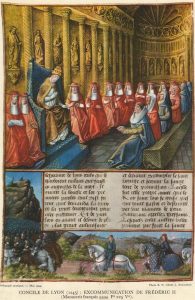
- Every Bishop has jurisdiction over the sacraments in his diocese. That means that he has the power to excommunicate anyone in the world and refuse them communion in his diocese on his own authority. For example, Bishop Briand of Quebec excommunicating American priest John Carroll, or, in our own day, Bishop Poprocki excommunicating pro-abort Catholics. This practice is common throughout the history of the Church.
- In times of crisis in Church history, the bishops have relied on confessions of faith to maintain communion with one another and the Holy See. If a bishop refused to confess the Catholic faith, they were excommunicated by another bishop.
- The Declaration of Truths recently published by several bishops condemns forty of the most prominent errors and heresies currently rampant in the Church.
- Every bishop has the power to call a diocesan synod, proclaim the Declaration of Truths for his diocese, and excommunicate all Catholics who will not profess this confession of faith.
Opinion:
The Declaration of Truths is the way forward for the Church precisely because it utilizes Vatican II and the conciliar Magisterium to condemn every error. By using this method, the hermeneutic of continuity is given definite form so that all Catholics can unite—Conservatives and Traditionalists. Every bishop must call a synod, proclaim the Declaration of Truths, and decree excommunication on every Catholic in the world who will not confess it. A simple formula is the following
If anyone will not confess and believe all forty propositions contained in the Declaration of Truths according to the same sense and same understanding that the Church has always held, let him be anathema.
This action will have two salutary effects. First, it will safeguard a bishop’s own diocese from an imposition of error from the Rhine group who currently controls the Vatican (especially with their Amazon Synod). Second, if a significant number of bishops do this, it will force all Catholics and bishops to reveal themselves either as Catholics or heretics. Eventually an Ecumenical Council or Papal Decree could then rule definitively regarding the Declaration, making it binding upon on the faithful.
At this time, this may only be a small number of bishops. But perhaps as things grow worse, a significant number could make a stand.
This may require the laity to move dioceses or take further action. Nevertheless in a time of crisis, desperate times call for desperate measures. These are the days that test men’s souls. These are the days wherein history will remember all courageous men and all cowardly men. Call your own bishop now and find out if he confesses all forty propositions. Share your own facts and opinions below.
Timothy S. Flanders
@meaningofcath