
I am beginning a series of forty posts commenting on the historical and theological significance of the Declaration of Truths. From my view, this document holds the key to the way forward and out of this crisis. See my essay here for why I believe that is. Among other things, the Declaration solves the confusion of the conciliar period by confessing forty propositions of faith and morals which address a great many of the errors inflicting souls today.
Against their Foundational Error
The first and foundational truth is the proper understanding of the development of doctrine. This is the foundation because it opposes the Modernists’ own foundation error: evolution of dogma. As St. Pius X says, the “intrinsic evolution of dogmal” is for the Modernists “amongst the chief points of their teaching.” It is
An immense collection of sophisms…that ruins and destroys all religion. [According to them,] Dogma is not only able, but ought to evolve and to be changed (Pascendi, 13)
This error is the contagion of every heretical infestation. Therefore it is the central heresy within Modernism, itself the “synthesis of all heresies.”
Foundational Truth
Therefore the Declaration begins with this proposition:
The right meaning of the expressions ‘living tradition,’ ‘living Magisterium,’ ‘hermeneutic of continuity,’ and ‘development of doctrine’ includes the truth that whatever new insights may be expressed regarding the deposit of faith, nevertheless they cannot be contrary to what the Church has always proposed in the same dogma, in the same sense, and in the same meaning (see First Vatican Council, Dei Filius, sess. 3, c. 4: “in eodem dogmate, eodem sensu, eademque sententia”).
It is worth quoting from the referenced Vatican I document:
If anyone shall assert it to be possible that sometimes, according to the progress of knowledge, a sense is to be given to doctrines propounded by the Church different from that which the Church has understood and understands; let him be anathema.
This particular language is used against the Modernists because from their first appearance in the 19th century until now, they use deceit to spread their errors. They claim to uphold the Catholic faith, yet they change its meaning.
Examples of Contrary Senses
So for example, they say they believe in the Resurrection, but what they mean by that is not that our Lord was physically dead and then rose from the dead. They mean that a Christian has an emotional experience of God and Jesus “rises in his heart.” The two senses are contradictory.
Or again the Church has taught that adultery is always and everywhere sinful, and that it is impossible for an adulterer to be given Holy Communion. And yet, Pope Francis has asserted that not only can adulterers sometimes not be sinning, but they can receive Holy Communion. The two senses are contradictory.
And again, the faith tells us that the state can lawfully put a man to death according the norms of justice, for the sake of the dignity of man. And yet Pope Francis has asserted that not only the death penalty but even long prison terms are contrary to the dignity of man. The two senses are contradictory.
The Vital Phrase
Against the erroneous evolution of Dogma, the Declaration utilizes the crucial phrase “same sense, same understanding” to safeguard a correct notion of Development of Dogma. This phrase was contained in the Oath Against Modernism until the Oath was suppressed by Pope St. Paul VI in 1967. Pope St. John Paul II began a new Oath, the Oath of Fidelity in 1998, but unfortunately it did not include this important phrase.
But what is a proper notion of doctrinal development? Ott (p. 7) makes the distinction between dogma in the material sense and dogma in the formal sense. This utilizes the philosophical distinction between matter and form. Matter is the stuff from which something is made, and form is the way the stuff takes form into a thing. So Dogma In the material sense means the whole of revelation given by the Apostles: the deposit of faith as a whole. Within this deposit is contained every truth from revelation. However, some truths are not apparent, or must be given definite form to be clear and beyond all doubt.
| Material | Formal |
|---|---|
| Deposit of faith | Deposit explained |
| Every truth is implicit | Truth made explicit |
| Disputed questions | Definitive doctrine |
Examples
An example: before Nicea, Christians believed that the Son of God was true God and true Man. This point of doctrine was already contained implicitly in revelation. But when Arianism arose, this point of doctrine was cast into doubt. Therefore the Nicene Council altered the form of the doctrine by taking what was implicit and making it explicit. It introduced the word consubstantial to express the same sense as before with more precise words. Thus the form of the dogma changed, but the matter stayed the same. Therefore the matter of the dogma is always the same sense.
Put another way, let us take for the matter a particular person named Michael. When Michael is a young boy, he is Michael. When Michael is an adult, he is Michael. His form has changed, but his matter—what makes him Michael—stays the same. It is impossible to become a different person.
Thus the Declaration states that new forms cannot create a sense that is contrary to the prior sense. New forms serve only to maintain the matter the same (as in Nicea) or allow the truths to reach their logical end (as in the growth of a person).
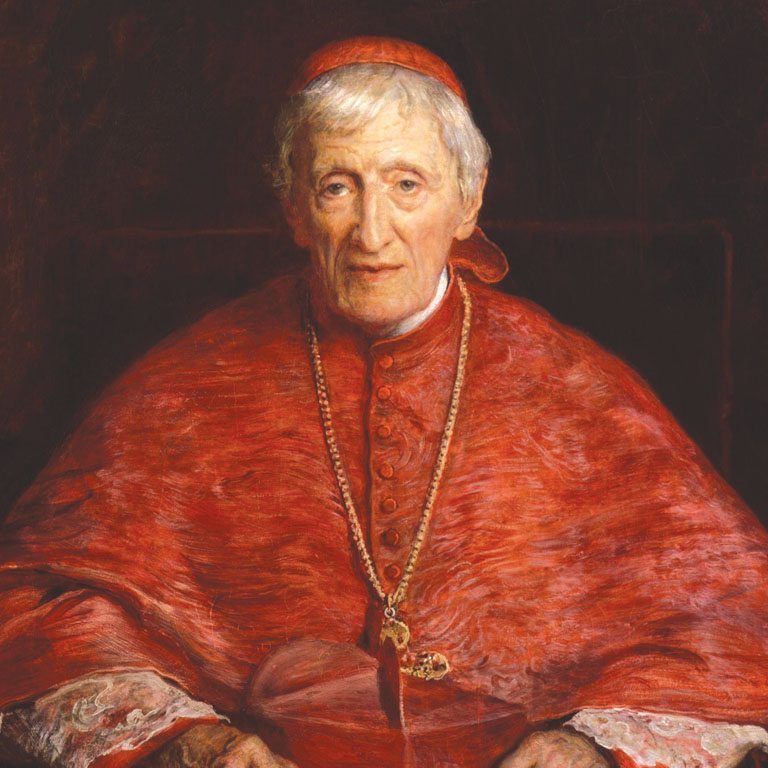
For an understanding or true development, it is crucial to study the writings of soon-to-be-Saint John Henry Cardinal Newman. His Essay on the Development of Doctrine can be found online or in print
See also the Resources page for more information.
Timothy S. Flanders
@meaningofcath