

By Jeremiah Bannister
“The ocean is the perfect memento mori. Each crested wave a burst of life. Each collapse of whirlpooled water a stark, sudden end. When the surface stills, only a graveyard can match such a foreboding peace.”
— Doonvorcannon, author of “Cerberus Slept”
So much of my life has been consumed by ruminations regarding death and destruction, even despair. The devil on my shoulder chalks this up as my having been born a boy, but he’s a dirty little liar–and I’m greater than the sum of my confirmation biases. After all, Hades hungers for men and women alike, and I’ve known my fair share of freakishly macabre females! He isn’t entirely wrong, though, as my fear (and fascination) of death probably began before I cut my teeth, while sobbing & suckling at my mother’s breasts, well-before even the development of an anal-retentiveness that plopped me diaper-deep in the ER with a herniated belly button. But barring the whole who, what, where, when, and why of how it all began, this much may be said as a matter of fact: that the majority of my days have been devoted to a dialogue (and Dionysian dance) with Death.
Don’t get me wrong, it wasn’t all doom & gloom. There were Kairos moments, transcendent through & through–and curiously enough, most of them took place near beautiful bodies of water. Like Jacob’s return to Beth-El, revisiting that sacred place where angels traversed a ladder spanning the space between heaven and earth, I’ve made pilgrimages of my own, mental and in memoriam, seeking to retrace where I was while being who I’ve been.
I recall standing near a rail at Seattle’s Elliot Bay, where I first observed the power and majesty of the Pacific. The rhythmic back-and-forth of container and supply ships was dreadfully delightful–even hypnotic, as the boats swayed from port to starboard like a mother rocking her baby back to sleep. I remember my stroll on the boardwalk of the Mermaid Quay at Cardiff Bay, where the winds of winter in Wales cut across the crashing waves, conjoining in chorus to create a serendipitous symphony of sound! I re-envision that dreary day in New York Harbor, tearfully saluting Lady Liberty from the deck of a water taxi sailing all too fast and far too slow. And I’ll never forget the Carolinian shores of North Topsail! Whitecaps danced in the distance, reminding me of the snow-covered peaks of Wyoming’s Grand Teton: they were ancient and awe-inspiring! But as with my experience on the Jubilee Bridge overlooking the River Thames–a lifechanging set of circumstances reserved for the book that I’m currently writing–I was hit by an undeniable fact. For there, while honing in on the horizon line, I felt the salty sea splash between my toes… gently reassuring me that, soon enough, everything will come to an end, leaving little more than a high-water mark in the wake of its return from whence it came.
To dread the deep and the dark.
To worry over the winds and the waves.
To lose myself in the lullabies of life and liberty.
That Hades, in time, swallows heathens and heroes alike.
Death was a diabolical dirge, deserving to be despised… defied…
… and, if at all possible, to be defeated!
These were terrible half-truths, taught to me by the sea. But I saw these things through faithless eyes, and like the Atlantic whitecaps, death appeared to be something safely in the distance. St. Cyprian was right, though: “We’re born with the halter around our neck; and every step brings us closer to death.” Belluacensis echoes this in his recalling that the King of France, caught in the throes of death, cried aloud with his final breath: “Behold, [even] with all of my power, I cannot induce death to wait one more hour.” Hence, my decades of dread, drowning in a debilitating death-spiral of despair–a sickness, which, if Kierkegaard is to be believed (and I believe that he is), leads unto death. And given the cyclical movements of my madness, I was doing worse than wasting time… I was paying full-price for a one-way trip down a slippery slide straight to She’ol.
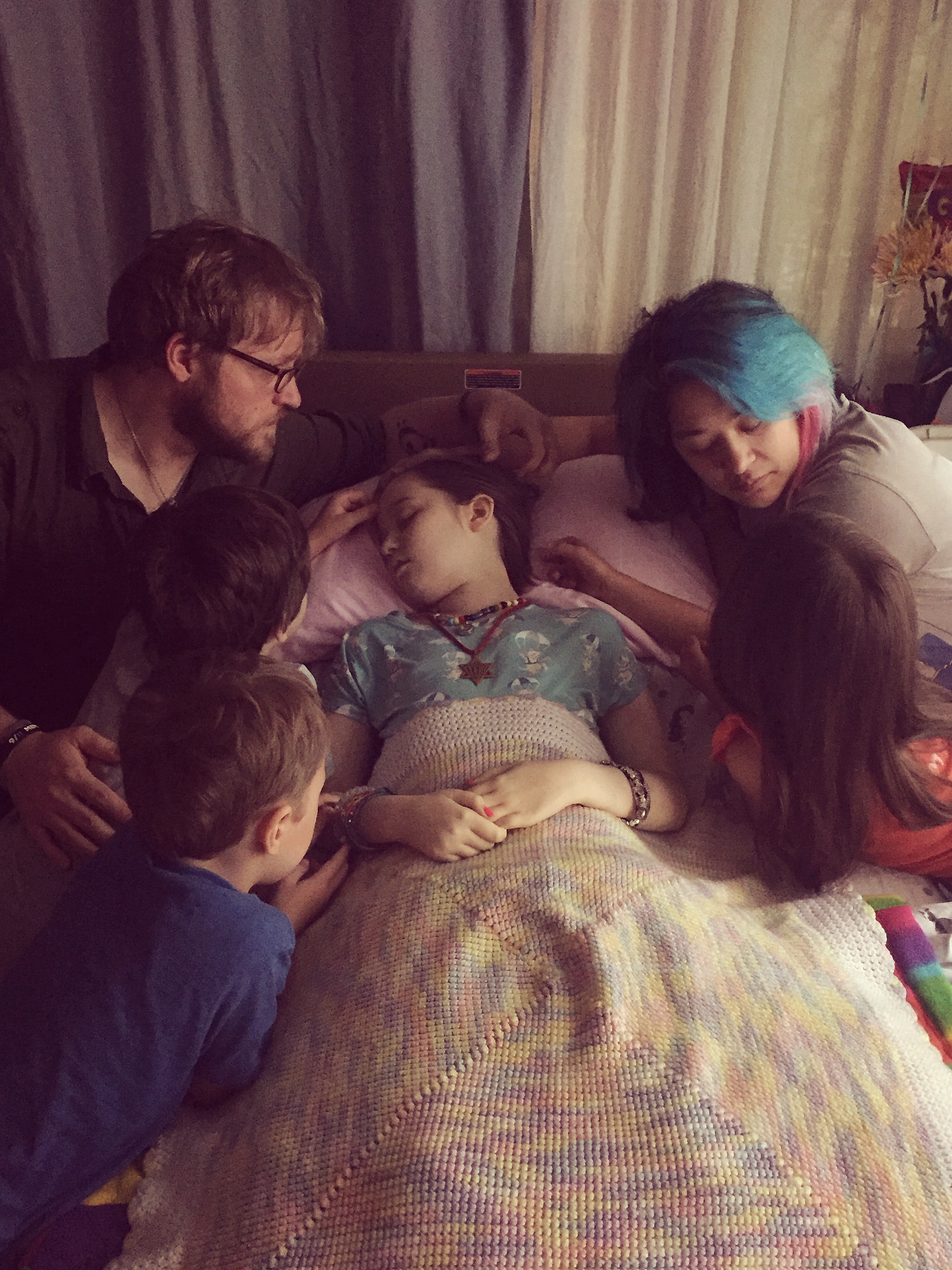
Then something happened! For, alas, in due time, Death made its bed in my home…
I know because I carried it, stiff as a board in rigor, to the hearse parked ominously outside. In the street, I caressed its ice-cold cheeks, used its hair to wiped my tears from its sunset eyes, and with quivering lips, I kissed it (as any loving father would) on the forehead. She was an ice princess, and with a smile on her face, she was a paradox, being both beautiful & blue. And though I was yet still alive, my spirit was resigned… and both of us were breathless.
Looking back, it seems fitting that, years before, I took at my baptism the Catholic name of St. Alphonsus-Maria de Liguori. His book, “Preparation for Death,” changed my life forever; and like me, he was tormented by tremendous tragedies, enduring immense amounts of intolerable pain and suffering. But (and quite unlike me), Alphonsus was willing, even desirous, to stand and smile, face-to-face with Death. For “memento mori!” was his motto, and he was convinced of the wisdom inscribed upon a skull once possessed by the Venerable Juvenal Ancina, which read, “What you are, I was; and what I am, you shall be.” Most importantly, he knew in his heart of hearts that eternity was in the balance. These convictions led him to a lifetime of mental prayer, pious devotion, and diligent service at the altar of God–an altar whereupon holocausts are offered, both of Lamb and of man… and now, hundreds of years after his death, he’s revered as a saint and doctor of the church!
What he was, I still am; but what (and where) he is, I pray to one day be! And now, as I approach my fourth Christmas Eve following the fate of my 12-year-old daughter to brain cancer, I choose to look at life and death with eyes of faith, convinced that, beneath the depth and the darkness, behind the wind and the waves, and beyond the terrible truths of time and tragedy, there is a Lamb who takes away the sins of the world, a memento mori longing to be lived, and a sacrificial fire, through which mortal men, upon reaching the high-water mark of their final breath, are made fit for heaven, their spirits soaring to that celestial sea from whence they came.
“O LORD my God, I, now, at this moment, readily and willingly accept at Thy hand whatever kind of death it may please Thee to send me, with all its pains, penalties, and sorrows.”
— A prayer from my 1938 Manual of Catholic Devotion
Editor’s Note: this piece originally appeared at ancientthought.com
***
 Jeremiah Bannister is a writer, YouTuber, and public speaker. After serving in the U.S. Navy, he earned a degree in Journalism & Mass Communication, with a minor in Political Science, from Olivet College (Michigan), where he was awarded the school’s top-honor in three specialties: creative writing, political science, and public speaking. Since then, he has hosted a local TV show, served as a contributing editor for the Distributist Review, and hosted a live AM/FM talk radio program (PaleoRadio). Jeremiah has presented before audiences at Michigan State University, Ferris State University, and Campellsville University, as well as before those attending the 2016 Make-A-Wish Michigan Wish Ballat the MGM Grand Hotel in Detroit, Michigan. He and his family attend the Traditional Latin Mass at Sacred Heart of Jesus in Grand Rapids, Michigan, where his children are also enrolled in the parish’s classical education school,Sacred Heart Academy. He’s currently completing a novel about the “real-life fairy tale” of his daughter Sami’s life and death with childhood brain cancer, and how her “heroic tragedy” led him and his family back to the Catholic Church. To learn more about his testimony, or to schedule an interview/event, visit his website or contact him at TeamTinyDancer@gmail.com. Follow him @paleocrat.