

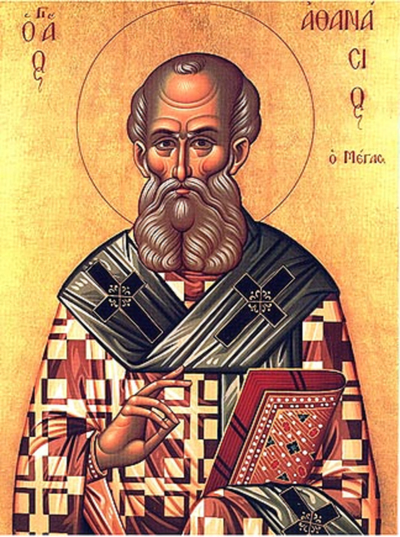
St. Athanasius against the Arians
Discount Code for Our Lady of Victory Press.
Use the coupon code “Guild20” to get a 20% discount at CatechismClass.com. See attached book The Roman Catechism Explained for the Modern World by the president of this catechesis site, Matthew Plese, as well as the other attached book(s) according to your tier of Guild membership.
Our online community uses Telegram, which is on smart phones or can be used on a computer if you are avoiding smartphone usage.
Join our prayer chat here:
-This is for prayer requests and all things prayer
Join our Domestic Church group run by our ladies: “Mary, Queen of the Home” here: https://t.me/+D7BrulRk7dpjZWNh
– this covers family spirituality, liturgical and other customs, homeschool, navigating modern technology, family recreation and more.
Join our Terror of Demons Men’s Group here:
Join the St. Joseph Guild Chat here:
–this group is meant to be open conversation on economically supporting each other against the Marxists
-this group is our international group which includes (but is not limited to) Americans, Canadians and Europeans
-we are also growing another Guild group specifically for those who find their home in Australia and Oceania. Join that group here:
Join our Penance Sodality, the Fellowship of St. Anthony here:
–This is a group of laity offering up penance and prayers for the clergy throughout the year
Feel free to message me here or on Telegram messenger and we can get back to you!
Please add these invocations to your daily prayers for 1.) the intentions of the Apostolate and 2.) the needs of all Guild members:
Our Lady of Victory, pray for us!
Mary, Queen of the Home, pray for us!
St. Joseph, Terror of Demons, pray for us!
St. Anthony of the Desert, pray for all clergy and seminarians!
We are currently working to have all Guild only videos available in one place, but for now you can scroll down on Patreon or here are some of our most popular Guild videos:
Guild Only Videos
St. John Paul II and St. Marcel the Moderate? series
Apostolate Consecration Pilgrimage
Our Lay Apostolate Constitution
Are Dances Condemned by the Church?
Vatican II and the Novus Ordo in the Providence of God:
Russian Rite Catholic on Russian History and Ukraine Crisis
The Book of Revelation: the Climax of the Bible Neglected
Other controversial topics: Jews Series, Occult series, E. Michael Jones, etc. (message me for more).
GUILD practical videos:
Live Local: the Great Reset and Secessionism
Family Homesteading with Matt and Maureen McKinley
Insurance Alternative? Health Sharing
The Meaning of Catholic
By Timothy S. Flanders
A very important motto for Catholics in our age is the phrase in essentiis, unitas; in dubiis, libertas; in omnibus, caritas (“In essentials, unity; in doubtful matters, freedom; in all things, charity”).[1] It is crucial that Catholics seize upon this and practice it during this crisis. The distinction between “essentials” and “doubtful matters,” however, is by degrees. The Church distinguishes these degrees by the Theological Notes of doctrine. The highest degree Note represents the highest degree of certainty and thus the greatest obligation for assent, while the lowest is the least certain and the least obligatory for belief:[2]
- De Fide – of the faith – explicit in Scripture, Tradition, may also be explicitly defined by highest Church authority
- Example: all who die in mortal sin will suffer hell for eternity[3]
- Denial of any of these truths is the mortal sin of heresy.
- De Fide Ecclesiastica – ecclesiastical faith – explicitly defined by Church authority, implicit in Scripture and Tradition.
- Example: the Assumption of Mary
- Denial of any of these truths is the mortal sin of heresy.
- Sententia Fidei Proxima – proximate to the faith – teaching is generally understood by the Theologians[4] as explicit in Scripture and Tradition but not explicitly defined by the Church
- Example: The Blessed Trinity can only be known through revelation[5]
- Denial of any of these truths is the mortal sin of error proximate to heresy
- Sententia Certa – theologically certain – implicit in Scripture and Tradition, not explicitly defined by the Church
- Example: the primary purpose of Matrimony is the generation of children. The secondary purpose is mutual help and regulation of lust.[6]
- Denial of any of these truths is the mortal sin of error against the faith
- Sententia Communis – common teaching – this teaching is implicit in Tradition and is generally accepted by the Theologians, but is technically a free opinion.
- Example: willful sins against the sixth commandment are always mortal sins[7]
- It is licit to object to these teachings if and only if there is grave cause. To object to any without grave cause is the mortal sin of temerity
- Sententia Probabilis – probable teaching – a teaching that is well founded on good authority yet is open to question. Pious beliefs and tolerated opinions also fall under this note and have the lowest degree of certainty.
- Example: Judas received Holy Communion at the last supper
- Denial of any of these teachings is licit provided piety is given to legitimate authority[8]
Thus we may see that in actual fact, Notes 1-4 are essentials to the faith, while 5 is technically “doubtful” (in the sense mentioned above) but only with grave cause, whereas 6 is entirely doubtful matter, provided piety is observed. Thus no man can call himself Catholic and deny anything above Communis, and can only question Communis with grave cause. A Sententia Probabilis alone is completely open for discussion.
Let us apply this further to current controversies. So, for example, Lumen Gentium explicitly states that the documents of Vatican II are not binding unless explicitly stated, indicating that unless they are quoting prior teachings, the documents must be held to be Sententia Probabilis or Communis.[9] Whereas Ordinatio Sacerdotalis spoke of the male-only sacramental ordination as binding on all Catholics “This Sententia must be held definitively by all the faithful of the Church.”[10] The former teachings have some room for discussion, whereas the latter is completely closed (including any notion of a female, sacramental deaconate).[11]
But in all things, a grave piety must be observed regarding the Magisterium: “The willingness to submit loyally to the teaching of the Magisterium on matters per se not irreformable must be the rule.”[12] Even if a man sees an issue with Vatican II, he is not permitted, through piety, to dismiss the council as a whole.[13] Nevertheless, if the matter is not closed, reasonable and pious inquiry can be made. As Ott explains: “By way of exception, the obligation of inner agreement [to magisterial documents] may cease if a competent expert, after a renewed scientific investigation of all grounds, arrives at the positive conviction that the decision [of the magisterium] rests on an error.”[14] At its best, the traditionalist movement represents such a scientific investigation. At its worst, the traditionalists are sinning against charity and piety while causing scandal and schism in the Church.