

Eastern Christological Controversies

What We’re Fighting For
By Nathaniel Richards
At this very moment, you and I are in a battle waged for eternal souls. My soul. Your soul. We creatures are either for the Lord Jesus Christ and perpetual union with Him in the Divine Life of the Holy Trinity or we’re not. There is no middle ground. To believe that we’re in anything other than a battle for our souls is lie. As baptized soldiers in the Lord’s Army, as practicing Catholics, we must stand on the side of Truth Himself. Being lukewarm is not an option—for our Lord says, because thou art…neither cold nor hot, I will begin to vomit thee out of my mouth (Apoc. iii. 16). We must stay in the Mystical Body and wage war against the world, the flesh, and the devil. This is how, as the Apostle says, we work out our salvation with fear and trembling (Philip. ii. 12).
Yet to always be on guard seems like a chore, does it not? Why should we have to stay awake? Yet the Lord bade His disciples to stay awake and pray as He anticipated the Hour of His Passion in Gethsemane, and bemoans the fact that they sleep instead (Mk. xiii. 34). And St. Peter tells us specifically in his epistle: Be sober and watch: because your adversary the devil, as a roaring lion goeth about seeking whom he may devour (I Pt. v. 8). Therefore, we have no choice. To sleep but for a moment is to be caught in the jaws of the Enemy. We are members of the Church Militant hoping to one day join the Church Triumphant—to be complacent will not do nor is admirable, when we have so great a cloud of witnesses (Heb. xii. 1) testifying to us that there is no other way but to do battle…putting our acedia and apathy to shame.
This active choice for God is what makes a Catholic. To see this hard truth of the Faith should not cause us to despair, however. Immolation and total sacrifice of self for others and for the Lord’s cause is our purpose. For the greatest principle and difference between a saint and a sinner, between salvation and perdition is this: voluntary victimhood leads to self-sacrifice and imitating the Agape that is God. To neglect this leads to victimizing of oneself that leads to self-imposed neuroses and rationalization of sin. Losing oneself—either in the blissful Beatific Vision or the terrible fires of the damned—is the only end for man. Loss to God is eternal victory, loss to Satan is eternal defeat. As we were created for God, it is best to say like Josue, as for me and my house we will serve the Lord (Jos. xxiv. 15).
St. Thérèse Lisieux, the Little Flower, understood this principle well. For when she contemplated how there were many souls doing penance for the sins of others and their own faults that wanted to be victims for God’s justice, she wondered how she could opt to be a victim to God’s “Infinite Mercy” (Thérèse, 110). Many of us Catholics, especially those of us in the laity, will never be able to imitate the lifestyle of an anchorite or hermit, but we can follow a Little Way of our own—dying to ourselves and saying yes to God. Fasting is good; fasting from sin and selfishness is better and helps us fast better when we do attempt to fast. We must constantly let ourselves be molded by God’s Mercy—seeking His pardon, and making that pardon known in our lives to others. When we understand the Augustinian principle of our restless hearts needing to drink the Living Water of God, we realize that nothing of this world will satisfy save God alone. We can only rest in Him.
Therefore, we may not rest now. We must wage war against Satan and the hordes of hell. And do so happily. Why? As Chesterton says in Orthodoxy, “It is easy to be heavy: hard to be light. Satan fell by the force of gravity” (Chesterton, 182). Further, at the end of his volume Chesterton says, “There was some one thing that was too great for God to show us when He walked upon our earth; and I have sometimes fancied that it was His mirth” (239). The Divine is buoyant, self-giving, and full of Joy Unspeakable; the Enemy is sour, self-serving, and full of Hatred. We fight for God best by being most authentically ourselves in Him—this will carry us to Heaven rather than bogging ourselves down to earth with our own egos.
St. Thérèse further elucidates this truth in her prayer to God:
It seems to me that if You found souls offering themselves to Your Love as holocausts, You would consume them speedily, rejoicing that the rays of infinite tenderness had no longer to be imprisoned in Your Heart. If Your Justice must be satisfied, although it extends only to earth, surely Your Merciful Love must long far more to fire our souls, because Thy mercy reacheth even to the Heavens (Ps. xxxv. 6). O Jesus, grant me to be Your happy victim; consume me in the fire of Divine Love, Your little holocaust (Thérèse, 110).
That’s what it comes down to, really. Becoming aflame in the Love which is the Triune God. All else that is not found like Him is burnt away like the chaff it is. Only Jesus gives us this opportunity to become part of this Eternal Fire. And we should desire to become like it if we desire to live forever in God, for our God is a consuming fire (Heb. xii. 29).
To burn with love for Love or to burn from lack of Him—that’s the crux of all time, and the scope of eternity.
Nothing in this world is worth losing God. Nothing. We soldiers may become weary, but we have the Sacraments and the treasury of the Tradition of the Church and the wellspring of Sacred Scripture to refresh our souls in this temporal reality…and root them in the never-ending world to come. Every pain we experience for the Gospel will have been worth it. Inconveniences and scars will be trophies. St. Thérèse was influenced by a volume of eschatological conferences penned by a French priest, Fr. Charles Arminjon, The End of the Present World and the Mysteries of the Future Life that touch on this point. He says:
In this life, when we hear the conversation of superior minds that have been matured and trained by experience and deep reflection, we lose the sense of time under the spell and fascination of their words. We sit in front of the fire during the long winter evenings, with the snow falling and the wind blowing and roaring and listen expectantly and with rapt, unflagging attention to the seaman back from distant shores, or the warrior who tells us about the perils of a long siege and the thousand pictures of death he encountered amidst the dangers of war.
How much greater will be our fascination, as we sit at the great hearth of our heavenly Father, listening while our brothers tell us the story of their seductive and manifold temptations and of the assaults waged by hell over which they triumphed. We shall not tire of hearing about those victories won in the sight of God alone, more glorious than those of conquerors; those battles waged in silence against the failings of the flesh and the turmoil of one’s own thoughts. We shall admire their efforts and their heroic generosity. We shall know about the twists and turns and uncertainties whereby the grace of the Spirit of God, through a strong but gentle impulse, led them to the harbor of repose, and turned even their deviations and falls to account, in the edification of their incorruptible crown. Ah! These will be inexhaustible subjects of conversation, which will never lose their interest and charm (Arminjon, 230).
These tales we shall tell in Heaven—how we lost to God—shall be of endless delight and fascination! We shall revel in the goodness of the Lord and how we were victims to His Infinite Mercy. We, the citizens of the New Jerusalem will be at rest. As St. Julian of Norwich says, “All shall be well, and all shall be well, and all manner of thing shall be well” (Julian, 65).
It is written in Hebrews that we have not here a lasting city, but we seek that one that is to come (Heb. xiii. 14). That, I believe is the mission of this apostolate. That is the Meaning of Catholic, as it were. This world is not our home. We are journeying to Jerusalem, to Heaven. We want others to get there by leaving vice and embracing the supernatural virtues only Jesus can give to our souls to get there. We Catholics want people to go to Heaven—above all else. We want people to behold that Everlasting City where the Lamb is the Light forevermore.
So let us keep fighting. There is a goal in mind. There is a King to serve. Frodo Baggins asked Samwise Gamgee what they were fighting for—the hobbit answered that there was something in this world worth fighting for. Likewise for us in the realm of men—there is something in this world worth fighting for. A new world. A New Heaven, and a New Earth. One Lord who makes it all come into being. Let us fight for Him.
In parting, I share a final thought from Fr. Charles Arminjon and a line from Sacred Scripture.
Everything that is not Jerusalem is unfit for us. Let us ask only for the goods and the peace it contains. Let us think only of heaven, let us seek only heaven, let us store up only for heaven, and let us live only for heaven.
A few moments longer, and all that must end will be no more; a few more efforts, and we shall be at the close; a few more combats, and we shall attain the crown; a few more sacrifices, and we shall be in Jerusalem, where love is always new; where there will be no other sacrifice but praise and joy. Amen (Arminjon, 237).
And he that sat on the throne said: Behold, I make all things new (Apoc. xxi. 5).
Works Cited
Arminjon, Charles. The End of the Present World and the Mysteries of the Future Life. Sophia Institute Press, 2008.
Chesterton, G.K., and Charles W. Colson. Orthodoxy. Moody Publishers, 2009.
Julian of Norwich. Revelations of Divine Love. Paraclete Press, 2016.
Thérèse, et al. The Story of a Soul. TAN Classics, 2010.
—
 Nathaniel Richards is a Catholic husband and father who lives in the Ozarks. He enjoys collecting Catholic books and promises that one day he will read most of them—eventually, maybe. Starting a Catholic bookstore that sells books rather than gifts is a dream of his. He converted from Oneness Pentecostalism to Anglicanism and eventually made his way to Catholicism in 2015.
NEW Book Coming in 2021
The Modern Catholic Liberal Disaster: Why Conservatives and Trads Must Unite
This book is coming in 2021, published by TAN Books. Its central thesis: the division between so-called “Conservative” and “Traditionalist” Catholics hinges upon a disagreement about the rights of Christ the King following the global liberal revolution since 1776. This disagreement has broken the former alliance between these parties, allowing the Modernist heretics and other enemies of Christ to seize control of the Church and society, leading to our current crisis. This series will attempt to present an objective historical picture and argue for both parties to unite once more against the enemies of Holy Church, as they once did throughout history until the time of the Vatican Councils. Below are brief preview posts of the some of the areas which will be covered in the book.
The Tridentine Alliance between Conservatives and Trads
The Liberal Revolutions and the Breakdown of the Alliance
Chapter 1: The Bloodshed Increases
Chapter 2: The Bloodshed Grows Still More and Pio Nonno Takes a Stand
Chapter 3: The Alliance Strained by the False Spirit of Vatican I
Chapter 4: The Synthesis of All Heresies
Chapter 5: The Great War against Christ the King and the Ultimatum of Fatima
Chapter 6: The Papacy‘s Compromise with the Enemies of Christ
Chapter 7: God’s Punishing World War II and the Surrender of Pius XII
The Triumph of the New Iconoclasts

Audio: Homilies of the Fathers
Editor’s Note: in one of the supreme ironies of the post-conciliar period, the Nouvelle théologie movement, ostensibly promoting a return to the Patristic mind, has resulted in a mindset entirely inimical to the Fathers. As a small part of the effort to restore Patristic devotion, we present these audio homilies taken from M. F. Toal’s four volume set The Sunday Sermons of the Great Fathers (Longmans: 1959). These posts will be posted on the podcast every weekend.
I Sun. of Lent – St. John Chrysostom
III Sun. of Lent – St. Ambrose
IV Sun. of Lent – St. Cyprian
Passion Sunday – St. Augustine
Palm Sunday – St. Ambrose
Easter – St. John Chrysostom
Low Sunday – St. John Chrysostom
II Sun. after Easter – St. John Chrysostom
III Sun. after Easter – St. John Chrysostom
IV Sun. after Easter – St. Cyprian
V Sun. after Easter – St. Basil the Great
Sun. after Ascension – St. Augustine
Pentecost – St. Basil the Great
Trinity Sunday – St. Basil the Great
Corpus Christi – St. Justin Martyr
II Sun. after Pentecost – St. Augustine
III Sun. after Pentecost – St. Ambrose
IV Sun. after Pentecost – St. Ambrose
V Sunday post Pentecost – St. Ephraim
VI Sunday post Pentecost – Venerable Bede
VII Sunday post Pentecost – St. Ephraim
IX Sunday post Pentecost – St. Augustine
X Sunday post Pentecost – St. Augustine
XI Sunday post Pentecost – St. Anthony the Great
XII Sunday post Pentecost – St. Basil the Great
XIII Sunday post Pentecost – St. Augustine
XIV Sunday post Pentecost – St. Basil the Great
XV Sunday post Pentecost – St. Peter Chrysologus
XVI Sunday post Pentecost – St. Anthony the Great
XVIII Sunday post Pentecost – St. Ambrose

Audio: True Catholic History
Editor’s Note: fundamental to the restoration of Catholic Tradition is understanding the history of our fathers. Through generations of Marxist public schools, Catholics have been robbed of their heritage. Their efforts to spread lies about our history have largely been successful, to the point that even high ranking Catholics parrot the Marxist slogans. In an effort to restore a measure of rationality and truth to history, we present this social history, showing why, if the Marxists really cared for the poor, they would promote the Catholic Church as the greatest force for good in the world and history. -T.S.F.
Catholic Social History 33-100AD
Catholic Social History 1000-1435
Catholic Social History 1435-1776
The Most Pernicious Heresy: Muhammadanism. History of Muhammad’s Life
Mary Against the Muhammadans: 632-1700
Catholic Social History 1776-Present
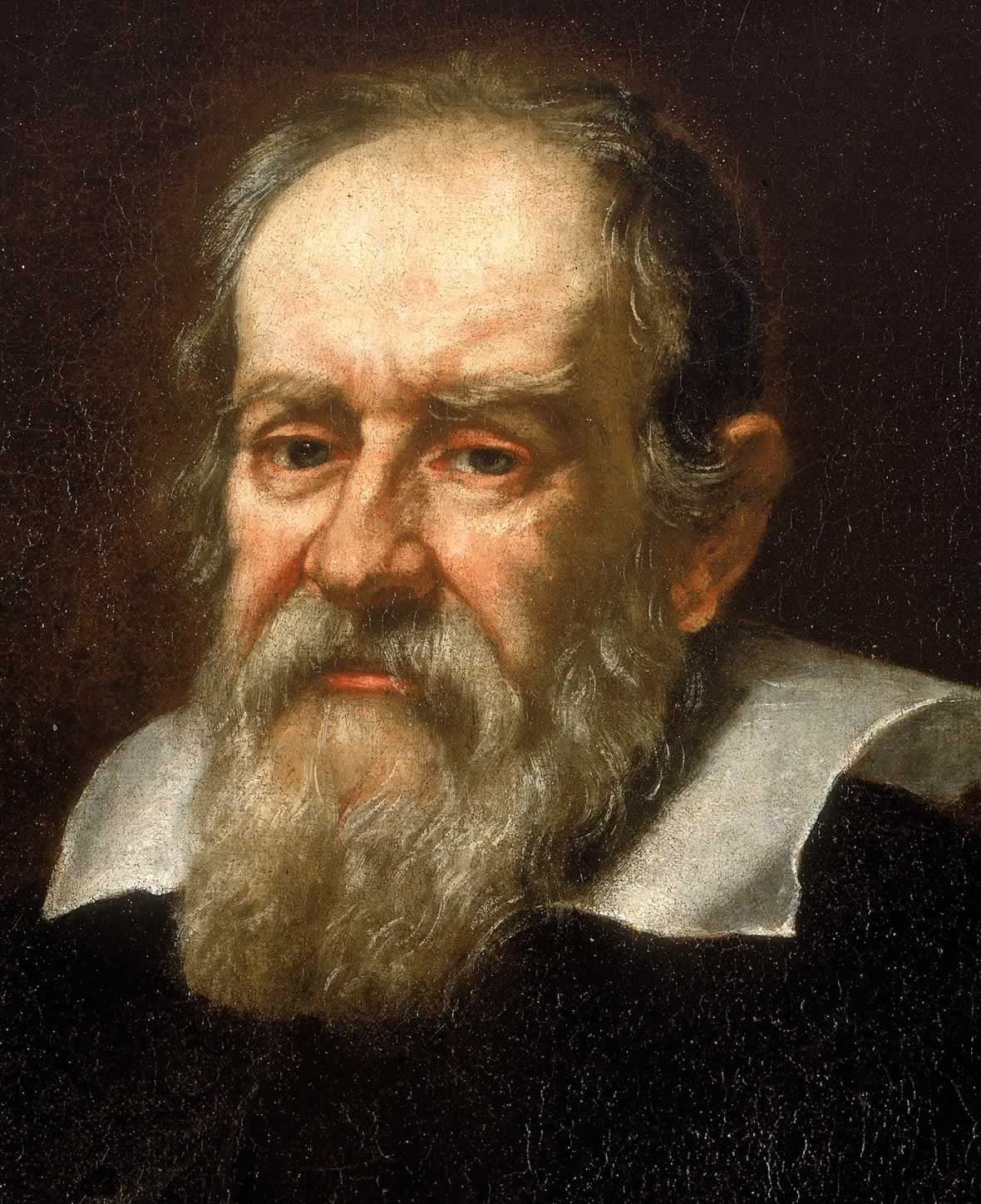
Thesis: Galileo was Wrong – The Church was Right

Editor’s note: this is part of a series of content intended to create honest debate surrounding the dominance of the so-called “scientific community,” which has in reality declined from true science into ideology. To this end, please contact us if you would like to offer any contribution to the debate, whether for or against.
By Robert J. Bennett, Ph.D.
The problem isn’t what we don’t know
That causes trouble so.
But usually what we think we know
That really just ain’t so.
The sounds of rebellion were already in the air. Twenty six years prior, Luther’s hammer had nailed his theses against the Wittenberg door, nails that signaled the split of a extant Catholic religion and culture into tens of thousands of fragments that continue to splinter today.
A generation later there was a similar revolution, splitting the Catholic faith even further along scientific lines: the post-mortem publishing of De Revolutionibus Orbium Coelestium, a new geometric and heliocentric model of the universe by the monastic Copernicus. He had feared public disclosure of his research would incur the wrath of the Catholic hierarchy, who held geocentrism as true to Scripture. Galileo pointed his home-made telescope at the heavens and claimed to find support for the heliocentric model; Copernicus now had a prominent Catholic scientist, to promote the heliocentric cause.
There was conflict between geocentrism and heliocentrism at both religious and scientific levels. The Holy Bible was the source of all truth, yet the Protestant Revolt now made Biblical exegesis a matter of the individual, not the Magisterium. Scholasticism was the philosophical basis for theological epistemology; science used an informal application of the future scientific method of Bacon – testing hypotheses by experiments.
Geocentrism vs. Heliocentrism: The Dogmatic Argument
About thirty Biblical verses supported the geocentric theory, some explicit, like I Paraliponenon XVI. 30: He has fixed the Earth firm, immovable. And similarly, Psalm XCIII. 1, Psalm XCVI. 10, Psalm CIV. 5 and Isaias XLV. 18. Most are implicit, saying the Sun rises and sets, but never that the Earth moves (the Josue and Hezekias events being exceptions that prove the rule). To challenge these verses as not being literal would mean that the Holy Bible contained error and that the challenger Galileo was in error, as was maintained by St. Robert Bellarmine, advisor to the Pope and Grand Defender of the Faith.
In the famous letter to Fr Foscarini, St Robert said:
First …. Galileo did prudently …to speak..hypothetically, and not absolutely, as I believe Copernicus spoke. …by assuming the earth moves and the sun stands still, all the appearances are saved better than with eccentrics and epicycles, is to speak well; there is no danger in this, and it is sufficient for mathematicians. But to want to affirm that the sun really is fixed in the center of the heavens ….. and that the earth …. revolves with great speed around the sun, is a very dangerous thing, not only by irritating all the philosophers and scholastic theologians, but also by injuring our holy faith and rendering the Holy Scriptures false.
Second. …the Council prohibits expounding the Scriptures contrary to the common agreement of the holy Fathers. … all agree in explaining geocentrism literally (ad litteram)
…Nor may it be answered that this is not a matter of faith, for if ….not ……..from the point of view of the subject matter, it is on the part of the ones who have spoken. It would be just as heretical to deny …..the virgin birth of Christ….
Third. [If heliocentrism were true] … then … we would rather have to say that we did not understand Scripture than to say that something was false which has been demonstrated. But …..any such demonstration… has not been shown to me. It is not the same thing to show that the appearances are saved by assuming that the sun really is in the center and the earth in the heavens. I believe that the first demonstration might exist, but I have grave doubts about the second, and in a case of doubt, one may not depart from the Scriptures as explained by the holy Fathers. … the words the sun also riseth and the sun goeth down, ….were those of Solomon, …. his wisdom was from God. Thus it is not too likely that he would affirm something which was contrary to a truth either already demonstrated, or likely to be demonstrated. And if you tell me that Solomon spoke only according to the appearances, and that it seems to us that the sun goes around when actually it is the earth which moves, as it seems to one on a ship that the beach moves away from the ship, I shall answer that one who departs from the beach, though it looks to him as though the beach moves away, he knows that he is in error and corrects it, seeing clearly that the ship moves and not the beach. But with regard to the sun and the earth, no wise man is needed to correct the error, since he clearly experiences that the earth stands still and that his eye is not deceived when it judges that the moon and stars move..
In summary –
- Heliocentrism has value as a computational model, simplifying science, not as spiritual truth. Danger lies in challenging scholastic beliefs, damaging the faith and making Scripture prone to error.
- The Magisterium and the Fathers forbid Biblical interpretation other than literally. It’s not just a matter of secular science, once the Fathers have addressed the issue. Any denial of Scripture would deny all of it. In a matter of doubt it is always the correct path to follow the Traditional interpretation.
- If it can be demonstrated that a certain interpretation does not in fact adhere to reality, then it must be admitted that we have not understood the Scripture, not the the Scripture is in error. If heliocentrism were true, then we just didn’t comprehend the Biblical meaning. But no one has shown St. Robert heliocentrism to be true. Observations of relative motion show that either geocentrism or heliocentrism could be true, but Holy Writ affirms only geocentrism is so. The wisdom of Solomon’s words would be proven false. The apparent motion of the shore as seen from a ship is easily resolved by looking at the ship from shore. But the Holy Bible already says what we see is true …the Earth at rest and the cosmos in motion.
Bellarmine’s point is this – if we doubt the validity of the words of the patriarchs, prophets and saints regarding something absolutely fundamental like geocentrism, how can it be unreasonable to then doubt it all? And the senses corroborate the geocentric evidence.
At his trial by the Holy Office Galileo was vehemently suspected of heresy, holding several propositions contrary to the true sense and authority of the Holy Scriptures:
- That the Sun is in the center of the world and immovable from its place is absurd, philosophically false, and formally heretical.
- That the Earth is not the center of the world, nor immovable, but that it moves, and also with a diurnal action, is also absurd, philosophically false, and, theologically considered, at least erroneous in faith.
Galileo was shown the instruments of torture, but never were they applied, contrary to popular lore. He ‘abjured’ of all the accusations and was sequestered at his summer villa for the rest of his life.
Geocentrism vs. Heliocentrism: The scientific side
Galileo held that tides proved the Earth’s daily rotation, but this predicted tides every 12 hrs, not the 12 hrs, 53 mins as observed. The Moon’s dominance was known then.
The accepted world model at this time was a particular type of geocentrism, embodied in the Ptolemaic flat geometry, where all celestial objects – Sun, Moon, planets, stars – surrounded the Earth in circular orbits.

Ptolemy’s model – simple, but complex to compute
The model required epicycles – wheels within wheels – to predict the actual elliptic planetary motion. Galileo’s observations contradicted the Ptolemaic model; he saw motion of Jupiter’s satellites, phases of Venus and retrograde motion of the outer planets.
This was but a temporary obstacle; Tycho Brahe’s geocentric model was hierarchical, placing Sun and Moon in level 1 Earth orbits, the Planets in Level 2 solar orbits and the moons in planetary level 3 orbits. (a Level 4 asteroid Ida has a satellite – Dactyl. The Tychonian model resolved all of Galileo’s issues; it is kinematically equivalent to the heliocentric model, but with Earth at center. Modern texts gloss over this geocentric model.

Tychonian GC model
The heliocentric model requires more epicycles than this one and is not centered exactly at the Sun’s center. There are no scientific arguments or experiments, now or at this time, refuting the geocentric model of Tycho.
Post Copernicum
Heliocentric books on the Index were banned, at first, then slowly removed as the controversy faded from importance. But the Church never formally retracted the Galilean edicts above, though both clergy and laity now chose to ignore them. To this day geocentrism remains (an invisible) part of the Magisterial teaching.
In October 1992, post-Vatican II, a papal commission decided to rewrite history by concluding that Galileo was, in fact, not guilty of any form of heresy, noting that the Inquisitors doubtless “acted in good faith.” The secular press trumpeted, “After 350 Years, Vatican Finally Says Galileo Was Right: Earth Moves.”
Geocentrism vs Heliocentrism: The modern era
Religious belief in geocentrism has now been relegated to the fantasy world of the Flat-Earthers, where guilt by association links geocentrists with the Flat-Earth foolishness. The superior arguments of Bellarmine are now ignored or ridiculed by the squishy bishops of the Church, intimidated by secular science.
In science, however, new [God-given?] discoveries have fueled a renewal of geocentric support. In an 1886 test by Michelson & Morley, scientists sought to existentially confirm the carrier of light waves, in effect, to find out what was waving – Aristotle’s quintessential aether solid. Light beams at 90 degrees should be affected differently as the Earth plows through the immovable aether in its solar orbit.
A shocker came in the result: no difference in speed between the two beams! Four reasons were proposed for the lack of speed, but none dared speak the obvious: the Earth was at rest.
Einstein’s illogical remedy to the unthinkable dilemma, a geocentric universe, was to claim that light always travels at constant speed c, no matter how the tester is moving. This led to conceptual darkness, where rulers and clocks depended on the viewer’s relative motion. The lid was now opened to a Pandora’s box of inane contradictions never to be reconciled.
His theory of relativity implied only relative motion prevails in physics. There’s no absolute reference frame, so Earth, Sun or any other body can be used for theoretical predictions. Acentrism replaces heliocentrism. But if relativity allows Earth to be the measuring frame, then why does mainstream science insist that the Earth orbits the Sun?
Response: Ideology trumps the truth.
Confusion reigns unless we now distinguish two branches of Mechanics:
Kinematics is applied math, the study of geometric measurement; relativity is valid for measurements.
So this is the law of relative motion:
If you are 5 meters north of me, I must be 5 meters south of you.
If you head 5 m/s north of me, I must be heading 5 m/s south of you
If you accelerate 5 m/s*s north of me, I must accelerate 5 m/s*s south of you…etc.
Dynamics is the study of predicted future motion, used the energy concept to determine the equations that predict future movement – the laws of physics/motion.
Relativity also claimed that all the laws of motion in dynamics were valid for all observers in constant relative motion (aka inertial frames of reference). These were the laws of mass (Newton) and charge (Maxwell) motion.
That all reference frames are valid for applying the laws of physics was assumed valid by Newton, Maxwell and all their contemporaries. Then Newton published a famous exception to prediction validity in his 1687 Principia, called Newton’s bucket. The law of centripetal force (a law of physics) was valid in predicting the curved water surface on a rotating bucket of water in the lab frame, but invalid when the centripetal force formula was applied by a person on the bucket, co-moving with it.
The water was still in the bucket frame, so its speed was zero. Then
Fc = mv2/r = 0 when v = 0
The predicted water surface was flat, contrary to what was seen and predicted by Newton in the lab frame!
There were philosophical debates concerning the interpretation of the result. Newton said this demonstrated the abstract existence of absolute space but didn’t define where that was in physical space. Ernst Mach said the distant stars created the inertial force to cancel the centripetal force. This hasn’t been resolved by our science overlords in over 325 years.
Their attempt to explain the result is risible. The bucket frame is not inertial, so we need to create a ‘fictitious force’ (yes, that’s what it’s called) to give the correct prediction. When I first heard this, I thought it was a joke. Who would pay tuition to learn fictitious forces in a fake physics class? Do history classes teach fake events or math classes false arithmetic: 2+2 = 5?
Consider if you were to compute 2+2 on Earth and got 4, but if moving relative to Earth, got 5. Would you say that the moving calculation of 5 was fictitious math? Or rather say that the immovable Earth – for whatever reason – was preferred nay, required for valid mathematics.
The mathematicians in this parable channel the defiant denial of establishment physics for geocentric reality, casting aside reason to preserve their Godless agenda of materialism.
Geocentric Evidence: The Inertial Frame is the Earth
What the lovers of darkness don’t realize, blinded by their ideological blinkers, is that the inertial frame – where the laws of dynamical prediction are true – is the Earth’s reference frame, and only that frame!
This is experimental proof (remember the scientific method) that the Earth has a privileged perspective in physics, the only view from which true predictions of future motion can be made. Motion can only be predicted by a tester absolutely fixed on a stationary Earth. This is the sense in which geocentrism is consistent with physical laws.
Many – in fact all – predictions from the Earth’s frame will be valid; all non-earth frame predictions will be ‘fictitious’. The obvious choice is geocentrist; only predict motion from the Earth’s perspective!
More examples could be given, but reader interaction via self-discovery of the methodology (or of one’s own errors) is very effective in retention of the truth.
Example: The hitch-hiker and Newton’s 2nd law: F= MA
Given: A driver heading north accelerates past a hitch-hiker of mass Mh with acceleration Ad. The driver’s mass is Md.
The hiker predicts the inertial force on the accelerating driver is Fd = Md x Ad and this force is what’s measured with a spring scale.
1) What is the acceleration of the hiker as measured by the driver…Ah?
2) What is the inertial force Fh on the hiker as predicted by the driver?
3) What is the measured force on the hiker?
Conclusion?
It’s to your benefit to solve this simple problem first, then continue below.
Solution
- This is a measurement, so kinematics applies and relativity.
Ah is equal and opposite to Ad … Ad = -Ah or Ad = Ah south
- Fh = MhAh = – MhAd <> 0
- But we know that the hiker feels no inertial force from the accelerating car!
Fh = 0 when measured!
Conclusion: As with Newton’s bucket, the laws of physics – in this case, F=ma – are only true predictions in the Earth or lab reference frame.
The hiker is in the Earth frame, so his prediction of force is true. The driver is in a non-inertial (non-Earth) frame, so physical laws make invalid predictions.
Remedy:
- Use only the lab frame for all applications of physical motion.
- Admit that the universe is so constituted, that only the lab frame of reference predicts future motion. Abandon the illogical mantra of fake physics and fictitious forces and concede that only from God’s good green Earth can future motion, on Earth or in the cosmos, be truly predicted.
Epilogue
What has been read, can’t be unread. Now that the truth is revealed, the reader is faced with a decision the geocentric knowledge imparted cannot be retracted.
The guy in the pew is in blissful ignorance of both the scientific and dogmatic support for geocentrism, but you, dear reader, must decide hereafter if you will believe and support the geocentric truth.
Once to every man and nation comes the moment to decide,
In the strife of Truth with Falsehood, for the good or evil side;
Some great cause, God’s new Messiah, offering each the bloom or blight,
Parts the goats upon the left hand, and the sheep upon the right,
And the choice goes by forever ‘twixt that darkness and that light. -J R Lowell
—
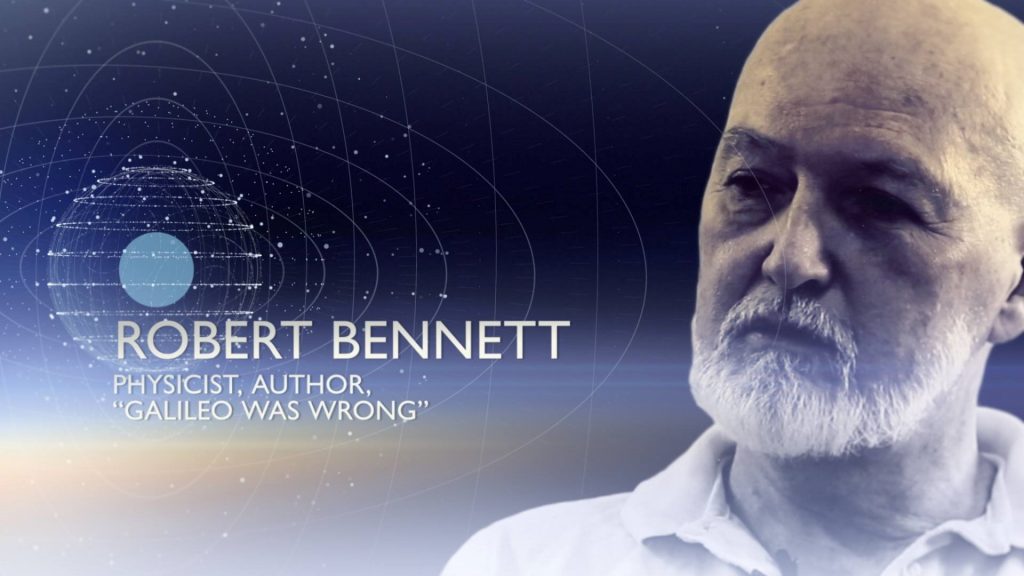
Robert J. Bennett, Ph.D., holds a doctorate in General Relativity from Stevens Institute of Technology. He served as a physics instructor at Manhattan College and Bergen Community College from 1967-1983, and is presently doing private tutoring in physics and mathematics. He has served as a consultant for the entire Galileo Was Wrong: The Church Was Right project.
True Scientific Debate
Editor’s Note: this is a new series of articles, videos and other content intended to create true scientific debate against the irrational tyranny of the so-called “scientific community.” Our postmodern world worships “science” as the only source of truth, but in reality this is not true science but ideology seeking to rationalize sexual immorality and other evils which darken the intellect. True scientific debate focuses on the empirical data of the scientific method within the philosophical presuppositions of Classical Realism. Please contact us if you would like to contribute to the debate in any way, for or against. -T.S.F.
Modern Medicine
The Theory of Evolution
Traditional Doctrine of Creation and Objections to Evolution by Kennedy Hall
Geocentrism

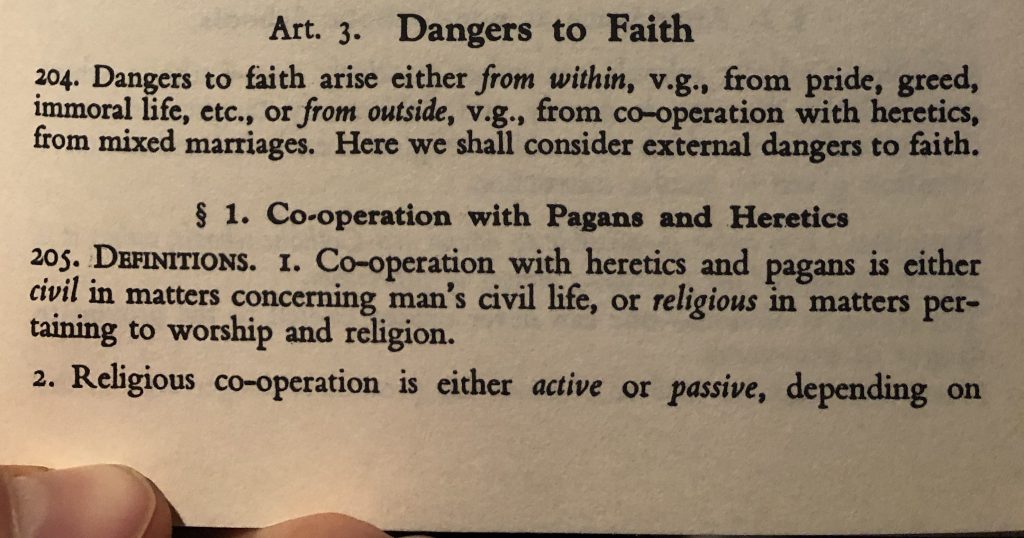
Cooperation with Heretics – Prummer


The Gifts of the Holy Spirit and the Perfection of the Virtues
From Garrigou-Lagrange, Three Ages of the Spiritual Life (Herder: 1947), 76


Annulment Revolution? Sources
Commentary by John Farrell
See also William Marshner, “Divorce or Annulment?”
Marriage Has Been Redefined
From Randy Engel’s Theology of the Body: A Study in Modernism
What the major differences between the canons on marriage found in the 1917 Code of Canon law and the 1983 revised version?
Fundamentally, the former embraces an “institutional” and “procreative” model of marriage and the latter represents a “personalist” model as envisioned by the Conciliar Fathers and by John Paul II. The contrast between the two is immediately evidence in their respective canons.
In the opening canons of the Sacrament of Matrimony of the 1917 Code (Book III, Part I, Title VII) we read:
Canon 1012. Christ our Lord raised the actual marriage contract between baptized persons to the dignity of a sacremnt. Wherefore, there can be no valid matrimonial contract between baptized persons which is not also necessarily a sacrament.
Canon 1013. The primary purpose of marriage is the procreation and education of children. The secondary purpose is to furnish mutual aid and remedy for concupiscence. The essential characteristics of marriage are its unity and indissolubility, which obtain a special stability in Christian Marriage by virtue of the sacrament…
Canon 1015. A valid marriage of the baptized is called ratified if consummation has not yet been completed. It is called ratified and consummated if between the spouses the conjugal act has taken place, to which the contract is ordered by its nature and by which the spouses become one flesh.
Canon 1081. Matrimonial consent is the act of the will by which both parties give and receive a perpetual and exclusive right over each other’s body (ius in corpus) for the purpose of acts which are suitable of themselves for the procreation of offspring.
Contrast this with the following canons of the 1983 Code (Book IV, Part I, Title VII):
Canon 1055. The matrimonial covenant, by which a man and a woman establish between themselves a partnership of the whole life and which is ordered by its nature to the good of the spouses (bonum conjugum) and the procreation and education of offspring, has been raised by Christ the Lord to the dignity of a sacrament between the baptized.
Canon 1057. Matrimonial consent is an act of the will by which a man and a woman mutually give and accept each other through an irrevocable covenant in order to establish marriage.
Canon 1061. A valid marriage between the baptized is called ratified only if it has not been consummated; it is called ratified and consummated if the spouses have performed between themselves in a human fashion (se humano modo) a conjugal act which is suitable in itself for the procreation of offspring, to which marriage is ordered by its nature and by which the spouses become one flesh.
Note that in Canon 1055 a new end–bonum conjugum or the “good of the spouses” is created and given first place, but is undefined. Obviously, the entire concept of “remedy for concupiscence” has been eliminated.
John Farrell commentary: All consummated marriages end at death. Almost all American nullity cases are based on defective consent (canon 1095). This means one lacked due discretion/capacity for what was essential (to the object of consent). Essential has been redefined by the Spirit of Vatican II to include almost anything regarding relationship dynamics. Pre-Vatican II, one needed to be able to simply “mate.” In post Vatican II praxis, one must be able to “soul mate.” So today if the interpersonal relationship was less than desired, one can get a c. 1095 annulment (incapacity to consummate in a human manner). Now that consummation has been redefined in the 1983 code to include ‘in a human manner,’ the garden variety consummation just won’t do any more. When people hear this, they detect fraud because of what their bishop never told them about consummation.
“The new criteria [for consummation] must also include a union of mind, soul and affections.” – Randy Engel, Theology of the Body: A Study in Modernism
“Warmth, tenderness, self-sacrifice, responsibility, cooperativeness, good manners—nobody knows where the list ends.” – William Marshner, Annulment or Divorce?
On the Authority of the Bishop Regarding Marriage Cases
Council of Trent
CANON VIII. If any one saith, that the Church errs, in that she declares that, for many causes, a separation may take place between husband and wife, in regard of bed, or in regard of cohabitation, for a determinate or for an indeterminate period; let him be anathema.
CANON XII. If any one saith, that matrimonial causes do not belong to ecclesiastical judges; let him be anathema. Session XXIV, 11 November 1543
Pius VI
[T]hese cases pertain to the tribunal of the Church alone for no other reason than because the marriage contract is truly and properly one of the seven sacraments. Epistle “Deessemus nobis,” to the Bishop of Motula, Sept. 16, 1788
Pius IX
We say nothing about that other decree in which, after completely despising the mystery, dignity, and sanctity of the sacrament of matrimony; after utterly ignoring and distorting its institution and nature; and after completely spurning the power of the Church over the same sacrament, it was proposed, according to the already condemned errors of heretics, and against the teaching of the Catholic Church, that marriage should be considered as a civil contract only, and that divorce, strictly speaking, should be sanctioned in various cases (Denzinger n.1767); and that all matrimonial cases should be deferred to lay tribunals and be judged by them (Denzinger n.1774); because no Catholic is ignorant or cannot know that matrimony is truly and properly one of the seven sacraments of the evangelical law, instituted by Christ the Lord, and that for that reason, there can be no marriage between the faithful without there being at one and the same time a sacrament, and that, therefore, any other union of man and woman among Christians, except the sacramental union, even if contracted under the power of any civil law, is nothing else than a disgraceful and death-bringing concubinage very frequently condemned by the Church, and, hence, that the sacrament can never be separated from the conjugal agreement (Denzinger n. 1773), and that it pertains absolutely to the power of the Church to discern those things which can pertain in any way to the same matrimony. – “Acerbissimum vobiscum,” Sept. 27, 1857
The conditions under which the seeking of a civil separation (the so-called “separate maintenance”) is tolerated are set down in a response of the Sacred Congregation of the Holy Office: “..there must be present just causes for the separation in the Judgment of the bishop..” – Holy Office, 1860
Leo XIII
[M]arriage is holy by its own power, in its own nature, and of itself, it ought not to be regulated and administered by the will of civil rulers, but by the divine authority of the Church, which alone in sacred matters professes the office of teaching. – Arcanum, 1880
Council of Baltimore III, 1884
We command all (i.e. baptized) married persons that they must not go to the civil courts to obtain a separation from bed and board without previously receiving permission from the ecclesiastical authority. Should anyone attempt this, let him know that he incurs the guilt of grave sin and that he is to be punished as the bishop shall decide. – Article 126
Synod of Rhode Island IV, 1957
Under pain of mortal sin Catholics may not approach the civil courts to obtain a civil separation, divorce or annulment, unless Our explicit permission has been given to them to do so. – No. 262. §1
Synod Portland, 1957
Husbands and wives who in disregard of divine and ecclesiastical law live apart are to be admonished to resume life in common; should they refuse, they should be denounced to the Ordinary.
Because of the very serious prohibition of church law, as well as because of the considerable scandal involved, the faithful shall be informed that no suit for civil divorce may be open unless permission of the Ordinary will have previously been obtained.
All marriage cases are to be referred to the Chancery Office by the parish priest of the plaintiff. Decrees 53, 310 and 312
Diocese of Lincoln, 1997
Validly married Catholics are strictly forbidden to institute civil divorce proceedings for a decree of separate maintenance or divorce without the previous authorization from the Ordinary. – Article 5.12.2
Canon law 1983 code
Can. 1692§2. Where an ecclesiastical decision has no civil effects or if a civil sentence is not contrary to divine law, the bishop of the diocese of the residence of the spouses, after having weighed the special circumstances, can grant permission to approach the civil forum.
Can. 1671 Marriage cases of the baptized belong to the ecclesiastical judge by proper right.
Can. 1401 By proper and exclusive right the Church adjudicates: the violation of ecclesiastical laws and all those matters in which there is a question of sin, in what pertains to the determination of culpability and the imposition of ecclesiastical penalties.
Can. 1696 Cases of separation of spouses also concern the public good; the promotor of justice must, therefore, always intervene, in accordance with can. 1433.