


Holy Week Devotions
Holy Week Customs for the whole family (Quarantine Edition)
Maundy Thursday-Holy Saturday
Seven Last Words of Christ
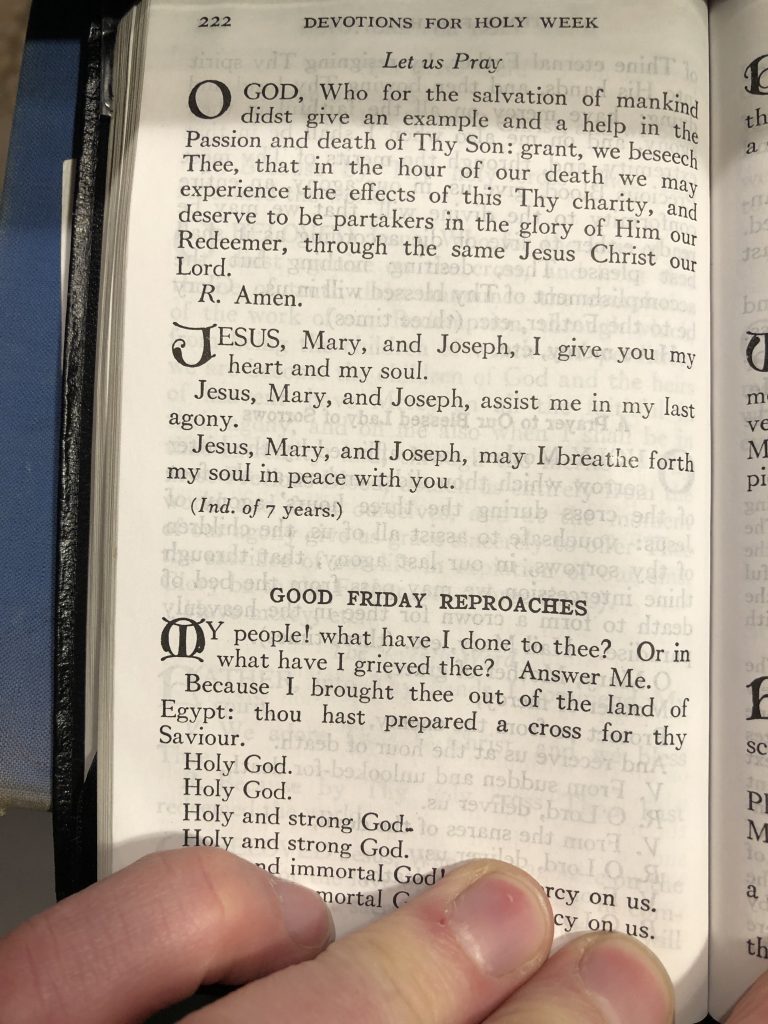
Prayer to our Lady of Sorrows
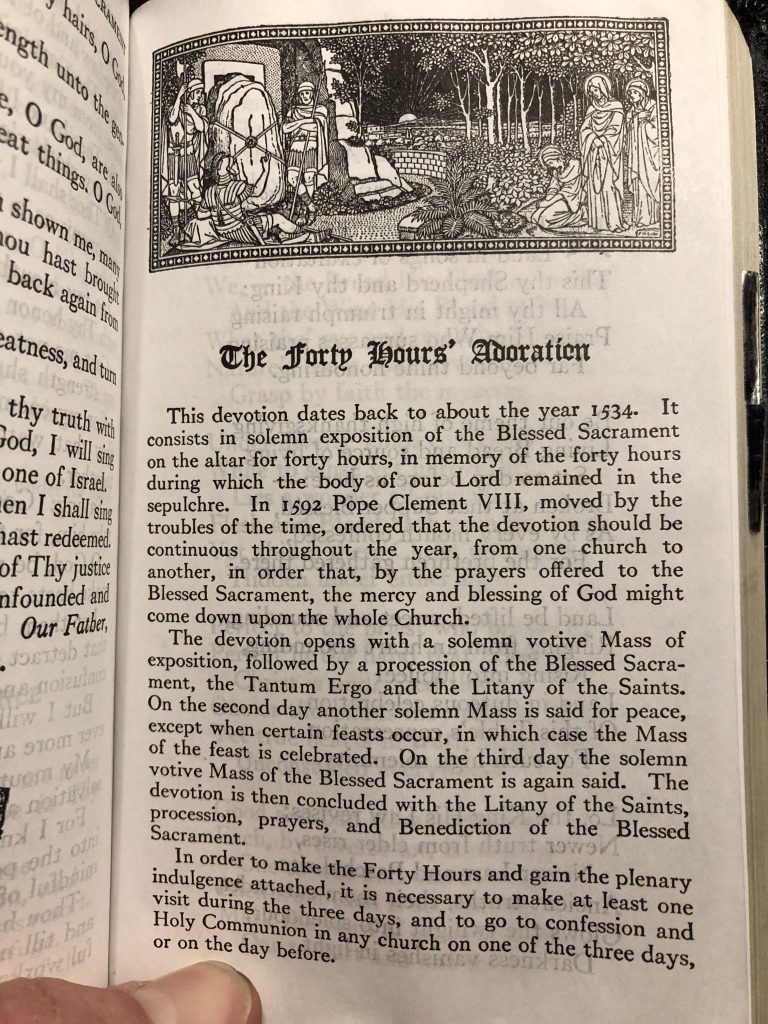
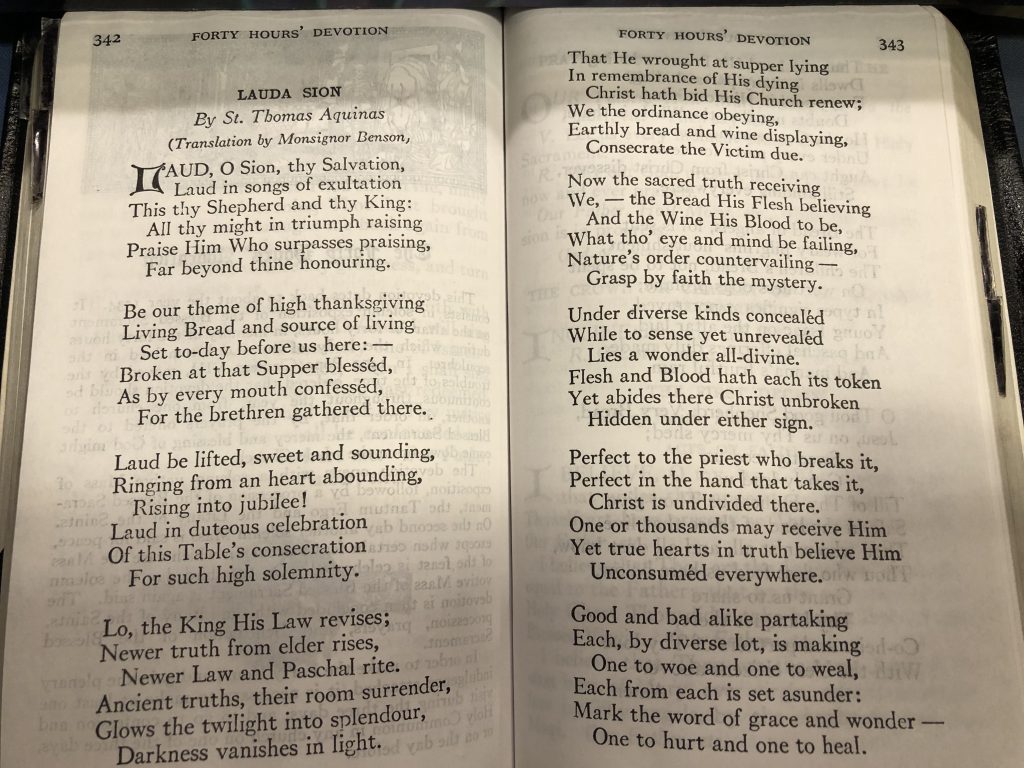
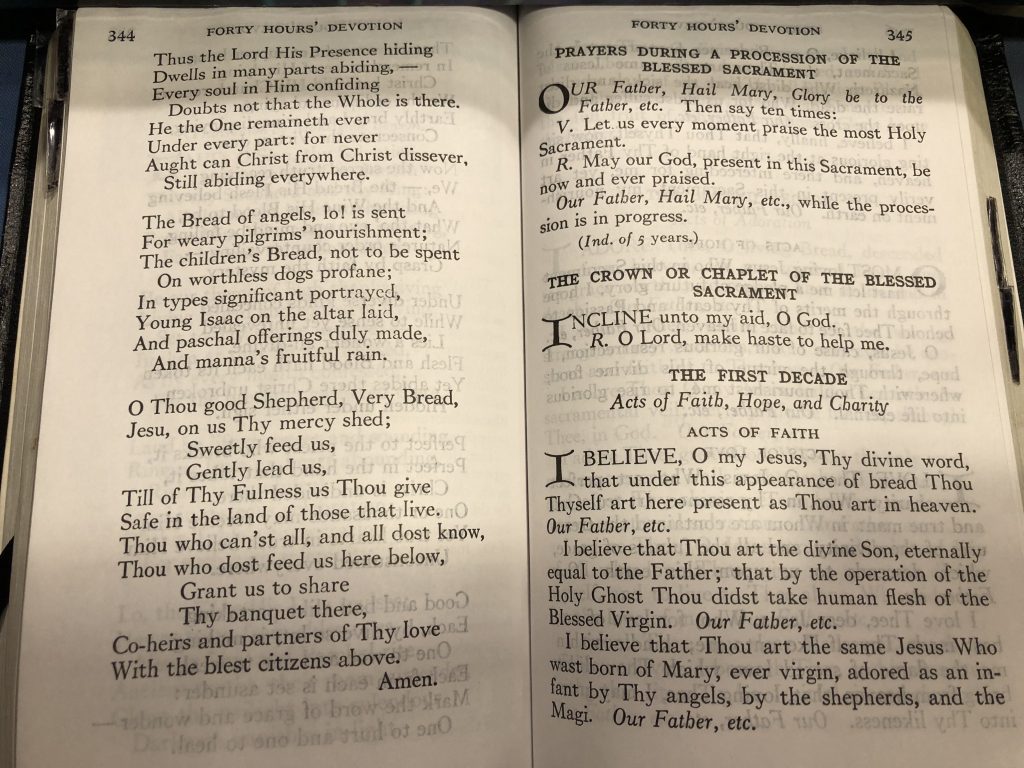
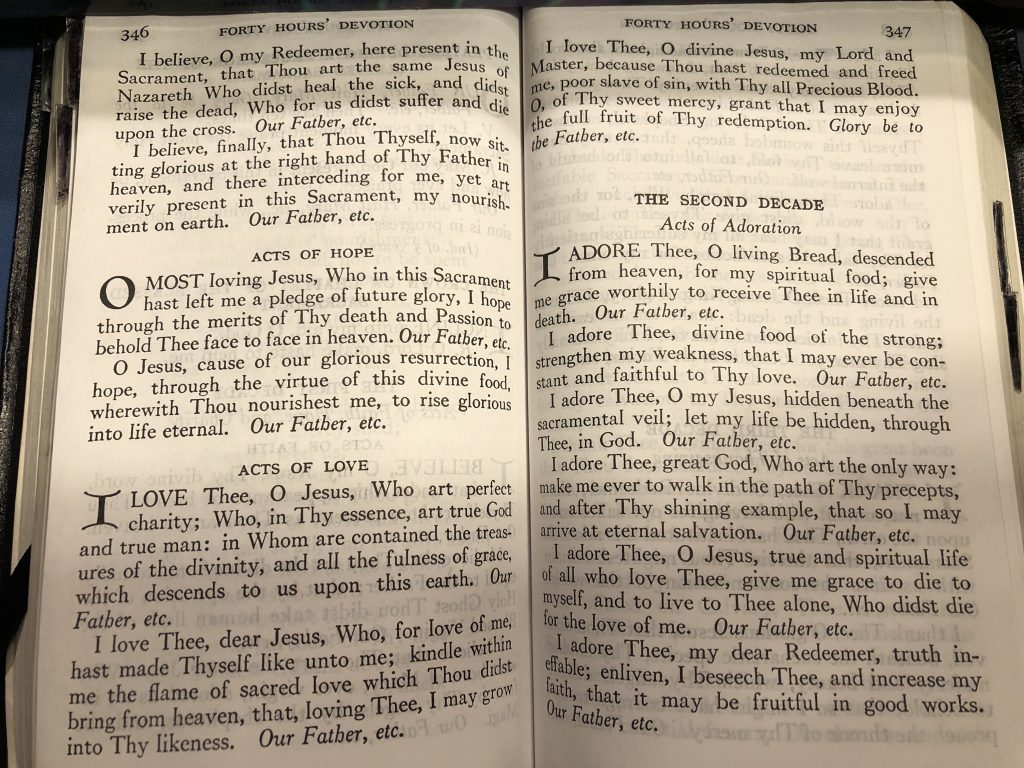
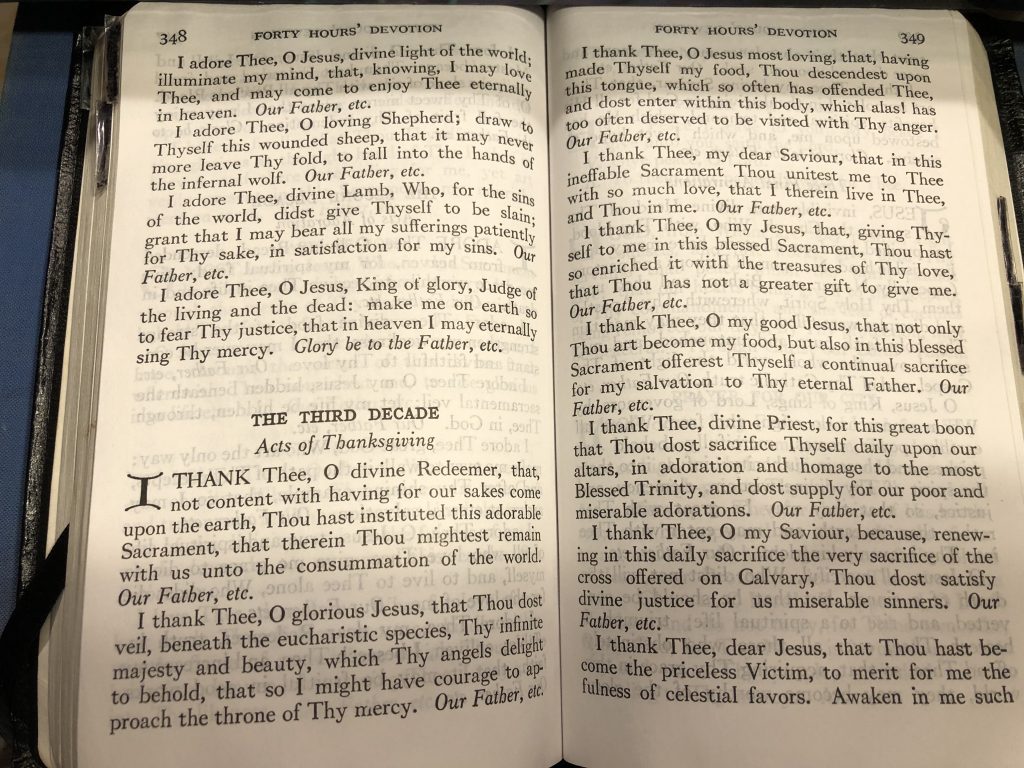
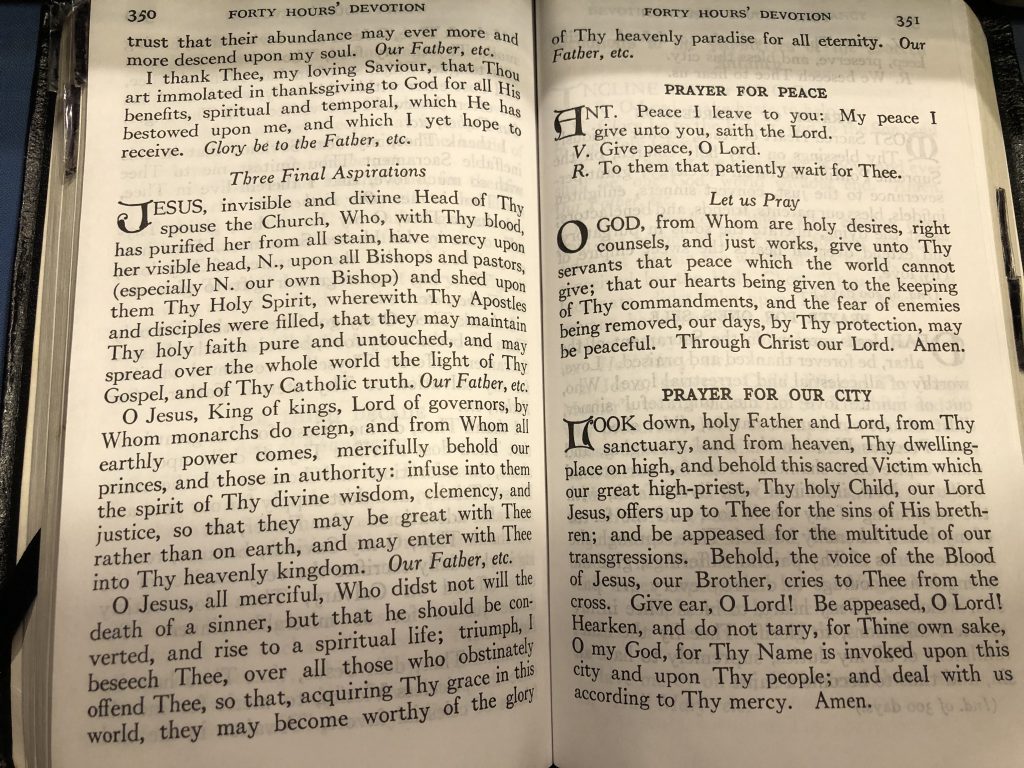
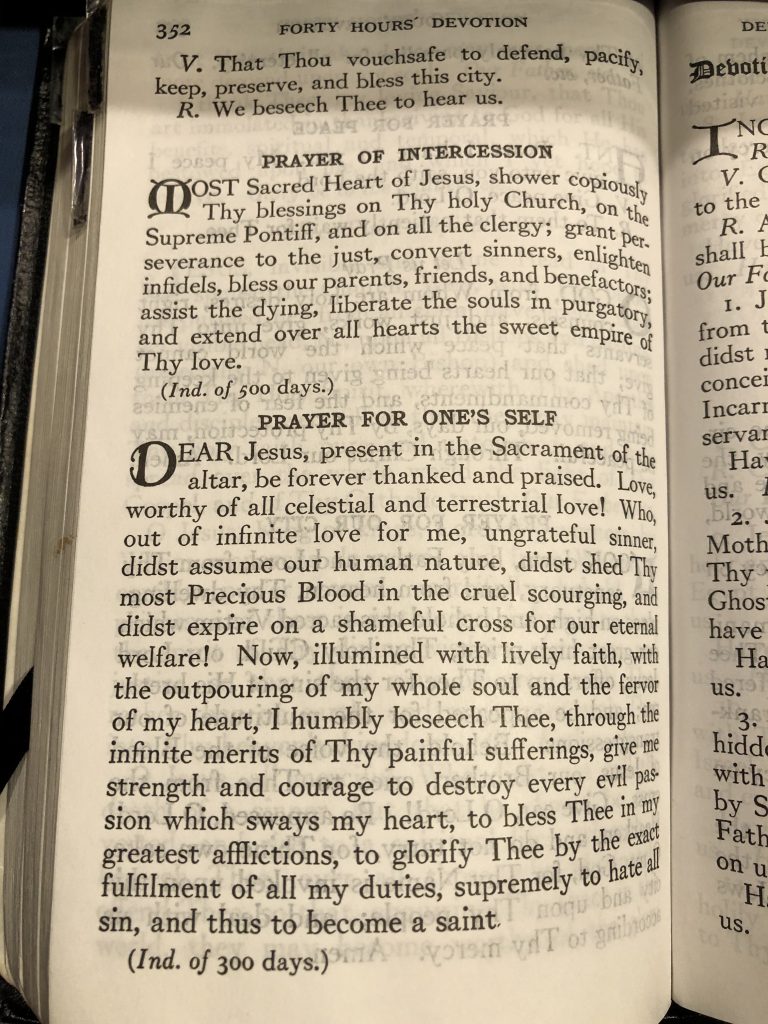
40 Hours Devotion
Seven Mysteries of the Precious Blood
The Holy Hour
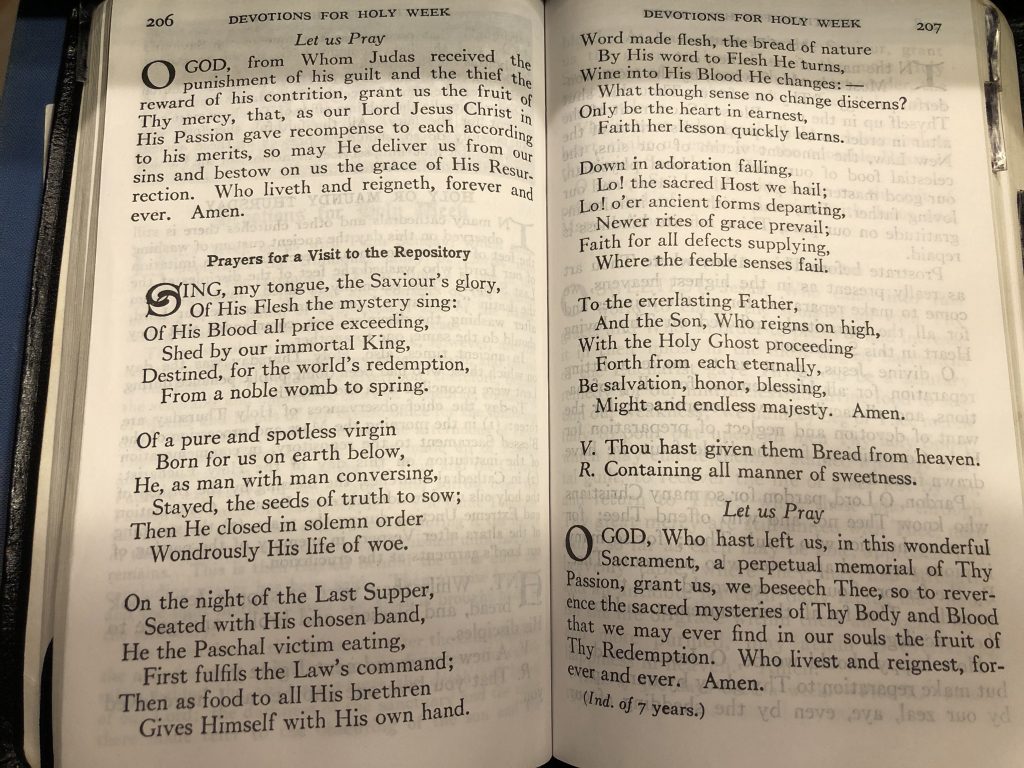
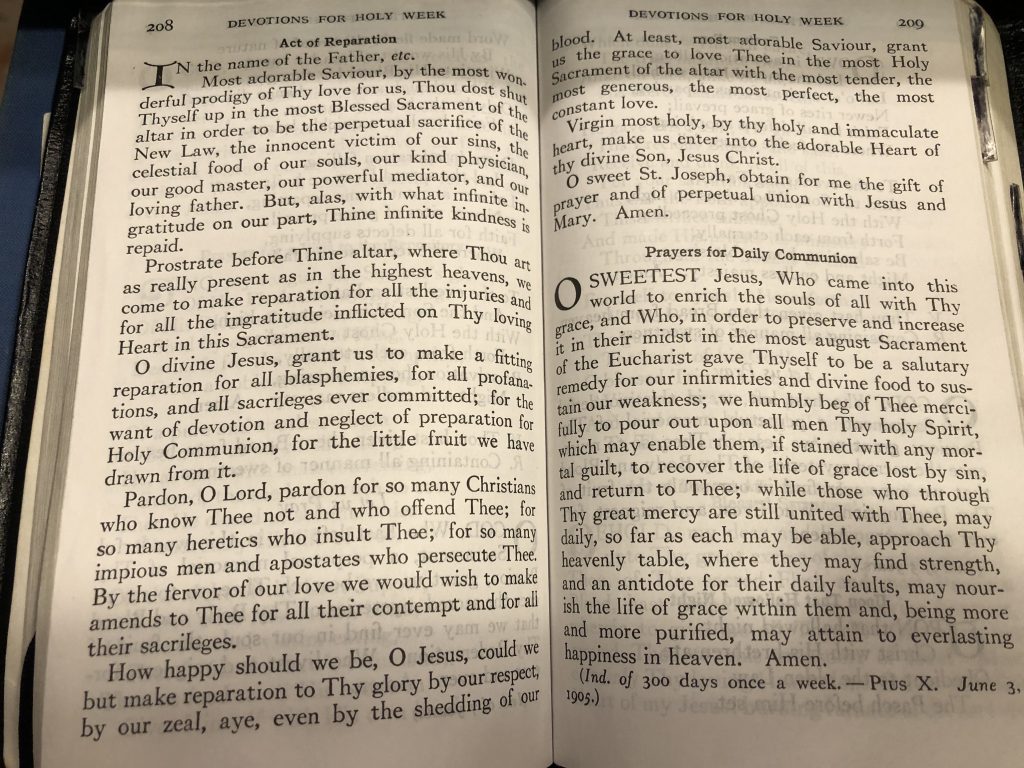
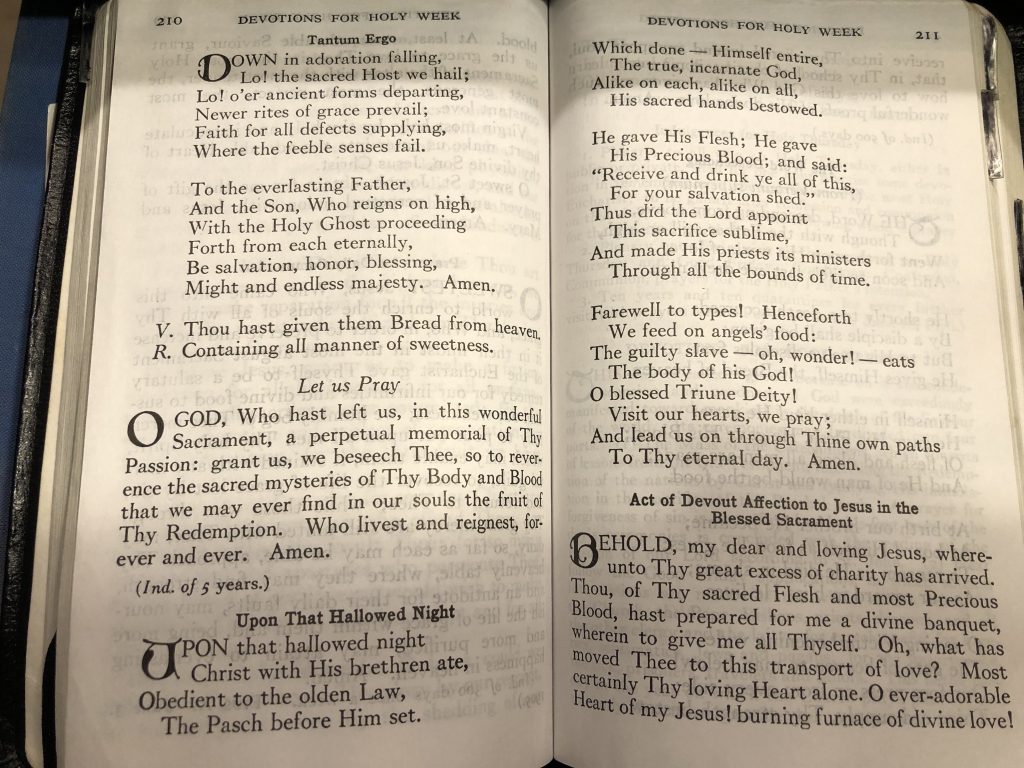
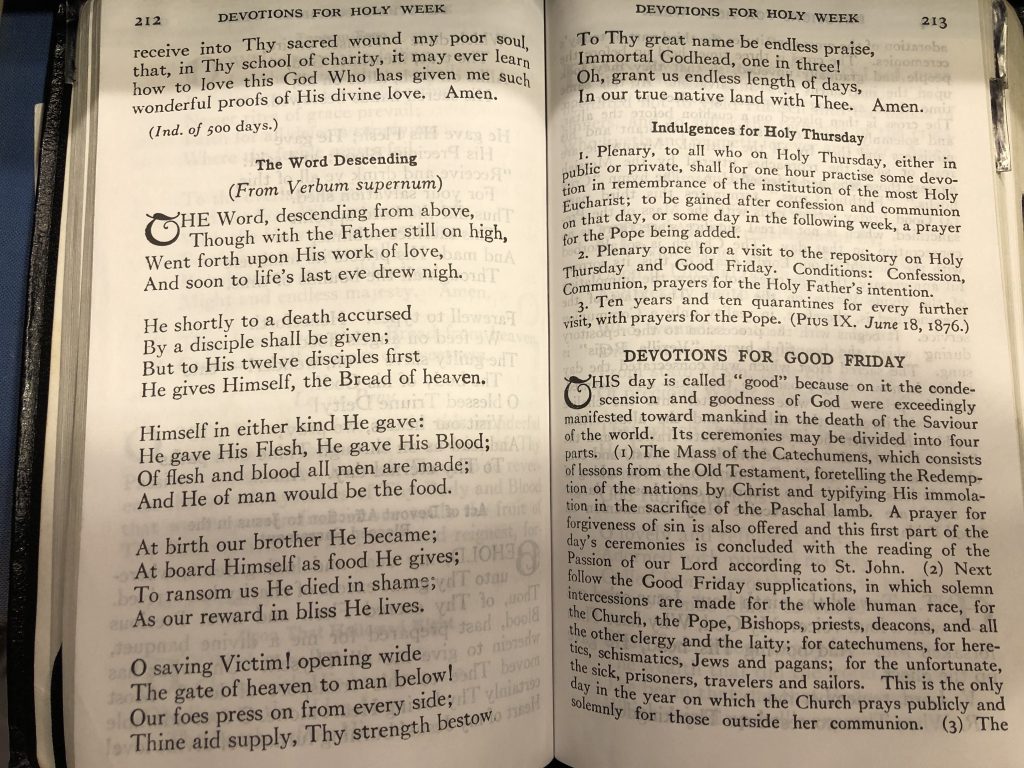
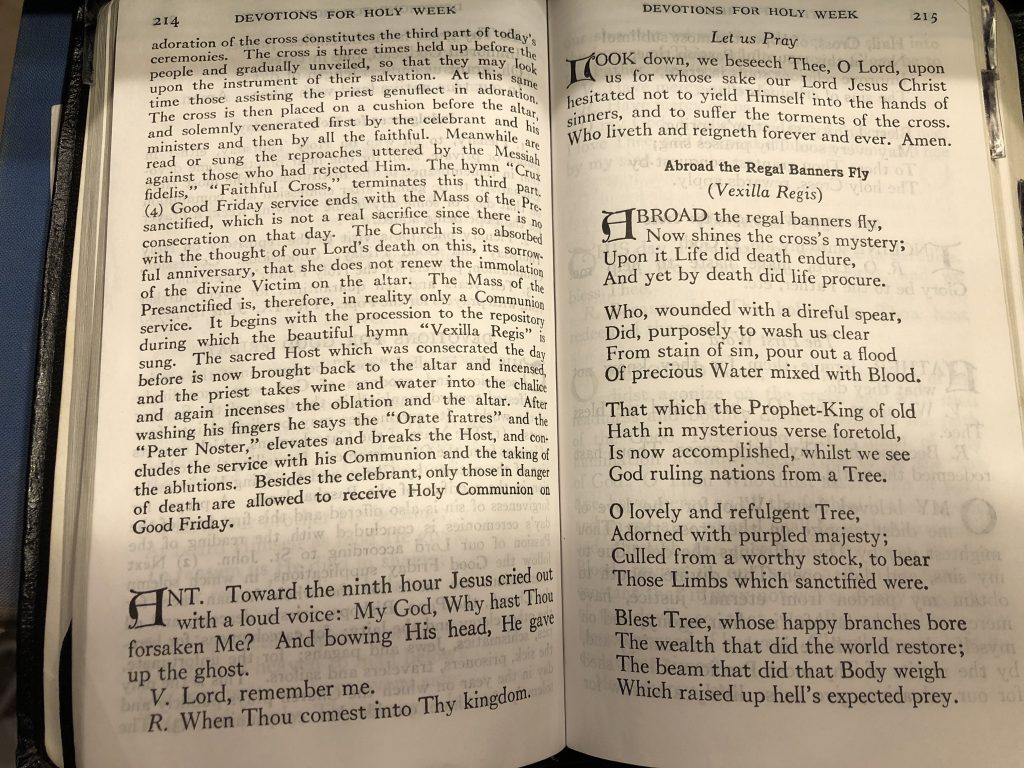
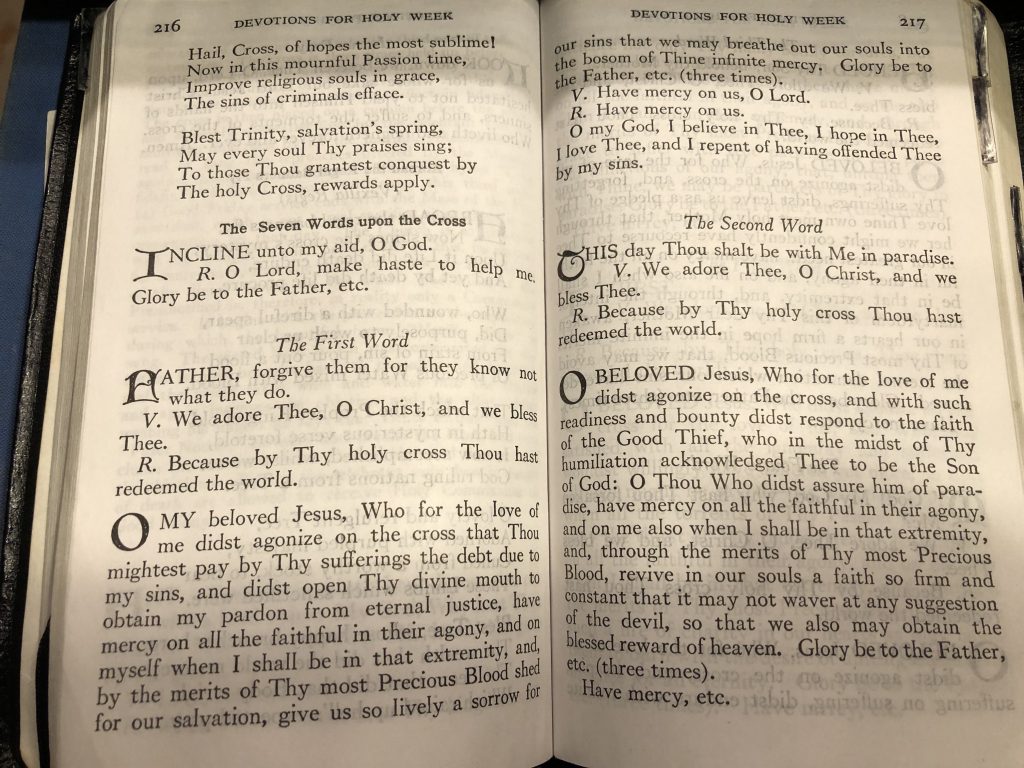
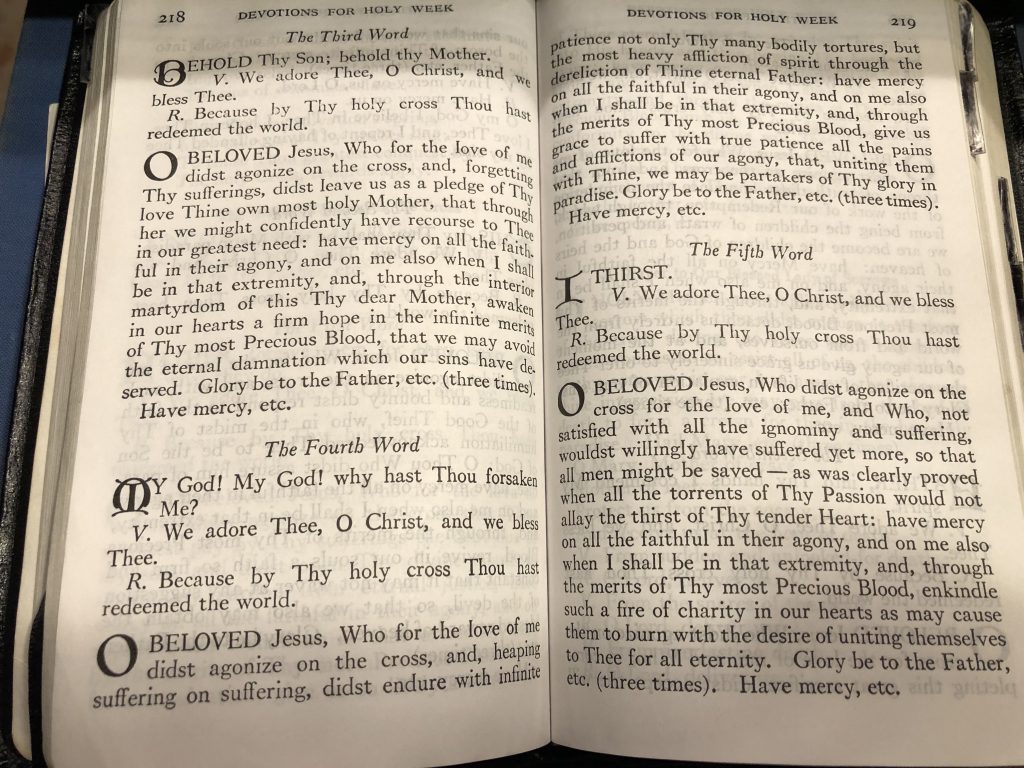
Below are excerpts from the traditional Catholic Prayerbook Blessed Be God.
Holy Week Customs for the whole family (Quarantine Edition)
The following family customs are given by the excellent site Old Soul Rad Trad. This site is absolutely essential to living a Catholic family life in today’s world. Please subscribe and support them.
- Palm Sunday (April 5): There are a couple of things to do with the palms you receive today (and hopefully you are able to receive one!). You can hang them over crucifixes and holy images, place one in a sick call set, weave it into a cross or something beautiful to display (a great quarantine craft!), or set aside a piece of one to burn (while praying to St. Barbara) for relief in times of storms or natural disasters (an Italian and French custom). If you want something to do with last year’s palms to make room (and your parish doesn’t ask for them to burn for Ash Wednesday), bury a piece in the four corners of your property for protection. As for food, the customary food to eat for Palm Sunday is figs.
- Holy Week (April 6 through 11): Traditionally, this is not only a time to increase Lenten penances, but many used to abstain from all servile labor this week (it used to be obligatory). This week there was a total suspension of ordinary routine, and that time was normally spent in prayer at the church, where people would keep long vigils. Consider making this week as special as you can by removing unnecessary work and entertainment and picking up extra prayers and readings (the Divine Office would be good here) and visiting the Blessed Sacrament where possible. This is also a time (on Monday, Tuesday, and Wednesday) to get the house spotless for Easter so that the Triduum can be completely focused on prayer.
- Spy Wednesday (April 8): Tonight begins the haunting Tenebrae services, where the next day’s Matin and Lauds are sung in a kind of funeral service for Our Lord. If you can’t get to one in person, there are lots to watch online as a family.
- Maundy Thursday (April 9): An old folk’s tale that would be fun for children begins today. After the bells ring at Mass for the Gloria (the last time they will be rung until Easter), they all fly away to Rome to visit the Pope, staying on top of St. Peter’s. When they return on Easter, ringing wildly, they bring back decorated Easter Eggs (these could appear in your children’s Easter baskets.) Today also begins the custom of visiting seven Tabernacles (each in a different church) from now until Holy Saturday. This would be a great activity to do if the family seems to be going stir crazy—you could even do it if you are unable to get out of the car (if the church is locked). Just park as close to the Tabernacle as you can and spend a little time in prayer before leaving for the next one. Remember that the idea of this tradition is to keep vigil with Jesus in the Garden of Gethsemane, a good thing to remind your children of. Finally, recite a Tantum Ergo today for a plenary indulgence under the usual conditions (new conditions that temporarily apply can be found here).
- Good Friday (April 10): Today has an air of somber silence. If you can’t get to any church services, here’s what you can do at home. It’s tradition to wear black today, a great reminder of today’s importance for those quarantined. It’s also tradition to cover mirrors and extinguish votive candles. Socializing, entertainment, and even talking are kept to a minimum, especially from the hour Jesus was nailed to the Cross (noon) to the time He died (3 p.m.). Try to observe an even more extreme silence and somberness for those three hours—no talking, phones and computers put away, etc. It’s tradition to eat Hot Cross Buns in the morning, kissing the cross on the top before eating it. It’s also tradition to perform the Way of the Cross—if you can’t go to a church, do it at home, even just by printing out the pictures and using painter’s tape to hang them around the house. If you want to perform an adapted Veneration of the Cross (because you are unable to get to church), here is a possible way to do it: the father of the house will say “Venite adoremus”, and the whole family will kneel three times, one for each time Jesus was mocked (in the high priest’s courtyard, in Pilate’s house, and on Calvary). Then everyone will kneel and kiss the cross, men first and then women. During this, the Improperia is sung. You can find it on YouTube here and directions to say the English translation yourself here. Finally, end the day by putting on a Passion play in your home or watching Mel Gibson’s movie, The Passion of the Christ.
- Holy Saturday (April 11): Depending on your parish, Easter baskets full of items to be eaten on the Easter feast will be blessed today or after the Easter Mass tomorrow (there are special blessings for eggs and bread). If you cannot make it to Easter Vigil, light candles or pray around a bonfire that evening. The father of the house can read the Exultet. A good activity for children on this day is to make Resurrection Cookies to be eaten on Easter.
- Easter Sunday (April 12): Today begins an entire season of rejoicing, and an octave lasting eight days. Everyone and everything should be decorated its best, from new Easter clothes (if you can afford it—if not, try reserving your nicest outfit to wear this day each year) to a beautifully decorated table. Even if you can’t go to Mass, we highly recommend dressing up as you normally would. The centerpiece of your table should be a Paschal candle that will stay up until the Ascension. You can adorn it with flowers (as we mention in our Liturgical Gardening post) and decorate the candle as they do in church (instructions here—another great quarantine craft). For more decorating ideas, here are a few of the season’s symbols you can use: lilies, bells, eggs, butterflies, and peacocks. The food eaten today is everything traditionally foregone during Lent: eggs, dairy, and of course, lamb! Another tradition is to watch the sunrise this morning to see if you can catch the sun dancing for the Resurrection. Also, from now through the Saturday in the Octave of Easter the Regina Caeli will replace the Angelus.
Maundy Thursday-Holy Saturday

Seven Last Words of Christ
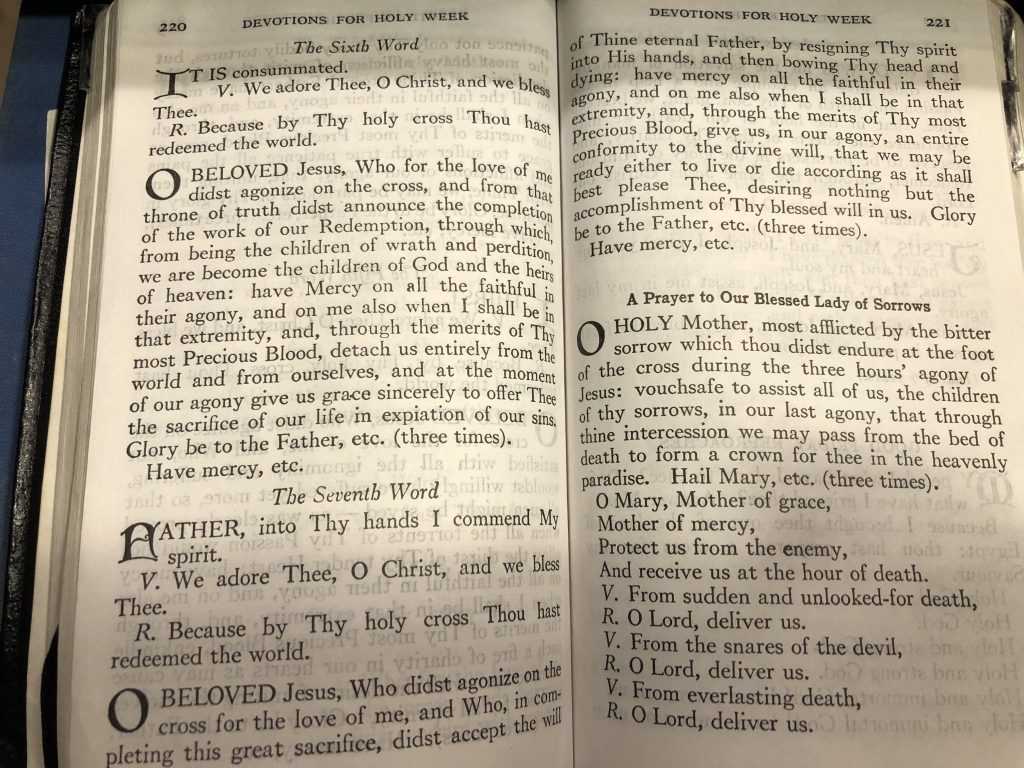
Prayer to Our Lady of Sorrows
40 Hours Devotion
Seven Mysteries of the Precious Blood


The Holy Hour


Podcast: Plague – A Lie Told Often Enough Becomes the Truth
Editor’s note: in this climate of fear and panic, it is vital that we maintain the right of every man to speak freely and debate the issues. More dangerous than any virus is the suppression of debate in unprecedented crisis situations. Calm, rational debate is what keeps this situation from being used by the enemies of Christ for their own ends. Please interact with K. Hall in the comments and cite your sources. -T. S. F.
***
K. Hall asserts that the media and the governments are lying to us about the China Communist Party virus. Sources mentioned can be found here.
Podcast: Is Modern Music a Problem?
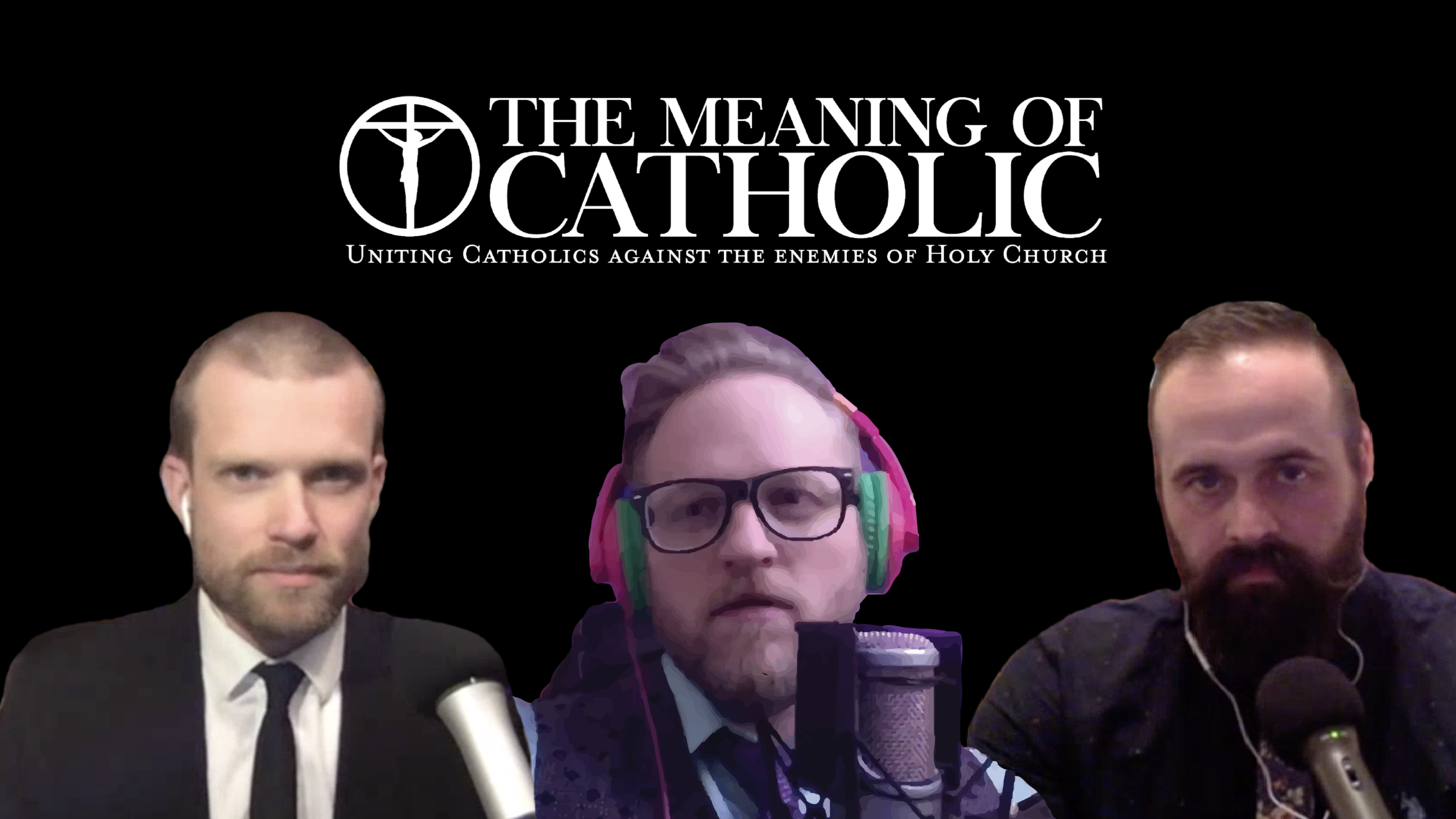
T. S. Flanders, J. Bannister and K. Hall are joined by Heavy Metal fan and Catholic Dave Hodges who will critique our video on “Music and Effeminacy” in which we argued that Modern music causes internal disorder and effeminacy. If you would like to critique anything from the Meaning of Catholic, please contact us here.
Podcast: Interview on the Allan Ruhl Show
T. S. Flanders is interviewed on the Allan Ruhl show. See Allan’s channel here.

Duties of a Priest in Time of Plague

St. Charles Boromeo administers the Sacraments in time of plague
By Timothy S. Flanders.
Any Law that is Against Justice Does Not Bind
St. Thomas:
Laws may be unjust in two ways: first, by being contrary to human good…either in respect of the end, as when an authority imposes on his subjects burdensome laws, conducive, not to the common good, but rather to his own cupidity or vainglory—or in respect of the author, as when a man makes a law that goes beyond the power committed to him—or in respect of the form, as when burdens are imposed unequally on the community, although with a view to the common good.
The like are acts of violence rather than laws; because, as Augustine says (De Lib. Arb. i, 5), “a law that is not just, seems to be no law at all.” Wherefore such laws do not bind in conscience.
Secondly, laws may be unjust through being opposed to the Divine good: such are the laws of tyrants inducing to idolatry or to anything else contrary to the Divine Law: and laws of this kind must nowise be observed, because, as stated in Acts v. 29: we ought to obey God rather than men (I-II q96 a4).
Justice and Charity Bind the Priest to Administer the Necessary Sacraments During Plague, Even at the Risk of His Life
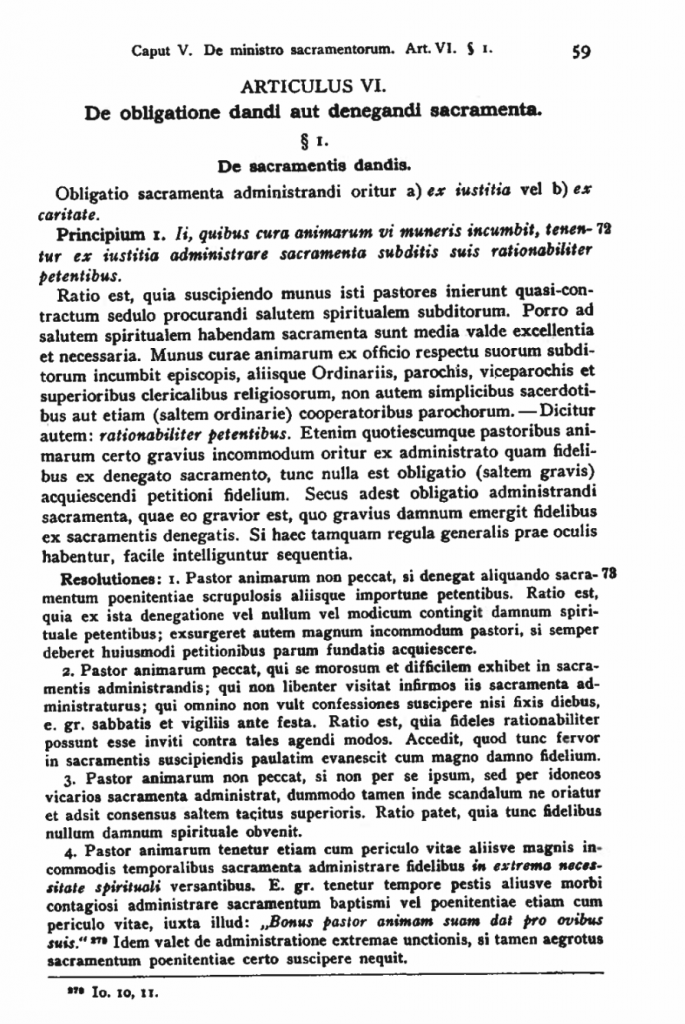
Prümmer, Manuale Theologiae Moralis, Vol III, no. 72ff:
The obligation to administer the sacraments comes from justice and charity.
Principle 1: Those who have the office of the care of souls are bound out of justice to administer the Sacraments to those under their care who reasonably ask for them.
The reason is because by receiving their office they act as pastors contracted especially to procure the spiritual salvation of those under their charge. The Sacraments are the ordinary means—most excellent and necessary—for spiritual salvation ….Reasonably request, if a certainly grave harm is caused to the pastor of souls by administering the sacrament which is equal to the grave harm caused to him who requests by denying the sacrament, there is in that case no obligation (at least not grave) of acceding to the request of the faithful. Otherwise, it is an obligation to administer the Sacraments—the obligation is more grave in proportion to how grave the loss would be for a denial of the Sacraments.
Since right is the object of justice, the souls under the priest’s care have a right to the necessary Sacraments for salvation by the contract of the priest to their souls in his incardination as their pastor. However, they must be reasonably requested. Prümmer discusses for instance a scrupulous soul asking for Confession every day—this is an example of an unreasonable request which would cause greater harm to the soul than denying the Sacrament. On the other hand, he also says a priest sins who makes it difficult for the faithful to get to confession on a reasonably regular basis. He continues regarding the time of plague:
4. The pastor of souls is bound to administer the Sacraments to the faithful when they stand in extreme spiritual necessity [i.e. about to die with no hope of recovery] even at the risk of his life or other great temporal harm. They are bound in time of plague or infectious disease to administer the Sacrament of baptism and penance even at the risk of their life, according to this Scripture: the good shepherd lays down his life for his sheep (Jn. x. 11). The same applies concerning the administering of extreme unction, provided there is a certainty that the sick man is not able to receive the Sacrament of penance.
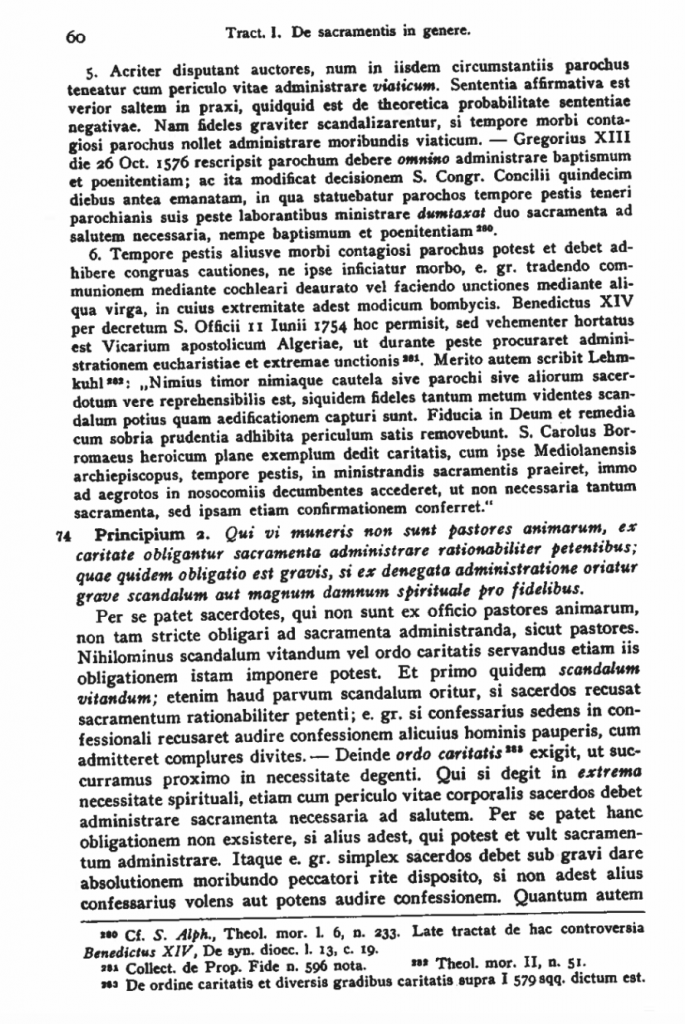
5. The authors sharply dispute if during these times as well the pastor is bound to administer the Viaticum. …Gregory XIII replied that a priest must definitely administer baptism and penance; and thus he modified the decision of the Sacred Congregation of the Council which had arisen 15 days prior, in which it was the stated that a priest is bound in time of plague to administer to his parishioners infected with the plague at least the two Sacraments necessary for salvation, namely baptism and penance.
6. In time of plague or other contagious disease the priest can and should take all proper caution to not be infected himself, e.g. giving the Communion by means of a gilded spoon or by making the anointing by means of a rod with silk at the end of it. Benedict XIV by a decree of the Holy Office 1754 permitted this, but he strongly urged the Apostolic Vicar of Algeria that during the long plague he should ensure the administration of the sacraments of the Eucharist and extreme unction.
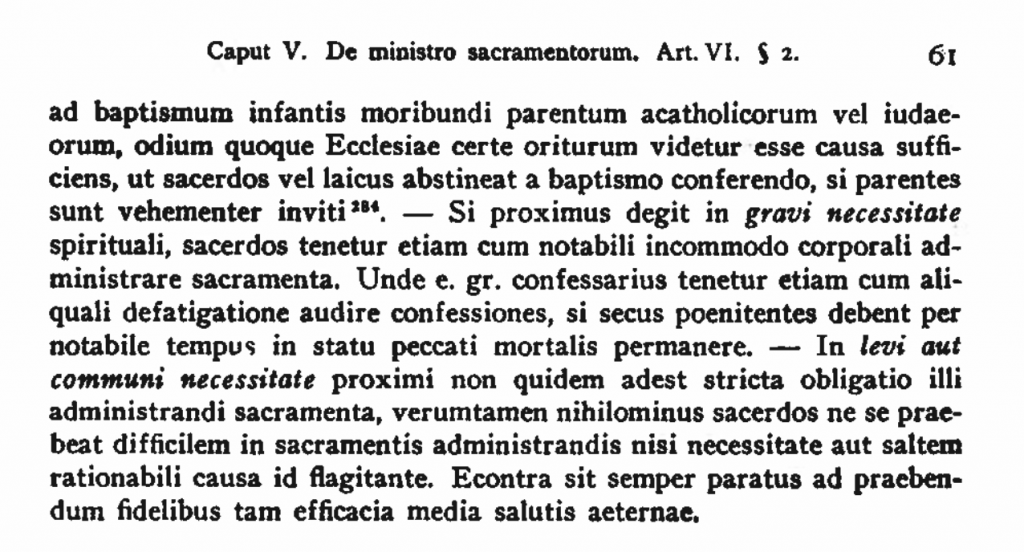
Since all who die in mortal sin suffer damnation eternally (De Fide, Ott, 479ff), those Sacraments which cleanse mortal sin are the most necessary Sacraments for salvation—Baptism and Penance. Baptism can be administered by a layman if a priest is not available (especially in danger of death), but the Sacrament of Penance cannot. This is why a priest must administer the necessary Sacraments for salvation even at the risk of his life because the soul is more excellent than the body. Prümmer goes on to talk about priests who are not pastors (eg. retired priests) are still bound by charity to administer the necessary Sacraments to those in extreme necessity even at the risk of their life.
The Perfect Act of Contrition is Not Sufficient for Most Souls
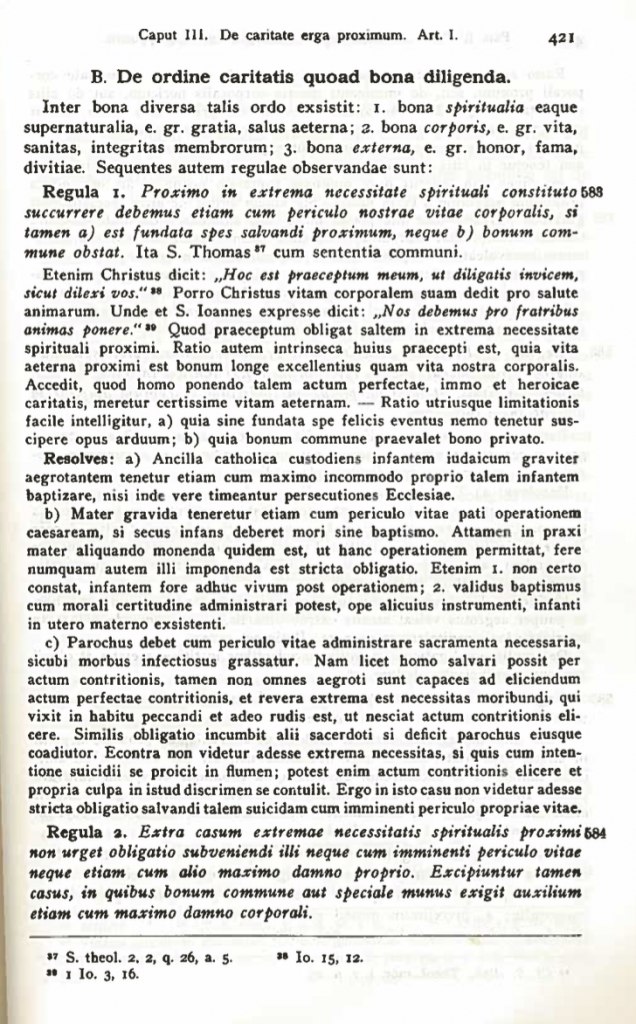
Prümmer, Manuale Theologiae Moralis, Vol I, no. 583:
A priest ought to administer the necessary Sacraments in places where infectious disease has spread, even at the risk of his life. For a man is able to be saved through the act of contrition, but not all who are sick are able to summon up within themselves the perfect act of contrition. Indeed, at death one’s necessity is extreme, and he who has lived in the habit of sin and wild living will not be able to summon the act of contrition.
This accords with what St. Alphonsus says in his sermon on the dying sinner. When a man has the habit of sin he will have great difficulty making a perfect act of contrition. Moreover, St. Alphonsus also observes (following Augustine and other Fathers):
God has indeed promised pardon to all who repent of their sins, but he has not promised to any one the grace to repent of the faults which he has committed. Sorrow for sin is a pure gift of God; if he withholds it, how will you repent? And without repentance, how can you obtain pardon? Ah! the Lord will not allow himself to be mocked. “Be not deceived,” says St. Paul, “God is not mocked.” (Gal. vi. 7.) St. Isidore tells us, that the man who repeats the sin which he before detested, is not a penitent, but a scoffer of God’s majesty. “Irrisor, et non pœnitens est, pui adhuc agit, quod pœnitet.” [De Sum. Bono] And Tertullian teaches, that where there is no amendment, repentance is not sincere. “Ubi emendatio nulla, pœnitentia nulla.” [De Pœnit.] (St. Alphonsus, Serm. XXI for Easter).
Instead, the dying sinner, if he does have any regret, he will probably have only a fear of hell (i.e. “attrition”) which is not sufficient for salvation unless the Sacrament of Penance is celebrated for his sake. This Sacrament will apply the merits of our Lord’s Passion to cover the defect of his contrition. This is why the priest is bound to administer Confession to dying sinners even at the risk of his own life.
_________
Translations from Prümmer by T. S. Flanders. If you would like a PDF of these entire sections, please contact me.
Vol. III: citations:
Vol. I citation:
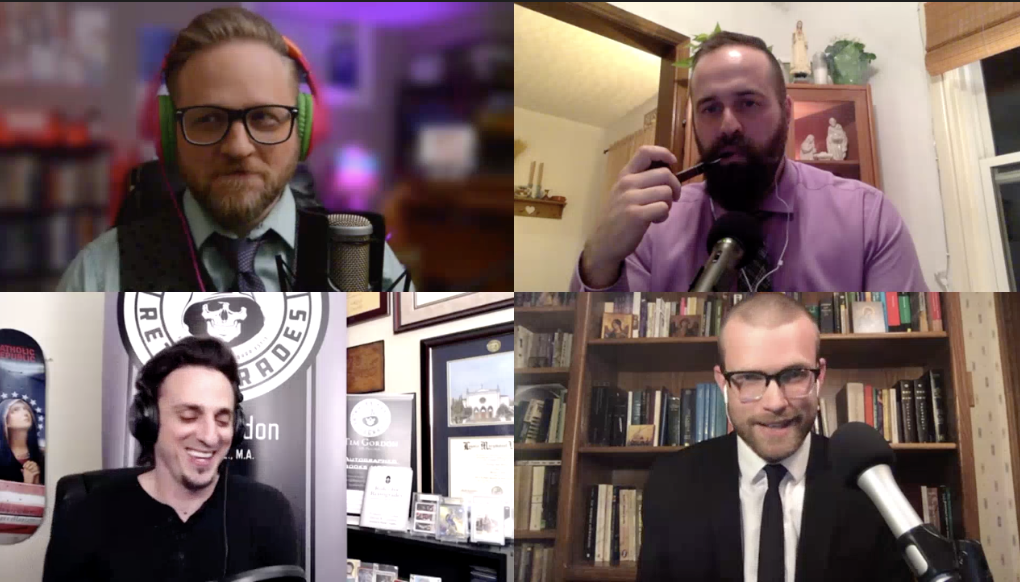
Podcast: Is Liberalism a Sin? Timothy Gordon and John Zmirak Guests
T. S. Flanders, J. Bannister and K. Hall discuss the global liberal revolution since 1776 with special guests Timothy Gordon and John Zmirak. This is part of an ongoing discussion at Meaning of Catholic on modern politics including Liberalism, Communism, Feminism and Catholic Social Teaching in various countries.
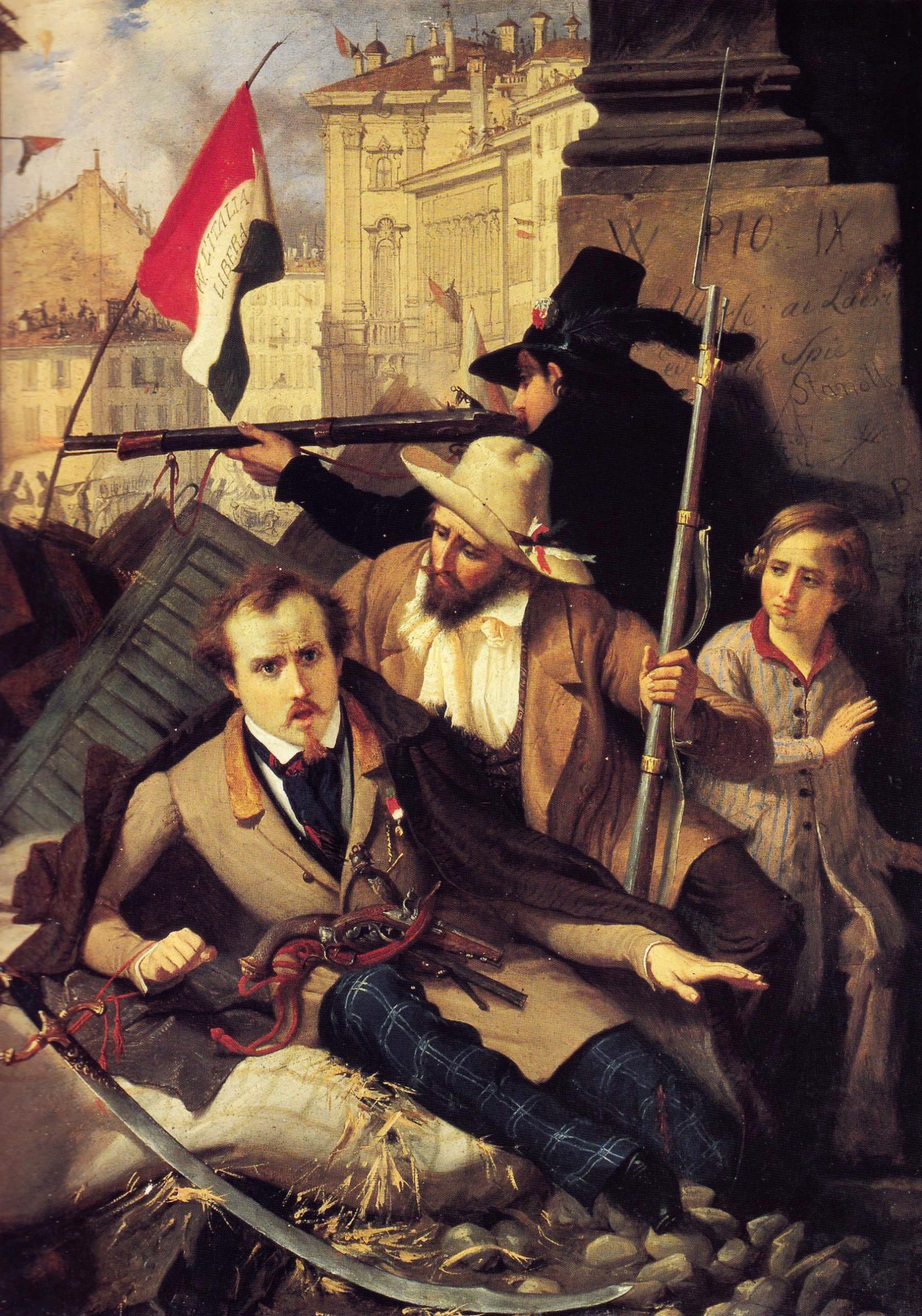
The Modern Catholic Liberal Disaster: Why Conservatives and Trads Must Unite Pt. II, Chapter 2
By Timothy S. Flanders
Read Part I here.
Read Part II ch. 1 here.
Chapter 2: The Bloodshed Grows Still More and Pio Nonno Takes a Stand
In opposition to Napoleon’s imperial ambitions against Europe, a coalition had arisen to defeat him. This coalition was made up of Britain, Prussia (Germany), Russia, and Austria. At the Congress of Vienna of 1815 they drew up new boundaries after the defeat of Napoleon. These growing powers were a prelude of what was to come within 100 years.
But what the revolutions of America and France had done was shown the watching world that one group of elites (the republican revolutionaries) could successfully use rhetoric such as “liberty” to provoke the common man to anger against the real injustice inflicted upon him by the established elite (the monarchists). They could then convince masses of common men to die for this cause and overthrow the monarchy, so that the republican elites could then seize power. Thus republicanism became a mass movement throughout Europe (and the Americas) with huge swathes of the population seized with revolutionary fervor. The first revolution which imitated the French and American happened in Ireland in 1798.
But this republicanism was not just zeal for a new form of government. The revolutionary leaders sought to unite the masses into one nation (before this, modern nations barely existed). To do this, the revolutionaries not only relied on “liberty” rhetoric, but something much more violently potent: extreme nationalism. This nationalistic fervor would have devastating effects just a few generations later. (We will use the term “nationalism” in this essay to contrast it with the virtue of patriotism. Nationalism as a term can also be used for the virtue of patriotism.)
At the same time, all of rural culture of Euro-America was being destroyed by the industrialists, who forced the population out of the country villages and into the factory and cities. This further contributed to a cultural breakdown with the displacement of families. For the first time in history most men worked far away from their wives and children, weakening the marriage bond and thus the family.
To make matters still worse, the republican political philosophies which desired to dethrone Christ the King from politics, also promoted secularizing forces among Christians. This was the age of “higher criticism” and Darwin’s Evolutionary theories which cast doubt on the whole Christian faith and the reliability of the Holy Scriptures. This began among the Protestants, but later gained strength within the Catholic Church as well, as we shall see.
The Iconoclasts supported any and all republican, secular and urbanization efforts. The Moderates were nuanced in their mixed feelings toward the social change. The Strict were adamantly opposed to these changes, and heavily supported the established elites.
Servant of God Pius VII had been a Moderate, but was willing to also excommunicate Napoleon and resist him to his face, manifesting the best of the Strict. Still, unlike Pius VII’s coronation of Napoleon, the Strict party would not compromise with the revolutionaries. After the death of Pius VII, the Strict were able to get their candidate elected as Leo XII. He was truly a Strict Iconodule, and showed no conciliatory actions toward the burgeoning secular republican order. In both France and Spain, he supported the reactionary movements which were intentionally using religion to gain power. Because the republican fervor was so deep and widespread, he began the general alienation of the mass of Europeans from the Church. His reign was unpopular in the Papal States, where republican fervor was strong, despite the memories of Napoleon’s forced republics. One of his successors, Gregory XVI, also followed him in a Strict opposition to the republican revolutions. Italy was growing in extreme national fervor as the Italian republicans sought to suppress all local allegiances and unite all Italians into one secular republic.
Into this chaotic imbroglio appeared one pope whose reign would shape the century and set the whole course of our current crisis into motion. That man was Giovanni Maria Mastai Ferretti: Blessed Pius IX.
The Influence of Pio Nonno
At the time of his ascension to the papacy in 1846, revolutionary forces were sweeping the Italian Penninsula, attempting to unite the many divided states into one secular republic like France and America. The revolutionaries had resorted to violence and many of their leaders had been exiled from the Papal States, provoking his predecessor, Gregory XVI against them.
But when he became pope, Pius IX was a Moderate. He thought at first that a policy of appeasement would mitigate the revolutionaries’ extreme tendencies and bode well for a peaceful compromise. His first act as pope was to pardon numerous leaders from the political revolutionaries. He then set up an advisory group to study the implementation of moderate republican reform of the Papal States for the sake of the common good.
However, shortly after this in 1848, those same pardoned leaders and their forces mounted violent assaults on Pius IX, murdering some of his associates and attempting to force him to democratize not only the Papal States but also the Church. They wanted to force him into supporting their political aims of uniting Italy especially against their national rival: Catholic Austria.
They forced Pius IX to flee Rome and seized control. The pope called upon the non-Italian, Catholic allies of France to help him return to his See backed by troops. Upon his return to the eternal city, the Holy Father had become convinced that the revolutionaries could not be trusted. He had given them an inch, and they quickly took a mile. He was no longer a Moderate, but a Strict Iconodule.

International Catholic troops defending Pius IX
Until his death in 1878 (still the longest pontificate in history), Pius IX waged all out war on every evil aspect of Iconoclasm, secularism and liberalism. He waged spiritual war by condemning their errors. Catholics from around the world came to Rome to take up arms to defend the Papal States from the violent overthrow by the secular Italians. Thus his pontificate became a unifying force of Catholics against all the secularizing forces of Europe.
The long and protracted struggle included the infallible definition of the Immaculate Conception in 1854 (which he targeted against the republicans’ main error: the denial of Original Sin), the Syllabus of Errors of 1864, and the First Vatican Council in 1870. All the while, the forces of secular Italy attempted to squeeze Rome and overthrow her.
Vatican I must be seen therefore as the most definitive act against the secularizing republicanism that had swept Europe. Bishops from around the world united in the Eternal City against the forces of anti-Catholicism waging around them. During the council itself, the fighting came to Rome’s door step, and the Italian republican army were attacking Rome even as the bishops hurriedly attempted to finish their proceedings.
Vatican I succeeded in passing just two documents. The first was Dei Filius, which condemned Iconoclasm in explicit terms and was passed unanimously at the council. It included this anathema which restates the Seventh Council’s anathema in a different way:
If anyone shall assert it to be possible that sometimes, according to the progress of knowledge, a sense is to be given to doctrines propounded by the Church different from that which the Church has understood and understands; let him be anathema.
This anathema directly contradicted all the Iconoclasts’ dreams of updating the Church to compromise with the secular world. The second document on the Church, stated that the head of the Church—the Roman Pontiff—expressed the infallibility of the Church when he was exercising his office. In particular this decree condemned forever the idea that the bishops were basically government officials–even as many of the fathers of Vatican I had been in some way appointed by their respective governments. Thus by these two decrees the Church at once condemned all Iconoclasm, and all challenge to the authority of the Church to teach the truth.
With that, the Italian armies broke through and stopped the council indefinitely (it was not officially closed until 1962). This bloodshed and overthrow of the Papal States was only a portend of the horror which was to come in a few short generations. But the papacy would fight with all its might against this evil…until it could not (or would not?) fight anymore.
Timothy S. Flanders
@meaningofcath


Why I will Never Participate in a New Mass Again Pt. 1
By Kennedy Hall
Part 1: For the Love of God
Introduction
I was hesitant to write this series of articles, as I did not want to come off as condescending or uncharitable to those who attend the New Mass. Some of the most faithful Catholics I know attend the New Mass, and I would imagine that many have never considered the liturgy all that much. If anyone is put off by the contents of these articles, please feel free to contact me, and also please understand that the positions taken herein are not based in antagonism. In essence, my liturgical positions are primarily a matter of the heart, even though I have come to see the theological justification for the superiority of the Traditional Mass. I do not exclusively attend the Tridentine Mass because I think I am better than any other Catholic, but instead because I know that I am likely worse than many Catholics. I do not presume to have the strength to be able to worship any different than my ancestors, as I understand how much more virtuous the lot of them were. If the reader takes anything away from this series, I hope it is that my stance is based in a deep love for Our Lord and Our Lady, and that my soul impells me to act in this manner.
Traditionalists need Charity Too
Surrounding the topic of liturgy, there are surely a myriad of voices online who comment on the subject. Some of these voices are quite helpful, while others may be antagonistic. I do not buy the stereotype that “trads” (traditional Catholics) are generally mean spirited, as my experience has been consistently the opposite. However, I will grant that when a “trad” goes wrong, it is usually in a stiff-necked and unfriendly manner. Again, most people I have met in the traditional Catholic world are kind, fun loving people who are seeking holiness, but “bad-apples” do exist. That being said, if I were to base my theological opinions solely on the people I have met, I would never attend a single parish on Earth. I can remember hearing jokes about vasectomies and people applauding Ireland’s decision to legalize abortion in a Novus Ordo setting. I would be daft to associate all Novus Ordo attending Catholics with the various heretics and apostates that fill the pews. This would be unfair and illogical to say the least.
When non-traditional Catholics flippantly refer to “angry trads” or “rad trads” in a negative way, it is not helpful. In addition, it could be argued that this flippancy is the other side of the coin with regards to the judgemental spirit they supposedly see in traditionalists. We should keep in mind that the sin of schism is a sin against charity, either against unity with the Church, or with other Catholics; brushing off, or dismissing traditional Catholics, including those who attend the SSPX is still a sin against charity–arguably a schismatic disposition.
Tradition in my Bones
Years ago I was commuting home with some colleagues from a Catholic elementary school. I had recently experienced a major interior conversion, and was on fire about my new found faith. In our conversation, the topic of liturgy came up. Of course, none of us had any theological training, so our conversation was based on mere opinion. One of my colleagues had expressed that her favourite type of Mass was the “folk” Mass, due to the sing-song nature of the music, and because the little children enjoyed it. She then asked me what my ideal Mass would look like; without hesitation I said, “I would like to be in a cave, somewhere in Israel, with monks chanting, and the whole place filled with incense and candles.”
They laughed, and so did I. I had no context for this traditionally spirited liturgical preference, but it was a natural disposition nonetheless. I should add that at this time in my life I began to develop a deep devotion to Our Lady. It was Our Lady of Guadalupe who brought me home, and my devotion to Her was bringing me closer and closer to the heart of the Church. Two years later I returned to Mexico City on another Mission–this is the location at which I had my major conversion two years prior–and I was elated to visit the Marian shrine at Guadalupe once again. I was again a chaperone on this trip, and one of our students hurt her ankle badly during the trip. Since she was on crutches, she couldn’t make the climb up the large hill at the shrine to Our Lady. Because of this, I stayed with her and accompanied her around the main level of the grounds. We found our way into the original Cathedral at Guadalupe, a building that Freemasonic Communists tried to destroy during the Cristero War. In this historic church, there is a perpetual adoration chapel off to the side.
We entered the chapel and I was awe-struck by the ornate beauty and holiness of the location. In effect, it was as if the wind had been knocked out me. There was a group of locals leading a series of prayers and hymns. I am fluent in Spanish, so I noticed they were not speaking Spanish, but instead a language with a similar style. They were speaking Latin. A sweet elderly lady led a Latin hymn, her voice filling the room like notes emanating forth from David’s harp. At this moment, I became a little emotional. It was as if I had traveled back in time, to an age when Christendom breathed with the sacred language of the Traditional Mass. Never had any prayer cut so deeply to my heart as this quiet Latin hymn. Shortly after, the group of locals finished their prayers and snuck away reverently. For a moment I knelt there, realizing for the first time in my life what Eucharistic Adoration truly was. No amount of reading or theological insight could have done for my soul’s ascent to Saving Truth, what a simple Latin hymn could do in a matter of a few moments.
This experience was an event that oriented my curiosity toward the traditions of the Faith, an orientation that grew stronger with the passing of my Nonno a few months later. His death, and his ancestral influence will be the focus of my next article.
—
 Kennedy Hall is a Catholic High School teacher, rugby coach, and part time writer on Catholic topics. He has written for the Kolbe Center for the Study of Creation, Serviam Ministries and the Fatima Center. He teaches Catholic Religion courses to French Immersion students and also speaks Spanish and Italian. Kennedy has spoken at various youth events, as well as on the topic of true Catholic masculinity. He has a passion for the Traditional Latin Mass and the restoration of traditional piety. A prodigal son, he was brought back into the Church with the help of Our Lady of Guadalupe, and prays for the day that all men depend on the Blessed Mother. He lives with his wife and 4 children in Stratford, Ontario. Follow him @kennedyhall.

Podcast: The Scourge of Plague

Podcast: Lent Homilies of the Fathers – St. Ambrose 3rd Sunday of Lent
Homily 26 of St. Ambrose, Bishop and Doctor.