

The Meaning of Catholic: Theological Notes
A very important motto for Catholics in our age is the phrase in essentiis, unitas; in dubiis, libertas; in omnibus, caritas (“In essentials, unity; in doubtful matters, freedom; in all things, charity”).[1] It is crucial that Catholics seize upon this and practice it during this crisis. The distinction between “essentials” and “doubtful matters,” however, is by degrees. The Church distinguishes these degrees by the Theological Notes of doctrine. The highest degree Note represents the highest degree of certainty and thus the greatest obligation for assent, while the lowest is the least certain and the least obligatory for belief:[2]
- De Fide – of the faith – explicit in Scripture, Tradition, explicitly defined by highest Church authority
- Example: all who die in mortal sin will suffer hell for eternity[3]
- Denial of any of these truths is the mortal sin of heresy.
- De Fide Ecclesiastica – ecclesiastical faith – explicitly defined by Church authority, implicit in Scripture and Tradition.
- Example: the Assumption of Mary
- Denial of any of these truths is the mortal sin of heresy.
- Sententia Fidei Proxima – proximate to the faith – teaching is generally understood by the Theologians[4] as explicit in Scripture and Tradition but not explicitly defined by the Church
- Example: The Blessed Trinity can only be known through revelation[5]
- Denial of any of these truths is the mortal sin of error proximate to heresy
- Sententia Certa – theologically certain – implicit in Scripture and Tradition, not explicitly defined by the Church
- Example: the primary purpose of Matrimony is the generation of children. The secondary purpose is mutual help and regulation of lust.[6]
- Denial of any of these truths is the mortal sin of error against the faith
- Sententia Communis – common teaching – this teaching is implicit in Tradition and is generally accepted by the Theologians
- Example: willful sins against the sixth commandment are always mortal sins[7]
- It is licit to object to these teachings if and only if there is good reason. To object to any without good reason is the mortal sin of temerity
- Sententia Probabilis – probable teaching – a teaching that is well founded on good authority yet is open to question. Pious beliefs and tolerated opinions also fall under this note and have the lowest degree of certainty.
- Example: Judas received Holy Communion at the last supper
- Denial of any of these teachings is licit provided piety is given to legitimate authority[8]
Thus we may see that in actual fact, Notes 1-4 are essentials to the faith, while 5 is technically “doubtful” (in the sense mentioned above) but only with good reason, whereas 6 is entirely doubtful matter, provided piety is observed. Thus no man can call himself Catholic and deny anything above Communis, and can only question Communis with good reason. A Sententia Probabilis alone is completely open for discussion.
Let us apply this further to current controversies. So, for example, Lumen Gentium explicitly states that the documents of Vatican II are not binding unless explicitly stated, indicating that unless they are quoting prior teachings, the documents must be held to be Sententia Probabilis or Communis.[9] Whereas Ordinatio Sacerdotalis spoke of the male-only sacramental ordination as binding on all Catholics “This Sententia must be held definitively by all the faithful of the Church.”[10] The former teachings have some room for discussion, whereas the latter is completely closed (including any notion of a female, sacramental deacon).[11]
But in all things, a grave piety must be observed regarding the Magisterium: “The willingness to submit loyally to the teaching of the Magisterium on matters per se not irreformable must be the rule.”[12] Even if a man sees an issue with Vatican II, he is not permitted, through piety, to dismiss the council as a whole.[13] Nevertheless, if the matter is not closed, reasonable and pious inquiry can be made. As Ott explains: “By way of exception, the obligation of inner agreement [to magisterial documents] may cease if a competent expert, after a renewed scientific investigation of all grounds, arrives at the positive conviction that the decision [of the Magisterium] rests on an error.”[14] At its best, the traditionalist movement represents such a scientific investigation. At worst, the traditionalists are sinning against charity and piety while causing scandal and schism in the Church.
Timothy S. Flanders
@meaningofcath

[1]The phrase itself seems to be of Protestant origin, although its Catholic truth seems to be self-evident. It was quoted with approval by Pope St. John XXIII in Ad Petri Cathedram, 72
[2]See Ott, p. 9-10
[4]This term Theologians (capital “T”) is understood to mean the “scholastics” or the “schoolmen” referring to the eminent saints and scholars from 1100-1700, particularly St. Thomas, whom the Church has received as authoritative. In general, a proposition which they unanimously agree upon is infallible. See Ripperger, Magisterial Authority on the Resources page.
[6]Ibid., 462. This Sententia was confirmed by the Holy Office under Ven. Pius XII
[7]St. Alphonsus, Theologia Moralis, vol. II (Mediatrix Press, 2017, Ryan Grant trans.), 466ff. See also Sermon XLVII, Eighteenth Sunday after Pentecost
[8]The virtue of piety is different than the colloquial term. It refers to the due reverence which we give to legitimate authority such as parents, superiors and Church authority. The common terms used today is religious assent of mind and will, which means essentially a pious reverence towards reflections on faith and morals (non-definitive) and giving at least respect to prudential teachings, even if you disagree (for example, on the death penalty, as the CDF has confirmed).
[9]Concerning the Theological Note, the appendix section of Lumen Gentium addresses this and states: “Taking conciliar custom into consideration and also the pastoral purpose of the present Council, the sacred Council defines as binding on the Church only those things in matters of faith and morals which it shall openly declare to be binding. The rest of the things which the sacred Council sets forth, inasmuch as they are the teaching of the Church’s supreme magisterium, ought to be accepted and embraced (excipere et amplecti) by each and every one of Christ’s faithful according to the mind of the sacred Council. The mind of the Council becomes known either from the matter treated or from its manner of speaking, in accordance with the norms of theological interpretation.” The “norms” referred to here are the Theological Notes, taking into consideration and various sources of Infallibility (Scripture, Tradition, prior Magisterium, the Theologians, etc). Since the entire worldwide episcopate (with few exceptions) accepted Vatican II, it automatically has the authority of Communis. However, since some of the subject matter is not definitive or are merely pious reflections, these things are properly Probabilis. Teachings of the prudential order are not theological and must be respected, but can safely be contradicted. For example, Gaudium et Spes advocates world government. Lay Catholics must respect this, but they are under no obligation to obey it, as it regards politics and economics, of which the lay order holds the final judgment as applying the principles of faith and morals to secure the common good in a particular nation.
[10]Ordinatio Sacerdotalis, 4: Hancque sententiam ab omnibus Ecclesiae fidelibus esse definitive tenendam. Ott (in 1954) states on p. 459 that this doctrine is a Sententia Certa, but we may properly speak of it now as Fides Ecclesiastica since it is defined since 1994. See also the response by the Holy Office on this point, clarifying that this teaching is to be held definitively as belonging to the deposit of faith (October 28, 1995)
[11]The diaconate as part of sacramental ordination (reserved to males only) is a Sententia Certa (Ott, 453)
[12]Donum Veritatis, 24. Emphasis in the original
[13]Fr. Ripperger asserts the same in Magisterial Authority, 24

Refute Protestants in Five Minutes Pt. 1: Truth

St. Francis de Sales, who converted all of Geneva from Calvinism
Editors’s note: this is a sample from the book Introduction to the Holy Bible for Traditional Catholics.
Give Protestants True Charity: Convert Them
This is the beginning of a series designed to help Catholics refute Protestants in five minutes using the same Holy Scriptures which Protestants claim to follow. I live in the United States where most Christians are Protestants, and I have also spent most of my life as a Protestant and am sympathetic to them.
They are brothers because they are baptized in the Name of Blessed Trinity and call upon the Name of our Lord Jesus Christ. But yet they are heretics, who deny Jesus Christ in His Body and His doctrine. Unless they repent of the sins of their fathers and return to the Body of Christ—the Roman Catholic Church—they have no sure hope to be saved.[1]
As such it is an act of true charity to refute our heretic brethren and warn them of the dangers of eternal damnation. These are the spiritual works of mercy of “instructing the ignorant” and “admonishing the sinner.” But hear this: Catholics, you must have charity. If you cannot speak to your Protestant friends or family with charity, do not speak at all. As it is written, Whosever shall say, Thou fool, shall be in danger of hell fire (Mt. v. 22) and again If any man say: I love God, and hateth his brother; he is a liar (I Jn. iv. 20) or again
Be ready always to give a defense to every one that asketh you a reason of that hope which is in you—But with modesty and fear, (I Pt. iii. 15).
Be Sensitive to Their Attachments
From experience as a Protestant and knowing Protestants across the nation and the world, it is my estimation that among all their tens of thousands of sects, most of them boil down to one or both of these things: emotional or intellectual attachments. An attachment is something in your senses or soul which incline your intellect and will toward a certain created object. An attachment gives you a pleasure which addicts you and causes you to return again and again to get this pleasure.
These attachments are most easily seen in the Protestant worship services. They may consist of powerful sermons, songs or hymns which cause emotional highs in the worshipers (helping them satisfy their emotional attachments). Or perhaps long, intellectual sermons which fulfill an intellectual attachment. Or they may include both of these. Most Protestants that I’ve ever known measure the value of their worship based on its personal emotional or intellectual stimulation.
I hope this goes without saying, but first it must be noted that these attachments, though disordered, do call upon the Name of our Lord Jesus Christ. Thus it is impossible that they do not have some positive spiritual value to every soul (at least in pontency). As it is written: No man can say The Lord Jesus, but by the Holy Ghost (I Cor. xii. 3).
Nevertheless properly ordered Christian worship is lifting the intellect and will to God in prayer. This does not mean getting an emotional high—although it can include this. And it does not mean gaining more intellectual knowledge—although it can include this as well. Lifting the intellect and will to God means growing in charity, which is union with God.
This is a subject for a much larger treatment but the point to seize upon here is that Protestants generally have these attachments. Thus it is crucial that the Catholic have charity for the Protestant, and take all possible care to be sensitive to these things. That means praying to the Holy Spirit to give you the gift of Counsel to speak words for this particular soul, not just to win an argument. Do all you can by God’s grace to speak with truth and charity, and trust not in yourself but in God, Whose instrument you are.
St. Thomas observes that we should not correct our brother if we know that correction will make him worse. If we insist on correcting him nonetheless, this is evidence of our own pride and lack of charity. Many Catholics just care about winning arguments, instead of the individual soul with whom you are speaking.
Instead, ask God for the grace to perceive where that soul is at spiritually. We have to realize that disordered attachments also serve to darken one’s intellect. Thus many Protestants will not understand you when you are speaking. If you find a Protestant who seems to have a sincere desire to understand, this soul is especially ready for you to focus on charity and truth. Give these souls as much of your time and energy as you can. But do not waste time speaking to obstinate, prideful Protestants—except to refute them for the benefit of others. Do not vainly hope to convert a fool, as it is written, Rebuke a fool, and he will hate you. Rebuke a wise man and he will love you (Prov. ix. 8).
Refute Them with the Holy Scripture
Once a man has true charity for the Protestant soul, it is very often helpful to ask questions. This allows the Protestant to come to his own conclusions and moreover, it is one of the favored methods of our Lord. It is also crucial that a Catholic use the Holy Scriptures to prove the Catholic faith, since the Protestants generally hold the Holy Bible to be authoritative.
All that is necessary is for Protestants is to read the Sacred Scripture entirely and in context and they will become Catholics. I will never forget my astonishment when I was a Protestant to learn about many verses I had never seen before. Most Protestants do not read with humility, nor do they consider the context, but we will deal with some of that below. The important thing to note is that many Protestants either ignore important texts from the Scriptures or else rely on incorrect translations. To this point, these refutation methods will each utilize a small amount of Scriptures, as well as the original languages. Note: these refutations will not convince all, but only those whom the Holy Spirit has prepared.
Refutation #1: The Truth
Thus the first question to ask a genuine Protestant Christian is this: what does the Holy Bible hold to be the pillar and foundation of truth itself?
Your average Protestant would answer that question with the assertion that their Sacred Scriptures (that is, only 66 books of their choosing) are the foundation of truth.
But what does the Holy Word itself say of this? From St. Paul’s first letter to St. Timothy:
But if I tarry long, that thou mayest know how thou oughtest to behave thyself in the house of God, which is the church of the living God, the pillar and ground of the truth (I Tim. iii. 15).
Si autem tardavero, ut scias quomodo oporteat te in domo Dei conversari, quæ est ecclesia Dei vivi, columna et firmamentum veritatis. (Why consult Latin?)
ἐὰν δὲ βραδύνω, ἵναεἰδῇς πῶς δεῖ ἐν οἴκῳθεοῦ ἀναστρέφεσθαι,ἥτις ἐστὶν ἐκκλησίαθεοῦ ζῶντος, στῦλος καὶἑδραίωμα τῆς ἀληθείας.
Here we may point out a few things: the Church is here identified with two physical, architectural elements in relation to an abstract thing: truth. This metaphor would have immediately brought up a common sight to St. Timothy who grew up in Lystra in the Roman province of Galatia: the temple.

It is not difficult to for a modern man to see the foundation and the columns here. Temples of this sort were scattered all over the Roman Empire, but even the Second Temple at Jerusalem would have also included a foundation and columns as well.
Thus what can we draw out of the meaning that St. Paul is discussing here with St. Timothy. The truth stands or falls with the Church in the same way that a temple stands or falls with its columns and foundation. In other words, the truth is dependent on the Church. And this makes sense when you consider the chronology:
1. ~250-150 BC: Septuagint Old Testament is translated and used by Jews across the Roman Empire
2. 33 AD: The Church is founded. Uses the Septuagint as its Scripture and Apostles as authority (Acts xv)
3. ~33-100 AD: Church writes New Testament, quoting Septuagint as Scripture
4. ~90 AD: Pharisees and Rabbis who rejected our Lord Jesus create Rabbinic Judaism, start the Masoretic Old Testament (later Protestant Scripture)
There’s more to the story here that we will cover in the future. The point here is that the New Testament came after the Church. So it makes sense that the Church is the pillar of truth since we cannot have Christianity without truth. The Protestants assert that the foundation of truth is 66 books of their Bible. But Christianity was founded before this Bible existed. Thus the question becomes: how can the Church be the pillar of truth without the 66 book Bible? That will be covered in the next installment of Refute Protestants in Five Minutes. Stay tuned.
Read Part 2 here.
For further reading on this subject, I recommend the classic text The Catholic Controversy
Timothy S. Flanders
@meaningofcath
[1] Bl. Pius IX condemned the error that “we can have a good hope that non-Catholics will be saved” (Syllabus of Errors) and Vatican II stated this: “Basing itself upon Sacred Scripture and Tradition, [this Council] teaches that the Church, now sojourning on earth as an exile, is necessary for salvation. Christ, present to us in His Body, which is the Church, is the one Mediator and the unique way of salvation. In explicit terms He Himself affirmed the necessity of faith and baptism and thereby affirmed also the necessity of the Church, for through baptism as through a door men enter the Church. Whosoever, therefore, knowing that the Catholic Church was made necessary by Christ, would refuse to enter or to remain in it, could not be saved” (Lumen Gentium, 14). And this is also affirmed in the Creed of Pope St. Paul VI. An important distinction with this is Objective vs. Subjective.
[2] Every translation is an interpretation. This is crucial to understand because most words in every language have multiple meanings. A translator must then choose one of the multiple meanings and limit the meaning of the original text into the translated text. Thus the translator makes an interpretation by choosing the most important meaning to draw out. Latin is crucial because it shows us one of the earliest interpretations of the Scriptures from the Church. Latin shows us how the Church understood the Greek. Not only that, but Greek and Latin both were the main languages of the whole Roman Empire (though in different ways), thus Latin in particular shows us this interpretation better than any other translated language.

Why the Term “Extraordinary Form” is Wrong

The Ambrosian Rite
Among the Nouvelle theologie theologians who gave us the Second Vatican Council and the post-conciliar Church, it is arguable that next to Karol Wojtyla (St. John Paul II), Josef Ratzinger (Benedict XVI) holds the most prominent place. Setting aside the resentful questions that some Catholics have over his abrupt resignation, in his short pontificate he made a number of important decisions that have had wide ranging impacts on the Church. Perhaps the most famous of these is his motu proprio, Summorum Pontificum, which confirmed that every priest of the Roman Rite can freely offer the Holy Sacrifice according to the rite of 1962 (the “Latin Mass”) without permission from the local ordinary.
Many things have been written about this truly epochal act of the Roman Pontiff, but I have never seen anyone address what I intend to address here, namely, its use of language. In the post-conciliar Church, it has already been pointed out how the use of language has been fundamental in implementing the “renewal” by the enemies of the Church (the liberal Nouvelle theologie party of Concilium: Kung, Schillebeeckx, Rahner, etc.) as well as the well-intentioned, conservative Nouvelle theologie party of Communio (Ratzinger, Wojtyla, et al.). Just consider the words “pastoral,” “active participation,” “renewal,” “spring time,” etc., and you can see how little these words hold a definite meaning, and yet how powerful they are in convincing the faithful to support any given agenda.
As such, we wish to discuss in this brief treatment the Roman Pontiff’s usage in coining the terms “Extraordinary Form” (in reference to the rite of 1962) and “Ordinary From” (in reference to the rite of 1969). With due reverence to Benedict XVI in his official acts, I wish to argue that the terms he used for the rites of the Mass are erroneous and must be abandoned.
The New Mass is the Most Extraordinary Form in History
The only way in which the Pontiff must have meant these terms is in reference to current practice (in 2007 when the document was released). At that time, it was true that the vast majority of the Masses celebrated in the Latin Rite Catholic Church were that of the New Mass. Thus the term already is bound to a certain time and place. As the faithful continue to disappear from the New Mass and continue to gravitate toward the Ancient Roman Rite, will this always be the case? Projecting the current trends decades into the future, this may not always be true. Thus the term, like so much of the post-conciliar optimism, already suffers from being time-bound.
Second, when considered from the view of two thousand years of history, the New Mass is a very extraordinary thing indeed, since all of our fathers celebrated the Ancient Roman Rite back to Trent (some sixteen generations at least). Before that, our fathers prayed the Latin Mass according to the local customs and usages permitted by the Holy See (eg. the Sarum Use as well as the ancient Ambrosian and Mozarabic rites among others).
Thus when we consider the “Latin Mass” as a non-vernacular, western rite encompassing all usages predating 1969, the New Mass becomes the most extraordinary form among them by the bare fact that it is not primarily in Latin and faces the people (among other things).
Another and more salient point is the New Mass’ form of origin. Ratzinger famously censured the New Mass as a “banal fabrication” (French preface to Gamber’s Reform of the Roman Liturgy). The New Mass is the most extraordinary form because it was created by a committee of Catholics and Protestants, whose head famously deceived the pope to implement his own agenda. Even worse, the Pope admitted that he did not even review significant liturgical changes that he approved trusting in these “experts” who were deceiving him.
Perhaps most shocking is the fact that the New Mass mirrors point for point the Anglican Mass of Cranmer, which was created in open revolt to the Catholic Church. Indeed, the New Mass is the most extraordinary form because it was fabricated in collaboration with, and in imitation of the enemies of the Catholic Faith.
The “ordinary” mode of origin for liturgy (as Reid argues convincingly and Ratzinger agrees) is a centuries old, organic development from Apostolic times. This is true for every form of the liturgy except the New Mass. Thus the New Mass is, in every way except current popularity, the most extraordinary form in history.
The New Mass is a Different Rite than the Roman Rite
As was mentioned above, the Latin tradition has various rites but the most prominent is of course the Roman Rite. But when we consider that the Roman Rite is a different rite than the Ambrosian or Mozarabic, in what sense are the Latin Mass and the New Mass two different forms of one Roman Rite?
On close examination, the only important similarity is that they have both been promulgated by Rome and both have an Angus Dei (not present in the Ambrosian Rite). But consider this: the New Mass contains only 17% of the prayers contained in the Ancient Roman Rite. Moreover, the reformers specifically removed phrases (“Hell,” “sin,” “death”) that would be offensive to Modern Man or Protestants. Thus the continuity between the Latin Mass and the New Mass is incredibly strained. Since the Ambrosian and Mozarabic rites are indeed different rites, at what point do the differences between the two “forms” of the Roman Rite constitute two different different rites?
For critics such as Gamber and Reid already mentioned (whom Ratzinger has supported), the differences constitute an aberration to the point of creating a different rite. No Catholic can fail to see and feel the difference, even in the most reverently celebrated New Mass.
Liturgical Disobedience is Only Justified for a Manifestly Grave Cause
In conclusion, anticipating critical remarks, it should be stressed that faithful Catholics can question the non-infallible decisions of the Holy See but only for a grave cause. Ordinarily all faithful Catholics should accept every decision and ruling of the Holy See. In certain rare cases noted throughout history, the faithful have called an erring Pontiff back to the correct path for the Church. But disobedience to the local bishop or the Holy See can only be justified for a manifestly grave cause (eg. a command to commit sin).
Indeed, liturgical “dissent” has already been twice exonerated by the Holy See. First, in Summorum Pontificum: this abrogated Paul VI’s rulings on the Mass and exonerated all those who had dissented from Missale Romanum (1969). Contrast Paul VI saying that “this [New Mass] is a law” (General Audience, November 19, 1969) with Benedict XVI stating the Ancient Roman Rite was in fact “never abrogated” (Summorum Pontificum).
The other area of “filial disobedience” is in the efforts of Credo to critique the translation ruling of Paul VI (Comme le prevoit). This effort was exonerated by St. John Paul II in 2001 with Liturgiam Authenticam, which abrogated Paul VI’s prior ruling and officially pronounced “formal equivalence” to be the official translation method for the New Mass. The Third Edition of the Roman Missal (“the one with ‘and with your spirit’”) was a direct result of this. (Meanwhile, the German and Italian bishops refused to obey this new ruling. Pope Francis then confirmed their disobedience by abrogating both Paul VI and John Paul II with Magnum Princium in 2017).
As many learned and faithful Catholic men have argued, the reform of the sacred rites of the Holy Sacrifice do constitute a manifestly grave cause. It has contributed to a great loss of faith in the Real Presence, and represents a grave scandal to the Eastern Christians. Let the reader review the sources here and examine his conscience before God. Above all, let us all have charity one to another, for all faithful Catholics are doing their best in this crisis.
Put ye on therefore, as the elect of God, holy and beloved, the bowels of mercy, benignity, humility, modesty, patience: Bearing with one another and forgiving one another, if any have a complaint against another. Even as the Lord hath forgiven you, so do you also. But above all these things have charity, which is the bond of perfection. And let the peace of Christ rejoice in your hearts, wherein also you are called in one body: and be ye thankful. Let the word of Christ dwell in you abundantly: in all wisdom, teaching and admonishing one another in psalms, hymns and spiritual canticles, singing in grace in your hearts to God. All whatsoever you do in word or in work, do all in the name of the Lord Jesus Christ, giving thanks to God and the Father by him (Col. iii. 14-17).
Timothy S. Flanders
@meaningofcath

Update: Our Plans to Counter the Enemies of Holy Church

The Mission of This Apostolate
This Apostolate was founded with the mission of uniting Catholics against the enemies of Holy Church. It is dedicated to our Lady of Victory with hope in God’s ultimate triumph through this crisis. We intend to provide a clear explication of the One True Faith with true Christian Charity.
Truth is severely lacking on the internet and widespread confusion is consuming the Church. And even among Catholics there can too often be a lack of charity. As such, we have our own internet promise about the work we do online. Right now that includes this site, some writing at One Peter Five, as well as a ministry on Twitter. It will soon include a YouTube Channel, further digital resources and books as well.

So far, I (Timothy) do the writing and my wife does the graphic design. In the future we plan to have other writers and collaborators as well. If you believe in the mission of this Apostolate and would like to contribute, please contact us.
We need your support

Rosemary Judith at 11 weeks in utero
We originally founded this site simply as a means to use our gifts to offer something of value to the Church and try to earn extra income for our family. Right now my wife is pregnant with our daughter, Rosemary Judith, and is quitting her job at the end of this year to raise our three youngest children full time. I work a full time office job and other side jobs as well, including this one. If you have the means and have benefited from this Apostolate, please consider becoming a Patron of our ministry or give a donation. Only $5 / month will be a great help. We will soon have free digital resources for all supporters of this ministry which we will communicate to you.
God willing, perhaps we may be able to expand this ministry further for the salvation of souls. But the potential for this ministry depends on your support. Please consider donating or subscribing.
If you have any comments or suggestions for our work please comment below. Most of all, we ask you to pray for our ministry, that it may be for the greater glory of God and the salvation of souls. Our Lady of Victory, pray for us.
In Jesus and Mary,
Timothy S. Flanders
@meaningofcath

Conquer Effeminacy and Be a Man – Five Things

St. Thomas More comforts his daughter before his death
Why Effeminacy Must be Destroyed
As we have discussed in another place, St. Thomas defines effeminacy as a reluctance to suffer due to an attachment to pleasure (II-II q38 a1). Now it must be stressed that effeminacy as a vice is not the same thing as femininity as a perfection given by God to women. Femininity is good, whereas effeminacy is disordered—but this will not be treated here.
In men, effeminacy is especially abhorrent because it directly tears down the perfections of masculinity, which in particular are ordered toward the virtue of fortitude. As it is written, Watch ye, stand fast in the faith, do manfully, and be strengthened. Let all your things be done in charity (I Cor. xvi. 13). Thus it is especially important for men to root out and conquer effeminacy in order that they may be men of God. Since effeminacy is an attachment to pleasure and an avoidance of suffering, the man of God must reverse both of these to gradually develop a moderation toward pleasure and a desire for suffering. Here’s how.
1. Cut out unnecessary Tech Pleasures
As we have discussed elsewhere, the harmful effects of technology must be taken seriously. In today’s world, a man is flooded with targeted dopamine releases from every side. Music and movies, Facebook and Twitter, iPhones and iPads–all are designed by their makers to give you pleasure and make you attached.
So the first step is easy: turn off all of these and start using only what is necessary. You need to call your wife? Fine, use your phone. You need to find an address? Fine, use the internet. But cutting off these pleasures will quickly remove a large portion of your attached pleasure and do it quickly, giving you a head start toward overcoming effeminacy. The goal is to become detached from the pleasure these things give so that even if you have to use them, you can say truly “I do not want this consolation.”
St. John of the Cross says we should use this prayer any time we are forced by necessity to accept some created pleasure of any kind. This is because the man of God is detached from every created pleasure and adheres to Jesus Christ alone. St. Alphonsus:
Whenever, therefore, any creature seeks to enter and to seize a portion of our heart, we must utterly refuse it admission; and then we ought to turn to Jesus Christ, and say to him: My Jesus, Thou alone art sufficient for me. I do not wish to love aught but Thee: Thou art the God of my heart; and God is my portion forever (Means to Acquire the Love of God, I).
On this necessary detachment I have written in another place. Here let us simply observe that although we must cut out all tech pleasures to work against effeminacy, it is sometimes necessary to use technology to fulfill the duties of your state in life. Technology can also be used for the virtue of eutrapelia, which is the virtue of games, or “right recreation.”
2. Cut off Unlawful Carnal Pleasure
The second and more strenuous battle is over carnal pleasure. Thankfully, cutting off technology will go a long way in this battle. Unfortunately, a man is still bombarded by immodesty every day unless he becomes a hermit. To go the next step, use the recommendations in this article and persevere in the fight to gain the victory eventually with God’s help.
One of the crucial aspects of this, of which we will speak again below, is changing your thinking about carnal pleasure. Every man has grown up with lies from TV and movies about carnal pleasure, and it is vital that he reverse his thinking and adhere to the truth. For example, the solitary sin, (especially with evil images) is perhaps the most effeminate thing a man can do (the Latin term mollis means “effeminacy,” “softness/weakness,” or “the solitary sin”).[1] Why? Because chastity is the denial of pleasure (suffering), whereas the solitary sin is a reluctance to deprive yourself of pleasure because of your attachment to it. Thus the solitary sin perfectly manifests what effeminacy is.
Even worse, the society is so effeminate that it exalts the degradation of our sisters too, for the pleasure of effeminate men. Effeminate men actually think that it is masculine to seek carnal pleasure with a woman without marriage. They openly boast of this! Their attachment to carnal pleasure comes before the commitment (suffering) of Matrimony. How effeminate! As any converted sinner will tell you, the passing pleasure of the self-absorbed, carnal life is like night and day compared to a richly blessed life with wife and children all your life.
It is vital that you see these things truly as they are. The will follows the intellect (I q82 a3). How you think will determine how you act. When you begin to see the truth about effeminacy, you will eventually find these things utterly abhorrent because of their effeminate character, and love what is truly masculine: suffering for the love of Jesus Christ. That’s why cutting out TV and movies will help here, since these images especially train our minds to believe errors about masculinity.
Instead, the most powerful remedy is undoubtedly the Holy Rosary. As we have stated before, this prayer perfectly combines mental prayer and vocal prayer. Since so much of our bondage is in the images we have permitted into our memories, mental prayer is crucial to reverse this attachment and adhere rather to images of what is true: the life and virtues of our Lord and our Lady. Truly the powerful, salutary effects of this timeless devotion cannot be exhaustively praised.
If you are married, it is necessary to make the conjugal act not an occasion to satisfy your lusts, but to moderate also this pleasure like a man–for the sake of your spouse. Only then will you be able to truly give your wife the Christian charity she deserves, and, by God’s gift, raise up children for His Church. For further discussion on this topic, please Fr. Ripperger’s talk “Conjugal Chastity” found here (Note: do not listen to this talk if you are not married).
3. Fast every week
Once you have renounced all unnecessary pleasure, you must work to acquire a love for suffering. From my view, the easiest way to start is to fast weekly. Disastrously, Pope St. Paul VI gave in to the pressure to relax the Church’s fasting rules. As a result, effeminacy has continued to spread. Why is this? Because effeminacy is an attachment to pleasure and fasting is detachment from pleasure. As such it is a crucial tool to use to overcome effeminacy.
Further, it is the concupiscible appetite which experiences pleasure from bodily goods–both food and the conjugal act. Thus when you fast, you are also fighting against lust. Fasting must be loved by all men of God.
Some practical tips: start small and build slowly. Cut out meat on Fridays. Once you have that down over a period of months, then start skipping breakfast. The Devil may try to trick you into taking on far more fasting that you are ready for, and then bring this good habit to a grinding halt after two weeks. Instead, form the habit slowly. When Lent comes around, take on a further fasting discipline and build this every year until you can fast like our fathers.
Another effective way to develop a good habit of fasting is to join an Exodus 90 group or start one of your own. This is a rigorous 90-day discipline that men take upon themselves as a group. The total discipline is much more worthy of our fathers’ fasts and is capable of teaching you the disciplines needed to overcome effeminacy. It is also an excellent source to gain man support, which we will cover below.
4. Moderate your emotional life
This topic is also crucial to understand due to the widespread confusion. When we speak of emotions or “passions,” we are referring to those movements of our concupiscible or irascible appetite that produce various emotions (love, joy, desire, hatred, fear, anger, etc). Now these movements of themselves are not sinful, since sin is in the will. They can be, however, disordered and incline your will toward evil. Thus they are not entirely neutral.
How can this be? Aren’t your emotions just your feelings? Shouldn’t you just share your feelings? Yes and no. We must make certain distinctions. First, the saints observe that there is a difference between antecedent and consequent emotions. A properly ordered soul that is perfected in Jesus Christ is ruled by the intellect. The intellect knows the truth and moves the will to do the good (remember: the will follows the intellect). Then the emotions are ordered by the will toward the good. This is consequent emotion. The emotions are a consequence of the will ordering them toward the good. For example, during an arduous battle, the warrior who has the virtue of perseverance orders the irascible appetite toward the good and produces the passion of courage. Or again, the emotion of joy is produced when the intellect knows the true and the will rests in the good.[2]
As a result of Original Sin, every man’s will is weakened, his intellect is darkened, and he is inclined toward evil. This means that he has antecedent emotion. His emotions flare up and influence him before his intellect and will can do anything. Have you ever encountered something that made you so angry that you sinned with your tongue? This is an example of antecedent emotion. The passion of anger arose in your irascible appetite so vehemently that it moved your intellect and will to commit sin instead of the other way around. That is why it may actually be true when you say, “I’m sorry I did not know what I was saying. I did not mean it. I wasn’t thinking.” This common phrase reveals this truth: your intellect and will were moved by your emotions. It was a disordered, antecedent emotion that was not ruled by your intellect.
Consequent emotion, then, is truly masculine, whereas antecedent emotion inclines us toward effeminacy, particularly by our attachments in our concupiscible appetite, which seeks pleasure. However, we must further distinguish between the perfect and sinners like us. A truly ordered emotional life is only enjoyed by the perfect. To us sinners, we cannot avoid the burning of antecedent emotion even daily and it is foolish to think we can be perfect after only a short time of penance. Our fathers repented in dust and ashes for decades before they attained perfection. What pride for us to become discouraged if we fail even after a year in this!
Therefore, we must take this knowledge about emotions and use it as a method of acquiring humility. When antecedent, disordered emotions arise, first cry to God and say: “O God, behold how disordered I am without Thy grace! Grant me the gift of self-knowledge.” Then stop and think. This brings us to our third distinction: feelings and emotions. We may distinguish them like this:
Irrational passions = emotions
Passions + reason = feelings
Since our emotions are governed by our intellect, stopping to think breaks the cycle of overwhelming, antecedent emotion. All that is necessary is to stop, think, and ask yourself: “Why am I having this emotion?” Sometimes you may not get the answers quickly (or at all) but other times it becomes clear why an emotion is arising. Once the source is clear we can then distinguish between truth and falsehood.
Much of our antecedent emotional life is based on falsehood. In particular, the allurements of pleasures discussed above are all falsehoods. They promise happiness but never deliver. Since the intellect is ordered toward knowing the true, we must press our minds toward the true source of happiness. Because of our fallen state, we hate suffering, even though it is suffering that will help us to attain true happiness. When your emotions arise because of your reluctance to suffer, raise your mind to God and say:
I thank Thee, Holy Father, that Thou hadst in love for Thy son disciplined me so that all my earthly affections may be stripped away and I may Thine and Thine alone.
Truly consider the fact that God in His charity has permitted some suffering to you so that you may be united to Him. This is the actual truth. When we meditate on the truth, our emotional life quiets down because it must submit to the truth by nature. Nothing can conquer a man who knows the truth and wills the good.
On the other hand, sometimes emotions are based on truth, for example courage or joy as was mentioned above. These we may call “feelings,” which can be used toward the good. When you think about your emotions and determine them to be based upon truth, you can then moderately will them (while avoiding any attachment) toward the good. For example, if we are inflamed with the passion of courage to overcome some difficulty and attain a good end, we can will this more and more to attain this end.
We can also use properly ordered feelings to excite the opposite passion in order to act against disordered passions and temptations. Scupoli observes, for example, that when we reject an evil thought (excepting lust), we can then bring it up and crush it again, strengthening a proper feeling toward it:
First, whenever you are assaulted and buffeted by the impulses of the lower nature, you must resist them manfully, so that the higher will may not consent. Secondly, when the assaults have ceased, excite them again, so as to have an opportunity of overcoming them with greater force and energy. Then challenge them again a third time, so as to accustom yourself to repulse them with scorn and horror. These two [additional] challenges to battle should be made in the case of every unruly appetite, with the exception of temptations of the flesh (Spiritual Combat, ch. 13).
As I mentioned above, this moderation of our emotional life takes decades. Do not fall into prideful discouragement because you still struggle with your emotions. This process will take much time and energy but through God’s divine grace you will overcome this aspect of effeminacy. A another aspect of this struggle in particular is man support, to which we now turn.
5. Get Man Support
One of the necessary steps for a boy to become a man is changing his support system from his mother to his father. The mother loves and nourishes the boy. The father loves and strengthens the man. Too many men today have had absent or effeminate fathers, and their mothers, because of the errors of feminism, have dominated the home. As a result a young man never truly grows into a man because this disordered home cannot properly help him through the transition from his mother to his father and thus become a man.
Ideally, a man has a strong father who is the head of the household, and the boy becomes a man through him. (Then a man takes the Virgin Mary as his mother and becomes the protector of his birth mother, not the other way around). Thus the normal man support is your own father. But if you’re like most men, you didn’t have this. To remedy this, we have to rely on strong masculine friendships to challenge you and strengthen you.
What is it about man support that is so important? God has given men the perfections necessary to build each other up into men. A woman is not given this perfection in the same way (she has other important gifts not treated here), and so a woman looks for her man to be her man, and is irritated when she is forced to “mother” a man as if he were a boy. Men need support in their weaknesses, but this comes primarily from other men, not women. When a man has the support of his brothers, he can then truly die for his wife like a man and care for her as she deserves. He will not rely on her to fulfill all of his emotions, but will be perfectly grounded in Jesus Christ, ready to suffer and die for her and the children if necessary.
Man support helps men sort out their emotions from their feelings. Talking to another man helps you see if your emotions are based on truth or falsehood. Talking to your woman about this will only make her feel unstable and unprotected, since she has to deal with your volatile emotions. Rather, if you have a feeling (reasoning + emotion), you can share this with your woman, and have a rational conversation. Your woman is not your mother.
Man support will challenge you to do all of the things above and naturally force you to be a man. This is all provided that you choose the right friends or have the fortune to have a strong father. A simple thing is to have one man who acts as your accountability, and talk with him once a week on the phone. Commit each new week to working on one aspect of manhood. Others have regular groups that meet and support each other.
Whatever works for your state in life, you must have man support for manhood. If you are deprived of good men all together, then read from the saints whose lives and writings are free online (see Resources). Read the Holy Scripture and consider the men of God: Elias, Moses, Abraham, David, St. Paul, our Lord Himself. Choose a patron saint who can help you become a man–St. Joseph in particular, but also St. George, St. Thomas More, the Maccabean warriors and martyrs. You are not alone, brother. Fight the good fight, and God will give you the victory in time. Let us close by pondering the words of a great married saint, the man of God St. Thomas More. It is said he prayed these words while in prison before he gave his life in defense of the one true faith:
Give me the grace, Good Lord:
To set the world at naught.
To set the mind firmly on You and not to hang upon the words of men’s mouths.
To be content to be solitary.
Not to long for worldly pleasures.
Little by little utterly to cast off the world and rid my mind of all its business.
Not to long to hear of earthly things, but that the hearing of worldly fancies may be displeasing to me.
Gladly to be thinking of God, piteously to call for His help.
To lean into the comfort of God.
Busily to labor to love Him.
To know my own vileness and wretchedness.
To humble myself under the mighty hand of God.
To bewail my sins and, for the purging of them, patiently to suffer adversity.
Gladly to bear my purgatory here.
To be joyful in tribulations.
To walk the narrow way that leads to life.
To have the last thing in remembrance.
To have ever before my eyes my death that is ever at hand.
To make death no stranger to me.
To foresee and consider the everlasting fire of Hell.
To pray for pardon before the judge comes.
To have continually in mind the passion that Christ suffered for me.
For His benefits unceasingly to give Him thanks.
To buy the time again that I have lost.
To abstain from vain conversations.
To shun foolish mirth and gladness.
To cut off unnecessary recreations.
Of worldly substance, friends, liberty, life and all, to set the loss at naught, for the winning of Christ.
To think my worst enemies my best friends, for the brethren of Joseph could never have done him so much good with their love and favor as they did him with their malice and hatred.
These minds are more to be desired of every man than all the treasures of all the princes and kings, Christian and heathen, were it gathered and laid together all in one heap. Amen.
For further aspects of this topic, I recommend this talk from Fr. Chad Ripperger. Please be aware that Fr. Ripperger’s work is PenanceWare. The information in this essay comes from St. Thomas and the moral tradition as passed down by Fr. Ripperger.
Timothy S. Flanders
@meaningofcath

[1]The “solitary sin” is the traditionally modest phrase which refers to m*sturbation. “Evil images” here refers to p*rnography. Moral theologians have always employed these and other phrases for the sake of the virtue of modesty. I clarify them here to explain any misunderstanding
[2]It should be noted here that sometimes there is an emotion and a virtue of the same name, such as “courage.” The distinction is simply in the faculty in which it is produced. Virtues have to do with the will, whereas passions exist in the appetites and are distinct from the will
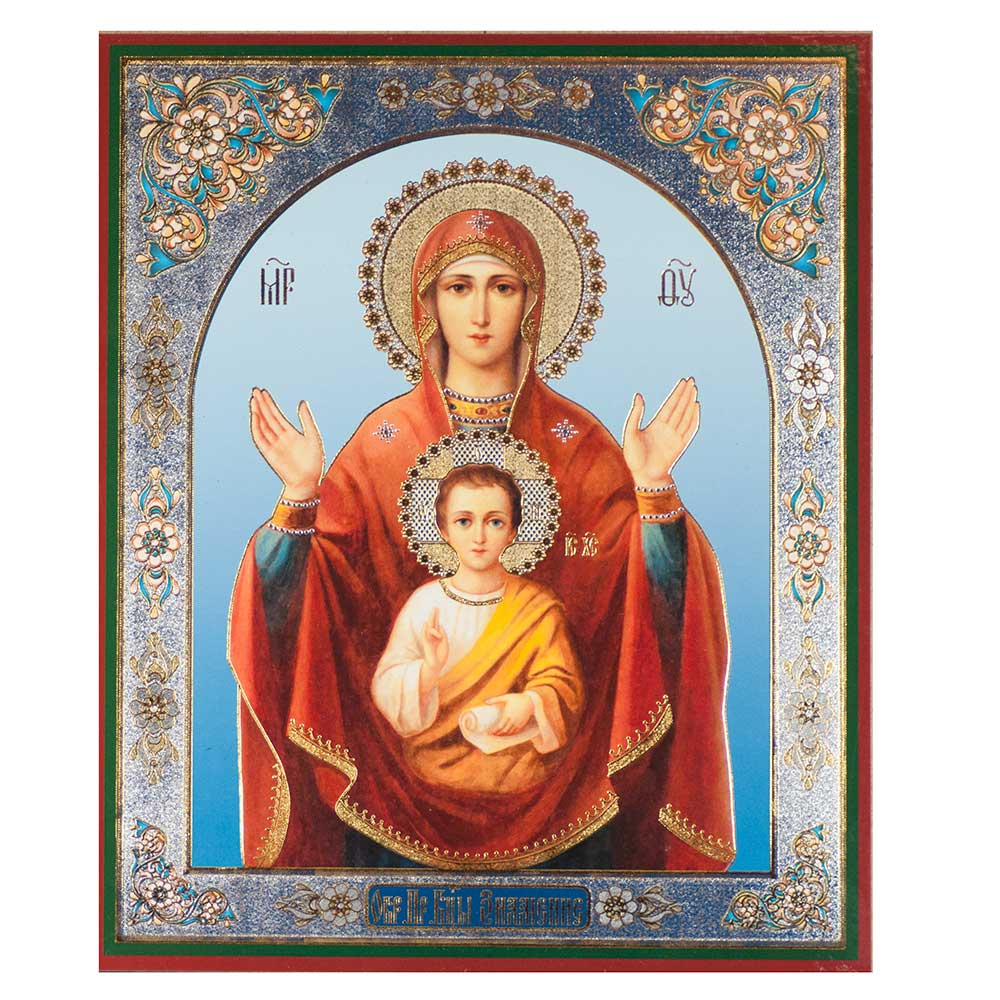
Reasons to Love Mary: Christ in You, the Hope of Glory

Marian Devotion is Christocentric
It is an unfortunate thing that some object to Marian piety based on an imagined opposition between Marian Devotion on the one hand and “Christ-centered” devotion on the other. This is a false dichotomy. Any true devotion to Mary results in greater devotion to Jesus Christ. As we argued in the first post in this series, devotion to Mary means union with Christ. Any man who claims he is devoted to Mary and is not more devoted to Christ as a result is not in fact devoted to Mary.
Jesus Christ has become incarnate. He could have appeared as an adult with no human mother, but He chose to make Mary the agent of his Incarnation. Mary shows us Christ in a way that Christ Himself does not show us: the perfection of a soul by Jesus Christ. All of the glories of Mary—her Immaculate Conception and sinless life, her Glorious Assumption, Coronation and power as Mediatrix—all these are nothing else than the dictum of the Blessed Apostle: Christ in you, the hope of glory (Col. i. 27).[1] Mary is the perfect manifestation of partaking in the divine nature (II Pet. i. 4).
Therefore devotion to the divine person of our Lord is devotion to Jesus Christ according to His person. Devotion to Mary is devotion to Jesus Christ according to His power. This mystery is particularly shown when the voice of Mary herself causes St. John to leap for joy (Lk. i. 44). Shall we accuse St. John of not being Christ-centered? God forbid! But in the mystery of Mary, hidden just beneath the surface (as in utero, so also spiritually): Christ in you, the hope of glory.
The Hail Mary is a prayer to Jesus Christ in Mary
The Holy Spirit spoke the first part of the Hail Mary by the mouth of the archangel Gabriel (Lk. i. 28). God announced through Gabriel that, having sanctified her, He intended to unite His Son to her, and through her make Him manifest to the world. This exchange is the same for every Christian soul. Our God sanctifies a soul in Baptism, the soul then comes to know the Lord through a personal union, and Jesus Christ is manifest through holiness of life.
Hail Mary
Full of grace
The Lord is with thee
Blessed art thou among women and blessed is the fruit of thy womb, Jesus
Thus every soul becomes filled with grace (although of a different measure than Mary), the Lord comes to be “with” them, and they become “blessed” to make present Jesus Christ. The reality is the same, but the mode and the measure are different.
Therefore let every man come to Mary, the Mother of Divine Grace and in her, be united to Jesus Christ Incarnate.
St. Augustine speaking to our Blessed Lady says, “You are worthy to be called the mould of God.” Mary is a mould capable of forming people into the image of the God-man. Anyone who is cast into this divine mould is quickly shaped and moulded into Jesus and Jesus into him. At little cost and in a short time he will become Christ-like since he is cast into the very same mould that fashioned a God-man (True Devotion to Mary
, 219).
From my view, the best work on Marian piety is True Devotion to Mary
Timothy S. Flanders
@meaningofcath
This is the Secret to Christian Happiness
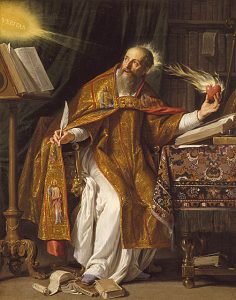
Our Lord Commands us to Suffer in order to follow Him
In the Gospel of St Luke, at the moment when “great multitudes” followed Him, our Lord turned to them and said
If any man come to me, and hate not his father and mother and wife and children and brethren and sisters, yea and his own life also, he cannot be my disciple. And whosoever doth not carry his cross and come after me cannot be my disciple. (Lk. xiv. 26)
Interpreting this passage, St. Gregory says:
We rightly hate our own soul when we indulge not its carnal desires, when we subdue its appetites, and wrestle against its pleasures. (Catena Aurea)
Our parents and relatives—even our own spouse—is here used by our Lord to show examples of our attachments to this earth. Through suffering, we renounce all earthly attachments (a godly hatred) in order to adhere to Jesus Christ alone. As He says in another place He that loveth father or mother more than me, is not worthy of me (Mt. x. 37). Only when we renounce all attachments can we then love others for God’s sake.
So that the heart belongs to Jesus Christ alone
Suffering is caused when we are attached to some convenience, desire or person. This attachment means we are relying on this earthly thing to make us happy. When they inevitably fail, it causes suffering because they are not making us happy. When this happens, most Christians try to soothe their emotions with psychology instead of accepting the cross.
Instead, Christians must understand that suffering is a blessing from God. When the emptiness of creatures is discovered through suffering, our heart’s attachment is loosed, so that we can adhere to Jesus Christ alone. In Him alone is all our happiness, for Jesus Christ is the same yesterday and today and for ever (Heb. xiii. 8). He says Come to me all you that labor and are burdened, and I will refresh you (Mt. xi. 28).
When your attachments cause you suffering, Jesus Christ says come to me. When your desires are not fulfilled, Jesus Christ says I will refresh you. Accept this suffering and give yourself to Jesus Christ alone.
Loving others for the sake of Jesus Christ
If we renounce our attachments and adhere to Jesus Christ alone, we can then truly love others. When we have attachments, we want others to make us happy and do our will. When we renounce these attachments through suffering, we are not seeking happiness in others. Instead, by placing all of our desire in Jesus Christ, we can then love others for the sake of Him, not ourselves.
Try this with your spouse, friend or child. Just for today, renounce all expectation of happiness from them. Detach yourself from every earthly happiness they can give you. Then only love them to please Jesus Christ. You will soon lose interest in what you want, and find yourself focused on what Jesus Christ wants. Then your love for them will become more and more selfless. Then whatever joy they give, you can receive as a gift from God. Then your love can be pure because you will find your true happiness in the Uncreated, not the created. Here is rest for your soul, and true happiness unto eternal life.
For further reading on this topic, I recommend the perennial classic, Imitation of Christ

Timothy S. Flanders
@meaningofcath
Every Bishop must Confess the Declaration and Excommunicate those who Oppose it
 Fact:
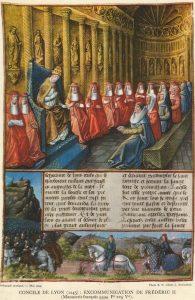
- Every Bishop has jurisdiction over the sacraments in his diocese. That means that he has the power to excommunicate anyone in the world and refuse them communion in his diocese on his own authority. For example, Bishop Briand of Quebec excommunicating American priest John Carroll, or, in our own day, Bishop Poprocki excommunicating pro-abort Catholics. This practice is common throughout the history of the Church.
- In times of crisis in Church history, the bishops have relied on confessions of faith to maintain communion with one another and the Holy See. If a bishop refused to confess the Catholic faith, they were excommunicated by another bishop.
- The Declaration of Truths recently published by several bishops condemns forty of the most prominent errors and heresies currently rampant in the Church.
- Every bishop has the power to call a diocesan synod, proclaim the Declaration of Truths for his diocese, and excommunicate all Catholics who will not profess this confession of faith.
Opinion:
The Declaration of Truths is the way forward for the Church precisely because it utilizes Vatican II and the conciliar Magisterium to condemn every error. By using this method, the hermeneutic of continuity is given definite form so that all Catholics can unite—Conservatives and Traditionalists. Every bishop must call a synod, proclaim the Declaration of Truths, and decree excommunication on every Catholic in the world who will not confess it. A simple formula is the following
If anyone will not confess and believe all forty propositions contained in the Declaration of Truths according to the same sense and same understanding that the Church has always held, let him be anathema.
This action will have two salutary effects. First, it will safeguard a bishop’s own diocese from an imposition of error from the Rhine group who currently controls the Vatican (especially with their Amazon Synod). Second, if a significant number of bishops do this, it will force all Catholics and bishops to reveal themselves either as Catholics or heretics. Eventually an Ecumenical Council or Papal Decree could then rule definitively regarding the Declaration, making it binding upon on the faithful.
At this time, this may only be a small number of bishops. But perhaps as things grow worse, a significant number could make a stand.
This may require the laity to move dioceses or take further action. Nevertheless in a time of crisis, desperate times call for desperate measures. These are the days that test men’s souls. These are the days wherein history will remember all courageous men and all cowardly men. Call your own bishop now and find out if he confesses all forty propositions. Share your own facts and opinions below.
Timothy S. Flanders
@meaningofcath
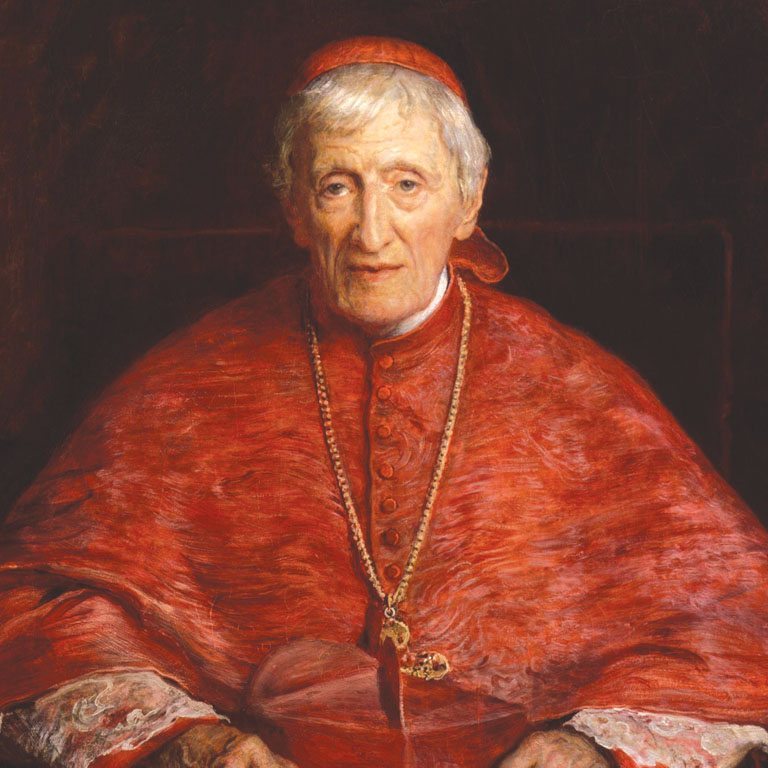
They Will Use Newman to Promote Heresy: We Must Understand True Development
I am beginning a series of forty posts commenting on the historical and theological significance of the Declaration of Truths. From my view, this document holds the key to the way forward and out of this crisis. See my essay here for why I believe that is. Among other things, the Declaration solves the confusion of the conciliar period by confessing forty propositions of faith and morals which address a great many of the errors inflicting souls today.
Against their Foundational Error
The first and foundational truth is the proper understanding of the development of doctrine. This is the foundation because it opposes the Modernists’ own foundation error: evolution of dogma. As St. Pius X says, the “intrinsic evolution of dogmal” is for the Modernists “amongst the chief points of their teaching.” It is
An immense collection of sophisms…that ruins and destroys all religion. [According to them,] Dogma is not only able, but ought to evolve and to be changed (Pascendi, 13)
This error is the contagion of every heretical infestation. Therefore it is the central heresy within Modernism, itself the “synthesis of all heresies.”
Foundational Truth
Therefore the Declaration begins with this proposition:
The right meaning of the expressions ‘living tradition,’ ‘living Magisterium,’ ‘hermeneutic of continuity,’ and ‘development of doctrine’ includes the truth that whatever new insights may be expressed regarding the deposit of faith, nevertheless they cannot be contrary to what the Church has always proposed in the same dogma, in the same sense, and in the same meaning (see First Vatican Council, Dei Filius, sess. 3, c. 4: “in eodem dogmate, eodem sensu, eademque sententia”).
It is worth quoting from the referenced Vatican I document:
If anyone shall assert it to be possible that sometimes, according to the progress of knowledge, a sense is to be given to doctrines propounded by the Church different from that which the Church has understood and understands; let him be anathema.
This particular language is used against the Modernists because from their first appearance in the 19th century until now, they use deceit to spread their errors. They claim to uphold the Catholic faith, yet they change its meaning.
Examples of Contrary Senses
So for example, they say they believe in the Resurrection, but what they mean by that is not that our Lord was physically dead and then rose from the dead. They mean that a Christian has an emotional experience of God and Jesus “rises in his heart.” The two senses are contradictory.
Or again the Church has taught that adultery is always and everywhere sinful, and that it is impossible for an adulterer to be given Holy Communion. And yet, Pope Francis has asserted that not only can adulterers sometimes not be sinning, but they can receive Holy Communion. The two senses are contradictory.
And again, the faith tells us that the state can lawfully put a man to death according the norms of justice, for the sake of the dignity of man. And yet Pope Francis has asserted that not only the death penalty but even long prison terms are contrary to the dignity of man. The two senses are contradictory.
The Vital Phrase
Against the erroneous evolution of Dogma, the Declaration utilizes the crucial phrase “same sense, same understanding” to safeguard a correct notion of Development of Dogma. This phrase was contained in the Oath Against Modernism until the Oath was suppressed by Pope St. Paul VI in 1967. Pope St. John Paul II began a new Oath, the Oath of Fidelity in 1998, but unfortunately it did not include this important phrase.
But what is a proper notion of doctrinal development? Ott (p. 7) makes the distinction between dogma in the material sense and dogma in the formal sense. This utilizes the philosophical distinction between matter and form. Matter is the stuff from which something is made, and form is the way the stuff takes form into a thing. So Dogma In the material sense means the whole of revelation given by the Apostles: the deposit of faith as a whole. Within this deposit is contained every truth from revelation. However, some truths are not apparent, or must be given definite form to be clear and beyond all doubt.
| Material | Formal |
|---|---|
| Deposit of faith | Deposit explained |
| Every truth is implicit | Truth made explicit |
| Disputed questions | Definitive doctrine |
Examples
An example: before Nicea, Christians believed that the Son of God was true God and true Man. This point of doctrine was already contained implicitly in revelation. But when Arianism arose, this point of doctrine was cast into doubt. Therefore the Nicene Council altered the form of the doctrine by taking what was implicit and making it explicit. It introduced the word consubstantial to express the same sense as before with more precise words. Thus the form of the dogma changed, but the matter stayed the same. Therefore the matter of the dogma is always the same sense.
Put another way, let us take for the matter a particular person named Michael. When Michael is a young boy, he is Michael. When Michael is an adult, he is Michael. His form has changed, but his matter—what makes him Michael—stays the same. It is impossible to become a different person.
Thus the Declaration states that new forms cannot create a sense that is contrary to the prior sense. New forms serve only to maintain the matter the same (as in Nicea) or allow the truths to reach their logical end (as in the growth of a person).
For an understanding or true development, it is crucial to study the writings of soon-to-be-Saint John Henry Cardinal Newman. His Essay on the Development of Doctrine can be found online or in print
See also the Resources page for more information.
Timothy S. Flanders
@meaningofcath
Fact/Opinion: The Amazon Synod

Remains of an Arian temple, modern Slovenia
Fact:
- In the 1960s the “Rhine Group”[1] successfully gained control of Vatican II and threw out the original document drafts to craft new ones. On the whole, the documents were perfectly orthodox but on particular points ambiguities remained where the Rhine group had successfully lobbied the Council for vagueness. Their aims in doing this (as revealed in the work of their greatest minds Rahner, Kung, and Schillebeeckx) was to use the ambiguities in Vatican II to promote the Modernist evolution of dogma against the Catholic faith.[2] One of these aims was to abolish celibacy and ordain women.
- Reaching for this ultimate goal, the Rhine group has successfully spread the practices of “female altar boys,” female lectors, and female “Extraordinary Eucharistic Ministers.”
- Their efforts, however, have been obstructed somewhat by the popes, notably St. John Paul II who issued a document defining that every Catholic must definitively hold that women cannot receive holy orders.
- Pope Francis, however, has given great power to the Rhine group and even praised those who openly promote female ordination. Early in his pontificate it became an open secret (fully documented by well-respected, mainstream journalist Edward Pentin)
that the synods are manipulated by the Rhine Group with Pope Francis. The chief author of the Instrumentum Laboris (first draft document) supports female ordination, and his document has been condemned by bishops (and a Cardinal) as “apostasy” and “heresy.” Moreover, it has been publicly admitted by some of the Rhine group that they do intend to ordain married men, then women deacons, then women priests (++Brandmueller confirms this as well). Secret meetings have already been held by the Rhine group ahead of the Amazon Synod.
 that the synods are manipulated by the Rhine Group with Pope Francis. The chief author of the
Opinion: due to the amount of power the Rhine Group holds in the Vatican (and very few bishops oppose them), it is likely their plan for a married priesthood and “unofficial” female orders will succeed. They will ordain married men first, then female “deacons.” Meanwhile, the new Curia constitution will allow women to run dicasteries in the Vatican, which has already begun. After a period of time when women dominate so many forms of leadership, the Rhine group will ask “Why not ordain women?” They will then “ordain” women, but their orders and “sacraments” will be invalid. This strategy has already been executed successfully in the Anglican Church.
As the doctrinal and moral crisis in the Church worsens, Catholics will have much to suffer in the coming years and our Lady, who is witnessing the Passion of the Body of Christ, will see the Death of the Church. Only then will come the Glorious Resurrection. Let every Catholic offer up prayers and sacrifices to petition Almighty God to turn away His just wrath and send us the hoped-for restoration.
Timothy S. Flanders
@meaningofcath
[1]. The “Rhine Group” is so named because it is composed mostly of Bishops and theologians from Germany, France, Belgium, and Denmark with a few exceptions, notably the powerful Italian Cardinal Martini.
[2]. When these aims became clear, a more conservative group led by Ratzinger broke from the Rhine group journal Concilium to form a rival journal entitled Communio, which promoted a more conservative view of the council.