

Summary of Catholic Doctrine with links to the Summa
Please see the sources below.
Duties of your State in Life
A Basic Rule of Life
The Ten Commandments
The Six Precepts of the Church
The Seven Sacraments
The Three Theological Virtues
The Four Cardinal Virtues
The Seven Gifts of the Holy Spirit
The Twelve Fruits of the Holy Spirit
The Seven Spiritual Works of Mercy
The Seven Corporal Works of Mercy
The Eight Beatitudes
The Seven Last Words of Our Lord
The Seven Stages of Sin
Why One Should Sorrow for Sin
Why One Should Go to Confession
The Three Marks of Real Penance
The Seven Penitential Psalms
The Seven Deadly Sins And Contrary Virtues
Ways of Conquering the Seven Deadly Sins
Sins against the Holy Spirit
Sins Crying to Heaven for Vengeance
Nine ways Ways of Being Accessory to Another’s Sin
Three Eminently Good Works
Three Evangelical Counsels
The Four Last Things
Subjects for Daily Meditation
Duties of your state in Life
Duties of the supernatural order: give glory to God by saving your soul; maintain your soul in a state of grace by frequenting the sacraments and fulfilling the six precepts of the Church and the Ten Commandments; overcome sin and grow in virtue; die in a state of grace.
Duties the married:
Mutual duties: mutual love of affection and service; life in common; rendering the marital debt when it is reasonably requested
Husband duties: head and protector of his family to guide his wife and children; duty to provide enough for wife to stay home and children to have proper care; to administer family property wisely.
Wife duties: show due obedience to her husband; to properly care for education of children and the home; holds the right to not be forced to work. She has a right to stay home since the children have a right to their mother full time. Grave cause may force also a mother to work if serious financial or other reasons make it truly necessary.
Children duties: show parents love, reverence, and obedience
Duties at the workplace:
Employer duties: treat employees with kindness; instruct and correct employees; provide for religious observance; pay a just wage to allow a man’s wife to care for the children at home.
Employee duties: due obedience and reverence; faithful service by never stealing employer’s time with personal matters.
A Basic Rule of Life
- To hear Mass on every Sunday and Holy Day of Obligation
- To receive Holy Communion only after careful preparation including fasting, prayer and Confession if necessary
- To make an examination of conscience every day and to go to Confession once a month. Choose one virtue each month to acquire. Repeat as much as necessary. Consider seriously at least every month your approaching death.
- To say one third of the Holy Rosary (five decades) every day
- To fast and abstain on every Friday of the year (excluding Solemnities)
- To begin Lent with a definite written rule
- To give alms to the needy and support my church
- To practice Mental Prayer for 15 minutes each day, particularly on the Passion of our Lord.
- To devote some time each week to reading the Holy Scriptures or learning about the faith
- On hearing the Holy Name of Jesus profaned, to say at least in one’s heart “Blessed be the Name of Jesus” as an act of reparation and intercession
The Ten Commandments
- I am the Lord thy God. Thou shalt not have strange Gods before Me.
- Thou shalt not take the name of the Lord thy God in vain
- Remember that thou keep holy the Sabbath day
- Honor thy father and thy mother
- Thou shalt not kill
- Thou shalt not commit adultery
- Thou shalt not steal
- Thou shalt not bear false witness against thy neighbor
- Thou shalt not covet thy neighbor’s wife
- Thou shalt not covet thy neighbor’s house
The Six Precepts of the Church
- To hear Mass on Sundays and Holy Days of Obligation
- To fast and abstain on the days commanded
- To confess our sins at least once a year
- To receive the Blessed Sacrament at Easter or within the time appointed
- To contribute to the support of our Pastors
- Not to solemnize marriage at the forbidden times; nor to marry persons within the forbidden degrees of kindreds, or otherwise prohibited by the Church, nor secretly
The Seven Sacraments
- Baptism
- Confirmation
- Holy Eucharist
- Confession (Reconciliation)
- Extreme Unction (Anointing of the Sick)
- Holy Orders
- Matrimony
The Three Theological Virtues
The Four Cardinal Virtues
The Seven Gifts of the Holy Spirit
The Twelve Fruits of the Holy Spirit
- Charity
- Joy
- Peace
- Patience
- Longanimity
- Goodness
- Benignity
- Mildness
- Fidelity
- Modesty
- Continence
- Chastity
The Seven Spiritual Works of Mercy
- To give counsel to the doubtful
- To instruct the ignorant
- To admonish sinners
- To comfort the afflicted
- To forgive offenses
- To bear patiently the troublesome
- To pray for the living and the dead
The Seven Corporal Works of Mercy
- To feed the hungry
- To give drink to the thirsty
- To clothe the naked
- To shelter the needy
- To visit the sick
- To visit the imprisoned
- To bury the dead
The Eight Beatitudes
- Blessed are the poor in spirit; for theirs is the kingdom of heaven
- Blessed are the meek; for they shall possess the land
- Blessed are they that mourn; for they shall comforted
- Blessed are they that hunger and thirst for justice; for they shall be filled
- Blessed are the merciful; for they shall obtain mercy
- Blessed are the clean of heart; for they shall see God
- Blessed are the peacemakers; for they shall be called the children of God
- Blessed are they that suffer persecution for justice’ sake; for theirs is the kingdom of heaven
The Seven Last Words of Our Lord
- Father, forgive them, for they know not what they do.
- Amen, I say to thee, this day thou shalt be with Me in paradise.
- Woman, Behold thy Son; behold, thy Mother.
- My God, My God, why hast Thou forsaken Me?
- I thirst.
- It is finished.
- Father, into Thy hands I commend my spirit.
The Seven Stages of Sin
- Suggestion
- Pleasure
- Consent
- Act
- Habit
- Slavery
- Spiritual Blindness
Why One Should Sorrow for Sin
- Because sin grieves and offends God
- Because sin is yielding to the Evil One
- Because sin brought the fall of man
- Because sin brought sorrow and suffering
- Because sin caused the Death of Christ
- Because sin separates us from God
- Because sin crucifies Jesus Christ afresh
- Because sin resists the Holy Spirit
- Because sin ruins our character
- Because sin deadens our conscience
- Because sin prevents the working of Grace
- Because sin imperils our immortal souls
- Because “the wages of sin is death.”
Why One Should Go to Confession
- It shows sorrow for sin
- It expresses the need for God’s Grace
- It strengthens the will and enlightens the mind
- It increases the beauty of holiness
- It brings peace to the mind and soul
- It keeps from presumption and pride
- It seeks pardon in God’s appointed way
- It releases from the eternal punishment
- It reduces temporal punishment
- It cleanses in the Blood of Jesus Christ
- It restores to a state of Grace
- It fits the soul for death and judgment
- It show Faith, Hope, and Charity
- It marks the Cross in our lives
- It leaves nothing undone to ensure pardon
Three Marks of Real Penance
- In the Heart – Contrition
- In the Mouth – Confession
- In the Life – Amendment
The Seven Penitential Psalms
- Ps. vi. Domine, ne in furore
- Ps. xxxi. Beati, quorum
- Ps. xxxvii. Domine, ne in furore
- Ps. l. Miserere mei, Deus
- Ps. ci. Domine, exaudi
- Ps. cxxix. De profundis
- Ps. cxlii. Domine, exaudi
The Seven Deadly Sins and Contrary Virtues
- Pride……………….Humility
- Covetousness…..Liberality
- Lust…………………Chastity
- Wrath………………Meekness
- Gluttony…………..Temperance
- Envy………………..Brotherly love
- Sloth……………….Diligence
Ways of Conquering the Seven Deadly Sins
In General: Prayer, fasting and alms; practice of self-denial, detachment and recollection in God’s presence.
Pride: Cultivation of simplicity; seeking meekness and humility of heart; meditations upon the life of Our Lord
Anger: Practicing self-control; silence before speaking; signing the Cross; recognizing the possibly of acts of violence; praying for others or self; rendering good for evil; kindness, patience, forbearance, forgiveness.
Envy: Cultivating charity, magnanimity, rejoicing in the joy or success of others.
Covetousness: Caring little for earthy things; never hoarding; being generous to man grateful to God, giving liberally to the Church and all good works; sharing with others.
Gluttony: Ruling our desires; being temperate and moderate; fasting; avoiding excess; taking less than desired.
Lust: Cultivating purity in thought, word, and deed; refusing to look at, speak or think of suggestive things; avoiding sources of temptation including movies, music or the internet; regular habits; exercise; prayer; fasting; flight in special bodily temptations; recognizing the awful consequences of lust.
Sloth: Living by Rule; being with useful or profitable employment; doing our duties conscientiously to the best of our ability as in the sight of God, for God’s glory; taking proper rest or recreation, but resisting idleness or laziness; singing spiritual hymns or psalms while we work.
Sins Against the Holy Spirit
- Presumption upon God’s mercy
- Despair
- Impugning the known truth
- Envy of another’s spiritual good
- Obstinacy in sin
- Final Impenitence
Sins Crying to Heaven for Vengeance
- Willful murder
- The sin of Sodom
- Oppression of the poor
- Defrauding laborers of their wages
Nine Ways of Being Accessory to Another’s Sin
- By counsel
- By command
- By consent
- By provocation
- By praise or flattery
- By concealment
- By partaking
- By silence
- By defense of the ill done
Three Eminently Good Works
Three Evangelical Counsels
- Poverty
- Chastity
- Obedience
The Four Last Things
Subjects for Daily Meditation
Remember, O Christian Soul, that thou hast this day and every day of thy life:
God to glorify
Jesus to Imitate
The Angels and Saints to Invoke
A soul to save
A body to mortify
Sins to expiate
Virtues to acquire
Hell to avoid
Heaven to gain
Eternity to prepare for
Time to profit by
Neighbors to edify
The world to despise
Devils to combat
Passions to subdue
Death perhaps to suffer
And judgment to undergo
[1] These lists are taken from the 1962 Roman Daily Missal published by Angelus Press as well as the Saint Ambrose Prayer Book published by Lancelot Andrews Press, 1st Ed. V. Rev. Fr. J. Guy Winfrey, editor. The Duties of State in Life are taken from Prummer, nos. 461ff as well as Fr. Chad Ripperger.
The Greek Schism is a result of rejecting the Latin Fathers

- The Latin Church, centered at Rome, gradually lost Greek due to historical reasons. However, the Greek and Latin Fathers were always understood to be of equal authority. We see this in St. Thomas, whose Catena Aurea quotes freely from all Fathers Greek and Latin. (Because of this assumption, the Latin Church eventually regained Greek).
- Thus in the west it was thought that, whatever differences existed between the Fathers, not only can they be reconciled, but whatever they agree upon is infallible. “No one in matters of faith and of morals may interpret the sacred Scripture contrary to the unanimous consent of the Fathers” (Trent, Decree Concerning the Use of Sacred Books). “Fathers” was assumed to mean both Latin and Greek.
- In particular, this assumption of equality is shown in the decree of Florence, which acknowledges that the Greek and Latin Fathers used different terms for the Procession of the All-Holy Spirit, but dogmatically defined that they meant the same thing (Denz. 691).
- The Seven Ecumenical Councils, all of them in Greek, were always received in the west, but according to the Latin Fathers, since all actions of the Councils needed to be translated into Latin. This is seen in the three interpolations into the Latin Nicene Creed, understood in the context of the three Latin creeds.
- Those among the Greeks, however, who adhered to schism with Rome (contrasted with the more irenic among them, who followed St. Maximos), began, starting with Photios, to regard the Latin Fathers to be of lesser authority than the Greek. Thus the alleged “heresies” of Rome – the Papacy, the Filioque, the Saturday Fast, no beards, the Azymes, Purgatory – are often actually a rejection of the Latin Fathers, whose writings are the proofs for all of these “heresies.” These excesses became acute in particular when the Greek political power was under threat from Rome.
- It is true that at times throughout history, Latins did disparage Greek practices that were in fact based on the Greek Fathers, but this never gained official sanction. Despite the awful trends of Latinizations, Roman dogmatic theology always assumed the equality of all Fathers.
- Insofar as a Greek adheres to the errors of Photios – that the Latin Fathers are of lesser authority – he adheres to schism with the consensus of the Fathers. Insofar as any Greek confesses the equal authority of the Latin Fathers, he is on his way to communion with Rome.
- Thus the term “Greek Schism” is employed to describe the historical cause of the schism from a doctrinal perspective – it is the Greeks who must come back to a consensus of the Fathers and confess that the Latin and Greek are of equal weight.
Reasons to love Mary: the Fourth Commandment

The Blessed Apostle declares to the Galatians: as many of you as have been baptized in Christ, have put on Christ (Gal. iii. 27). The word for “put on” is ἐνδύω which means to sink into clothing. In another place the Apostle, in his passage concerning Matrimony, states concerning Christ that we are members of his body, of his flesh, and of his bones (Eph. v. 30). These mysterious sayings of the Apostle have been understood by the Church from the earliest times to express the total union with Christ through the Sacraments. The term “total” is applied here to contrast a partial union, which takes place in only part of you – for instance, your “heart” or “mind” or “soul” only. The difference with total union is that it is a union with Christ which unites all of you with all of Him. In particular, the contrast becomes acute when we consider that our very bodies are also united to Him in the Sacraments, and not just our souls.
And so in Baptism we put on Christ in a way that changes our spiritual and bodily reality. Thus St. Paul considers the fruit of this union to transcend the bodily realities of race, state, and gender (v. 28). Thus the bodily union with Christ in the Sacraments is a physical union which is actually physical and yet is more real than our physical reality we see.*
It is thus that we must begin our discussion about Marian devotion, because Marian devotion takes for its efficient cause true union with Christ.[1] Marian devotion is a direct result of true union with Christ, and therefore lack of Marian devotion may be a result of lack of union with Christ.
We begin with this presupposition of a sacramental nature merely to satisfy our brethren (perhaps who are separated) to whom love of Mary does not come easily. For most Christians throughout history, loving Mary is a purely natural, freely flowing devotion to our Mother than any child would have. It is an offense against God that Marian devotion has been openly attacked especially over the past five hundred years.
For if union with Christ forms the efficient cause of Marian devotion, we may identify another efficient cause from the perspective of the commandments of God: the Fourth Commandment. For if we are truly united to Christ in a way that is physical yet is more real than our normal physical world, we are truly in Christ to the point that God is our Father and Mary is our Mother – just as is true for our Lord. As it is written he saith to the disciple: Behold thy mother. And from that hour, the disciple took her to his own (Jn. xix. 27) and again The dragon was angry against the woman: and went to make war with the rest of her seed, who keep the commandments of God, and have the testimony of Jesus Christ (Apoc. xii. 17). In this we see that Christians are called the seed of Mary in the same way as Christ is the seed of Mary and the Holy Ghost. Thus if we are truly united to Christ we must have Mary as our Mother. Otherwise, our union with Christ is not real.
Thus we have God our Father and Mary our Mother. In laying down the Ten Commandments, our God reserved the first three for Himself: no other Gods, the hallowing of His Name, and the keeping of His Holy day. The first commandment which is justice to man is the virtue of piety contained in the fourth commandment: honor thy father and thy mother.[2] This is re-affirmed emphatically by the Law of Moses in the additional judicial precept He that curseth his father, or mother, shall die the death (Ex. xxii. 17). The justice of this penalty is re-affirmed by our Lord in Mark vii. 10 in his disputing with the Pharisees. This shows the importance of the Fourth Commandment and how serious an offense to God it is to break it.
Thus if Mary is our mother in a way that is more real even than normal physical reality, then she is our mother in a way greater even than our biological mother. And if God commanded us to honor our earthly mother, how much more our true, heavenly Mother Mary? Therefore whoever refrains from honoring Mary as our Mother sins and confesses that he does not have true union with Christ. His union with Christ can only be within his mind, or his affections, but not truly in his soul, his person and his life.
(I say this with respect to our separated heretic brethren, the Protestants – I have been a Protestant for most of life (at the time of this writing). But when I consider the union with Christ that I did have when I was a Protestant with that which I have in the Sacraments and manifested in Mary, it is simply like night and day. And any Protestant convert can attest to this.)
Therefore because of our true union with Christ and because of the commandment, let every man honor, love and cherish our mother Mary, our Lady and our Queen. The following is taken from the Eastern Catholic service of Compline:
O All-Holy Lady, Mother of God, Spotless, Blameless, Pure and Immaculate, who by thy wondrous birth-giving hast united the God the Word to man and joined the outcast nature of our race to heavenly things. Who alone art the hope of the hopeless, the succor of the embattled, the ready help of them that flee unto thee and the refuge of all Christians. Abhor me not, the sinner, the accursed one, who have altogether rendered myself unworthy by shameful thoughts words and deeds and through indolence have become a slave to the pleasures of the life. But as the mother of the man-befriending God, mercifully have compassion upon me, and receive my supplication though it be offered on unclean lips, and using thy boldness as a mother, importune thy son our Lord and Master, that He may open even to me the tender compassion of His goodness, so as to overlook mine innumerable trespasses and turn me to repentance and show me forth as a zealous doer of his commandments. And be thou ever with me as thou art merciful and compassionate and the lover of good, to defend me against the assaults of the adversaries and lead me to salvation. And at the hour of my death to care for my wretched soul and drive far away from it the dark countenances of evil demons. And in the terrible day of judgment, to deliver me from eternal torment and show me forth as an heir of the unspeakable glory of thy Son and our God. May this be my lot, O my Lady, Most Holy Mother of God, through thy mediation and help, through grace and love toward mankind of thine only begotten Son, our Lord and God and Savior Jesus Christ, to Whom is due all glory honor and worship, with His Unoriginate Father and His All-Holy, Good, and Life-Creating Spirit, now and ever and unto ages of ages.
Timothy S. Flanders
@meaningofcath

*Nevertheless we note here that this union does not destroy the physical realities of the natural order of race, state, or gender, but rather gives them their meaning in reality. This regrettably must be said in order to contrast the insane excesses of the modern Communists in denying the reality of biological gender.
[1]Efficient cause is the philosophical term meaning that thing by which something is made.
[2]”Justice” is the virtue in which a man gives to every one his due (II-II q57 a1), and piety is the virtue by which we especially give to our parents and other lawful authority their due (II-II q101).
The New Declaration is the Perfect Document to unite the Church in a time of crisis
One Peter Five has published my article regarding the New Declaration. This is a momentous moment which we must seize upon. I encourage every Catholic to read this document and ask your own bishop to confirm it.
Fact and Opinion: The Current Baltimore Bishops Meeting
 Alleged: in 1978, Cdl. Gagnon gave to Pope St. Paul VI the fruit of his publicized investigation of the curia, documenting widespread moral and financial corruption. This dossier was committed to John Paul I, and then to St. John Paul II. No concrete action was taken.[1]
Facts: in 2012, Benedict XVI was given the fruit of his own curial investigation: a 300 page dossier detailing widespread moral and financial corruption. Benedict resigned and presumably committed this dossier to his successor. Pope Francis has taken no noticeable action on this. In 2018, McCarrick was exposed as a serial predator, and credible allegations (Vigano) tied this directly to Pope Francis and St. John Paul II.[2] The Pennsylvania Grand Jury report documented massive moral and financial corruption. Later documents have proven Vigano’s allegations including the lying of Cdl. Donald Wuerl, whose friend, Bp. Wilton Gregory has succeeded him in Washington DC. Pope Francis has not released any investigation on McCarrick but issued a Motu Proprio stipulating that the bishops will investigate themselves.
Opinion: Until all dossiers of corruption are released – both the 2012 and the 1978 if it exists – it is difficult to reasonably trust the bishops nor the Vatican. Every bishop must confess the Declaration and must then put this into practice by excommunicating all heretical preachers and pro-abort Catholics, as His Excellency Poprocki has done. Only after this is done can the faithful reasonably trust bishops.
[1]This is attested by the eyewitness account given in the book The Godmother, (reported about in Crisis) and also reported at Catholic Exchange, but I have not been able to find better sources about this investigation and this dossier.
[2]The victim of McCarrick, James Grein, told Dr. Taylor Marshall in an interview that he told St. John Paul II everything about McCarrick in person in 1987. See both of these interviews here and here.
My Short Apologia against the Greek Schism

One Peter Five has been gracious enough to publish my short apologia against the Greek Schism. I will have a follow up essay which will be longer to expand on many of the issues presented here.
In Christ,
Timothy S. Flanders
Who are the “Enemies of Holy Church?”
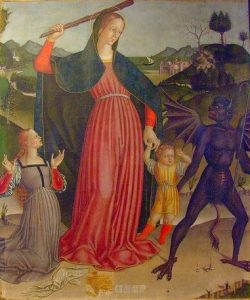
The Church has enemies
At Easter every Eastern Catholic hears the chant from the words of the Prophet: Let God arise, and let his enemies be scattered: and let them that hate him flee from before his face (Ps. lxvii. 2). Moses writes that this was also chanted by the Israelites when they set out from the camp (Num. x. 35).
The Litany of the Saints includes this petition: “That Thou wouldst humble the enemies of Thy holy Church, We beseech Thee, hear us.” And again in the prayer after Holy Communion by St. Thomas the Christian prays that the Sacred Mysteries may be “my strong defense against all my enemies, visible and invisible.”
So what is clear from this is one thing: the Church has enemies. The official prayerbook of the Church—the Holy Psalter—is replete with violent images of enemies and warfare. As the Prophet declares: Blessed be the Lord my God, who teacheth my hands to fight, and my fingers to war (Ps. cxliii. 1) and again I shall beat them as small as the dust before the wind; I shall bring them to nought, like the dirt in the streets (Ps. xvii. 43). Thus not only does the Church have enemies, but in her prayer she fights against them manfully with great violence. So who are these enemies?
That these enemies are the world, the flesh and the devil
In the Roman Catechism, in the section on the parts of the Church, we are told that those who are still breathing members of the Church form the part known as the “Church militant.”
It is called militant, because it wages eternal war with those implacable enemies, the world, the flesh and the devil.
These three enemies are the source of all temptations. These are the three enemies defeated by our Lord in his own temptation, and these three enemies are renounced in our baptism. St. Thomas explains these three enemies in his section on Our Lord’s temptation:
For at first [Satan] tempted Him to that which men desire, however spiritual they may be—namely, the support of the corporeal nature by food [the flesh].
Secondly, he advanced to that matter in which spiritual men are sometimes found wanting, inasmuch as they do certain things for show, which pertains to vainglory [the world].
Thirdly, he led the temptation on to that in which no spiritual men, but only carnal men, have a part—namely, to desire worldly riches and fame, to the extent of holding God in contempt [the devil]. (III q41 a4)
These sources are all connected, but we can summarize them like this:
- The world – temptation from outside a man (at the natural level)
- The flesh – temptation from inside a man (from his own nature laboring under Original Sin)
- The Devil – temptation from outside a man (at the preternatural level)
Each of these manifests themselves in a particular way against each individual and each society. In the future we will treat our current enemies in more detail.
Now Dom. Scupoli says that the foundation of the spiritual life is distrust of self and trust in God (Spiritual Combat, ch. I). This is because only God is totally above nature and by supernatural grace can give power to man to overcome his enemies. He delivered me from my strongest enemies, and from them that hated me: for they were too strong for me (Ps. xvii. 18).
That our weapons in this combat are prayer, fasting and alms
It is a De Fide dogma of the Church that we can merit nothing for our salvation without God’s power through supernatural grace (Ott, 246ff). Grace present in the Sacraments and the Gifts of the Holy Spirit are the ordinary source of God’s supernatural power. In Confirmation – the Sacrament of the Holy Spirit – a man receives full initiation as a Christian warrior:
By Confirmation we are armed and arrayed as soldiers of Christ, publicly to profess and defend His name, to fight against our internal enemy and against the spiritual powers of wickedness in the high places (Introduction to Sacraments).
When grace is operative within us, we have power to use the weapons of a Christian to overcome our enemies and truly merit our salvation. The weapons of every Christian are the Three Eminent Good works: prayer, fasting, almsgiving.
Each weapon is specifically aimed at each enemy, but taken generally they include all good works.
-
Alms are against the world. This can be defined as performing good works for your neighbor, particularly in giving material aid to the poor. Instead of allowing the world to pressure you to sin, good works call the world to convert to Christ. Let your light shine before men, that they may see your good works, and glorify your Father who is in heaven (Mt. v. 16).
-
Fasting is against the flesh. It may be defined as denying the inclinations of our disordered desires, particularly by limiting food. Instead of allowing the flesh to pressure you, fasting calls the flesh to submit to Christ. I beat my body and bring it into subjection: lest perhaps, when I have preached to others, I myself should become a castaway (I Cor. ix. 27).
-
Prayer is against the Devil. It is defined as lifting the mind and heart to God, particularly during private prayer. Instead of allowing the Devil to pressure your mind and heart, you call your mind and heart to Christ. For thee my flesh and my heart hath fainted away: thou art the God of my heart, and the God that is my portion for ever (Ps. lxxii. 26).
The purpose of this site is to unite Catholics against the enemies of Holy Church. Therefore let every man go to God for his power and his weapons. Let every soul fight manfully against these enemies, and the gates of hell will not be able to withstand us. All nations compassed me about; but in the name of the Lord I will destroy them (Ps. cxvii. 10).
Litany of the Saints (ancient version)
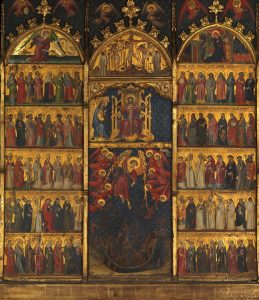
The Litany of the Saints is a very ancient Christian prayer in which the Church militant calls upon the Church triumphant for help for themselves and the Church suffering. This prayer is of particular use as our fathers enduring all forms of suffering to bring to us the saving faith we now enjoy. Traditionally this prayer is prayed during a penitential procession on the Greater Rogation Day (April 25) as well as the Lesser Rogation Days (the Monday through Wednesday before Ascension Thursday). This ancient practice has been suppressed in the modern reform and the Litany of Saints, to my knowledge, is only prayed at the Easter Vigil and at an Ordination. Unfortunately, like the other prayers of the Holy Mass, much of this prayer was further edited in the modern reform. For example the petition “against the enemies of Holy Church” is specifically mentioned by Pope St. Paul VI’s translation document Comme le prevoit 24 as being “contrary to Modern Christian ideas.” Thus it was removed as well as the petition to be delivered from the wrath of God, the petition to convert the nations and schismatics and the petition against “the spirit of fornication.” However, the petition to be delivered “from everlasting death” has been retained in the modern version. I have not found an online source which prints the entire prayer so I have printed it here. The translation below is taken from the Daily Roman Missal 1962 by Angelus Press.
Lord, have mercy on us.
Christ have mercy on us.
Lord, have mercy on us.
Christ, hear us,
Christ, graciously hear us.
God, the Father of heaven, have mercy on us.
God the Son, Redeemer of the world, have mercy on us.
God, the Holy Spirit, have mercy on us.
Holy Trinity, One God, have mercy on us.
Holy Mary, Pray for us.
Holy Mother of God, Pray for us.
Holy Virgin of virgins, Pray for us.
Saint Michael, Pray for us.
Saint Gabriel, Pray for us.
Saint Raphael, Pray for us.
All ye holy angels and archangels, Pray for us.
All ye holy orders of blessed spirits, Pray for us.
Saint John the Baptist, Pray for us.
Saint Joseph, Pray for us.
All ye holy patriarchs and prophets. Pray for us.
Saint Peter, Pray for us.
Saint Paul, Pray for us.
Saint Andrew, Pray for us.
Saint James, Pray for us.
Saint John, Pray for us.
Saint Thomas, Pray for us.
Saint James, Pray for us.
Saint Philip, Pray for us.
Saint Bartholomew. Pray for us.
Saint Matthew, Pray for us.
Saint Simon, Pray for us.
Saint Thaddeus, Pray for us.
Saint Matthias, Pray for us.
Saint Barnabas, Pray for us.
Saint Luke, Pray for us.
Saint Mark, Pray for us.
All ye holy apostles and evangelists, Pray for us.
All ye holy disciples of our Lord. Pray for us.
All ye holy Innocents, Pray for us.
Saint Stephen, Pray for us.
Saint Lawrence, Pray for us.
Saint Vincent, Pray for us.
Saints Fabian and Sebastian, Pray for us.
Saints John and Paul, Pray for us.
Saints Cosmas and Damian, Pray for us.
Saints Gervase and Protase, Pray for us.
All ye holy martyrs, Pray for us.
Saint Sylvester, Pray for us.
Saint Gregory, Pray for us.
Saint Ambrose, Pray for us.
Saint Augustine. Pray for us.
Saint Jerome, Pray for us.
Saint Martin, Pray for us.
Saint Nicholas, Pray for us.
All ye holy bishops and confessors, Pray for us.
All ye holy doctors, Pray for us.
Saint Anthony, Pray for us.
Saint Benedict, Pray for us.
Saint Bernard, Pray for us.
Saint Dominic, Pray for us.
Saint Francis, Pray for us.
All ye holy priests and levites, Pray for us.
All ye holy monks and hermits. Pray for us.
Saint Mary Magdalen, Pray for us.
Saint Agatha, Pray for us.
Saint Lucy, Pray for us.
Saint Agnes, Pray for us.
Saint Cecilia, Pray for us.
Saint Catherine, Pray for us.
Saint Anastasia, Pray for us.
All ye holy virgins and widows, Pray for us.
All ye holy men and women, Saints of God, Make intercession for us.
Be merciful, Spare us, O Lord.
Be merciful, Graciously hear us, O Lord.
From all evil, O Lord, deliver us.
From all sin, O Lord, deliver us.
From Thy wrath, O Lord, deliver us.
From a sudden and unprovided death, O Lord, deliver us.
From the snares of the devil, O Lord, deliver us.
From anger, and hatred, and all ill will, O Lord, deliver us.
From the spirit of fornication, O Lord, deliver us.
From lightning and tempest, O Lord, deliver us.
From the scourge of earthquake. O Lord, deliver us.
From pestilence, famine and war, O Lord, deliver us.
From everlasting death, O Lord, deliver us.
Through the mystery of Thy holy Incarnation, O Lord, deliver us.
Through Thine advent, O Lord, deliver us.
Through Thy nativity, O Lord, deliver us.
Through Thy baptism and holy fasting, O Lord, deliver us.
Through Thy Cross and Passion, O Lord, deliver us.
Through Thy death and burial, O Lord, deliver us.
Through Thy holy Resurrection, O Lord, deliver us.
Through Thine admirable Ascension, O Lord, deliver us.
Through the coming of the Holy Spirit the Paraclete, O Lord, deliver us.
In the day of judgment, O Lord, deliver us.
We sinners, We beseech Thee, hear us,
That Thou wouldst spare us, We beseech Thee, hear us.
That Thou wouldst pardon us, We beseech Thee, hear us.
That Thou wouldst bring us to true penance, We beseech Thee, hear us.
That Thou wouldst govern and preserve Thy holy Church, We beseech Thee, hear us.
That Thou wouldst preserve our Apostolic Prelate, and all ecclesiastical orders in holy religion, We beseech Thee, hear us,
That Thou wouldst humble the enemies of Thy holy Church, We beseech Thee, hear us.
That Thou wouldst give peace and true concord to Christian kings and princes, We beseech Thee, hear us.
That Thou wouldst grant peace and unity to all Christian people, We beseech Thee, hear us.
That Thou wouldst bring back to the unity of the Church all those who have strayed away, and lead to the light of the Gospel all unbelievers, We beseech Thee, hear us.
That Thou wouldst confirm and preserve us in Thy holy service, We beseech Thee, hear us.
That Thou wouldst lift up our minds to heavenly desires, We beseech Thee, hear us.
That Thou wouldst render eternal blessings to all our benefactors, We beseech Thee, hear us.
That Thou wouldst deliver our souls, and the souls of our brethren, relations and benefactors, from eternal damnation, We beseech Thee, hear us.
That Thou wouldst give and preserve the fruit of the earth, We beseech Thee, hear us.
That Thou wouldst give eternal rest to all the faithful departed, We beseech Thee, hear us.
That Thou wouldst graciously hear us We beseech Thee, hear us.
Son of God, We beseech Thee, hear us.
Lamb of God, Who takest away the sins of the world, Spare us, O Lord.
Lamb of God, Who takest away the sins of the world, Graciously hear us, O Lord.
Lamb of God, Who takest away the sins of the world, have mercy on us.
Christ hear us.
Christ, graciously hear us.
Lord, have mercy on us.
Christ, have mercy on us.
Lord, have mercy on us.
Our Father.. (silently to…) And lead us not into temptation, But deliver us from evil. Amen.
[Ps. cxix]
O God, come to my assistance; O Lord, make haste to help me.
Let them be confounded and ashamed that seek my soul:
Let them be turned backward, and blush for shame that desire evils to me: Let them be presently turned away blushing for shame that say to me: ’Tis well, ’tis well.
Let all that seek thee rejoice and be glad in thee; and let such as love thy salvation say always: The Lord be magnified.
But I am needy and poor; O God, help me. Thou art my helper and my deliverer: O Lord, make no delay.
Glory be. As it was.
V. Save Thy servants.
R. Who hope in Thee, O my God.
V. Be unto us, O Lord, a tower of strength.
R. From the face of the enemy.
V. Let not the enemy prevail against us.
R. Nor the son of wickedness have power to hurt us.
V. O Lord, deal not with us according to our sins.
R. Neither requite us according to our iniquities.
V. Let us pray for our Sovereign Pontiff N.
R. The Lord preserve him, and give him life, and make him blessed upon the earth, and deliver him not up to the will of his enemies.
V. Let us pray for our benefactors.
R. Vouchsafe, O Lord, for Thy name’s sake, to reward with eternal life all those who do us good. Amen.
V. Let us pray for the faithful departed.
R. Eternal rest grant unto them, O Lord, and let light perpetual shine upon them.
V. May they rest in peace.
R. Amen.
V. For our absent brethren.
R. Save Thy servants, who hope in Thee, O my God.
V. Send them help, O Lord, from the holy place.
R. And out of Sion protect them.
V. O Lord, hear my prayer
R. And let my cry come unto Thee
V. The Lord be with you
R. And with thy spirit
Let us pray —O God, Whose property is always to have mercy and to spare, receive our humble petition: that we, and all Thy servants who are bound by the chain of sin, may by the compassion of Thy goodness be mercifully absolved.
Graciously hear, we beseech Thee, O Lord, the prayer of Thy suppliants, and forgive the sins of those that confess to Thee: that, in Thy bounty, Thou mayest grant us pardon and peace.
In Thy clemency, O Lord, show Thine unspeakable mercy to us: that Thou mayest both loose us from all our sins, and deliver us from the punishments which we deserve for them.
O God, Who by sin art offended, and by penance appeased, mercifully regard the prayers of Thy people making supplication to Thee, and turn away the scourges of Thine anger, which we deserve for our sins.
Almighty, everlasting God, have mercy upon Thy servant N., our Sovereign Pontiff, and direct him according to Thy clemency into the way of everlasting salvation, that by Thy grace he may both desire those things that are pleasing to Thee, and perform them with all his strength.
O God, from Whom are all holy desires, right counsels, and just works, give unto Thy servants that peace which the world cannot give; that both our hearts, given over to Thy commands, and our times, the fear of our foes removed, may by Thy protection be peaceful.
Inflame, O Lord, our reins and hearts with the fire of the Holy Ghost: that we may serve Thee with a chaste body and please Thee with a clean heart.
O God, the Creator and Redeemer of all the faithful, grant to the souls of Thy servants departed the remission of all their sins: that through pious supplications they may obtain that pardon which they have always desired.
Go before, we beseech Thee, O Lord, our actions by Thine inspirations and further them by Thine assistance; that every word and work of ours may begin always from Thee and by Thee be likewise ended.
Almighty, everlasting God, Who hast dominion over the living and the dead and art merciful to all, of whom Thou foreknowest that they will be Thine by faith and good works: we humbly beseech Thee, that they for whom we intend to pour forth our prayers, whether this present world still detain them in the flesh, or the world to come hath already received them out of their bodies, may, through the intercession of all Thy Saints, by the clemency of Thy goodness, obtain the remission of all their sins. Through our Lord Jesus Christ, who with Thee in the unity of the Holy Ghost, liveth and reigneth God, world without end.
R. Amen.
V. The Lord be with you.
R. And with thy spirit.
V. May the almighty and merciful Lord graciously hear us.
R. Amen.
V. And may the souls of the faithful departed, through the mercy of God, rest in peace.
R. Amen.
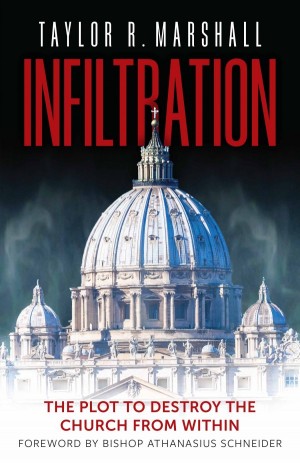
Book Review: Infiltration by Taylor Marshall
See my full review at Amazon here. Do yourself a favor and read this book. It is very readable and has lots of information to consider in the current debate about the crisis. See my timeline for more information. I address critics of this work here. Every reasonable Catholic can disagree with various points of this work, but what we cannot do is dismiss it without evidence. All we need to do is face up to the evidence, and discuss this reasonably.

Five things to get you through the crisis in the Catholic Church

By Timothy S. Flanders
This article is also available in French.
You may be struggling in this crisis. You may be scandalized by the evil priests, or by the Holy Father himself. You may just be asking the question: what do we do? (Acts. ii. 37). Here are five things to do to get you through.
I. Take up your cross manfully like a saint
This is not the Church’s first crisis. We have been through many wars, bloodshed, plagues, evil popes, evil priests, Catholic armies waging war on Catholic armies, Muhammadan invasion, Viking invasions, Roman, British, Nazi, Communist extermination campaigns and more: But in all these things we overcome, because of him that hath loved us (Rom. viii. 37). St. Paul wrote those words when our faith barely had any adherents, but he manfully took up his cross for the sake of Christ the King to endure beatings, shipwrecks, scourges, stoning, constant peril, nakedness, cold and hunger (II Cor. xi. 25-27). Why? Because he knew that Christ the King had conquered and would conquer. So the first task is in the interior: take up your cross manfully like all our fathers did before us. What does this mean? It means making yourself unshakably resolute to live and die in this faith. To accept and love this suffering, uniting it to the Passion of our Lord, and offering it to Almighty God. To do this in hope, knowing that even if you die before you see the “Liberty and Exaltation of Holy Mother Church”—it will indeed come.
The Prophet declares: Expect the Lord, do manfully, and let thy heart take courage, and wait thou for the Lord (Ps. xxvi. 14). And in another place the Blessed Apostle cries out: Watch ye: stand fast in the faith: do manfully and be strengthened. Let all your things be done in charity (I Cor. xvi. 13-14). Through all the centuries, through every Church crisis, our fathers took up their crosses manfully and conquered. And many of them died before seeing the triumph. This crisis – like every other crisis throughout history – is nothing to Almighty God, Who is a consuming fire, who quickeneth the dead; and calleth those things that are not, as those that are (Heb. xii. 29; Rom. iv. 17). For to Him, the Gentiles are as a drop of a bucket, and are counted as the smallest grain of a balance: behold the islands are as a little dust (Is. xl. 15). We will speak of this history in more detail in the future.
Now St. Thomas defines effeminacy as a reluctance to suffer due to an attachment to pleasure (ST II-II q138 a1). Our age has been dominated by effeminate men for some time, and this has been a large cause of the crisis. So stop being effeminate. Renounce all pleasures and take up your cross manfully. Hear the words of The Imitation:
“To many the saying, Deny thyself, take up thy cross and follow Me, seems hard, but it will be much harder to hear that final word: Depart from Me, ye cursed, into everlasting fire. Those who hear the word of the cross and follow it willingly now, need not fear that they will hear of eternal damnation on the day of judgment” (Imitation Bk. II, Ch. xii).
Thus we must see and consider not only to the earthly triumph of Christ the King, but also our own death, the account we must render to Jesus Christ. How will you answer the Just Judge? Let us pass to the second point.
II. Read The Imitation and do what it says
It is said that this book is the best-selling book of all time besides the Bible – and with good reason. This book distills the spiritual life better than any book out there. If one book could sum up the whole of western spirituality – this is it. This will teach you how to take up your interior cross in detail. But be warned: this book will kick you in the teeth and show no mercy. Consider this:
“Our Lord Jesus Christ Himself was not one hour of His life without suffering: it behooved Christ to suffer, saith He, and rise again from the dead, and so enter into His glory. And why dost thou pretend to seek another way than this royal way, which is the way of the holy cross? The whole life of Christ was a cross and a martyrdom, and dost thou seek rest and joy? Thou errest, thou errest, if thou seekest any other thing than to suffer tribulations; for this whole mortal life is full of miseries and beset on all sides with crosses. And the higher a person is advanced in spirit the heavier crosses shall he often meet with, because the pain of his banishment increases in proportion to his love. Yet this man, thus in many ways afflicted, is not without some comfort, because he is sensible of the great profit which he reaps by bearing the cross” (Bk II, Ch. xii).
Or again in another place:
“Study to be patient in bearing the defects of others, and their infirmities, be they what they may; for thou hast many things, which others must bear withal. If thou canst not make thy self what thou wouldst be, how canst thou expect to have another so exactly to thy liking?” (Bk. I, Ch. xvi).
The book treats with spiritual admonitions, then interior disciplines and consolations, ending with extended meditations and prayers on the Blessed Sacrament. Most chapters can be read in 5-10 minutes each day. This work will keep you grounded and challenge you daily, as it has for our fathers before us. Get a handle on your spiritual life before you presume to help anyone else. But as The Imitation declares “sublime words make not a man holy and just: but a virtuous life taketh him dear to God” (Bk. I, Ch. i). So let us pass to the next point.
III. Pray the Holy Rosary daily
At the center of these five things we come to the Holy Rosary. The list of saints, doctors and popes who have promoted this devotion is too long to recount here. This topic will receive its due consideration, but I will summarize briefly here.
The Holy Rosary is essential by the fact that it includes the two essential forms of prayer: mental and vocal, as St. Louis de Montfort observes.[1] Vocal prayer without mental prayer is a stagnated spiritual life, whereas mental prayer without vocal is unhinged imagination (see this introduction to the Nine Levels of prayer). The Holy Rosary perfectly focuses both forms of prayer into a daily, powerful meditation on the life and virtues of our Lord and our Lady. As St. Augustine says, there is no spiritual exercise more fruitful or more useful to our salvation than continually turning our thoughts to the sufferings of Our Savior.[2]
As the Blessed Apostle declares whatsoever things are true, whatsoever modest, whatsoever just, whatsoever holy, whatsoever lovely, whatsoever of good fame, if there be any virtue, if any praise of discipline: think on these things (Ph. iv. 8). If we think upon these things, we will become holy, based on this principle: “good which is understood moves the will” (ST I q82 a3).
When our thoughts are on the life and virtues of our Lord, we lose interest in sin and our will is purified. But in order to attain this, as St. Louis points out, we must not look for sensible devotion or spiritual consolation, otherwise our prayer will be disordered.[3]
St. Louis de Montfort teaches that we should all be praying a full Rosary every day—fifteen decades and all three groups of Mysteries. This is actually the first official Rosary as promoted by Pope St. Pius V in 1569 as it is piously believed that our Lady gave this devotion to St. Dominic as “My Psalter” (i.e. 150 Aves).[4] However, our Lady of Fatima said to at least pray “One third of the Rosary” every day. Important word of counsel: do not attempt a full Rosary daily until your habit of saying one third is thoroughly engrained. Best to do your spiritual discipline in the morning, as St Francis de Sales says, but forming the habit is the most important part. For me, I began saying one third on my commute to work every morning. This made sure that I would always get my Rosary in since I was always commuting. Find a time where you can always say your one third and do it.
IV. Fast and offer penance for all clerics and the Holy Father
A proper response to any sinner is to offer penance for him. This offers reparation for the offense given to God’s glory, and also seeks to merit the graces necessary for the conversion of that soul. As it is written, He hath prayed for the transgressors (Is. liii. 12).
When we see Church leaders or others falling into sin and error, it is easy to get angry. But anger must be moderated according to right reason, otherwise it can be disordered and sinful (II-II q158 a1). Offering penance for those in sin is an act of mercy which also helps your own soul to moderate anger.
However, St. Thomas also observes that a lack of anger can sometimes be a sin, when there is reason for anger. Thus anger must be a result of right reason directed as a “zealous anger” toward virtue (loc. cit.). So penance is also spiritual violence with which we, by right anger, fight and put to death vice and sin—in our brother and in ourselves. As it is written, if by the Spirit you put to death the deeds of the flesh, you shall live (Rom. viii. 13) and again, The kingdom of heaven suffereth violence, and the violent bear it away (Mt. xi. 12). Fasting, moreover, moderates the excesses of the concupiscible appetite (pleasure), curbing effeminacy. Let us conclude with the final point.
V. Know the faith and pass it down
We live in a dark age. A saeculum obscuram. We live in a time when the meaning of Catholic is obscured. Our task is to fight the good fight of faith (I Tim. vi. 12) and stand fast and hold the traditions (II Thes. ii. 14) so that we may pass down the faith to our children after us. Our fathers withstood innumerable terrors in their day, and our faith is the proof of their victory in Christ the King.
In this age, unfortunately we cannot rely on many bishops. Too many of them have either been ill-formed in the faith or have willfully worked against the faith to overturn it. As Pope Emeritus Benedict wrote recently, over the past fifty years, “individual bishops rejected the Catholic tradition as a whole [and] sought to bring about a kind of new, modern ‘Catholicity’ in their dioceses.”[5]
Thankfully, no amount of bad faith can rewrite the works of the saints and doctors. There is no redacted version of Denzinger (even though the New Lectionary and Psalter is). How many current controversies on faith and morals have already been settled by Church authority? Thus to hold the line against the enemies of Holy Church—especially Modernism and “Progressivism”—we must simply avail ourselves to these resources. We will speak in detail in the future about which books you need.
Most of us have little influence over the Vatican or the Bishops (although we will address this in the future), but we can confess the faith and pass it down to our children. This, for many of us, forms our chief duty. We know that our children or our children’s children (or their children) will eventually see the Liberty and Exaltation of Holy Mother Church. Thus, in our decedents, let us see the victory ahead and do our part so that our children have the strength to stand fast against the evil.
Our Lady of Victory, pray for us.
—
[1]St. Louis de Montfort, The Secret of the Rosary (TAN: 1993), 17
[4]Consueverunt Romani Pontifices (1569). Pope St. John Paul II later promoted also the Luminous Mysteries written by St. George Preca.
[5]Pope Emeritus Beneidct, “The Church and the Scandal of Sexual Abuse,” translated by Anian Christoph Wimmer (2019). Emphasis mine.