

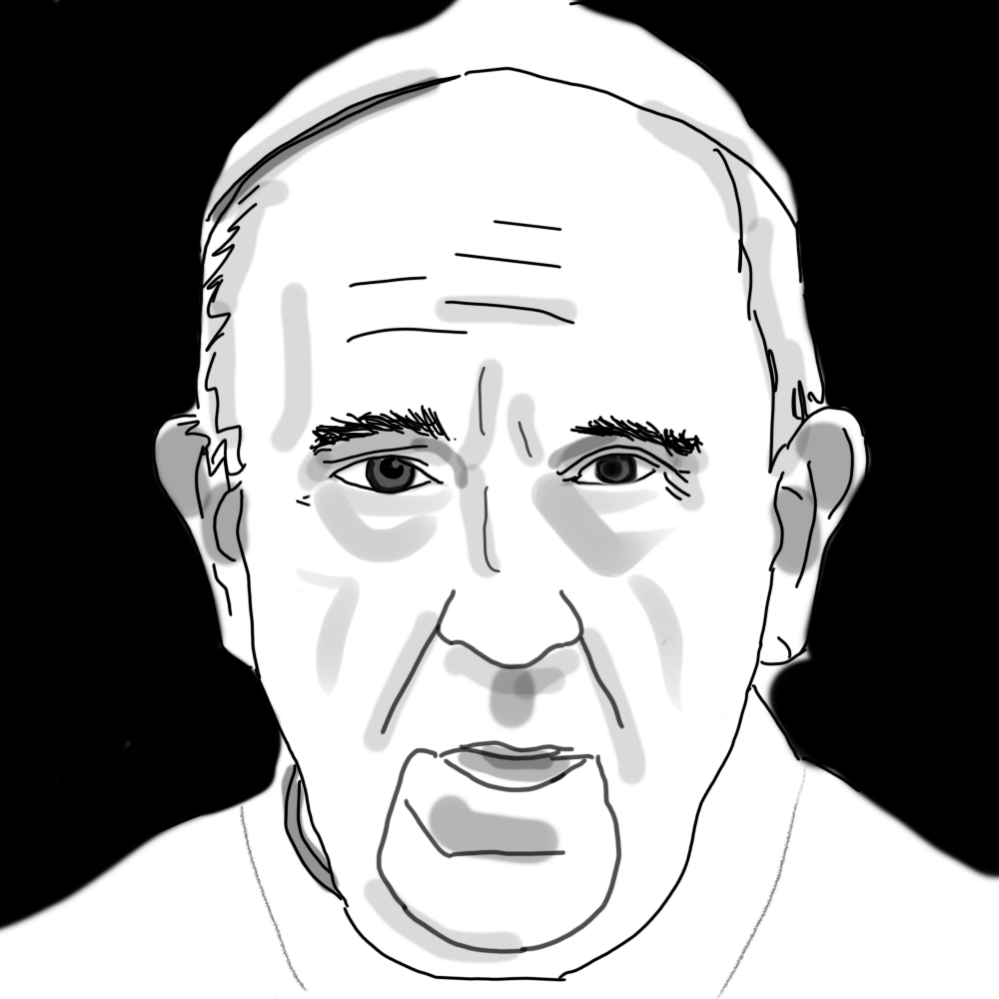
Concerning Pope Francis
 I. There is legitimate disagreement among Catholics about Pope Francis
II. Religious submission takes for its object fallible authority
III. Insofar as Pope Francis manifestly denies the faith, I will resist him
IV. Insofar as Pope Francis confesses the faith, I submit to him
I. There is legitimate disagreement among Catholics on this point
During the great Western Schism, St. Vincent Ferrer backed the antipopes in Avignon, while St. Catherine of Siena supported the true popes in Rome. Both saints were utterly convinced and worked passionately to win over the faithful to their cause. If the saints disagreed over the status of the pope in a time of crisis, how much more will we sinners disagree in our time?
We live in evil days. It is a time in which, as Ratzinger once wrote, the Catholic faith is surrounded “with a fog of uncertainty” which has “hardly been seen before at any point in history.”[1] We live at a time when bishops have rejected the whole faith and seek to subvert it.[2] We must stand fast in the faith of our fathers and be willing to give our blood before we compromise a single letter of the faith. This is how our fathers conquered in their day, and this is how we will conquer in ours.
At the same time, we must permit disagreement where it is licit to do so. In this way truth and charity will be maintained. As we shall say later on for example, every Catholic is obliged to confess the dogma of hell, yet Catholics can disagree about whether the Holy Father has denied this dogma. Any disagreement on the latter point must not overshadow the former unity. Catholics must be able to unite over what is essential and disagree on what is doubtful with all humility and mildness, with patience, supporting one another in charity. Careful to keep the unity of the Spirit in the bond of peace (Eph. iv. 2-3). At the same time, as St. Francis de Sales teaches in his section against slander, “you must speak freely in condemnation of the professed enemies of God and His Church, heretics and schismatics,—it is true charity to point out the wolf wheresoever he creeps in among the flock” (Devout Life, Ch. 29). Therefore let us proceed reasonably taking care we do not sin against truth nor charity.
II. Religious submission takes for its object fallible authority
As I stated in my confession of faith, I believe Jorge Bergoglio to be the valid Bishop of Rome as Francis I, to whom I submit with religious submission of mind and will. This type of submission is the normal, daily submission that every Catholic owes to the Roman Pontiff. This religious submission is given to non-infallible authority, and is a step below the assent of faith, given only to what is infallible.[3]

Religious submission therefore is an action of the virtue of piety, defined by St. Thomas as rendering due honor and reverence to superiors.[4] The highest piety is given to God alone, yet to every lesser authority submission is given according to its due mode. Thus anything taught by a bishop is at least Sententia Probabilis if not Communis, due solely its authoritative origin (See The Meaning of Catholic). But even Communis can be set aside for good reason. This good reason is the case in which the high authority of the hierarchy is opposed to the higher authority of God Himself or an infallible truth of the faith. And it is just so with each order of human authority.
Thus St. Alphonsus says that we “obey our confessors in everything which is not manifestly sinful,” (Serm. 4th Sun. after Easter). And again the Roman Catechism says that wives must yield to their husbands “a willing and ready obedience in all things not inconsistent with Christian piety” (2.7 Matrimony duties). And again regarding children, if “commands [of the parents] be wicked or unjust, they should not be obeyed, since in such a case they rule not according to their rightful authority, but according to injustice and perversity” (3.4 Parents).
Thus we see that religious submission to lawful authority is always conditional upon the principle that this authority is also subject to God. If ever an authority refuses to submit to God, as St. Thomas says, we cannot submit to it. This is according to the Scripture We must obey God rather than men (Acts v. 29).[5]
But, as St. Alphonsus says, (ibid.) we cannot justify any refusal to submit unless it is manifest that such submission would be itself a sin. It must be manifest because what is manifest is beyond all judgement and doubt. That which is doubtful requires judgment from authority. Thus we cannot, upon our own judgment and opinion, set aside the lawful command of an authority. If, however, an authority is manifestly opposed to some higher authority, we must assent to the higher authority against him.[6] In this we will contrast the assent of faith and the assent of religion, to which we now turn.
III. Insofar as Pope Francis manifestly denies the faith, I will submit to the higher authority of the faith
Catholic doctrine which has the theological note of De Fide obliges the Catholic to give the assent of faith. This assent is higher than religious submission because it submits to something as infallible, revealed by God and explicitly defined by the Church.[7] Thus to refuse the assent of faith to a De Fide doctrine is a mortal sin against faith, whereas refusal of religious submission to authority is not always sinful as we have shown.
For example, it is De Fide dogma that the damned souls will receive eternal punishment (Ott, 509). The Athanasian Creed states that at the Final Judgment, “they that have done good shall go into life everlasting; and they that have done evil, into everlasting fire” (cf. Mt. xxv. 45). This teaching is confirmed by numerous councils and defined by the Church beginning with the Ecumenical Council of Constantinople II (543) “If anyone says or holds that the punishment of the demons and of impious men is temporary, and that it will have an end at some time, that is to say, there will be a complete restoration of the demons or of impious men, let him be anathema”.[8] Thus this dogma is infallible De Fide to which every Catholic is obliged to give the assent of faith under pain of mortal sin.
Now in reviewing the Holy Father’s two encyclicals, four apostolic exhortations, as well as Amoris Laetitia, Evangelium Gaudii and Misericordia et Misera, there is no mention (in this sense) of “Hell,” “Eternal Punishment” or “Eternal Condemnation.”[9] But we do have this general principle contained in Amoris Laetitia, 297: “no one can be condemned forever (in perpetuum damnari), for that is not the logic of the Gospel. Here I am not speaking only of the divorced and remarried, but of everyone, in whatever situation they find themselves.” And again in a homily His Holiness declared “The way of the Church is not to condemn anyone for eternity” or in another place “God never condemns, he only loves and saves.”
In the context of Amoris Laetitia, His Holiness says that this principle—mens evangelii “mind of the Gospel”—applies to a particular concrete situation: since God does not condemn forever, the Church does not condemn forever. It would seem clear from his homilies as well that he believes this to be an eternal principle of the Gospel. To make matters more confusing, His Holiness has permitted a prominent Italian newspaper to report private statements ascribed to him, indicating that he denies eternal punishment but believes that damned souls are annihilated (the Vatican issued a vague response to this). He has said elsewhere that sinners must repent to avoid hell, but given all of these statements, the faithful can reasonably ask: Holy Father, what do you mean by “Hell”? It would appear reasonable to conclude that if God does not condemn eternally, then Pope Francis does not understand “Hell” as eternal condemnation.
Out of piety, we must always interpret the Holy Father in the best possible way. However, we cannot abandon reason while doing so. All that is necessary in these circumstances is for the Holy Father to provide a confession of faith to leave the matter beyond all doubt. Thus far, the Holy Father has refrained from doing so. As it stands, a reasonable and pious man may conclude that the Holy Father denies the dogma of hell. Thus insofar as he does deny the faith, I submit to the higher authority against him.
IV. I submit to Pope Francis insofar as he confesses the Catholic faith
Since early 2014, Catholics have repeatedly sought–directly or indirectly–a confession of faith from the pope, concerned about the spread of confusion among Catholics regarding this and other doctrines.[10] This has happened at least thirty-five distinct times with only a single response from Pope Francis (albeit unofficial), when he was asked in person.[11]
If a father tells his son to deny the faith, his son will be troubled in his heart. Refusing out of piety to believe that his father wants him to commit manifest sin, the son asks him: “Father, did you really mean that I should deny the faith?” When the father refuses to respond, the son, unless he denies reason, can only come to one of two conclusions: the father is negligent and does not care enough to clarify himself or the father in fact intends to deny the faith. These two conclusions are manifest from the application of reason.
Based on his refusal to provide a confession of faith regarding the many errors and heresies (including moral failures) he is accused of I can only conclude that the Holy Father is negligent or he intends to deny the faith. In either case, it is manifest that Pope Francis resists the faith – either indirectly through negligence or directly through subversion. Therefore in regard to Pope Francis I must exercise the virtue of caution. St. Thomas defines caution as a part of prudence, meaning using knowledge of the past to foresee and avoid evil.[12] Now heresy is a very grave evil, which corrupts the soul, and it is for this reason, as we have seen, that the obligations of piety are set aside if they oppose the obligation of faith. Caution, therefore, leads me to prudently avoid submission to Pope Francis unless he is confessing the faith. At such a time as God sees fit to fully rectify the crisis in the Church, I will have less need of such caution. But until that time, I will confess the faith and submit to the Pope insofar as he submits to the faith, and resist him insofar as he resists the faith.
In the meantime, I submit to you, dear reader, for your own comments on the matter.
Timothy S. Flanders
@meaningofcath
—
[1]Ratzinger 1967: Intro to Christianity, 11
[2]Ratzinger as Pope Emeritus again notes this in his recent article “The Church and the Scandal of Sexual Abuse”
[3]Donum Veritatis,23. See also this discussion.
[6]This is not to say that what is manifest to some may not be manifest to others, as we asserted regarding the saints in the Great Western Schism. Among us sinners, clear reason can be impeded by other factors such as sin, ignorance, or a disordered intellect.
[8]Denz 411. For more references, see here.
[9]The two exceptions are Laudato Si, 148: “any place can turn from being a hell on earth into the setting for a dignified life” and Gaudete, 115: “the unguarded tongue, set on fire by hell, sets all things ablaze (cf. Jas 3:6)” and in a morning meditation he states “perhaps there is the danger, the danger of continuing in this way [of sin], far away from the Lord for eternity. This is very bad!”
[10]Maike Hickson, “Before Pope Francis was accused of heresy, Catholics reached out to him numerous times,” Life Site News, May 7, 2019
[11]This was an informal clarification regarding the Abu Dabi statement. The clarification was not printed but reported second hand by HE Athanasius Schneider
[12]ST II-II q49 a8
Against the vice of curiosity

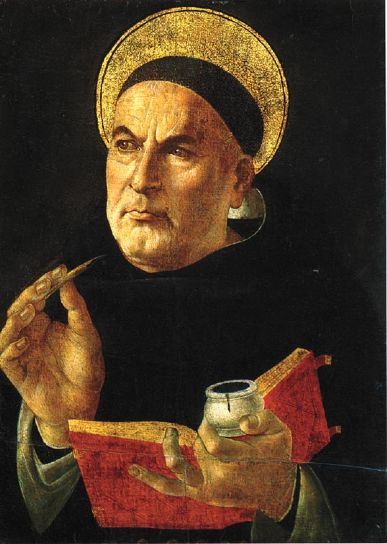
St. Thomas defines the vice of curiosity as “when a man is withdrawn by a less profitable study from a study that is an obligation incumbent on him” (ST II-II q167 a1). Fr. Ripperger defines it as “Inordinate desire for useless or profane knowledge.” The opposite vice is negligence, defined as “lack of due solicitude” (ST II-II q54 a1) elaborated by Prummer as “the voluntary omission of knowledge essential to one’s state and condition of life.”[1] So we have curiosity which is an excessive desire for knowledge, and negligence, which is not enough desire for knowledge.
The virtue and mean is studiousness, which is “the virtue in which one pursues knowledge according to one’s state in life” (Ripperger, op. cit). Each state of life has duties and those duties require knowledge. The first duty of every state is to know the faith essentials for your salvation and then those practical matters particular to your state.
As any parent has the duty to protect their children, they must take care to have some knowledge about the world of politics both secular and ecclesiastical. This helps us to develop the virtue of caution in this crisis, which is necessary to protect our children. However, it is not incumbent upon any parent to delve completely into the endless research of these doubtful matters, since it creates a danger of curiosity, in which a parent will forsake the duties of their state in life. Therefore, let the reader beware of curiosity and not be taken by fables and endless genealogies, which furnish questions rather than the edification of God which is in faith (I Tim. i. 4). Or again the Holy Ghost declares:
Seek not the things that are too high for thee, and search not into things above thy ability: but the things that God hath commanded thee, think on them always, and in many of his works be not curious. For it is not necessary for thee to see with thy eyes those things that are hid. In unnecessary matters be not over curious, and in many of his works thou shalt not be inquisitive. For many things are shewn to thee above the understanding of men. And the suspicion of them hath deceived many, and hath detained their minds in vanity (Ecclus. iii. 22ff).
Knowledge of the history and nature of the crisis can be good for the faithful to properly respond, but we must also realize that much of this evil will remain hidden from us and known only to God. Take what is helpful to know for the duties of your state, and leave the rest to God.
—

The Council of Florence: No Scholarly Consensus?
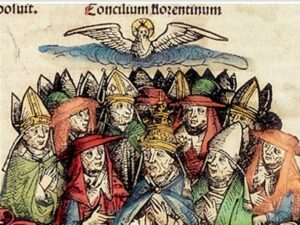
The Council of Florence is a nebulous thing. It took place at the climax of two historical epochs—the western struggle through schism and civil war and the eastern struggle through civil war and Turkish invasions. The divisions that these epochs led to—the western division into Protestant and Catholic, and the eastern division into Eastern Catholic, Greek Orthodox and Russian Orthodox—persist until today. Not only do they persist, but the historical memories which justify each division continue to cast a haze over the history of the Council of Florence, telling us that a clear historical understanding of the council has still not been reached. Ever since the council, the divisions of Christians have defined how the council was remembered—each divided community looking at it in their own way. In the twentieth century, a new reevaluation of the council began.
It started in the 1930s, when, as the 500th anniversary of the Council approached (1949), the Pontifical Oriental Institute began the immense project of preparing the primary source material for publication. This led to the Epistolae Pontificiae (Papal Letters) published from 1940-46, the Acta Graeca (official Greek acts of the council) in 1953, and the Acta Latina (official Latin acts of the council) in 1955. The editor of the Acta Graeca was Fr. Joseph Gill, a Jesuit scholar.
In 1959 Fr. Gill published The Council of Florence


Fr. Gill’s work, accomplished as it was with a scrupulous study of the primary sources, has not been duplicated since then, but has remained the standard reference source for the council. At the time of its publication, the Jesuit scholar was praised for his objectivity, seeing as how he made extensive use of the only other primary source to the council—the memoirs of an anti-union Greek Deacon named Syropoulos. Fr. Gill made clear that Dcn. Syropoulos’ memoir should be taken with caution, but should not at all be dismissed as ahistorical. The basic points of the council that Fr. Gill points out—and that everyone has since agreed upon—are as follows.
As the Latin Christians were attempting to resolve the tensions of the disastrous 14th century (with the Western Schism and Conciliarism), they reached out to the Greek east as part of their reform efforts.[1] The Greek east, who had also experienced a terror-filled 14th century (with the Hesychast controversy and numerous civil wars) had been surrounded by the Muslim Turks since 1365, when Constantinople became a virtual vassal of the Ottomans.[2] The Greeks had begun to believe that western military aid was the only way to save them from falling under the dominion of Muhammad like the rest of eastern Christendom. After the siege of 1422, when the Turks nearly took Constantinople, the Greek Roman Emperor was determined to received military aid from his brothers in the west or perish against the Turks.
A council was finally convened at Ferrara (and later moved to Florence) in 1438—where the Greeks and the Latins met.[3]. It seems quite clear that both sides genuinely desired union but both also had political concerns—the Latins desired to reestablish papal monarchy against the Conciliarists while the Greeks wanted Latin swords to defend the walls of Constantinople. From the primary sources, Fr. Gill presents a picture of the council as a difficult and tedious process in which both sides failed in many ways to respect the other and genuinely meet in Christian fraternity. Despite this, after nearly a year and a half of debates and arguments, an agreement was reached based on an important principle: unity in doctrine and diversity in cultural tradition. One of the most crucial of these (which took seven months to hammer out) was the agreement on the Filioque. Despite a significant linguistic barrier, the pro-union Greeks and the Latins were able to agree that the Latin Fathers and the Greek Fathers used different terminology for the same doctrine of the Holy Spirit. This principle of unity in diversity would be a crucial one for years to come.
The Union was proclaimed in 1439. However, the anti-union Greek party (led especially by Markos of Ephesos, the only Greek prelate who refused to sign the union[4]) quickly gained strong support among the Orthodox east, and especially in Constantinople whose population held on to bitter hatred for the Latins who had conquered them over two hundred years before. The anti-union Greeks revolted against the two pro-union Greek Patriarchs, Metrophanes I and Gregory III, who fled the city to the west.
But while the Emperor and other pro-union Greeks were attempting to bring union with their countrymen in Constantinople, Pope Eugenius was attempting to bring military defense to the city. Disastrously, however, the pope was unsuccessful in rallying enough western powers to the aid of their eastern brethren (two dominant powers, England and France, were spending all their resources in fighting each other). The Crusade of Varna which was mustered in support of the Greeks (but also to save the Latins of the Balkans) was terribly defeated in 1444.
After this all seemed hopeless against the Turks. The anti-union Greeks were able to gain the patriarchate in 1450 with Athanasius II, but he resigned soon thereafter. The Greeks of Constantinople were divided over the union until the final moments of 1453, when, in the last liturgy of Hagia Sophia, all Greeks—pro-union or anti-union—(as well as the Latins residing there) all communed together and then went to die in defense of the city. The pro-union Emperor was killed, and an anti-union Patriarch (Gennadios Scholarios) was installed, and pro-union Greeks were suppressed.
Despite this, many eastern Christians revived the union soon after, notably the Antiochians in 1457 and 1460, and Kievan Ruthenians in 1458. Meanwhile anti-union Slavs in Moscow, struggling to establish their church in opposition to the Greek domination of Constantinople (now seen to be destroyed by the wrath of God for its loyalty to the union), bitterly opposed the Slavic reception of Florence. Nevertheless, the number of eastern Christians who accepted the Florentine diversity in unity continued to grow especially following the Union of Brest in 1596. But because of this the Christian east was viciously divided into Eastern Catholics (who accepted Florence), Greek Orthodox (under the Turks) and Russian Orthodox (exalting themselves as the Third Rome).
One of the most interesting thoughts that Fr. Gill brings out is his contemplating whether the Council of Florence’s pro-papal doctrine made the Reformation inevitable. This may be true since the Florentine council was an anti-council of the pro-conciliarist Council of Basel, which also sent representatives to the Greeks. This council, after Ferrara-Florence was convened, eventually condemned Eugenius, elected (yet again) an anti-pope, but faded away and was dissolved by the Holy Roman Emperor in 1447. Florence was held in obedience with the decree of Constance Frequens which mandated frequent Ecumenical Councils. However, because Pope Eugenius’ papal monarchy prevailed at Florence, Frequenswas not followed, and Eugenius’ successors did not implement conciliar reforms. Still, Fr. Gill does show his bias in his dismissal of Conciliarism as a deformity of the legitimate Church of Christ, to which the anti-union Eastern Christians (and Protestants, for that matter) would take umbrage.
The important accomplishment of Fr. Gill was to set forth the primary documents for all to study and also interpret them in a fairly reasonable and dispassionate manner. This allowed the Ecumenical scholarship of the Orthodox and Catholic churches (drawing on the catalyst of Vatican II) to commence and flourish. During the 1970s the North American dialogue between Orthodox and Catholics gained ground, while preparations were being made on the international level for an official dialogue from the episcopal level.
At the same time, a reaction was unfolding among the Orthodox who were skeptical about this new Ecumenism or even condemned it. The schismatic Old Calendarist monastery, Holy Transfiguration in Boston, MA, translated and reprinted an anti-union The History of the Council of Florence
In that same year, however, the International Dialogue began between the Orthodox Church and the Roman Catholic Church (no Eastern Catholics were represented). They produced three significant documents in the 1980s and were on their way to discussing some substantial issues when the Soviet Union dissolved in 1991. This set off a firestorm of bitter disputes over church property and past offenses between the Orthodox and Eastern Catholics, threatening to stop the international dialogue all together. But two years before the official dissolution of the USSR, an international scholarly conference was held near Florence on the subject of the Council. The scholarship presented at the conference was edited by Giuseppe Alberigo and published
Dr. Alberigo (presumably Catholic) argued that no “organic” and complimentary ecclesiology existed at Florence. Fr. John Meyendorff (Orthodox son of Parisian-Russian refugees who was teaching in New York) agreed on this and so did the Orthodox Metropolitan Damaskinos and Gillian Evans. Fr. Meyendorff added further that at Florence the Greeks and Latins “debated issues without solving them and solved issues without debating them” (referencing the ‘resolution’ of the Filioque debate and the lack of discussion on the Papacy). The Anglican scholar Henry Chadwick further agreed that the ethos of the council was not one of genuine fraternal contact, but of contentious argumentation and bitter triumphalism. He did, however, disagree that a genuine balance was not struck, even ecclesiologically, a position to which at least two other scholars (Halleaux and Doch) agree.
Kallis argued in agreement with Dr. Tsirpanlis (and against Fr. Gill) that the union was signed under duress about the Turkish advance and under pressure from the Latins. The Orthodox scholar Nicholas Lossky, meanwhile praised Markos Eugenikos as a great man. Still, Fr. Meyendorff stated that the Greeks were “uniformed and provincial.” Overall, according to one reviewer, the scholarship edited by Dr. Alberigo presented lessons for contemporary ecumenism by showing the importance of non-theological factors – cultural, linguistic, political; the problems of ‘reception’; the need for humility in ecumenical dialogue; the importance of extending doctrinal agreement to include sanctity, catholicity, and apostolicity in the church.[5]
Later in 1994 St. Vladimir’s Seminary published The Christian East and the Rise of the Papacy: The Church 1071-1453 A.D
In 1999, T. Ferguson published a fascinating article (“The Council of Ferrara-Florence and its Continued Historical Significance”) which argued that the Council of Florence actually formed the basis for the Constantinople-Moscow division which reached even to the 1996 Estonian schism.[6]
In 2001 a provocative book was released by little known French Lebanese Orthodox scholar Lina Murr Nehme (Muhammad II Imposes the Orthodox Schism), which argued that the Council was valid and that the Turks imposed the schism, exalted the anti-unionists, and helped promote an anti-union historical memory. It is undeniable that the Muhammadans played an overwhelming role in the history of Florence especially after the council, and that this history is mostly ignored. Unfortunately there is very little scholarly review of this particular work and its unique thesis.
In 2003, Henry Chadwick’s seminal work East and West
Finally more recently was Siecienski’s work in 2010 The Filioque: History of a Doctrinal Controversy
As we have seen, despite a greater amount of study given to this event and the sources, the confessional bias which colors every man still makes itself known in the conclusions drawn (with the notable exception of Nehme). Nevertheless, the objectivity of scholars is sharpened by the ecumenical dialogue which causes every side to speak to each other in an unprecedented way. It would seem, from the opinion of this writer, that from a historical perspective, the greatest failure of Florence was the failure of the western powers to defend Constantinople against the Muhammadans. Whatever the numbers of adherents or opponents to Florence in New Rome, the Turks were no doubt the winning party, who sided against Florence and against Christ. Thus whatever successes Florence may have made, everything was stifled by this political failure.
If we consider that Florence did become the basis for the Uniate movement, and by the bare fact that every Eastern Catholic Church (not including the Maronites and Italo-Albanians who predate Florence) has some relation to Florence either directly or indirectly, we may objectively look at the results here. Since the time of Florence until today, over a long struggle of politics and bloodshed from every side, some number from every single Eastern Christian Church has come into communion with Rome. According to Fr. Roberson in 2008, this entire number is approximately 13,209,516.[7] When compared to the total number of Eastern Churches out of communion with Rome, this may be considered by Rome as a failure of numbers, and by the Eastern Orthodox as a false union. Moreover, the Eastern Catholics have been largely excluded from the ecumenical talks since Vatican II and the whole Uniate movement discredited. This is part of the larger internal struggle among Latin Catholics over the meaning of Vatican II in relation to Fatima and the Conversion of Russia. But from the Eastern Catholic perspective, exemplified in the foremost Eastern Catholic saint—St. Josaphat Kuntsevych—and every soul that has come into communion with Rome from the East, Florence was no failure but an opportunity for every Eastern Christian to unite with Rome. It is unfortunate that the struggle of the Uniates is not respected and given a voice today in the Catholic-Orthodox ecumenical dialogue. These Eastern Catholics, more than anyone, have been the result of Florence, and their number though small is not insignificant. Moreover for them, union with Rome represents not only ecclesiastical unity, but a sure hope for eternal life since they believe that it is necessary for salvation that every soul be subject to the Roman Pontiff.
Placeat tibi, Sancta Trinitas.
Timothy S. Flanders
@meaningofcath
Bibliography
Chronological list of works on Florence and their reviews
1959 The Council of Florence
Allen Cabaniss. The Journal of Religion,40:3. (July, 1960), 216
Michael Cherniavsky. The American Historical Review, 65:1. (October, 1959), 100-1
Oscar Halecki. Renaissance News, 13:2. (Summer, 1960), 141-5
J. Joseph Ryan. The Catholic Historical Review,46:1. (April, 1960), 59-60
1961 Eugenius IV, Pope of Christian Union, The Popes through History, Volume 1
John Hanly. Irish Theological Quarterly,30:3. (September, 1963), 286-7
Richard Luman. Church History, 31:2. (June, 1962), 242-3
Brian Tierney. Speculum, 37:3. (July, 1962), 433
M. Wilks. Journal of Theological Studies,14. (1963), 534
1964 Personalities of the Council of Florence
Gerald Christianson. The Journal of Religion, 45:4. (October, 1965), 347-9
Francis Oakley. Speculum, 41:1. (January, 1966), 131-2
1971 The History of the Council of Florence (Ivan Ostoumoff, 1847. Translated by Vasilii Popov. Boston, MA: Holy Transfiguration Monastery)
1974 Mark Eugenicus and the Council of Florence (Constantine Tsirpanlis. Thessaloniki: Center for Byzantine Research.)
John E. Rexine. Greek Orthodox Theological Review, 21:3. (January, 1976), 313-5
1991 Christian Unity. The Council of Ferrara-Florence: 1438/39-1989 (Bibliotheca Ephemeridum Theologicarum Lovaniensium)
Mark S. Burrows. Journal of Ecumenical Studies, 30:1. (Winter, 1993), 113-4
Gerald Christianson. The Catholic Historical Review, 79:2. (April, 1993), 326-7
Leo Donald Davis. Theological Studies, 54:2. (June, 1993), 351
André de Halleux. Revue théologique de Louvain, 25:3. (January, 1993), 366-8
John A. Newton. The Expository Times, 103:10. (1992), 314-5
D. M. Nicol. Journal of Ecclesiastical History, 43:3. (July, 1992), 472-4
N. Tanner. Journal of Theological Studies, 43. (January, 1992), 822
1994 The Christian East and the Rise of the Papacy: The Church 1071-1453 A.D
1999 “The Council of Florence and its Historical Significance” (T. Ferguson. St. Vladimir’s Seminary Quarterly. 43:1. 55-77)
2001 Muhammad II imposes the Orthodox Schism (Lina Murr Nehme. Beirut: Aleph et Taw)
2003 East and West: The Making of a Rift in the Church: From Apostolic Times until the Council of Florence
2010 The Filioque: History of a Doctrinal Controversy
[1]The Council of Constance, as part of the Conciliarist movement, desired to unite with the Greeks and cause them to “return” to the Church
[2]The Turks, having conquered the Christians of Serbia and Bulgaria, set up an outpost at Adrianople, west of Constantinople. This surrounded the Greeks on east and west.
[3]We are passing over the more complex points of history concerning the predecessor Conciliarist council of Basel for the sake of brevity and clarity
[4]Who was later canonized by Constantinople shortly after a mass of Arab Christians (under Greek dominion in the Turkish Rum Millet) accepted Florence in the early 18th century
[5]John A. Newton, “Christian Unity: The Council of Ferrara-Florence,”The Expository Times, 103:10. (1992), 314
[6]In which Moscow excommunicated Constantinople
[7]See Fr. Ronald Roberson, The Eastern Christian Churches 7th Ed. (2008), 141ff
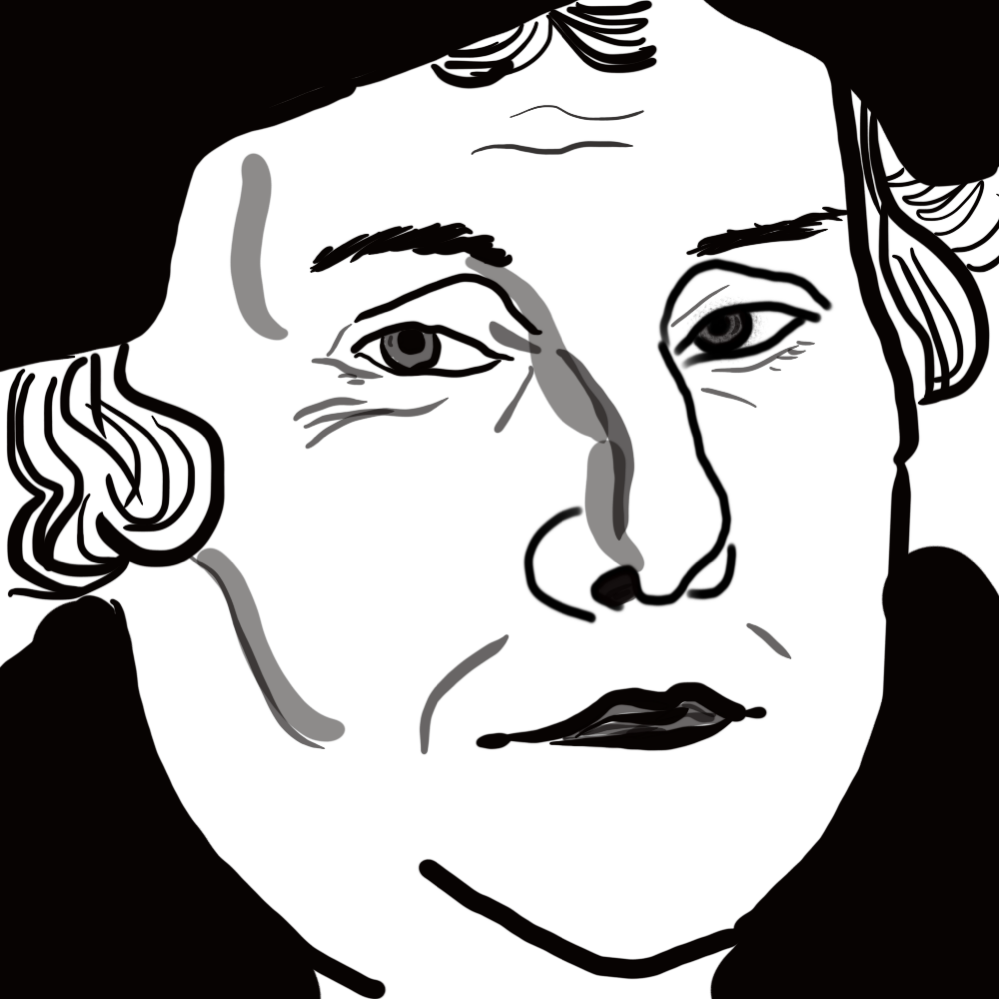
The Fruits of Martin Luther’s Scrupulosity

There are few people in the history so studied as Martin Luther. He is certainly a complex figure, and his legacy is as divisive as it is broad. Still, a sympathetic look at a few objective facts about his life give us a picture of a sincere Christian with a troubled childhood and firm conviction. Among Protestants, his story can illustrate important lessons. Above all, it is the fruits of Martin Luther’s scrupulosity that show the tension between hope and despair, humility and pride, and continuity and rupture within the struggle for Christian unity.
Every family has fights. It’s part of family life. When those times come, we are torn between hope and despair. We despair not only over the people in our family, but even the institution itself. We want to ‘run away from home.’ Martin’s troubled childhood led to an excruciating scrupulosity. It drove him to terror and doubt over the love of God, His acceptance, and forgiveness—all things which were communicated to him through the Catholic doctrine and praxis. In many ways this intense spiritual depression reflects the deeper groan of Europe through centuries of plague, schism and clerical abuse. The Christian family was doubting if the institutions that made them a family—the Papacy, the Sacraments, the Priesthood—were worth it. Would they be better off without them? Should they run away from home? Some did.
But young Martin struggled with a hope that the Church would give him the answers. He followed his confessor’s instructions, even though they did not seem to help. He read the mystics, and received absolution in confession—“Go in peace, the Lord hath put away thy sins”—but still, these things did not penetrate his scrupulosity. In the struggle for a family to ‘work it out,’ there is always the voice of the aged, encouraging us: “It’s OK. It’ll work out.” Ultimately something deep inside Martin’s spirit refused to listen to the wisdom of the elders. Nothing helped.
Martin never found the answers in the Church. He was still wrestling when he found his own revelation in his doctrine of ‘Faith Alone.’ Ultimately he felt that he had to reject the counsel of the Church authorities and make his own authority. His scrupulosity had caused him to involuntarily reject the affirmations of others, and in forming his own opinion, he found it was his only solution. This represents for us when we give in to despair and give up on reconciling the family. We now decide to make our own way, because we think it is the only solution. We run away from home.
This, however, is the difference between humility and pride. In a spiritual irony, the depth of our despair becomes a fountain of pride, because in our despair we choose to reject the answers given to us from wisdom (that is, the family structure itself), and choose to make our own. But humility is rooted in love, which “bears all things,” and is willing to go to the cross for the sake of reconciliation. Martin made his own doctrine which he believed was that of the early church. But this in fact was an antiquarianism of his own making, which could not find any living connection with the past. When faced the struggle to bear all things patiently, he chose to try to convince others to run away from home too.
This led ultimately to rupture. When Catholic reformer Erasmus broke with Luther, he did so over the teaching on free will. When Luther rejected free will, Erasmus realized that Luther did not desire to patiently endure the family in order to reform it, but rather to break from it, and from the tradition that holds it together. Luther’s scrupulosity had driven him to despair, and his only solace was his own teaching, no matter what the cost.
In this way, Luther projected his own spiritual struggles upon the whole Church and caused a most unfortunate prejudice and misunderstanding about Catholic doctrine which is shared by Protestants to this day. When he ran away from home, many ran with him, but they ran in all directions. It would have been better if the Protestant movement became just one other communion. Instead, because Luther had based his doctrine on his own authority, so did everyone else, and instead of the terrible schism of three popes, there were now so many self-made popes that Europe was past the point of no return.
The foundation of all Christian unity must first be love. It must be willing to bear all things and seek to be humble towards one another, in the hope that unity can be restored somehow. We must reverse the scrupulosity of Martin with our own childlike confidence in the mercy of God through the prayer of our Lord to His Father that cannot fail. “May they be one as we are one.” Do we really believe this? And are we willing to be crucified for it? A servant is not above his master.
Antiquarianism: One Step from the Summit of Pride

Christian unity requires charity through humility. Humility means to bind up one’s identity with another; to say “I am because of you. I need you.” This must first be directed toward God, then to one’s own parents and one’s neighbor.
Thus to “Love the Lord thy God with all thy heart, with all thy soul, and with all thy mind” means to not have a heart except that which is God’s, to not have a soul except that which is God’s and to not have a mind except that which is God’s. Your identity cannot exist except in communion with Him.
So also to “Love your neighbor as your self” means to not have a self except that which is your neighbor’s. This is humility: the soil of charity from which Christian peace is born.
These two are inseparably bound. As St. John puts it, “He who says that he loves God and does not love his brother is a liar.” If someone loves God, he must obey God and love his neighbor. But even if he wishes to love his neighbor, he cannot do so without loving as God loves.
With these two commands the Christian is bound to find identity in both time and eternity. If he wishes to seek eternity, he cannot but know his brother here and now and love him, because he must obey God. But he cannot know of God’s commands unless he is told of them by his brother. Thus he needs the eternal God to know his brother now and he needs his brother now to know the eternal God.
For the eternal God is only known through revelation: a point in time in which He reveals Himself to men. A person must then pass on the revelation to others. In order to know God, one must listen to another who has already received Him. Only then can he know God.
This is where humility must be learned: when a man must listen to the wise and learn to know God through them. Only then can someone know God. “A fool spurns his father’s discipline, but he who heeds his correction shows prudence.” The prudent man who seeks wisdom understands that he is dependent upon the elders in order to know God. Without the guidance of the wise, man cannot even recognize God, even if He were to reveal Himself. Eli must explain to Samuel who is really calling him.
The recognition that my own abilities are ultimately inadequate is the beginning of finding my identity with another: humility. No one born of woman can deny his dependence physically. But we must learn from this physical dependency also the spiritual dependency. Then we will be humble.
The opposite of humility is pride. Pride is the refusal to share any identity with another or to depend on them. It is the refusal to love. A man who is prideful lies to himself, that he is sufficient of himself and needs no one. Instead, everyone is indebted to him.
He will claim that he has direct contact with eternity without any recourse to his brother now. But if he actually had direct contact with eternity, the eternal God would have told him to have recourse to his brother now, since the two are inseparably bound.
Instead, the prideful man avoids recourse to his brother now, and instead invents a fantasy for himself. This fantasy is neither in time (which is now) or in eternity. It is ‘antiquity.’ He claims that his revelation from God is as it was in the beginning, sicut erat in principio.
But there is no one alive who was there at that time. No one is breathing who can corroborate his story. So ‘antiquity’ is at his disposal: he may mold it however he wishes. Now everything is a matter of historical interpretation, and his, he claims, is as good as any. And so his own knowledge of God comes from his own self, instead of his neighbor. He needs only to love his own self as his self.
When our Lord came to us in the depth of humility, he bound up his identity to forty-two generations from Abraham. He claimed to know how it was sicut erat in principio, but he also spoke the amen: antequam Abraham fieret, ego sum, before Abraham was, I am. Anyone who claims to know the former must also claim the latter, or admit he is one step from the summit of pride.
The reason for this is that if he cannot claim that he existed in antiquity, he must claim instead that he is equal to or greater than the wisest person who ever lived. He must maintain that even the wisest men of old were unable to communicate the truth as well as he can now, for all of their sons could not pass down the revelation until today.
This antiquarianism is behind much of the division among Protestants (and even Catholics). In every generation there must be reformers. But there is a choice. A reformer can submit in humility to the wisdom that came before him and then seek to transmit that wisdom into transformation now. He can speak with authority because he has bound up his identity with the generations that came before him: a living connection to antiquity, not a fantasy.
On the other hand, he may choose antiquarianism: he may construct for himself his own ‘early church’ which does not obligate him to submit to anyone but himself. He need not submit to anyone’s wisdom but that of ‘antiquity’ in the Bible: his interpretation of the text on his own authority.
The former submission creates genuine renewal and unity, because it is based on humility. The latter creates schism and denominationalism, because it is one step from the summit of pride. Then the sons of antiquarianism can take the next step: reject even the authority of antiquity. But this is the last brick of Babel.
For further reading on this subject, I recommend the classic text The Catholic Controversy
Timothy S. Flanders
@meaningofcath
Martin Luther and Ulrich Zwingli at Marburg: Lessons for Protestants

Martin Luther and Ulrich Zwingli were only six months apart in age, and their separate spheres of Protestantism were largely independent of one another, although Ulrich could be said to have gotten many ideas from Martin. To a substantial degree, these two Protestant leaders agreed on doctrine. Unfortunately and ironically however, the one thing that separated them was their divergent teachings on the chief Sacrament of Christian unity: the Eucharist. This disagreement was profound and continues to be a dividing factor among confessional Protestants to this day. As such, Martin and Ulrich’s dialogue at Marburg presents us with three very vital lessons for Protestants today.
Interpreting the Bible
The first lesson we may draw from this disagreement is obvious: the Bible must be interpreted by human beings. Everyone agrees that the New Testament teaches about the Lord’s Supper. Protestants disagree as to what is taught. Martin was absolutely convinced that hoc est corpus meum, “this is my body,” meant precisely that, and confessional Lutherans still hold the Real Presence of our Lord in the Sacrament. Martin believed Ulrich’s doctrine twisted scripture even worse than Catholics and published a treatise to this effect titled That the words “This is my body…” still stand firm against the fanatics (i.e. Zwinglians).
Ulrich took our Lord’s dictum “The spirit giveth life, the flesh availeth nothing,” as an ontological barrier to any understanding of the Real Presence. He believed that when the believers ate the Sacrament, they ate only bread. Ironically, they both vehemently disagreed with the Catholic formula of transubstantiation, even though Martin’s doctrine was far closer to Catholicism than Ulrich’s. So Ulrich despised Martin’s doctrine because it smacked of Catholic ‘superstition.’ But the common authority between them—and between all Christians even today—namely the Bible, was being interpreted differently by each of them.
Influences
This leads us to our second lesson, which is also very simple: human beings are influenced by different things. This causes different interpretations. Martin had had such a powerful personal experience with the scriptures and the teaching of “Faith Alone,” that he was absolutely unwilling to make the text say anything less than what it said literally. His most fierce attack on the Catholic faith was its teaching that the act of the Mass was a “good work” that could–by God’s grace–“merit” one’s salvation. But Martin believed that Faith Alone meant that God saved you completely independent of your merits (since you had no free will and your every act was sinful). Thus he found great comfort in an understanding of the Eucharist which was all God’s doing: the Words of Institution were God’s affirmation of His own presence; the power of the words themselves made present the reality.
To Martin, Ulrich’s doctrine of “memorial” seemed to be Catholic superstition because it made the celebration of the Supper about the people and their remembering of Christ, instead of God’s work alone. Ulrich’s Supper was again a Mass and a “work,” which was so abhorrent to Martin. In Ulrich’s presence, over the customary German beer and theology, Martin began banging his glass on the table over and over and chanting with ever increasing vehemence “Hoc est Corpus meum! Hoc est Corpus meum!! Hoc est Corpus meum!!!”
To Ulrich, this was all nonsense. He was a Renaissance humanist, an enlightened, scientific man, with a great love for the Classics. He had devoured Greek, not to mention Latin, and loved the use of advanced rhetoric from the ancient authors. Because of this, he was convinced that the Bible was a perfect example of excellent literary prose, rife with similes and metaphors (which is, of course, very true). And when he came to the Words of Institution, he could not see it otherwise: “This is my Body” must mean “This [represents] my Body.” Ulrich’s own background and experience could only show him this interpretation.
Further, he employed philosophical arguments to counter Martin. For a body to be a body, it must conform to the limits of space and time. How could such a thing happen if the body of our Lord is seated at the right hand of the Father? Martin countered with his own metaphysics of a “ubiquitous” body which is omnipresent. But Ulrich was not swayed by this. The debate was over. Martin could not commune with Ulrich’s sophistry and symbolism, and Ulrich could not commune with Martin’s crass bread worship. Both interpreted the text, but men were influenced by different things.
The Deciding Factor
Thus, our third and most important lesson to draw here must be this: there must be a nonhuman force to decide between the different people interpreting the Sacred Text. What will we be left with if only humans interpret the text? Human traditions. The very thing the Protestants hated the most. So what can we do? We have the Bible, and we have the human interpreters. Can we seriously add anything to this?
I believe the key is in what Martin used to defend his teaching of the Real Presence. He writes this:
The witness of the entire holy Christian church (even if we had nothing else) should be enough for us to maintain this doctrine [of the Real Presence] and neither to listen to nor tolerate any sectarian objections. For it is dangerous and terrible to hear or believe anything contrary to the common witness, faith, and doctrine which the entire holy Christian church has maintained from the beginning until now—for more than 1500 years throughout all the world.[1]
Here Martin appeals to the common consensus of all Christians before him. They all believed in the Real Presence. The implication is obvious: if you want to go against 1500 years of Christians believing to the contrary, who do you think you are? You would be exalting yourself over all of your Christian fathers who came before you. This is Antiquarianism. And it is one step from the summit of pride.
And so I believe we can take a hint from Martin here. There is an authority that is ancient—the Scripture themselves—but there is also a living authority, even up until the present day, which helps stabilize the pride of our interpretations from our own personal authority. This living authority is in fact nonhuman, though it involves humans, because no one human can be said to have been the author of it. Rather, it is the shared experience and witness of all Christians everywhere, from the earliest times, filled with the Holy Spirit: the Lord and Giver of Life.
I believe this is the key to unity among Christians, especially Protestants and Evangelicals. We must realize how prideful an affront against our forefathers this is, to speak on our own authority. Why go through the trouble? We now have two thousand years of Christian wisdom to draw from!
I believe that many divisive issues, such as the one we have discussed here, would fade away once we recognized this. Thankfully, it is a thing increasingly recognized by large movements of Evangelicals. The so-called “Emergent Christians” love the writings of the early Church. Wheaton College has begun an “Ancient Christian Studies” program. This is good. They are coming under the broader Christian authority and entering into the deeper Christian family. They may be surprised at what they find.
[1]Cited in Paul Althaus, The Theology of Martin Luther, trans. Robert C. Schultz (Philadelphia: Fortress Press, 1966), 334.
For further reading on this subject, I recommend the classic text The Catholic Controversy
Timothy S. Flanders
@meaningofcath
10 Lessons the Chalcedonians can learn from their rapprochement with the Miaphysites
In Nomine Patris et Filii et Spiritus Sancti, amen. Suscipe, Sancte Pater.

Baba Shenouda, former Pope of Alexandria
Since 1964 and before, the near-longest division in the history of the Church—between the Chalcedonian Orthodox and the Miaphysites, dated from c. 500—has had promising developments. These events challenge Chalcedonian Orthodoxy in its own self-understanding and can lead individual Orthodox Christians to finally come into communion with Rome.
1. Protestants can sometimes have a good influence
First, it should be admitted that the Ecumenical movement of the Protestants had a significant role to play in encouraging and fostering the dialogues that have effected the rapprochement of the Chalcedonian and Miaphysite Orthodox Churches. It is true that the vision of Patriarch Joachim III in 1902 and the epocal Encyclical of the Ecumenical Patriarchate 1920 began a new era for the Orthodox Churches. These, however, were largely apropos western Protestant ecumenical movements and questions. Some Orthodox Churches accepted the invitation from the Protestants in 1920 when they wanted to plan for an international Ecumenical organization. This was the beginning of the Faith and Order movement which culminated in Orthodox-Protestant participation in the ‘World Conference of Faith and Order’ in 1927.
This later grew into the World Council of Churches (WCC) in 1948, of which significant portions of the Orthodox Churches—including the Ecumenical Patriarchate—were founding members. Later, all the Orthodox churches joined the WCC—including the Miaphysites. As Yossa relates, “the ongoing participation of the Orthodox churches in the WCC provided a climate and a platform to initiate serious discussion of common causes.”[2] It was within the WCC that two men from either group of churches met and began to collaborate—Nikos Nissiotis of the Ecumenical Patriarchate and Paul Verghese of the Malankara Indian Orthodox Church (later Metropolitan Paulos Mar Gregorios of Delhi). This work with the WCC helped galvanize the Orthodox Churches to meet together at Rhodes in 1961 and also invite the Miaphysites. In 1963, when the WCC Faith & Order Commission met, Swiss Reformed Protestant Lukas Vischer began working closely with Nissiotis and Verghese to eventually organize the first formal Orthodox-Miaphysite consultation in 1964, in which it seemed that the bulk of the division was overcome in matter of days.[3]
Virtually as soon as the two church families managed to come into constructive dialogue with each other in this century, it was realized that physis…was being used in different ways in our different churches.[4]
In a matter of days a division and misunderstanding that had lasted nearly fifteen hundred years—almost sixty generations!—was viewed in an entirely new and promising way, almost resolved then and there. And this was due in large part to the encouragement, sponsorship, and support of Protestant Christians through the WCC. Moreover, can not the Protestant openness to diversity in doctrine (no doubt to a fault) be seen as a strength in the midst of intransigent myopia holding tenaciously to old prejudices? Indeed, this very cooperation with Protestants has helped the Orthodox rediscover their own tradition more fully. A more mature understanding of the Church canons, for instance, has been brought to bear on mainstream Orthodox theology.
To view [Church canons] as fixed legislation codified for eternity represents thinking which is quite foreign to Orthodoxy. As one might well expect of a living and dynamic organism such as the Church (which is both eternal and also historical, located in time and space), canonical and disciplinary measures are apt to evolve together with the Church’s perception and evaluation of the circumstances.[5]
To those still locked in the myopic vision of a ‘steadfast fidelity to the Fathers’ which includes an unbending attitude to follow, say, festivals, new moons, and sabbaths[6] even “in opposition to the stars”[7] themselves, these words are anathema. But to those who can distinguish those things which “are of small consequence”[8] and those which are not. We will explore this further below. Suffice it to say here that
[The] Inter-Orthodox consultations, and the later meetings sponsored by the WCC, not only demonstrated successful collaboration between the two communions, but helped to dispose of a widely-accepted belief that Orthodox churches are unwilling or unable to effectively witness and proclaim the Gospel, through their respective traditions, in a modern and relevant way.[9]
The Protestants, because of their excessive division, must pursue a unity in diversity. Among Protestants themselves, this is error mixing with error. But there is a legitimate unity in diversity which has been, at times, tragically missing among the Orthodox churches at acute moments of religious and political tension. This is seen in particular when the Florentine reconciliation with Rome on the Filioque and Miaphysitism – which utilized such a differentiated unity (Denzinger 691ff.) – was rejected by most Chalcedonians and Miaphysites alike. Since so many Chalcedonians are fixed in an anti-Roman prejudice, at least they can learn a certain amount of reasonable diversity from the Protestants. By the prayers of Panagia, may this help bring them to Holy Unia. This leads us to our second lesson:
2. Reexamining old controversies does not mean compromising the Orthodox faith
We think we are being Patristic when we are being the most zealous and unbending, taking up, say, the great diatribes of St. Cyril against Nestorius, but we neglect that current within the patristic legacy (found in the same St. Cyril in his later years [in his compromise with John of Antioch in 433]) which was peacemaking, open to reconsideration and reformation, for the sake of the truth and for the unity of the Church.[10]
The Ecumenical Movement has helped many Orthodox see that the Holy Fathers, while steadfastly upholding Orthodoxy, also loved their opponents, and were willing to compromise with them when necessary for the good of the Church. The attitude of the Holy Fathers has become more clear to Orthodox—renewing the tradition. For example, St. Gregory Nazianzus wrote of heretics
There is a separation between us and them, not only those who hold aloof in their impiety, but also those who are most pious, and that intended to bear the same meaning both in regard to such doctrines as are of small consequence and also in regard to expressions.[11]
The Saint acknowledges that among the heretics are Christians completely innocent of heresy but through circumstance have ended up among them. This flies in the face of a pseudo-patristic phronema that seeks to brand every member of a separated communion as absolutely doomed heretics. We do not have moral certainty of each soul’s eternal destiny. Lest we forget, one of the greatest ascetics of the Chalcedonian Churches (not to mention Rome), St. Isaac the Syrian, is in fact not of their Church, since he was never in communion with the Chalcedonian Orthodox Church (nor Rome) in his lifetime.
Taking this thought further, it is found that the persons condemned by the Ecumenical Councils may have not been as heretical in their soul as was originally thought. The Sixth Council couples Dioskoros with Eutyhes as men “hated of God” and Severos with Apollinarios as teachers of “the mad and wicked doctrine.”[12] Modern research, however, is shedding new light on these initially condemnations. It seems that despite the infallible authority of the Councils on matters of faith, they are less absolute to assert inexorable perdition as the fate of those excommunicated.
The churches today must see the significance of the decision of the Eumenical Councils in the confirmation of the Orthodox Faith and not in the condemnation of persons. Truth for essence of the Faith and love for the condemned persons should prevail in our deliberations.[13]
But this raises a number of troubling questions: are we not betraying the legacy of our holy fathers who condemned such persons? Bouteneff elucidates:
Although one would never wish to say that “we know better than the Fathers” in a qualitative sense, we also must acknowledge the benefit of hindsight, and in particular the church’s continued historical, doctrinal, and linguistic reflection, has often yielded new perspectives on the situation which produced the anathemas.[14]
The Ecumenical Councils themselves are received and reinterpreted “in the light of the demands of the church in order to discover the will of God according to the contemporary dimensions of the Church.”[15] This is the role of every generation to transmit the Holy Tradition and interpret it for the current situation in the world.
We must approach the ecumenical council…with the question of how it expresses eternal truths in a time-and space-bound existence, how it is to be understood and applied given the situation before us and given what we now know. Just as we find ourselves needing to apply coniliar and patristic teaching to circumstances which could hardly have been envisaged by the human authors of the day (such as space travel, in vitro fertilization, or cloning), so must one account for the evolving terminology, evolving church-political and geopolitical situations.[16]
Moreover, this reevaluation is by no means without patristic precedent. Besides the terminological compromise that St. Kyrillos (Cyril) made with John of Antioch in 433, examples abound of the holy Fathers reexamining conciliar decisions based on new evidence. For example, St. Athanasios exonerated a group of Christians condemned at Serdica for holding that there is one ὑποστάσις in the Trinity. When he found out that they meant something different by ὑποστάσις than was known by those who condemned them, he felt justified in taking this action even against a council.[17] Again, Theodoret of Cyrus and Ibas of Edessa were once deposed, then reinstated after accepting the Ephesian Council of 431. Then in 533 some of their writings were condemned. As Bouteneff states, “the Church’s actions evolved as the persons involved changed their approach, but also as more information came to light… The monolithic and undifferentiated approach is neither helpful nor in accordance with Orthodox tradition.”[18]
At the same time, as Fr. Meyendorff points out, “regional veneration of ancient saints is possible in spite of past conflicts, for this veneration acknowledges their merits, not their faults, which are left to the judgment of God.”[19] These merits are emphasized within a context where “the spirit of charity, mutual respect and an openness to legitimate theological diversity were in short supply.”[20] For example, many would consider the conduct of St. Kyrillos as despicable behavior in using monks as shock troops and bribing the imperial officials. Nevertheless, his Christology is pristine and his willingness to make peace with his ecclesiastical and theological rivals outshines whatever faults may be present.
Now that this openness has been enriched by close collaboration, we see that
both the Orthodox and Oriental Orthodox recognize that both families of churches have maintained the Apostolic Faith, we can now also recognize that these teachers bore witness to the faith although they may have reflected different theological traditions and preferred different terminology in their explication of particular Christological issues.[21]
This was recognized by theologians at the time, too. In the 433 Formula of Reunion stated that, in discussing the humanity and divinity of our Lord Jesus,
[some] theologians take some as common, as relating to one Person, and others they divide as relating to two natures, explaining those God-befitting in reference to the Godhead of Christ, and those lowly in reference to his manhood.[22]
And again, St. Flavian, confessing his faith to the emperor in 449,
we confess Christ in two natures…[but] we do not refuse to speak of one nature of God the Word, if it be understood to be one nature incarnate and made man, inasmuch as our Lord Jesus Christ is one and same (Person) out of both (natures).[23]
Thus thankfully, the Chalcedonians can see that such nuances are not betraying the Tradition, but simply confessing that there is more to the Tradition than just the Cappadocian-Greek theology. As one of the committee members stated, “It is a sin not to be separated from heretics. In the same way it is a sin to be separated from the Orthodox!”[24] Or as His Eminence Metropolitan Damaskinos writes,
The ministry of the Unity of the Church is a witness to Faith, as it is constantly conressed in the Creed. Any quarrelsome theological disposition or dimished sensitivity at the prospect of restoration of ecclesial Unity, when there is an official declaration of full agrement on the right Faith, should be regard as unthinkable and certainly as reflecting a false understanding of the operation of the mystery of the Church in the history of Salvation.[25]
3. Chalcedonians cannot ignore the political aspects of the controversies
First, we need to come to terms with the reality of the role that nationalism played.
It is in no way novel or prophetic to cite the role of nationalism and ethnic identity in the origin and the continuation of our disunity. Non-Chalcedonians have often perceived Chalcedonians to be the Imperial Church, and as such the Church of the oppressor. Even with the demise of the Empire there can be a tendency, particularly on the part of the Chalcedonians, to require of the Non-Chalcedonians nothing short of total assimilation into their church structure, if not into their version of history. As a reaction, there is often a marked desire to maintain one’s separate ecclesiastical identity as an assertion of national identity and uniqueness. And theological issues are often brought in as a support, so that doctrinal convergences which might occur through careful theological work are deliberately resisted in the desire to remain distinct, or “distinctive,” on all fronts. All this makes clear how much has to happen in the area of the “healing of memories.”[26]
While it is true that one should not overemphasize the role of nationalism in Christian division, the political tensions cannot be ignored. Theological controversy does not happen in a vacuum without social, cultural, and political tension. The violent actions of successive Chalcedonian emperors like Justin and Justinian (which Bouteneff alludes to above), attempted to suppress the Miaphysites, and only served to provoke them to greater and more deliberate resistance. Thus these divisions played themselves out in the context of an imperial power and the distinctive personhood of cultural idiosyncracies. Neither one can be abandoned, but balance must always be maintained between the integrity of the universal Church and the integrity of each particular church. Divisions within the Church have nearly always hinged on this faultline.
Secondly, the invasion of Muhammad and al-Kalifaat al-Rashidun nullified nearly all official dialogue between the two, since communication was suppressed by the followers of Muhammad.[27] Thus an official dialogue and reconciliation was made virtually impossible.
Historically conditioned prejudices, concrete ecclesiastical circumstances and practical difficulties made the road to unity more difficult…the extraordinarily unfavorable historical circumstances in which these Churches lived did not permit a continuous dialogue in a synodal frame.[28]
Each side of the Chalcedonian controversy was becoming embittered by the harsh repression of the Emperors, but was still not fully resolved when the Muhammadan armies crested the hills of Jerusalem and bested the Roman legions at Yarmuk in 636. As St. Sophronios of Jerusalem wrote at the time, that these invasions were the wrath of God for our sins, so it can be seen that the failure to reconcile was in large part the cause of the failure to defend against the onslaught of the Muhammadans.[29]
Nevertheless, both churches kept the faith, in spite of the rancor which had developed because of bad blood and the extreme difficulty of Muslim domination.
The severity of the historical clashes and the long period of isolation in exceptionally trying times perpetuated a spirit of theological confrontation, although it did not interrupt a common reference to the authority of the common patristic tradition to which both sides turned in order to find either the justification of their own or the refutation of the opposing position.[30]
And thus, since a common tradition was still drawn from, the spiritual life of each church continued to be alive and grow. Moreover, contacts did continue, and spiritual exchanges occurred, even to the point of mutual theological development.[31] Indeed, the Kingdom of Armenia, so long spared from Muhammadan domination, even participated in the fifth through seventh ecumenical councils. The encyclical of Photios (866) was also sent to the Miaphysites and received favorably, and the Armenian St. Nerses IV (d. 1173) carried on fruitful contact with the Romans in Constantinople until political circumstances pulled them apart.[32] But more than this, these limited official contacts represented the greater unofficial contact that was preserved and lead to mutual enrichment, which has blossomed in the modern dialogues.
This brings us to our fourth lesson:
4. Talking together with the opposing side can be mutually edifying
As mentioned above, the theological development of both churches were enriched even with the limited contact they had following the Chalcedonian tension and the Muhammadan take-over. After God quelled the political circumstances preventing contact, and Protestant Ecumenism spurred on rapprochement, the Orientals stated officially in their own conference in 1965: “We hope that common studies in a spirit of mutual understanding can shed light on our understanding of each other’s positions.”[33] This has lead to the historic conclusions we have stated above, and new closer integration of particular theological traditions. In 1987, shortly after the first official dialogue, the Joint Declaration of the Middle Eastern Patriarchs stated concerning the rapprochement that “We rejoice in realizing how much we have advanced in our rediscovery and in the growing consciousness among our people of the inner unity of Faith in the Incarnate Lord.”[34] Thus a common faith was strengthened by the realization of an “inner unity.” This strengthens the catholicity of faith and allows it to grow towards the work of salvation, and ultimately reunion with the Holy See.
When the planning committee was meeting to organize the official dialogues, in 1979, a joint symposium was held on the spirituality of monasticism.[35] This symposium also began collaboration on common pastoral issues in the modern world. These collaborations were later expanded and developed at the Official Dialogues at Chambésy in 1990 and 1993.[36] The common faith then, led to the real pastoral work.
The mutual edification, ultimately, is simply the union of fraternal love in Christ for the sake of the Gospel. As Middle Eastern Patriarchs in 1987 put it,
We urge our people to continue to deepen their consciousness in the deep commonality of faith and to relate to one another as brothers and sisters who share the same Gospel, the same faith and the same commission entrusted to them by their common Lord.[37]
Thus even without the unique traditions that each side can share with each other, the mutual edification from fraternal contact with other Christians is indispensable. In the midst of schismatic umbrage and cleavage in the Church of God, it can be too easy for the eye to say to the hand, “I don’t need you!” And the head to say to the feet, “I don’t need you!”[38] Instead, with the advent of mutual understanding, a deep appreciation and love has begun to be rediscovered among the Orthodox. This not only strengthens the catholic nature of faith, and leads to pastoral collaboration, but deepens the reality of brotherly love[39] which is the goal of the Christian life and the telos of the Gospel.
5. Words are crucial, yet not the end goal
This brings us to the true nature of the disagreement:
Theological research has shown that the problem was mainly terminological: both schools of thought used the same terms differently in expressing the divine-human oneness of Christ.[40]
Karmiris elaborates on this point:
Orientals condemnation of Chalcedon can probably be traced to a misunderstanding of the Greek-Orthodox dogmatic terms “ousia,” “physis,” “prosopon,” “hypostasis,” hypostatike enosis,” “Logos,” etc., which could not be precisely translated into the eastern national languages of the people to whom these churches belong.[41]
The Cyrillian language of the Miaphysites “is Orthodox; it is only its external expression and formulation which seem to remind one slightly of Monophysitism.”[42] It is simply expressed in Alexandrian formulation rather than Antiochian. To the Antiochians, it seemed like heresy, just as the Antiochian terminology seemed like heresy to the Alexandrians. Through mutual contact the reality behind the words have been discovered and been seen to be entirely legitimate.
This leads to a maturation of the Church’s mind (or rather, a renewal of Orthodox phronema) in regards to the use of language and its place in dogmatic discourse:
The church is not obliged to remain inflexible and to wrangle over words and phrases; it has the right to change them or to replace them with others. The only qualification is that the essence of the Orthodox dogmas, which in any case must always remain unchanged, may not be affected or altered.[43]
Our faith is ultimately not in the Nicene Creed per se, but rather to the reality behind the Creed. The words of the Creed, moreover, are a means to an end—salvation and the World to Come. That is the whole purpose and telos of words. Those who persist in a pharisaic obsession to the words themselves, strain a gnat and swallow a camel,[44] all the while dividing the Church of God and provoking God to wrath.
“Words should serve and express the essence, which is our common search for restoration of full communion.”[45] The essence is that by which we attain to union with Christ—which is ultimately ineffable and unspeakable. The saints use words only to guide us to theosis, the words are not theosis in themselves. Thus it is crucial that the words express the correct path to salvation, or the faithful will err and follow the wrong path.
The problem is with the pentecostal nature of Church linguistics. If the words are understood differently to different people, have they failed in their aims? Even with a universal terminology (such as the Nicene Creed), it must still be translated to individual cultures and engender diversity. This leads to our sixth lesson:
6. A Differentiated Consensus is what real unity means
The agreed statements (particularly at Chambésy) have affirmed that both sides can legitimately continue to use their own terminology.[46] Furthermore, it is accepted that the Miaphysites do not accept the Ecumenicity of the 5th through 7th councils (because of the condemnation of their saints, mentioned supra), but accept their doctrinal essence as Orthodox.[47] Thus a ‘differentiated consensus’ is accepted as unifying, placing emphasis on the faith expressed, not on the exactitude of numbering the councils.[48] This seems to be the best unity possible for them as long as they remain outside of Rome. However, as mentioned above, there is a legitimate differentiated unity that they can maintain.
“Such a historic achievement in Orthodox dogmatics validated, perhaps for the first time [outside Rome], the concurrent use of alternate, thoroughly orthodox and traditional systems or verbal expressions in describing the same reality of faith.”[49] But through this, it is discovered that a ‘differentiated consensus’ is the norm in the Church, even with a common creed. Bouteneff points out, for example, that even Armenian theology differs in terms from other Miaphysites.[50] Thus, a sort of Sabellian heresy of complete uniformity does not exist—and should never exist—in either church.[51] An exactitude in language is indeed possible for those who share a common tongue—the bishops perhaps, who are able to know Greek or Latin—but for the faithful, the terms must be in their own language at some point. Thus the unity between these different cultures cannot be more than a differentiated consensus which agrees in essence but is culturally particular—exactly manifesting the love and unity of the God who is One Substance in Three Persons. It is crucial that this balance is maintained, just as it was at Florence.
7. God can preserve unity outside of canonical boundaries
With this spiritual renewal comes an awesome discovery that, despite being “separated from each other for centuries,”[54]
…we have now clearly understood that both families have always loyally maintained the same authentic Orthodox Christological faith, and the unbroken continuity of the Apostolic Tradition, though they may have used Christological terms in different ways. It is this common faith and continuous loyalty to the Apostolic Tradition that should be the basis of our unity and communion.[55]
This was affirmed again and again from the initial meeting at Aarhus in 1964 to the official statements of Chamésy in 1990. It is now undisputed to many Chalcedonians that the Miaphysites are fully Orthodox with those who inherited the Chalcedonian Orthodox tradition.
What this means is that God can indeed preserve Orthodoxy outside of the borders of canonical discipline, and they have only to come together to discover this reality (or not) in other Christians. One scholar stated that the Miaphysites still “organically belong[ed]” to the other Orthodox though their canonical status was schismatic and heretical in their eyes.[56] This points to the reality that God is the true arbiter of heresy and orthodoxy. It is remarkable to discover, for instance, that in the liturgies of the Miaphysites, the fourfold “without” of Chalcedon which describe the Incarnation (“without mixture, without change, without division, without separation”) appear.[57] Even across these barriers the foundation of Christian life was preserved. If Chalcedonians admit, indeed, that the Miaphysites have “from the very beginning” not in fact been heretics, then they must admit God’s Providence can preserve even those condemned by Ecumenical Councils.[58]
This dialogue and its outcome challenge us to recognize the presence and action of the Holy Spirit beyond our own familiar cultural and political realm, which we easily identify with the Church. It is demanding to admit this and to look with new eyes at our one-sided and ethnocentric convictions about Church history.[59]
The discovery is simply that this schism was in fact one not from the Church but within the Church itself. It was not a foolish misunderstanding, since both sides condemned the same heresy. They simply were unable to recognize the Orthodoxy in one another. It seems to the Chalcedonians that the Church, in both sides of this conflict, did conquer the heresy is question, and despite the failures, but God saved both sides because of the faithfulness of the saints to the Tradition. This makes the division all the more tragic, because it could have been averted.
There is a common grief for the historical misapprehensions which froze the love and interrupted the communion of the two Churches, in spite of the fact that the consciousness of the common reverence towards the same apostolic and patristic tradition was clear … The church consciousness was constantly burdened by mutual anathemas which aggravated the open wound of the division in the body of the Church.[60]
Nevertheless, we can rejoice in the mercy of God who is oft-forgiving and compassionate to our weaknesses. We can rejoice, too, that God is showing the Chalcedonians the way to unity.
8. Talking with your theological opponents can actually produce unity
The historical disagreement has been cleared and the fullness of faith and spiritual life is being rediscovered in the other tradition. It proves that a conscious theological dialogue can lead to ecclesial unity.[61]
The method used—cooperative scholarship and fellowship—has proved true. The Commission was established by the Chalcedonian bishops and has a very high authority.[62] It has worked through these issues patiently and seemingly resolved them. It gives hope to the rest of Christendom, since this is (almost) the oldest division in existence. Perhaps it is the first step to the full reconciliation with the Roman See. “Thanks be to God that ancient controversies and rivalries have given way to a new era of sincere and open dialogue and communal brotherhood.”[63] If the Chalcedonians continue this approach, what more will they discover? But there are those who refuse to engage in this approach of mutual charity and understanding.
9. Mt. Athos isn’t infallible
In 1995, the Holy Mountain issued a ‘memorandum’ which condemned the theological dialogue between the Orthodox and the Miaphysites.
It is well known that a hurried union is being forced upon the Orthodox and the Non-Chalcedonians in spite of the yet existing dogmatic differences and of unsettled ecclesiological problems.[64]
The theological method which has born fruit was denounced and accused and caricatured. “The theological Dialogue [is made into] a subject only for certain theologians, experts of dogmatics, who are quite indifferent to the disquiet of the pious.” This accusation is quite foolish. It dismisses the good faith of the participants outright, and creates parties of conflict among the Chalcedonians, and stirs up dissension among brothers, which is something that the Lord abhors.[65]
The reconciliation is accused by the Athonites of being founded on “un-Orthodox presuppositions.” Instead, a different ecclesiastical vision is put forth, one in line with Cyprianic ecclesiology, without the balance of the other Fathers. The idea that the Church exists outside the Chaldeonian Churches is denounced as a challenge to the claim that the Orthodox Church is the True Church.
Mt. Athos refuses to allow that an Ecumenical Council could err in determining the heresy of an individual (denouncing Dioskoros, Severos, and others as heresiarchs) and thus the conclusions of Orthodox theologians quoted supra represent “an unacceptable decision, alien to the sound mind of the Church, which offends the fundamental consciousness of the Church concerning the authority of the Ecumenical Council” and is a “a profound blasphemy against the Holy Spirit.” It is further condemned as a betrayal of certain holy Fathers “Maximus the Confessor, Sophronius of Jerusalem, Anastasius of Sinai, John Damascene, Photius the Great, Theodore the Studite, Theodosius the Cenobiarch, etc.” who deemed Miaphysites heretical, ignoring other patristic evidence to the contrary.
Further denunciations came against the reconciliation because only the condemnation of the ‘extreme’ monophysitism of Eutyches was required of union. The Orthodox expressions of the Miaphysites (used by St. Kyrillos) are castigated as “moderate Monophysitism” claimed to be patristically denounced as heresy, and should be purged from Miaphysites before unity. Thus the Athonites disallow a different terminology to express the same essence, confounding the Holy Trinity into Sabellian sublimation.
The ‘memorandum’ goes on to denounce the ambiguities of the Joint Statements as “expressions susceptible to a monophysitic interpretation similar to the teaching of Severus,” which need clarification, but since none was given, further accusations abound, and further dissension is stirred up. It is claimed that since the Miaphysites do not accept the ecumenical councils as ecumenical, the Chalcedonians have reason to doubt their good faith, especially since the minutes of dialogues have not been published “for the people of God” (a phrase repeated several times which continues to create factions like some Communist class struggle). The Theological Dialogue is also at fault, however, for working without synodal approval, and is thus questioned if it is a “scandalous deception in the information given to the people of God.” Finally the desire to reform liturgical books to reflect a new understanding is to Mt. Athos “extremely disturbing” and an exhortation is given
that the Orthodox will preserve for themselves the Orthodox Faith unspoiled but also for the Non-Chalcedonians, so that they will have the possibility of return to the true Church of Christ, from which they have been cut off for fifteen centuries…In the event, however, that the union will come about outside of the only Truth—God forbid—we declare expressly and categorically that the Holy Mountain will not accept such a false union.
In the midst of this relentless upbraiding, one wonders if any of the monks of the Holy Mountain who issued this statement had talked personally to those on the dialogue, particularly the Miaphysites themselves. If this is not the case, one cannot help but wonder if the Athonites are committing the same mistake by refusing to talk and listen, as the Theological Dialogue has done, in order to truly “mutually understand.” One wonders too, how many monks see a great spiritual father in the Nestorian St. Isaac of Syria, and fail to make any conclusions about the work of the Holy Spirit outside of their canonical frame of mind. Further, one must question the very basic mind set of the Athonite fathers themselves—what is the purpose, venerable Fathers, of language? Is it an end in itself, or a means to an end?
In any case, we must, ultimately choose. The judgment of Mt. Athos here stands. No one can doubt that they will go into schism if the reconciliation is consummated. In that event, who will the Chalcedonians follow? Those who spoke to the Miaphysites face to face, discussed with them and shared common scholarship, charity, and understanding? Or those who are on the Holy Mountain, cut off from the dialogues and can only read about them? Certainly the sanctity and devotion of Mt. Athos should never be discounted, but the reality is that it is not the universal head of the Chalcedonian Churches, and is not infallible. At one time, all of Mt. Athos was in schism because of the New Calendar. Now all of the monasteries (except one) has returned to communion with the rest of the Chalcedonians. They must realize the real fruit that the ecumenical dialogue has produced, and place their trust in Christ. Any reconciliation is bound to provoke schism, and the Chalcedonians must at some point be willing to do the will of God despite their intransigent brothers who refuse to see the Holy Spirit’s work. In this the Chalcedonians also have a choice to make about what Orthodoxy is. Which is more pleasing to God? An uncompromising defense of terms, rites, calendar dates, and yeast? Or the union with Christ and the power of the Holy Spirit in every nation, tribe, and tongue?[66] This choice is at the heart of every Orthodox Christian in this time. This will determine the future of the Orthodox Churches. As His Eminence Metropolitan Damaskinos observed,
The ministry of the Unity of the Church is a witness to Faith, as it is constantly confessed in the Creed. Any quarrelsome theological disposition or diminished sensitivity at the prospect of restoration of ecclesial Unity, when there is an official declaration of full agreement on the right faith, should be regarded as unthinkable and certainly as reflecting a false understanding of the operation of the mystery of the Church in the history of salvation.[67]
It is this faith we must hold to with our whole life and blood, holding before us always the “terrible judgment seat of Christ” which will render to every man according to his works.[68]
10. Chalcedonians should be open to reconciliation with Rome
If the Chalcedonians accept that the reconciliation with the Miaphysites is God’s will, they must further be open to reconciliation with the Apostolic See. For if God has preserved the Orthodox faith among the Miaphysites for some sixty generations, could He have done the same for their brethren in western lands? Indeed, already with the first meeting of the international dialogue in 1982, the Joint International Commission for Theological Dialogue between the Roman Catholic Church and the Orthodox Church stated that their approach to the dialogue would begin with common ground, in order to “show [that] we express together a faith which is the continuation of the apostles.”[69] This document then affirmed that in the epiclesis of the Eucharist, there is the fullness of Church, since there is only one Church of God, and each Eucharistic assembly and sacrifice is “not a section of the body of Christ…each Eucharistic assembly is truly the holy church of God, the body of Christ.” By preserving a valid Eucharist, the Chalcedonians possess within themselves the true faith if only they do not deny Rome.
Then in 1993, the International Commission stated firmly that
On each side it is recognized that what Christ has entrusted to his Church – profession of apostolic faith, participation in the same sacraments, above all the one priesthood celebrating the one sacrifice of Christ, the apostolic succession of bishops – cannot be considered the exclusive property of one of our Churches.[70]
Should the Chalcedonians not take these things seriously? Should they not pray to Christ for mercy and wisdom to discern the truth of these matters? Insofar as they do not deny any Roman dogma, they preserve the true faith.
Indeed, in a large part the discussion is now focused on how the Papacy will be exercised, as it was affirmed by Ravenna that the bishop of Rome does possess universal primacy. It is a crucial issue, because it involves the universal ministry of Episcopal oversight. Nevertheless,
we should not fall into the trap of believing that all organizational issues must be formally settled prior to the solemn reestablishment of full communion… These resolutions to organizational concerns may become more evident once unity is restored and the “scandal” of disunity is overcome.[71]
Ultimately, as Bouteneff concludes in his essay on the Miaphysite reconciliation, unity is impeded by two things: complacency and fear. In places where there is little to no mixing with Christians of other communions (like monastic mountains, for instance), complacency is often prevalent. Where different communions have great contact with one another (in the Middle East, for example), unity is much more urgent matter, especially in the face of contemporary political crises. Secondly, the Chalcedonians are afraid of unity. Unity presents a “threat to those who prefer the status quo.”[72] Moreover,
In some strange way we seem to cherish our disunity. We seem to draw security in denouncing the other. We fear that our beloved anathemas might be threatened! We define our own church by pointing to our differences with the other.[73]
But the Chalcedonians must take heed to the words of the Blessed Apostle: the works of the flesh are manifest: enmity, strife, jealousy, fits of anger, rivalries, dissensions, divisions, envy, and things like these. I warn you, as I warned you before, that those who do such things will not inherit the kingdom of God.[74] These things crucify the Body of Christ. Let them repent their sins, plead for mercy, and call upon the intercession of the all-Holy Mother of God.
This division is an anomaly, a bleeding wound in the Body of Christ which according to His will that we humbly serve, must be healed.[75]
If the Chalcedonians can truly overcome their prejudices to see Miaphysites as they are, then they are one step closer to Roman union. But lacking any universally recognized ecumenical structure, it will be left to individual Chalcedonians to reconcile with Rome (just as it will be left to individual Chalcedonians to reconcile with the Miaphysites). The Roman primacy has maintained this differentiated consensus in which unity consists, because by God’s Providence it has (not without struggle) been free from any lasting nationalized prejudice. It is here that the churches must coalesce if they are to truly heal from division. In Rome they will find their unique rites respected and preserved. It is here that the Church of Christ is found in its fullness.
Placeat tibi, Sancta Trinitas.
[2] Yossa, 97
[3] Yossa, 100
[4] Bouteneff, “Chalcedonians and Non-Chalcedonians: Realizing Unity,” St. Vladimir’s Theological Quarterly 42 (1998), 154
[5] Bouteneff, 160ff; emphasis his
[6] Col. 2:16
[7] Vladimir Soloviev, Russia and the Universal Church
[8] St. Gregory Nazianzus, Oratio 21, xxxv in Bouteneff, 168
[10] Bouteneff, 168 n20
[11] Oratio 21, xxxv in Bouteneff, 168
[12] In Metropolitan Methodios of Aksum, “The Christology of the Ecumenical Synods,” Ekklesiastikos Pharos vol. LVIII, (1976), 18
[13] Methodios, 6
[14] Bouteneff, 161
[15] Methodios, 5
[16] Bouteneff, 161
[17] Bouteneff, 161
[18] Bouteneff, 160, 161
[19] Meyendorff in Bouteneff, 163
[20] Thomas Fitzgerald, “Toward the Reestablishment of Full Communion,” The Greek Orthodox Theological Review, vol. 36, no. 2 (1991), 176ff.
[21] Fitzgerald, 179
[22] From John of Antioch’s Formula of Union in Methodios, 11
[23] In Methodios, 12; emphasis my own
[24] In Fr. Heikki Huttunen, “Orthodox Unity For the Life of the World,” in Chaillot and Belopopsky, eds. Towards Unity: The Theological Dialogue Between the Orthodox Church and the Oriental Orthodox Churches, 14
[25] Met. Damaskinos, “The Theological Dialogue between the Orthodox and the Oriental Orthodox Churches,” in Chaillot and Belopopsky, 34
[26] Bouteneff, 165ff.
[27] Damaskinos, 30
[28] Damaskinos, 30ff
[29] In a synodical letter without date, Sophronius gives an extensive list of heretics and asks, in the valedictions, that the following may be granted by God to “our Christ-loving and most gentle emperors…a strong and vigorous sceptre to break the pride of all the barbarians, and especially of the Saracens who, on account of our sins, have now risen up against us unexpectedly and ravage all with cruel and feral design, with impious and godless audacity; Ep. synodica, PG 87, 3197D-3200A; see Roberty Hoyland, Seeing Islam as Others Say It (Darwin, 1997), 69
[30] Damaskinos, 33
[32] Cited in J. N. Karmiris, “Unification on the Basis of Cyril’s Formula,” Greek Orthodox Review (1965), 62 and Damaskinos, 30
[33] Official statement of the Conference of Oriental Orthodox Churches held in Addis Ababa, Ethiopia, 7-14 January, 1965 in Chaillot and Belopopsky, 35
[34] Joint Declaration of the Patriarchs of the Middle East, 1987, in Ion Bria, The Sense of Ecumenical Tradition, (Geneva: WCC, 1991), 117
[35] Yossa praises this as “a testament to the success of the inter-Orthodox collaboration established in the consultations” (111)
[36] Yossa, 120ff.
[37] Joint Declaration of the Patriarchs of the Middle East, 1987, in Bria, 117
[38] 1 Cor. 12:21
[39] 1 Pet. 1:22
[40] Huttunen, 12
[41] Karmiris, 61
[42] Karmiris, 66
[43] Karmiris, 73
[44] Matt. 23:24
[45] “Communiqué of the Joint Commission, St. Bishoy Monastery, Egypt, 20– 24 June, 1989,” in Chaillot and Belopopsky, 59; in Yossa, 117
[46] Fitzgerald, 175; Yossa, 123
[47] Fitzgerad, 176
[48] Fitzgerald, 176
[49] Yossa, 119
[50] Bouteneff, 158
[51] Bouteneff, 163
[54] 1st Agreed Statement; in Fitzgerald, 173
[55] 2nd Agreed Statement (Chambésy, 1990) in Huttunen, 14
[56] Johannes N. Karmiris, “The Problem of the Unification of the Non-Chalcedonian Churches of the East with the Orthodox on the Basis of Cyril’s Formula: ‘mia physis tou theou logou sesarkomene,’
[57] Huttunen, 13
[58] Damaskinos, 33
[59] Huttunen, 15
[60] Opening address of Met. Damaskinos at the 3rd official Dialogue at Chambésy; in Yossa, 120
[61] Huttunen, 16
[62] Fitzgerald 178, 181
[63] Joint Declaration of the Patriarchs of the Middle East, 1987, in Bria, 117
[64] Concerning the Dialogue Between the Orthodox and Non-Chalcedonian Churches: A Memorandum of the Sacred Community of Mount Athos, http://orthodoxinfo.com/ecumenism/mono_athos.aspx
[65] Prov. 6:19
[66] Rev. 5:9
[67] Damaskinos, 34
[68] Rom. 2:6
[69] The Mystery of the Church and of the Eucharist in the Light of the Mystery of the Holy Trinity (The Munich Document, 1982). Accessed at http://www.vatican.va/roman_curia/pontifical_councils/chrstuni/ch_orthodox_docs/rc_pc_chrstuni_doc_19820706_munich_en.html
[70] Balamand Statement, (1993) http://www.vatican.va/roman_curia/pontifical_councils/chrstuni/ch_orthodox_docs/rc_pc_chrstuni_doc_19930624_lebanon_en.html
[72] Bouteneff, 167
[73] Ibid., 168
[74] Gal. 5:19, 20
[75] From a response given by Metropolitan Damaskinos to Pope Shenouda at the Anba Bishoy meeting; “Communiqué of the Joint Commission, St. Bishoy Monastery, Egypt, 20– 24 June, 1989,” in Chaillot and Belopopsky, 59; in Yossa, 117
Holy Father
This post was originally published here where the original comments are retained. It was written in 2012 when I was Eastern Orthodox, but before I had come to the conclusion that I was in schism (and there are other views expressed I may no longer hold). For an explanation of why I reject the Greek schism entirely, see my article I Left Eastern Orthodoxy for the Church Led by Pope Francis, and I Don’t Regret It.
________________________________________
In Nomine Patris et Filii et Spiritus Sancti, amen. Suscipe, Sancte Pater.
“When Christ calls a man, He bids him to come and die.”
—Lutheran martyr Dietrich Bonhoeffer
executed at Flossenbürg concentration camp, 1945
Wisdom
From my youth my father taught me that “if you could choose just one book of the Bible, you should choose Proverbs.” Later I realized that he was absolutely right. The book of Proverbs, I think, can be summed up in these few precepts:
(1) The fear of God is the beginning of wisdom.
(2) Wisdom is attained by listening to (and being corrected by) the wise (i.e. humility)
(3) Wisdom is the source of life.[1]
The seventeenth verse of chapter ten seems to sum this up nicely: he who heeds discipline shows the way to life, but he who ignores correction leads others astray. This is what my father taught me. But it would take many years for me start to comprehend this. This brief essay is an attempt to summarize what I’ve learned so far.
Coming to grips with folly
As I grew older, as is often the case, I began to ask questions about the faith I grew up with (which happened to be ELCA Lutheranism). Why could our faith only be traced back five hundred years? What was happening during those hundreds of years in between? Was God asleep? Also, why is the Old Testament so shunned? Why does there seem to be a huge disconnect between the Old and New Testaments in terms of worship, hierarchy, priesthood, sacrifice, etc.? Why, moreover, are there so many divisions? What are these “denominations?” I questioned many about such matters and others but found few who provided satisfactory answers.
But as I read the Holy Scripture and pondered on these difficult questions, I began to feel enormous sorrow above all for the pervasive division among Christians. I became ever more deeply broken in spirit by the countless divisions of Christian brethren against Christian brethren. It was unbearable, excruciating. How could all of us say we loved our Lord Jesus, and hate our brother?[2] Praise God with our lips yet with those same lips curse our brother, who has been made in God’s likeness?[3] The only course of action that seemed justifiable to me was to seek out every Christian division in existence and learn from them and understand them. Could I affect any sort of unity? Could I help someone reconcile? I didn’t know what I was doing, but I knew that I must follow the shuddering of my soul and probe the darkness of this mess—somehow I was called to do it by God. I knew that much. All along the redolence of my father’s words echoed before me as I waded into the murky depths of abrasive rancor and bitter enmity.
And as I trekked out on my quest for Christian understanding, I began to see how right my father really was. I was starting to realize that the problem, as it seemed to me, was that no one had read Proverbs. Christians were not being humble, with the fear of God, they were refusing wisdom (they weren’t even talking to one another, much less learning from past wisdom!), and were thus hopelessly divided and dividing. Groups of Christians seemed to huddle around each other and create their own little world in order to indulgence in apathy for their Christian neighbor and the division between them. I was appalled.
Moreover, as time passed, I became disillusioned with Evangelical Protestantism. So few Protestants seemed to even care about unity. But even more importantly, I came to a grave realization about the Bible. I had always thought, like any good Protestant, that the Bible alone was sufficient to settle all the divisions and doctrinal controversies. But with so many divisions all claiming the Bible’s authority, I began to see the folly in this. The Bible wasn’t crystal clear in all things. It needed to be interpreted for a given situation, especially in these controversial matters. And when I claimed the “Bible Alone” I was actually claiming “my wisdom alone” to interpret.[4] I was refusing to be guided from the wisdom of the past who could help me interpret. This, my dear brethren in Christ, is folly.
The reason is this: without the foundational truths of Proverbs, the rest of the Bible becomes no longer a two-edged sword cutting you to the heart,[5] but you yourself begin to wield that sword to cut others. But like Nahab and Abihu, you offer strange fire before God,[6] and in your desperate lunging with a holy blade not made of human hands you fall into the pit that you made for another.[7] The divisions among Protestants has gotten to the point where it has made ecumenical reconciliation nearly impossible, since church structures no longer exist to unite them.[8] Forty thousand divisions of Christians using “The Bible Alone” were all convinced that their doctrine was true. How could we be so blind to this? Oh wretched man that I am, who will save me from this body of death?[9]
Encounter with the Body of Christ
Now back when I was an Evangelical Protestant, I was far more protestant than most Protestants. When I had come of age as a young man and thought I knew something, I became convinced of one thing. I hated the “whore of Babylon”—the Catholic Church—and the “tyrannical” pope who “usurped the place of Christ,” becoming “the antichrist” who was sending people to hell for their “Mariolatry” and Eucharist worship. But at the same moment as this disillusionment with Protestantism was setting in, God brought into my life pious Catholics (I had never met a pious Catholic before!) who were able to explain better the jarring doctrines of the Communion of Saints, the Liturgy, and the Holy Eucharist. I remember one Catholic friend saying, “When the Catholic Church has a problem, they work it out and stay united.” That sounded good to me! I began to appropriate Catholic devotional practices into my prayers, and since I was still immersed in my Evangelical Church groups, I told others how I had warmed up to Catholicism and tried to alleviate their fears (which were really just misunderstandings). For some reason, however, I never really contemplated the universal fatherhood of Papa.[10]
Later, as I branched out in my search for understanding among Christians, I began to attend a local Arab church in my city. This Arab church was Antiochian Orthodox, and I began to learn more about Church history through their publications, many of which were written by converts to Orthodoxy. I read Ware’s classic The Orthodox Church, but also Gilquest’s Becoming Orthodox, Bernstein’s Surprised by Christ, and listened to Damick’s “Orthodoxy and Heterodoxy”and countless other podcasts on Ancient Faith Radio, and I poured over the many Conciliar Press booklets that you can find in most Orthodox parishes in the U.S. Their central thesis was very intriguing because I had never heard of such a claim: that the first Protestants were the Catholics, who, emboldened by the first individualist (the pope) broke away from the early Church by asserting the pope’s right to change (and invent!) his own doctrine apart from the consensus of the Church’s wisdom. So the answer to Christian unity was this: adhere to the “unanimous teaching of the Church fathers” through consensus, and then you’ll have unity. The Orthodox Christians told me that their church was completely unified in faith, and thus could call others “in all humility” to their church—the one true Church.[11] This made sense to me because I believed in wisdom. It seemed that hearkening back to the wisdom of our holy fathers of the faith was the answer to unity. Perhaps this was the answer to the division of the Church!
But I was still deeply broken in spirit. Somehow this intellectual idea did not satisfy. There was a deeper pain that the intellect couldn’t touch. Then God brought me into the Divine Liturgy. When I was an evangelical Protestant, we liked to sing songs that affirmed us—“Your grace is enough for me!…Oh how He loves us!” For some reason I felt worn out by them. I had stumbled into the Divine Liturgy of the Arab church when I was particularly exhausted in spirit over the division of the Church and the apathy of Christians. It was then that I heard chanted “Let us pray to the Lord—Lord have mercy…Lord have mercy…Lord have mercy…Lord have mercy.” It was indelibly imbued with the life-giving grace of repentance. And God drew me into this reverent, majestic worship, and I was brought to my knees weeping as I understood for the first time the reality of the Eucharist—not just in my intellect, but deep down in my heart. God’s answer to the chaotic imbroglio of this tormenting thought of Christian division was this—take and eat, this is my body which is broken for you. I was gasping at the great love of God in Christ.
Then came Lent. Beyond all question, the mystery of godliness is great.[12] The liturgical services of Lent in eastern Christianity are indeed mysterious and indeed great—for they penetrate the soul and speak powerfully to the spirit. My priest gave me specific guidance about how to pray during this time, and I began to learn how to pray the Prayer of St. Ephraim—the traditional Lenten prayer of Eastern Christians.[13] As I struggled to put these things into practice, our God, who is rich in mercy, out of the whirlwind, came to me and spoke clearly to my spirit.[14] In the midst of all my intellectual discovery and torment over the division of the Church, I suddenly knew, deep in my soul, that by my own obstinacy I was responsible for the division in the Church. Like Father Zosima I suddenly knew I was responsible for all men.[15] I was spending all my time criticizing others for their lack of humility, calling down fire from heaven upon the wicked man who pilfered the pauper’s ewe lamb.[16] But our Lord said to me clearly—you are the man![17] It was I who was responsible for the division of the Church. Get away from me Lord, for I am a sinful man![18]
It was then that I began to finally understand that principle of wisdom, instilled from my youth but not yet ingrained. It was in accepting rebuke that I found wisdom, because in accepting rebuke I found humility—and humility is the fear of God. As it is written: Let a righteous man strike me, it is kindness. Let him rebuke me, it is oil on my head; and my head will not refuse it.[19] Then I knew with sudden horror and relief, who is in me: the Righteous Man and the wicked man.
In me—the wicked man sits in the seat of the scornful[20]
In me—the Righteous Man meditates on the Law of wisdom[21]
In me—the wicked man is furious if someone rebukes him[22]
In me—the Righteous Man accepts unrighteous scourging patiently[23]
In me—the wicked man wishes to be free from his brother
In me—the Righteous Man empties himself for his brother’s sake[24]
In me—the wicked man refuses to forgive[25]
In me—the Righteous Man forgives his brother as he crucifies him[26]
In me—the wicked man curses his brother to hell by his wrath[27]
In me—the Righteous Man is willing to go to hell for the sake of his brother[28]
In me—the wicked man is independent from every authority
In me—the Righteous Man is responsible to all men
In me—the wicked man will kill his brother to preserve his life
In me—the Righteous Man will die to save his brother
That is how I realized that my father was right—Proverbs is the foundational wisdom which must guide every Christian—wisdom through humility, fear of the Lord, and receiving correction from the wise. Suddenly I experienced a moment of clarity. And contrition. And it was as if I had never known God before that moment.
This knowledge of God and self had come within and through the majesty of the most holy sacrifice of the altar in an eastern Church, and so I resolved soon thereafter to become Orthodox. I now knew who the wise were—our holy Fathers, inspired by the Spirit, who have gone before us. But this was by no means an intellectual relationship. I had real communion with the saints who are living members of the Body of Christ. It was a relationship of filial piety and humble devotion—they were loving parents, guiding me on the way to union with “Christ our God.” The final exhortation of the litany in the eastern service always stirred up this devotion: Calling to remembrance our all-Holy, Immaculate, most-Blessed and Glorious Lady the Theotokos[29] and ever-Virgin Mary, with all the saints, let us commend ourselves and each other, and all our life, unto Christ our God.
And thus it was through this communion with the Saints that I felt myself drawn into a deeper relationship with Jesus Christ. I could no longer keep myself from communion with the Immaculate Body and the Precious Blood of “our Lord and God and Saviour Jesus Christ.” For He is the Righteous Man. He has to come and bind the strong man[30]—the wicked man within me! For I had for the first time, it seems, seen his wicked face—and alas! What power he had over me! I wanted to hate him with a perfect hatred.[31] I longed to curse him to hell—let his children be fatherless and his wife a widow, let his name be blotted out of the book of life[32]—and let his infants be dashed against a rock.[33] But oh how weak was I! How corrupted by sinful passions and desires! Oh wretched man that I am, who will save me from this body of death?
Entering the Church of Christ
In my days as an Orthodox catechumen, I was rather open to Roman Catholicism, especially since I had a western liturgical heritage, and I had been helped along the way by pious Catholics. Even after reading the anti-Catholic books mentioned above, I was always committed to Christian unity, and initially I believed that Catholics, with the Orthodox, were also a part of “the one true Church.” But very soon (God knows) I became flared up with wrath against Rome, in the same way as I had been as a Protestant. For the wicked man cannot bear for an instant to have any authority telling him what to do (and thus demand he be humble). Rather, he lusts after the unclean pleasure of myopic autonomy at any cost (that is, intransigently insisting that your view point is the only thing valid). In order to do this, the wicked man deceived me into condemning the Papa’s authority as unjust, thereby claiming a moral high ground for myself. It was a cunning trick: concealing pride by accusing of pride the one who claims the authority to rebuke your pride. It is the wicked man’s calculated, preemptive strike. It makes you hate evil (which is good[34]), but become unwilling to hate the evil inside yourself. Thus the wicked man, with nefarious craftiness, used against me the good intensions the Righteous Man gave me. It’s simply Adam in the garden—blaming someone else for your own sin.
Now as an Evangelical Protestant, my critique against having a Father in Rome was rather shallow. “It’s not biblical.”The Body of Christ bears the marks of the folly that comes from trying to wield this two-edged sword. But the Orthodox—ah-ha! I was told that they had “the unanimous teaching of the Church Fathers” on their side! Well, now that’s a different story! When I read the stories of bishops rebuking Papa for his incursion into their business, my hatred was enflamed and the wicked man said through me—“The prideful pope of Rome! It’s his fault!”[35] Besides of this, the most unassailable argument what undoubtedly this—the forgeries. Surely those Vatican notaries had doctored up this whole business about papal primacy! Yes, those evil, prideful, wicked bishops! They were craving power, and they took it all for themselves and divided the Church![36] I looked at the Holy Father with invincible distrust.
This solution gave me unclean, sinful pleasure—because I now had someone to hate. The wicked man inside me was satisfied, and I was so glad I didn’t have to let anyone tell me what to do. Because in The Orthodox Church, “infallibility resides solely in the ecumenicity of the Church…not of one hierarch but of all the people of the Church.”[37] Thus the laity had a right to govern themselves, and nobody was going to domineer us—we just all submitted to the wisdom of Holy Tradition. Somehow I was hoping that the Orthodox Church would be a democracy.
Blinded by such passions (I had no idea about any of this at the time), I, like many Protestant converts to Orthodoxy in English-speaking lands, never bothered to truly understand Roman Catholicism before I rejected it. The very word “pope” was like a counter-argument in itself—its refutation was a fait accompli to a soul prostituted to the wicked man. I did not evaluate this according to Christian wisdom (even though I thought I had committed myself to the wise). I did not search the Church Fathers to confirm or deny the assertions of these Orthodox polemics. A few quotations was good enough for me, and good enough for my sinful nature—I could submit to wise men of the past, and selectively choose which wise men to listen to (which patristic interpretation), but I sure wasn’t going to be under the pope! I became an Orthodox apologist and polemicist, proving to everyone that the Orthodox Church was the one true Church, and that everything else was an impious derivation therefrom. I saw myself as a pious freedom fighter, liberating others from the tyranny of division, ushering them into the light of Orthodoxy. I was overjoyed to finally have the answer to the division in the Church.
The Sacramental Life
After I was chrismated on Pascha of 2010, I began to receive the Holy Mysteries and begin to live, with God’s help, a Sacramental life—Confession and the Sacrifice of the Eucharist. And like anyone who has entered into the Sacramental life from Protestantism can tell you—it is like night and day. Confession in particular became a crown of thorns to teach me the glory of Christ in humbling myself and piteously pouring forth all of my darkness before another human being: God’s priest. It is the path to humility and wisdom. Confession (thank God) is one of the most powerful weapons of the Righteous Man against the wicked man. I didn’t know it yet, but the Righteous Man was taking hold of a weapon and shield and arising to my help.[38]
Because I had an authority over me. It was nothing more than Proverbs. He who heeds discipline shows the way to life, but he who ignores correction leads others astray. As I lived the Sacramental life, God’s grace began to open my eyes to see more of that wicked face—oh God, he was all around me! My wounds are loathsome and corrupt, Because of my foolishness.[39] Mine eye wastes away because of grief; I have grown old because of all mine adversaries.[40]
Under the direction of my confessor, I began reading from the lives of the Saints. I began to see their wisdom. They taught that obedience is the swiftest route to humility.[41] I read the classical ascetical text of St. Ignatii Brianchaninov, The Arena.[42] That changed my life. He related the patristic view that “the voluntary giving of advice is a sign that we regard ourselves as possessed of spiritual knowledge and worth, which is a clear sign of pride and self-deception.” The privilege of judgment and teaching should be reserved for those appointed to the task.[43] I was also directed to read St. John Cassian, the greater founder of western monasticism. In his Institutions he writes:
It is dangerous to judge others because, being unaware of the need or the motive out of which they do things offensive to us but either correct or excusable in God’s sight, we put ourselves in the position of having judged them rashly; in this we commit no small sin by thinking of our brothers other than we ought.”[44]
And again in the Conferences:
The knowledge of everything is attained by those who think well and with simplicity about all matters and who strive to imitate faithfully rather than to discuss everything that they see being taught or done by the elders. But whoever begins to learn by discussion will never enter into the reason for the truth, because the enemy will see him trusting in his own judgment rather than in that of the fathers and will easily drive him to the point where even things which are very beneficial and salutary will seem useless and harmful to him. The clever foe will so play upon his presumption that, stubbornly clinging to his own unreasonable understanding, he will persuade himself that only that is holy which he considers to be correct and righteous, guided by his erroneous obstinacy alone.[45]
As I read these words my spirit was in ashes and my heart mourned for the multitude my sins. Mine iniquities are gone over my head: As a heavy burden they are too heavy for me.[46]
I began to submit myself to my confessor, to other priests, to seek their advice and not my own. The grace of the Righteous Man began to penetrate my spirit. I saw my sin like the gaping horror it was, and my hatred for the wicked man was beginning to grow towards perfect hatred. At the same moment, an unspeakable joy began to enter my heart, as God soothed me into surrendering to obedience and humility. I began to understand the exhortation of Holy Scripture: submit to one another out of fear of Christ.[47] I began to find great joy in submission and obedience. It was the path to humility! It was the wisdom of Proverbs. It was the beginning of repentance.
But as the Righteous Man was waging war against the wicked man inside me (and I was trying my best to not get in the way), I began to learn some disturbing truths. The Orthodox Church was not what I was told it was. I was told that Orthodoxy was completely unified with no need for a pope. But some mischief began to appear among the Orthodox episcopacy. One of our bishops was treated rather unjustly by his superior and I was told (by reliable sources) that racism was the motivation and bribery the means. In response, our bishop simply moved to another jurisdiction in order to be under a different authority. This struck me as deeply disturbing. Of course I was not going to be under the illusion that wicked priests did not exist. But even if all that was alleged was not true, there was still something there that didn’t sit right. In the early Church, didn’t bishops appeal to Rome to be vindicated from something unjust like that? Sure, sometimes the pope’s decision was not accepted,[48] but at least a structure existed to judge between bishops. But as I read more and talked to other Orthodox Christians, I discovered a deep-seated rivalry between the Greek Orthodox and the Russian Orthodox. Two competing primacies. What was this? That didn’t seem right. I knew some Church history, and I knew that if the pope of Rome was in heresy, then Constantinople should be the new court of appeals. There must be, as Ignatii stated, the “one who is appointed to judge.”[49] But from what I was reading, it seemed that many Orthodox—whole churches, and by far the largest one, Russia—would never submit to that authority. Where then, was the virtue of obedience? Of humility? This deeply disturbed me.
I began to think about the autocephalous organization of the Orthodox Churches. Were they all independent of one another? Was there no structure of obedience that could humble us all and unite us? I began to realize that there must be something to be said about Rome’s approach. To make matters worse, the Orthodox priests I knew were themselves divided on this issue. Some were favorable toward Rome, some were less than favorable.
Then something happened. Because of the sacramental grace given me by the Righteous Man in confession, I realized my own folly. I had completely dismissed the Roman Catholic view point. I had not investigated it as I had the Orthodox faith. I had not read their catechism, their apologetics, or their patristic evidence. I had not tried to look at Catholicism on its own merits. Everything I knew about Catholicism I learned from Orthodox sources (save of course, those basic things my pious friends taught me). Why did I do this? I had actually rejected something without first understanding it—and I had rejected it according my own wisdom, not the wisdom of our forefathers. I remembered telling this to an Orthodox convert friend who also treated Rome the same way. I said, “So are we still Protestants then?”
I realized that in my sinful desire to be without authority I had actually unconsciously wanted the Papacy to be heresy (the wicked man had deceived me, as I said above). That’s when I realized that the issue of universal fatherhood in the Church is really a spiritual issue. It’s like talking to an Atheist about God. You can argue with the most unassailable rhetoric and logic, and at the end of the day he’s not going to open his heart to God, unless he allows the Spirit to touch his heart. The reason is because his sinful nature values its own autonomy. If he were to believe in God, he would have to change his whole lifestyle. He would then be under an authority.
So too with the Papacy. Even the thought that an authority can be over me to ultimately check my autonomy immediately engenders a knee-jerk rejection from my sinful nature. Since obedience is the swiftest route to humility, our pride can never countenance such a thing. The wicked man will convince you unconsciously to believe anything but that.
Rapprochement
So I began learning again. I spoke to Catholics themselves this time, and listened to how they understood their own faith. I met a learned Catholic online who stated that “I have never met an Orthodox Christian online or in person who actually understands the Catholic faith.” In the name of Christian unity I took him up on that, and we began to correspond. I began to uncover the massive army of Catholic straw men which Orthodox polemics were fond of conquering. It quickly became clear how deeply we had misunderstood (often intentionally!) Catholic doctrine, and not allowed it to speak for itself. Purgatory. Indulgences. “Satisfaction.” “Merits.” Immaculate Conception. How many of these things had I dismissed without any wisdom? The Righteous Man was opening me. In no wise speak against the truth; but be abashed of the error of thine ignorance.[50]
I began reading again. I read The Early Papacy and Adrian Fortescue and Russia and the Universal Church by Vladimir Soloviev. Both of these authors deeply understood the Orthodox critique of Catholicism. Both of these authors radically altered my perception of the Church. Fr. Fortescue, while affirming the authority of Holy Tradition, also convinced me of the necessity of a living authority. It was a new concept I had never before considered:
To be obliged to hark back some fifteen hundred years, to judge for yourself, according to the measure of your scholarship, what the documents of that period imply, would be the end of any confidence in a living authority. It is a far worse criterion for religion than the old Protestant idea of the Bible only. We say that it is impossible for a plain man to make up his own religion out of the sixty-six (or seventy-three) books…written at different times, and not specifically for his difficulties now. It is even more obviously impossible if to these you add about a hundred volumes of Migne [i.e. the Church fathers]. All these methods of taking some early documents, whether the Bible or the Fathers, and making them your standard, mean simply a riot of private judgment…Good and learned men…disagree as to what the early Fathers believed…as much as they disagree about the teachings of the Bible. The only possibly real standard is a living authority, an authority alive in the world at this moment, that can answer your difficulties, reject a false theory as it arises and say who is right in disputed interpretations of ancient documents.[51]
I was deeply moved in my spirit by this appeal to a “living authority.” This idea was revolutionary in my mind. I was open to it because I had tasted the joy of obedience to the priests in the Orthodox Church. But it also made sense to me historically, for the Church as a whole. During the period of the Seven Ecumenical Councils, the Orthodox Catholic Church responded to heresy by calling a universal council and defining dogma explicitly and exactly. Orthodox doctrine is the answer to heresy, and it claimed obedience: the decrees were sent to all the churches for them to obey.[52] Could this living authority—the Papacy with the Ecumenical Council—be that which humbles and unites all? Was this not the work of the Righteous Man calling all to obedience to wisdom?
The Orthodox Christians around me were condemning Rome as heresy because of the Papacy, filioque, and other such things (the list is longer or shorter depending on who you talk to). But I realized something: it didn’t add up. If the filioque is a heresy, then what is the Orthodox doctrine of the Holy Spirit? They respond and say “The Orthodox Church teaches that the Holy Spirit proceeds from the Father alone.” Yes, this is the doctrine of St. Photios. But do you not know, my brother, that St. Gregory of Cyprus has a different doctrine? Does the Council of Blechernae (1285) represent the Orthodox doctrine of the Holy Spirit? Is it ecumenical? Why or why not? They respond, “We’re not sure which one is Orthodox, but we know the filioque is heresy.” But tell me, my Christian brother: if I cannot find which is the Orthodox dogma, how can I be an Orthodox Christian?
Further, in the local councils (at Jassy and Jerusalem) which responded to Protestantism, according to Kallistos Ware, “one does not find the Orthodox tradition in its fullness.”[53] These canons were later modified because of their western influence. Which dogma, then, is the Orthodox dogma? If the council was modified, on what grounds? If it was accepted, on what grounds? If I claim that, for example, Aquinas’ transubstantiatio doctrine is the Orthodox one (since it was affirmed by Jerusalem, 1672), what will an Orthodox Christian tell me? “No, it’s a mystery. We don’t believe in that western scholasticism.” Why not? Because the current view rejects it? The ‘current view’ once accepted the Immaculate Conception, but now does not.[54] The “consensus” once condemned the murder of life-creation, but now does not.[55] What of the biblical canon? What is the Orthodox canon? The Council of Jerusalem affirmed the Apocrypha but St. Philaret’s catechism denies these books canonical status. “It is mystery,” I am told, “the Church works by consensus. You can’t hope for some papal responsa. Nothing is defined so exactly like the Papists, that’s what makes Orthodoxy beautiful.”[56]
But tell me, my Christian brother, have you never read how “the 318 fathers of Nicaea…the 150 fathers of Constantinople…the 600 fathers of Chalcedon” defined indefatigably that “this [and not that] is the faith of the Fathers! The Faith of the Orthodox! The faith that has established the universe!”[57] If the Orthodox Church fails to articulate exactly (just as the Ecumenical Church did) what Orthodox doctrine is and what it is not, then what can we say concerning the claim that the Orthodox Church alone constitutes the true Church?
Then Soloviev’s thundering words rang resoundingly clear to me:
Why has not the East set up a true ecumenical council in opposition to those of Trent or the Vatican? How are we to explain this helpless silence on the part of Truth when face with the solemn self-assertion of Error?…while the great assemblies of the Church continue to fill a prominent place in the teaching and life of Catholicism, it is the Christian east which has for a thousand years been deprived of this important feature of the Universal Church, and our best theologians, such as Philaret of Moscow, themselves admit that an ecumenical council is impossible for the Eastern Church as long as she remains separated from the West. But it is the easiest thing in the world for our self-styled Orthodox to confront the actual councils of the Catholic Church with a council that can never take place and to maintain their cause with weapons that they have lost and under a flag of which they have been robbed…Either we must admit, with our extreme sectarians [i.e. the Old Believers], that since a certain date the Church has lost her divine character and no longer actually exists upon earth; or else…we must recognize that the Universal Church, having no organs of government or representation in the East, possess them in her Western half.[58]
I came to realize that the claim that the Orthodox Church was united was a fiction. While the Orthodox condemn the ecclesiology of Rome, our best theologians cannot replace it with something better. “Orthodox theology has not yet built up a systematic doctrine on Church government.”[59] But if the alleged ‘heresy’ of the Papacy was condemned, what is the Orthodox answer? An honest look at the history of post-1054 Eastern Christianity will prove that there is no oriental answer. Are the Palamite councils of the 14th century ecumenical and thus infallible? Why is that? Is it because at this time the Orthodox sees was under Muslim domination, and thus the divine authority of the Imperial capital held sway? And after the fall of Constantinople, why did Moscow assume its primacy on political grounds at the Stoglav Sobor of 1551? And why is the council of 1666 not considered ecumenical, since it was convoked by the Emperor and included all the other Patriarchates? But it repudiated Stoglav and excommunicated millions of Russian Old Believers as heretics. My brother will say: “These things work by consensus, why are you getting so legalistic? That’s the western legalism talking.” But tell me, my Christian brother: did not the councils enact canons? Is not canon law the norm of the Church praxis? And if you speak of consensus, why then is the council of Chalcedon ecumenical? Or Ephesus? It was rejected by millions of Christians in Egypt, Armenia, Syria, and the whole of Asia into China. Where does consensus start, and where does it end?
From 1700-1917 Russian bishops were condemning as uncanonical the abolition of the Patriarchate by the Czar while the rest of the Orthodox churches (dominated by Turk-appointed Greeks) affirmed its canonical status. The whole of Bulgaria was in schism and heresy from the (Greek) Patriarchates of Constantinople, Antioch, Alexandria and Jerusalem for three generations, while in communion with Russia, by far the greatest Orthodox church.[60] All the while, since 1453, the See of New Rome has accepted the self-aggrandizement given him by the Turks (in which all other sees were forcibly ruled by Greeks) and then in the 19th century each church, one by one, rebelled against him and created their own ‘canonical’ autocephalism. Again, on what grounds?
Rather, as the Orthodox Metropolitan John Zizioulas writes, the Orthodox communion continues to suffer from “autocephalism” as something like an ecclesiological heresy,
as a result [of which], relations among the ‘sister churches’ tend to resemble more and more the relations between sovereign states, all the more so as a strong dose of nationalism (condemned in 1872 as “phyletism,” which paradoxically all unanimously denounce as a heresy and many, at the same time, profess it in practice) is mixed with this notion of “independence.”[61]
I discovered, moreover, that the Orthodox chronology usually given (that the schism began in 1054, for example), was actually itself a Greek suppression of Orthodox history. No one tells the story of Patriarch Peter of Antioch opposing the wicked intrigues of Michael Keroularios, who impiously desecrated the Blessed Sacrament because it did not contain yeast. No one mentions that the sack of Constantinople in 1204 was instigated by a Byzantine prince! Or, as the Orthodox scholar David Bentley Hart has it,
I eagerly await the day when the Patriarch of Constantinople, in a gesture of unqualified Christian contrition, makes public penance for the brutal mass slaughter of the metic Latin Christians of Byzantium – men, women, and children – at the rise of Andronicus I Comnenus in 1182, and the sale of thousands of them into slavery to the Turks. Frankly, when all is said and done, the sack of 1204 was a rather mild recompense for that particular abomination, I would think.[62]
What has happened is that the political foundations of primacy which New Rome (Constantinople), Third Rome (Moscow) and Other Rome (Serbia) have dreamed up and attempted to build, have been the virulent voices which shout down the rest of less-nationalist Orthodoxy. They are filled with an unforgiving spirit, forgetting the words of the Righteous Man, that for this they will not be forgiven.[63] There are millions of Orthodox who have accepted papal primacy (or at least are amicable to it) and are dismissed as unorthodox by the more nationalist shouts of Greco-Serbo-Russian nationalism. Our patriarchate of Antioch, moreover, was not definitely out of communion with the pope until the 18th century.[64] As Orthodox scholar Fr. Laurent Cleenewerck put it,
The Orthodox are extremely distrustful of Roman Catholics and would almost like to forget that their calendar and theology is replete with ‘Popes of Rome’ whose teachings about their own authority is better left unmentioned. They also know that accepting a universal ministry of unity and arbitration—something called for by authentic catholic orthodoxy—would jeopardize their nationalistic and ethno-centric kingdoms. Sadly, everyone is trying to look busy doing nothing about it.[65]
What this leads to is innumerable schisms based on things like celebrating Christmas on a different date, or nationalist rebellions like the one in Georgia. These self-styled Orthodox strain out the gnat of festivals, New Moons, and Sabbaths, and swallow the camel of hatred, discord, jealousy, fits of rage, selfish ambition, dissensions, and factions.[66] This is the massive division of Orthodoxy. As one Orthodox priest told me once, “We couldn’t organize…a birthday party.”
If we cannot organize a birthday party, how will we speak the truth to a dying world? How could we follow the commandment of our Lord to preach to all nations, baptizing them in the Name of the Trinity, if we did not know who to baptize?[67] This is the most troubling thing of all. How can I be sure about very fount of the remission of sins? I was baptized Lutheran, and the Antiochian Church only gave me chrism. Is my baptism valid or not? The Russian Church only chrismates, but Greeks rebaptize (and Mt. Athos will re-do everything). They respond and tell me that “this is only by oikonomia.” But why is this canonical concept of St. Nikodemos the correct one? Was this not a repudiation—in the face of the Arabs finally throwing off the Greek yoke for union with Rome—of the 1484 Constantinopolitan ruling that implied Catholics were still a part of the Church?[68] Ware says St. Nikodemos is the “indefatigable saint.”[69] But even Florovsky taught that oikonomia was highly dubious.[70] I could see the folly in a Church without a living authority.
These two commands of Christ [Mk. 16:16], which must be fulfilled, the one, namely, to teach, and the other to believe, cannot even be understood, unless the Church proposes a complete and easily understood teaching, and is immune when it thus teaches from all danger of erring. In this matter, those also turn aside from the right path, who think that the deposit of truth such laborious trouble, and with such lengthy study and discussion, that a man’s life would hardly suffice to find and take possession of it; as if the most merciful God had spoken through the prophets and His Only-begotten Son merely in order that a few, and those stricken in years, should learn what He had revealed through them, and not that He might inculcate a doctrine of faith and morals, by which man should be guided through the whole course of his moral life.[71]
I had believed in the authority of the Ecumenical Council for the Church. Now I saw the necessity for the Papacy for the first time—at least in theory. But I was not going to trust my own judgment again. I was going to follow the wisdom of the Saints. Did they teach Papal primacy, supremacy, and infallibility? He who walks with the wise grows wise, but a companion of fools suffers harm.[72] I prayed to the Righteous Man to grant me humility and wisdom.
Our Holy Fathers
I found that two competing primacies were both the result of bishops claiming power: Rome and Constantinople (New Rome). However, there is a weightier sway of sanctity which more soundly solidifies the former claim. It is clear that the former claimed power based on Apostolic grounds at least since St. Stephen I (d. 257) which was affirmed by numerous individual saints and councils of bishops. They openly supported this universal primacy (including its infallibility) on both Apostolic and political grounds.[73] These things were taught by saints. Witness the papal teaching of St. Leo:
In the whole world, Peter alone is chosen…so that, even if there are many priest and shepherds in the people of God, Peter may properly rule over those whom Christ also rules in an eminent way.[74]
Even among the blessed Apostles, there was side by side with an equality of honor a distinction of authority; and though all were equally chosen, nevertheless pre-eminence was given to one over the others. On the same principle distinction is made between bishops, and the mighty design of Providence has ordered it that all may not claim every prerogative but that in each province there should be someone possessing primacy of jurisdiction over his brethren; and again that those presiding in the larger cities should receive a wider responsibility, that through them the care of the Universal Church might ultimately rest upon the one see of Peter and that no part should be anywhere be separated from the head.[75]
Peter does not cease to preside in his see and his consortium with the Eternal Pontiff never fails. For that steadfastness with which he was endowed, when he was first made the Rock, by Christ Who is Himself the Rock, has passed to his successors, and wherever any stability is manifest it is beyond doubt the might of the supreme Pastor which is in evidence. Could anyone consider the renown of bless Peter and yet be ignorant or envious enough to assert that there is any part of the Church is not guided by his care and strengthened by his succour?[76]
Or how did St. Leo act in reference to the Ecumenical Council of Chalcedon, when by conciliarity the council declared that New Rome was elevated above Alexandria and Antioch?
The agreements of the bishops which are contrary to the holy canons of Nicea…we declare null and void, and by the authority of the blessed Apostle Peter we annul them completely by a general decree.[77]
Shall we accuse St. Leo the Great of pride and an attempt to usurp the power of Christ? Even the preeminent Orthodox scholar Fr. John Meyendorff admits that St. Leo’s ecclesiology anticipates “in every way” the dogma of Vatican I.[78] If this was true, what becomes of our claim of Vatican I being heretical? Moreover, what shall we say to any pope who will annul, by petrine authority, the acts of an Ecumenical Council? He is imitating St. Leo the Great. We find ourselves fighting against the man whose sanctity turned back the hordes of Atilla the Hun. The wise in heart accept commands, but the chattering fool comes to ruin.[79]
Greater power was grabbed by Papa (starting with St. Gregory the Great, building upon the ecclesiological foundation laid by St. Leo) by necessity because of the Roman Emperor’s imperial ambitions (often heretical), and Papa turned to the Frankish kingdom to be his new Orthodox protector. This was the effort of Ss. Gregory II, Gregory III, and Zacharias (the latter two being Greeks). These were saints. Should I dismiss their wisdom?
The necessity of this action during Iconoclasm cannot be challenged except by claiming a nationalist Church where political loyalties become religious loyalties. The Roman Empire in the east took grave umbrage at this act by Papa, as if it were a heresy to not pledge allegiance to (heretical) New Rome.[80] It would only be a heresy if nationalism had infected the Church of God to the point that New Rome was the only political allegiance a Christian could have. This is precisely what had happened. For the primacy of New Rome was grabbed not on apostolic grounds, but solely on political grounds (though an Apostolic mythos later developed).[81] Betrayal of this primacy, then, became synonymous with political disloyalty, which confounds earthly politics with the Church of God. An unwise king will ruin his people.[82]
This resulted in, as Tia Kolbaba’s works[83] detail, a calculated effort by Roman patriots in Constantinople to destroy the religious (and thus political) credibility of the west by any and all means—including denouncing their patristic heritage of azymes, fasting rites, liturgical usages, and even the Latin language itself.[84] Moreover, how many saints did this? Shall we pit St. Photios against St. Leo? How could I claim one as heretical over the other? Who am I to disagree with saints? And yet they disagree with each other.
But this petty bickering was tragically exacerbated when the western kings fell into this same base political game and responded in kind. To make matters worse, the Papacy, forgetting the wisdom of St. Leo III (in suppressing the filioque usage rather than the doctrine), allowed the filioque to be chanted in Rome, and the political schism began to coalesce. Then the hoped-for recovery of a Greco-Roman Christendom against Islam was destroyed in the Crusades, when the political loyalties imploded the Christian ones in the most terrible fratricide hitherto unknown. Is this not the most potent tool of the wicked man? The pride of kings and presidents and their ideologies and armies?
Despite all this, some of our Christian forefathers still held to the most salient point about wisdom. In the dialogue that occurred between Nicetas of Nicomedia and Anselm of Havelburg in 1136, we find this shown beautifully. These two great theologians disagreed vehemently on the doctrines of the filioque and such things, but they concluded that these disagreements did not impair salvation, and that they could be resolved by a consensus of the Latin and Greek Fathers.[85] But here is what I discovered. No such consensus exists. Or at least, has certainly never existed in the east. East and west both lost the other’s language, but only the west reappropriated Greek. In the process, she became more open over the centuries to Greek theology, to the point that from the Roman perspective, the Orthodox Church is completely Catholic, and is welcome to communion, if they will only reconcile with the Holy Father.
The east, however, has never regained Latin and appropriated the Latin patristics.[86] Why am I then surprised that the east rejects the Latin dogmas? Since at least St. Photios (who knew no Latin) the east had had a strong party of anti-Latins, who wanted to “cover the shame” of the Latin fathers by essentially conforming them to the Greek. St. Mark of Ephesos (who also knew no Latin) wrote an entire treatise against Latin customs that were taught by the Latin fathers.[87] Instead of following their own fathers, the Latins should follow the Greeks![88] I could not bring myself to agree with this approach. How could God have inspired all the Latin tradition and let it be led so far astray, cut off from the Greek? It made more sense to me that they must have been unaware of these things at the time, and made a mistake out of ignorance and pious zeal, rather than malice and wickedness. How could I claim that these saints had not vanquished the wicked man within them? Who was I to judge them?
Myopia of Spirituality
Ultimately, the real test for orthodoxy of the west was not the filioque, not the Papacy, not even the catechism. It was the sanctity of their saints. The whole purpose, after all, of every one of these dogmas, doctrines, ecclesiastics and philosophies and whatever else—it is one thing: union with Christ. Heresy, moreover, is always connected with spiritual death. The reason is because it is a rejection of humility and wisdom. It is as Cassian wrote above: “trusting in your own judgment.” Arius. Macedonius. Luther. Calvin. Each one chose his own judgment over both the wisdom of the forefathers, and the living authority of the Ecumenical Council.
It seemed to me that I could read no end of books to the weariness of the flesh,[90] but in the end I could still be trusting in my own judgment if I was not convinced by the sanctity of the western saints. Because to me, the most serious accusation one can lay to the west is that her saints are delusional. They could have all taught papal authority, but what if they were raving mad? I discovered that none other than St. Ignatii Branchininov, who had taught me so much, held this view, that all the post-1054 western saints suffered from spiritual “drunkeness.” Fr. Seraphim Rose made mention of this in his work Orthodoxy and Religion of the Future, in which he quoted St. Ignatii as saying of western spiritual classic, The Imitation of Christ that
There reigns in this book and breathes from its pages the unction of the evil spirit, flattering the reader, intoxicating him…the book conducts the reader directly to communion with God, without previous purification by repentance…from it carnal people enter into rapture from a delight and intoxication attained without difficulty, without self-renunciation, without repentance, without crucifixion of the flesh with its passions and desires(Gal. 5:24), with flattery of their fallen state.[91]
I took these criticisms seriously. Fr. Seraphim Rose said that the Holy Fathers spoke of two types of spiritual deception—false miracles and false feelings. Both had one goal: prevent the soul from repenting. In other words, reject wisdom and humility. I knew from experience that various divisions of Protestantism did precisely this.
I decided that the only thing to do would be to read the life of every western saint, to see if any of them truly fell into this delusion. From a few years ago, therefore, I began to collect the summaries of each saint’s life—east and west—from various online sources. I created a collection for every day of the year. I studied the actions of each saint and highlighted every element that seemed suspect—stigmata, mystical visions, ecstasies, etc.
In the process, I was deeply moved by the piety of the western saints, and found that none of them failed to preach repentance. All of them, without exception (from my reading) preached bare contrition and penance. Moreover, they worked innumerable miracles, through faith conquered kingdoms, shut the mouths of lions, quenched the fury of the flames, and women received back their dead, raised to life again. They went about in sheepskins and goatskins, destitute, persecuted and mistreated—the world was not worthy of them.[92]
Then I discovered something else: after Florence, numerous Orthodox saints admired western saints and translated their works. For example, the incorruptible St. Dimitri of Rostov prayed the Rosary, was devoted the passion and heart of our Lord, and filled his library with Bonaventure, Thomas àKempis, and Peter Canisius among others.[93] He also spread a devotion to the sufferings of the Blessed Virgin, which originally was included in the (very conservative) ROCOR Jordanville prayer book, but was later deleted because it was too ‘western.’[94] Is this just another example of private opinion? Not against the Latin fathers alone, but even our own incorruptible father? If St. Dimitri is incorruptible, then how can these works be filled with such evil? Would St. Dimitri concur with the sentiments of St. Ignatii? And other Eastern saints were also attracted to western spirituality.[95]
And I finally read The Imitation of Christ. I couldn’t believe that St. Ignatii could take offense at it. I could find no difference in spirituality to The Arena. I could find no instance of pursuing feelings over repentance, as was alleged. The following quotations from the work explicitly contradict St. Ignatii’s critique:
There is no other way unto life and to true inward peace, except the way of the Holy Cross and of daily mortification… For God will have thee learn to suffer tribulation without consolation, and to submit thyself fully to it, and by tribulation be made more humble…If thou wilt make any progress keep thyself in the fear of God, and long not to be too free, but restrain all thy senses under discipline and give not thyself up to senseless mirth…It is often better and safer for a man not to have many comforts in this life, especially those which concern the flesh. But that we lack divine comforts or feel them rarely is to our own blame, because we seek not compunction of heart, nor utterly cast away those comforts which are vain and worldly… Know thyself to be unworthy of divine consolation, and worthy rather of much tribulation. When a man hath perfect compunction, then all the world is burdensome and bitter to him.[96]
I realized that what had infected many Orthodox was a ‘myopia of spirituality’—an obtuse concentration on the outward forms of spirituality without the good sense to look beyond the externals. A perfect example of this is an article at the quasi-schismatic site ‘Orthodox Info’ entitled “A Comparison: Francis of Assisi and St. Seraphim of Sarov.”[97] It compares the spiritualities of these two great saints, but with a shallow prejudice against the former. In its dialectical approach, it reveals this myopia, essentially asserting that a spirituality that does not replicate 19th-century Ruso-Philokalian asceticism is necessarily heretical. It focuses closely on external manifestations of spirituality, rather than examining its inner substance. Why on earth should the spirituality of 19th century Russia look exactly the same outwardly as 13th-century Italy? This article, moreover, even distorts the eastern tradition, claiming, for example, that public penance is a sign of prelest, or that seeking visions is necessarily pride. Have you forgotten, my Christian brother, of the public penance of the Stylites? How much more public can you get than forty years on a three-story pillar in the middle of town? And the visions: have you forgotten St. Gregory Palamas’ prayer-mantra: “Lord, enlighten my darkness”? Man looks at the outward appearance, but the Lord looks at the heart.[98]
The Providence of God
In the end, I could not bring myself to conclude that the west was heretical, because of her saints. The saints had taught the Papacy, they had defeated the wicked man in their own bodies, and they could be nowhere else but Paradise, rejoicing in the all-Holy Trinity with all the saints from the east. It was because of this that I could not trust the Orthodox polemics anymore, because they challenged the Providence of God. They claimed that the Latin fathers were forged. If this is so, then prove it. But then we fall into endless historical debate. Where does this really lead? To accusations against brothers and distrust in the Providence of God. If they are not forged, then why did the Providence of God allow for a whole Latin tradition to develop, confessing the filioque, submitting to Papa, and make saints just the same?
Still, there remained one final recourse: prayer. I needed one final dewy fleece. I knew that I could read until my last breath and even then I would not have all the information (I couldn’t know all the saints). I turned to God. I made a vow. The first I have ever made. During the Triodion of this past year (the pre-Lenten season), I vowed to God that I would say a prayer fifty times a day to ask God to not lead me into temptation. This, in fact, was on the advice of St. Ignatii, who said that a monk should beseech the Lord to deliver him from deception. At the same time, I reexamined everything. I took a Master’s course called “Survey of the Eastern Tradition” as well as “Opposition to Ecumenism.” I read Florovsky, Lossky, Bulgakov, Louth, Meyendorff, Schmemann, Afanassieff, Staniloae, Zizioulas, Colliander, as well as Silouan, Arseny and Khomiakov, Philaret, Popović, Rose, Romanides, Kalomiros, and Cavarnos, and I also studied St. Photios, and translated some of the works of St. Mark of Ephesos. I prayed and prayed that God would manifest my error and my deception. I trusted that God wills all to come to salvation and the knowledge of the truth[99] and would not allow me to be led into error. I besought Him with tears.
With God’s help, I fulfilled that vow. For the whole of Lent God did not speak a word to me. Then, during the last week, He brought great peace to my heart and showed me how to follow him. He lead me to the place I am now: an Orthodox Christian who has reconciled himself, in his heart, to the Holy Father, and to his western brothers, and to our holy fathers of the lands of the west. To put it more eloquently, I will affirm the words of my favorite Russian writer coming to the same conclusions from within his Orthodoxy:
The manifest impossibility of finding or creating in the East a centre of unity for the Universal Church makes it imperative for us to seek it elsewhere. First and foremost we must recognize ourselves for what we are in reality, an organic part of the great body of Christendom, and affirm our intimate solidarity with our Western brethren who possess the central organ which we lack. This moral act of justice and charity would be in itself an immense step forward on our part and essential condition of all further advance.[100]
The Conclusion of the Matter
After reading this article, my Orthodox brethren will probably respond in one of the following ways:
- Accuse me of pride for not following the party of St. Photios or St. Mark of Ephesos, or for sharing publically my personal spiritual struggle
- Get into a historical debate which leads nowhere but to the mutual accusation of forgeries, which cannot be confirmed definitely
- Repeat wearisome prejudices and add ranks to the army of straw men that Orthodox polemicists triumphantly cut down with rhetorical flame throwers
- Introduce some new information I had not considered
- Ask (perhaps scornfully) “Why don’t you just become Catholic?”
As to #1 and #2, I repose ultimately on the Providence of God. The fact is that the Latin saints developed the Papacy, the filioque, and the rest. If they had true sanctity, then how could God allow all this to happen except by His providential guidance? And are we left to accusations of forgeries which leads nowhere but to distrust of brothers rather than faith in God? If my brother thinks that he knows me well enough to judge my pride from this brief essay, I will admit that he is not very far off the mark! I have, after all, attempted to admit that my own pride has been the obstructing factor leading to my own spiritual confusion. Nevertheless, let me stress here that I refuse to judge any saint. I have not refrained from honoring with the appellation “St.” those whom I can no longer agree with in all things. I would rather rest on the fact that whatever mistake a saint may or may not have made, must have been from his or her ignorance, rather than from any malice on their part. Far be it for me to think myself worthy to utter such folly! If my brother offers something new in #4, what shall I do? I am bound by my own words to listen humbly and be corrected as much as God gives me the power to do so. The way of the fool seems right to him, but a wise man listens to advice.[101]
In regards to #3, what is most often misunderstood is the universal fatherhood of the Holy Father. Every Orthodox Christian I have ever talked to about this misunderstands the doctrine.[102] The reality is that the fatherhood of Papa is within the Church and conciliarity in the same as a father’s authority is within the family. The Vatican II document Lumen Gentium beautifully elucidated this relationship. Moreover, we should admit that “the fact of primacy at the universal level is accepted by both East and West” but that the differences involve the exercise of that office and its foundation, “a matter that was already understood in different ways in the first millennium.”[103]
The Church has adopted different ecclesiastical structures according to the time, but the Apostolic primacy of the bishop of Rome is the oldest and most universally recognized institution of ecclesiastical polity—excepting only the threefold episcopal structure witnessed in the New Testament and explicitly in St. Ignatios of Antioch. Bl. John Paul II himself said that the Papacy is “open to a new situation.”[104] And Joseph Cardinal Ratzinger published the official statement in 1992: “the worldwide apostolic service [of the Papacy]…while preserving its substance as a divine institution, can find expression in various ways according to the different circumstances of time and place, as history has shown.”[105]
Those who ask #5 betray their ignorance as to the current situation between Rome and the Orthodox. Since Vatican II’s Unitatis Redintegratio (and before), Rome has recognized the full catholicity of the Orthodox Church. In other words, the Orthodox Church is a part of the Una Sancta of the Creed and yet, insofar as it persists in refusing the invitation to communion and reconciliation with the Holy Father, it is schismatic. For the Orthodox part, our episcopally-blessed theologians in America have come to the same conclusion: we share the same Catholic-Orthodox faith of the Apostles.[106] Moreover, the International Dialogue, which was created in 1979 by Pope John Paul II and Ecumenical Patriarch Demetrios I, agreed in 1993 that
On each side it is recognized that what Christ has entrusted to his Church – profession of apostolic faith, participation in the same sacraments, above all the one priesthood celebrating the one sacrifice of Christ, the apostolic succession of bishops – cannot be considered the exclusive property of one of our Churches…It is in this perspective that the Catholic Churches and the Orthodox Churches recognize each other as Sister Churches, responsible together for maintaining the Church of God in fidelity to the divine purpose, most especially in what concerns unity.[107]
The document goes on to condemn “all proselytism” from both sides.[108] This document was signed by official representatives from the Ecumenical Patriarchate and the Patriarchates of Alexandria, Antioch, Russia, Romania, Cyprus, as well as by those representing the Church of Poland, Albania, and Finland. Moreover, it is becoming more clear to scholarship (especially as Eucharistic ecclesiology becomes embraced by more Orthodox) that this position on the schism is in fact the one of Holy Tradition and history, and those who oppose it, as Hart states “are in fact not defenders of tradition, but rank modernists.”[109] Thus since I posses the Catholic faith by communion at my Orthodox parish, there is no reason for me ‘convert.’ Moreover, since I commune with the Body of Christ, and the same Sacramental reality is present at every Catholic communion, we are in fact in communion with one another.[110]
At the same time, it imperative that we make as our identity the statement of our leaders: that we are ‘sister churches.’ Moreover, even a casual observer cannot fail to see the complimentarity of east and west. While the west struggles with a temptation of liberalism and modernism, the east struggles with a temptation of conservatism and legalistic-pharisaicism. As western Catholicism is reeling from a generation of iconoclasm, the Greco-Russian patristic and liturgical tradition of the Orthodox Church, as well as the more localized ecclesiastical structure can provide much needed balance to the current centralized structure of modern Catholicism.[111] At the same time, the universal structure given in Catholicism is the antidote to centuries of nationalist ethnophylism rampant in Orthodox ecclesiastics from Moscow to Montana. Moreover, more Orthodox scholars are producing work against the continued schism with Rome.[112] We have only a great need to engage in dialogue with Rome in order to re-form these structures along the lines that that Bl. John Paul II said in his famous encyclical Ut Unum Sint:
I insistently pray the Holy Spirit to shine his light upon us, enlightening all the Pastors and theologians of our Churches, that we may seek—together, of course—the forms in which this ministry may accomplish a service of love recognized by all concerned.[113]
This search for good forms of the Petrine ministry must be pursued with earnest, in obedience to the will of Christ our Lord, knowing that we await a condemnation at His terrible judgment if we fail to build up the Church of God but rather continue to destroy it by our sins.[114] Moreover, the Orthodox Church has already acknowledged, in some way, the Petrine primacy of Rome in the Ravenna document quoted supra.[115] This mutual dialogue has brought about a deeper understanding of the Petrine ministry as emanating chiefly from the episcopal ministry of the Eucharist (Eucharistic Ecclesiology) in perichoretic relationship with the patriarchal-provincial structures and universal primacy of Rome.[116] In the past, these different aspects of Petrine primacy have too often been exclusivised (on both sides) into an either/or polemic rather than a both/and mystery. This helps explain the universal patristic affirmation of the “princedom” of St. Peter, and yet the silence of some great Fathers as to universal Petrine primacy vis-à-vis Rome.[117] Both sides must give up their exclusivism to some degree in order to come together. Why has the Church been plagued with so many ambiguities if not to teach us the necessity of love? This openness has already been begun by the west with Vatican II and numerous apologies and acts of public contrition for past atrocities. Except for the courage of Ecumenical Patriarch Athenagoras I when lifting the anathemas with Paul VI in 1965, the unapologetic silence of our Orthodox bishops sometimes seems dreadfully obstinate.
The conclusion of the matter, in the end, is wisdom, humility, and the fear of the Lord. It is Proverbs. The annihilation of the wicked man and the triumph of the Righteous Man. This has been the beginning and the end of this struggle in my life, and I only hope these words are not too long-winded as to obstruct any edification they might engender. If we only have humility, I believe the problems in the Church will melt away. I leave you, dear reader, to consider this final example.
St. Chad was an Abbot in England who reposed in the later 7th century. He was a holy man who was made bishop of York during a long vacancy. But when St. Theodore, bishop of Canterbury, made a general visitation, he judged that St. Chad’s episcopal consecration had been somewhat invalid. What did St. Chad say to him? Did he attempt to evade correction by using some canonical technicality? Did he assert that “no one setteth himself up as a Bishop of Bishops, or by tyrannical terror forceth his Colleagues to a necessity of obeying…every bishop…can no more be judged by another than he can himself judge another,”[118] or “The bishops are not to go beyond their dioceses to churches lying outside of their bounds, nor bring confusion on the churches”?[119]
No. In the face of another bishop’s correction, he said this: “If you know that I have not duly received episcopal ordination, I willingly resign the office, for I never thought myself worthy of it; but, though unworthy, for obedience sake I submitted, when bidden to undertake it.”[120]
This is the humility wherein the wicked man is put to death. This is the humility that fatherhood demands. This is the humility that will heal the Church.
Placeat tibi, Sancta Trinitas.
Bibliography
A Library of the Fathers of the Holy Catholic Church (Oxford: Parker, 1844), The Epistles of St. Cyprian
Afanassieff, Fr. Nicholas. “The Church Which Presides in Love.” The Primacy of Peter. Edited by Fr. John Meyendorff. St. Vladimir’s Seminary Press, 1992.
Alfeyev, Archbishop Hilarion. “The Patristic Heritage and Modernity.” The Ecumenical Review, Vol. 54, No. 1-2. http://www.thefreelibrary.com/The+patristic+heritage+and+modernity.-a087425979
Ambrose, St. De Sacramentis. Edited by Henry Chadwick. Loyola University Press, 1960
Bede, The Venerable. The Ecclesiastical History of England
Branchininov, St. Ignatii. The Arena. Translated by Archimandrite Lazarus. Jordanville, 1997.
Bulgakov, Fr. Sergei. “By Jacob’s Well.” Journal of the Fellowship of Ss. Sergius and Alban, 1933
_____.The Orthodox Church. St. Vladimir’s Seminary Press, 1997.
Cabasilas, St. Nicholas. Commentary on the Divine Liturgy.
Cassian, St. John.Conferences. Translated by Boniface Ransey. Paulist Press, 1997.
_____.Institutes. Translated by Boniface Ramsey. Paulist Press, 2000.
Chadwick, Henry. East and West: the Making of a Rift in the Church. Oxford University Press, 2005
Cleenewerck, Fr. Laurent. His Broken Body. Euclid University Press, 2008
Clément, Olivier. You are Peter. New City Press, 2003
Congregation for the Doctrine of the Faith, Some aspects of the Church understood as Communion.1992. htttp://www.vatican.va/roman_curia/congregations/cfaith/documents/rc_con_cfaith_doc_28051992_communionis-notio_en.html
Dostoyevsky, Fyodor. The Brothers Karamozov.
Dvornik, Fr. Francis. Byzantium and the Roman Primacy. Fordham, 1966
Ekonomou, Andrew. Byzantine Rome and the Greek Popes. Lexington Books, 2007
Encyclical of the Eastern Patriarchs 1848. http://orthodoxinfo.com/ecumenism/encyc_1848.aspx
Florovsky, Fr. Georges. Bible, Church, Tradition. Nordland Publishing Company, 1972
_____. “The Limits of the Church.” Church Quarterly Review, 1933
Fortescue, Fr. Adrian The Early Papacy. Ignatius Press, 2008.
Frank, Chrysostom. “Orthodox-Catholic Relations: An Orthodox Reflection.” Pro Ecclesia, VII, 1, Winter 1998
Hart, David Bentley. “The Myth of Schism.” Ecumenism Today. Ashgate, 2006
John Paul II, Bl. Papa. Ut Unum Sint.1995. http://www.vatican.va/holy_father/john_paul_ii/encyclicals/documents/hf_jp-ii_enc_25051995_ut-unum-sint_en.html
Joint International Commission for the Theological Dialogue between the Roman Catholic church and the Orthodox Church. Ecclesiological and Canonical Consequences of the Sacramental Nature of the Church Ecclesial Communion, Conciliarity and Authority, (“The Ravenna Document”). 2007. <http://www.vatican.va/roman_curia/pontifical_councils/chrstuni/ch_orthodox_docs/rc_pc_chrstuni_doc_20071013_documento-ravenna_en.html>,
_____.Uniatism, Method of Union of the Past, and the Present Search for Full Communion (“Balamand Statement”). 1993. http://www.vatican.va/roman_curia/pontifical_councils/chrstuni/ch_orthodox_docs/rc_pc_chrstuni_doc_19930624_lebanon_en.html
à Kempis, Bl. Thomas. De Imitatione Christi
Kohmiakov, Alexei. On the Western Confessions of Faith. https://www.archangelsbooks.com/articles/east_west/WesternConfessions_Khomiakov.asp
Kolbaba, Tia. The Byzantine Lists. Illinois Press, 2000
_____.Inventing Latin Heretics. Western Michigan University Press, 2008.
Lodyzhenskii, M. V. “A Comparison: Francis of Assisi and St. Seraphim of Sarov.” Light Invisible: Satisfying the Thirst for Happiness. http://orthodoxinfo.com/praxis/francis_sarov.aspx
Meyendorff, Fr. John, Imperial Unity and Christian Division. St. Vladimir’s Seminary Press, 1989.
_____, ed. The Primacy of Peter. St. Vladimir’s Seminary Press, 1992
Nehmé, Lina Murr. Muhammad II Imposes the Orthodox Schism. Aleph Et Taw, 2004
Nichols, Fr. Aidan. Rome and the Eastern Churches. Ingatius Press, 2010.
Orthodox Prayer Book. Holy Trinity Monastery. Jordanville, NY. 1986. http://www.myriobiblos.gr/texts/english/prayerbook/main.htm
Photios, St. Mystagogy of the Holy Spirit (886). http://www.myriobiblos.gr/texts/english/photios_mystagogy.html
Pius XI, Papa. Mortalium Animos. 1928. http://www.vatican.va/holy_father/pius_xi/encyclicals/documents/hf_p-xi_enc_19280106_mortalium-animos_en.html
Rose, Fr. Seraphim. Orthodoxy and the Religion of the Future. St. Herman Press, 1997.
Soloviev, Vladimir. Russia and the Universal Church. Translated by Herbert Rees. London: Centenary Press, 1948.
Theophanes. The Chronicle of Theophanes. Translated by Harry Turtledove. University of Pennsylvania Press, 1982
United States Conference of Bishops. The Catholic Church in Ecumenical Dialogue 2002. USCCB, 2002
Ware, Kallistos. The Orthodox Church. Penguin, 1993
Zizioulas, Metropolitan John. “Primacy in the Church: An Orthodox Approach.” Petrine Ministry and the Unity of the Church. Edited by James F. S. A. Puglisi. The Liturgical Press, 2002.
[1]1:7; 10:8, 10:17, 13:20; 3:19, 4:7; among many others
[4]This realization was largely the result of reading Rob Bell’s Velvet Elvis and having an encounter with Mormon missionaries.
[8]This is seen in such fundamental texts such as the Lutheran-Catholic Join Declaration on Justification (1999). Through this the Lutherans (if interpreting their Lutheranism through the Declaration) are no longer excommunicated by the Council of Trent. However, since no supra-ecclesial authority exists in Lutheranism, even an agreed statement like this cannot reconcile Lutherans as a whole to Catholicism, even if the Catholic Church can reconcile to them.
[10]I have taken to use the original Latin title, as its English equivalent seems to me to alleviate the inherent prejudice that the name engenders. The word “pope” itself (because of our sin) is, in the minds of many, a curse word which refutes itself.
[11]Kallistos Ware, The Orthodox Church, 307
[13]Found here: http://en.wikipedia.org/wiki/Prayer_of_Saint_Ephrem
[15]Fyodor Dostoyevsky, The Brothers Karamozov, Bk VI, ch. 3
[19]Ps. 141:5 according to the Hebrew.
[22]Prov. 9:8, Rebuke a fool and he will hate you; rebuke a wise man and he will love you
[25]Mt. 6:14, If ye forgive not men their trespasses, neither will your Father forgive your trespasses
[27]Matt. 5:22, Whoever says, “You fool,” shall be guilty enough to go into the fiery hell
[29]Theotokos, a transliteration of the Greek Θέοτοκος, which means “The one who gives birth to God,” or “Mother of God.” This term has a rich history in eastern theology.
[34]Rom. 12:9; love must be sincere; hate evil, cling to what is good.
[35]Cf. St. Cyprian (against Pope St. Stephen I), St. Basil (against St. Damasus’ ruling regarding Meletios), the Celtic saints resistance to Wilfrid’s vindication of Pascha via Papal Primacy at Whitby in 567, Photios’ excommunication of pope Nicholas I, etc. The Encyclical of the Eastern Patriarchs 1848, moreover, says that St. Irenaeus “boldly and victoriously opposed and defeated the violence of Pope Victor in the free Church of Christ” (13). On every issue, however, Papa’s ruling seems to have always won, despite opposition.
[36]I refer here to the infamous Donatio Constantini or the so-called “Isidorean Decretals,” both of which do little to aggrandize Papa beyond what the saints have said of him, as will be said below
[37]Alexei Kohmiakov, On the Western Confessions of Faith, quoting The Encyclical of the Eastern Patriarchs (1848)
[41]See, for example, the life of St. John of Damascus from the Lives of the Saints by St. Dimitri Rostov
[42]This text brings together much of the ascetical wisdom of the eastern fathers, and was published before Brianchaninov’s death in 1867. It is still read on Mt. Athos.
[43]See Branchininov, The Arena, trans. Lazarus (Jordanville, 1997), 53
[44]St. John Cassian, Institutes, bk. 5.30 in Boniface Ramsey, trans. (Paulist, 2000), 134
[45]St. John Cassian, Conferences, 18.3 in Boniface Ransey, trans. (Paulist, 1997), 636
[48]I refer here particularly to the Meletian-Paulinan schism or to the Photian schism among other examples
[49]Constantinople did in fact claim this right in the synodal tomos of 1663, which attempted to block the ascendency of Moscow as Third Rome. This is cited in Laurent Cleenewerck, His Broken Body,133
[51]Adrian Fortescue, The Early Papacy, 22ff. and n2
[54]Sergei Bulgakov flatly states, “The Orthodox Church does not accept the Catholic dogma of 1854” (Bulgakov, The Orthodox Church, 117). On what grounds does he make the claim that the Orthodox Church “does not accept” this or that? Which authoritative council or which consensus said so? On the contrary, Kallistos Ware admits that “in the past individual Orthodox have made statements which, if not definitely affirming the doctrine…at any rate approach close to it; but since 1854 the great majority of Orthodox have rejected [it]” (259). Moreover, the preeminent Orthodox scholar (and Catholic convert) Lev Gillet believed it, and published a solid study documenting its teaching by such greats a St. Photios and St. Gregory Palamas (which can be accessed here: http://eirenikon.wordpress.com/2008/07/31/the-immaculate-conception-and-the-orthodox-church-1/). Orthodox scholar Laurent Cleenewerck writes with characteristic erudition and irenicism: “There are many Orthodox Christians who make the sweeping statement that this Roman Catholic belief is a heresy ‘flatly rejected’ by the Orthodox Church. When asked to point to a local or Ecumenical Council of the Orthodox Church to justify this assertion, they reluctantly have to admit that there is no such authority—only one’s very private opinion” (His Broken Body, 45). Unfortunately Cleenewerck’s words can be applied to many Orthodox assertions of Latin ‘heresies’
[55]Commonly known under the euphemism “contraception.” See this erudite study by Taras Baystar: http://www.orthodox-christianity.com/2011/11/orthodoxy-and-contraceptiona-change. As far as I know, no Church father ever taught that deliberately killing life-creation is acceptable. The most allowed is natural birth prevention, by abstinence.
[56]Sergei Bulgakov writes in The Orthodox Church “The finished character of a religious system does not always proceed from an interior maturity, but sometimes from the fact that everything in it has been hastily forced into the shape of serviceable formulae. This makes things easy for the weaker brethren but it fetters the Christian spirit, for this spirit is ever striving onwards and upwards” (130). What does “onwards and upwards” mean exactly? How is this ambiguous statement to be understood in light of the Ecumenical Councils’ precise definitions? Do these “fetter the Christian spirit”?
[57]From the proclamations of the Sunday of Orthodoxy
[58]Vladimir Soloviev, Russia and the Universal Church, trans. Rees (London: Centenary Press, 1948), 49, 50
[59]Fr. Nicholas Afanassieff, “The Church Which Presides in Love,” inThe Primacy of Peter, (Crestwood, NY: St. Vladimir’s Seminary Press, 1992), 92
[60]This is the Bulgarian schism, which lasted from 1870-1945
[61]See his essay “Primacy in the Church: An Orthodox Approach” in Petrine Ministry and the Unity of the Church (ed. Puglisi), 129
[62]David Bentley Hart, “The Myth of Schism,” Ecumenism Today (Ashgate, 2006). However, I cannot agree with Hart’s styling the atrocities of 1204 as a “mild recompense.” Nevertheless, his point stands.
[63]Matt. 6:15; If you do not forgive others their trespasses, neither will your Father forgive your trespasses
[64]This is documented in Fr. Aidan Nichols study Rome and the Eastern Churches
[65]Fr. Laurent Cleenewerck, His Broken Body, 34
[66]Matt. 23:24, Col. 2:16, Gal 5:20
[68]The North American Orthodox-Catholic Theological Consultation published a fine study on this concept which puts to rest the claim of rebaptism: http://www.scoba.us/resources/orthodox-catholic/baptism-sacramentaleconomy.html. The Greek Orthodox Archbishop Spiridon of America, however, did not like this document and immediately fired all the official Orthodox theologians of the American Consultation. However, one month later he resigned and his successor, His Eminence Demetrios, reinstated all of them.
[69]Ware, The Orthodox Church, 205
[70]“The ‘economic’ interpretation is not the teaching of the Church. It is only a private ‘theological opinion’, very late and very controversial, which arose in a period of theological confusion and decadence in a hasty endeavor to dissociate oneself as sharply as possible from Roman theology” (Florovsky, “The Limits of the Church,” Church Quarterly Review, 1933).
[71]Papa Pius XI, Mortalium Animos (1928), 8
[73]Conspicuous examples in every century seem to be the following: the council of Nicea (325), Serdica (343), Pope St. Damasus I (d. 384) and St. Siricius (d. 389); the council of Chalcedon (451) and St. Leo’s papal ecclesiology (d. 461); the Formula of St. Hormisdas (517); St. Gregory’s papal power (d. 604), the papal ecclesiology of St. Maximos (d. 662) and St. Agatho I (d. 681), St. Wilfrid at the synod of Whitby and St. Bede’s witness of the same (664); papal power of St. Gregory II (d. 731), St. Gregory III (d. 741), and St. Zacharias (d. 752), and the papal ecclesiology of St. Theodore Studios (d. 826) among many others.
[74]Sermo 4.2 PL 54, col. 149-150 qtd. in Fr. John Meyendorff, Imperial Unity and Christian Division,151
[75]Works (ed. Minge, Paris 1846 etc.) I.676, qtd. in Soloviev, 132
[76]Ibid., 155-6 qtd. in Soloviev, 126
[77]Ibid., I.1000 qtd. in Soloviev, 130; it is telling that an Orthodox layman uses this very quotation against the primacy of Constantinople: “Canon 28 and Eastern Papalism: Cause and Effect?” http://www.aoiusa.org/canon-28-and-eastern-papalism-cause-or-effect/
[78]Fr. John Meyendorff, Imperial Unity and Christian Division (SVS Press, 2011), 153; Meyendorff relegates St. Leo’s papal ecclesiology to a “Janus complex.” Florovsky dismisses saintly deference to the “inviolable decrees” of the “Holy and Apostolic See” as “private opinions” (Bible, Church, Tradition, 84).
[80]The Greek historian Theophanes himself states that at the time of the Iconoclasm of Emperor Leo, “Gregory, pope of Rome, caused Rome, Italy, and all the west to secede from both political and ecclesiastical obedience to Leo and his Empire” The Chronicle of Theophanes, Harry Turtledove, trans. (Philadelphia: University of Pennsylvania Press, 1982), 408
[81]Detailed in Dvornik’s Byzantium and the Roman Primacy (Fordham, 1966)
[83]Inventing Latin Heretics (Western MI, 2008) and The Byzantine Lists (Illinois, 2000)
[84]As the racist comment of Emperor Michael III (d. 867) reveals when he said that “Latin is a barbarian and Scythian tongue,” and St. Photios also denigrates the Latin tongue (Mystagogy, 87). We should point out, however, that St. Gregory the Great expressed similar feelings toward Greek during his stay in New Rome (Andrew Ekonomou, Byzantine Rome and the Greek Popes (Lexington Books, 2007), 15). Fortunately for the west, this anti-Greek sentiment did not seem to become a pan-cultural policy. The same cannot be said of the east.
[85]See Chadwick’s discussion of this important moment in his classic text East and West: the Making of a Rift in the Church (Oxford, 2005)
[86]One might claim, however, that the attempted ‘Latinization’ of Russia, especially during the 19th century, as an example of this. Some one more learned in this time period should comment on this aspect, which I know little about.
[87]For example, St. Mark’s treatise That not by the voice of the Lord’s words alone are the divine gifts sanctified, but because of the prayer and blessing of the priest, by the power of the Holy Spirit (PG 160:1080). This Consecration of the elements by the Voce Domini was taught by St. Ambrose in De Sacramentis, Bk. IV.23: “And before the words of Christ the cup is filled with wine and water; but where the words of Christ work, there is proved the blood which redeems the people. See, therefore, by how many great ways the word of Christ tranforms all things!” St. Mark is also opposed some centuries earlier by Greek theologian St. Nicholas Cabasilas in his work Commentary on the Divine Liturgy, which argues (in the face of Latin accusations) that the two consecration rites on substantially the same.
[88]See St. Photios’ Mystagogia of the Holy Spirit, 68, 70-72
[91]See Fr. Seraphim Rose, Orthodoxy and the Religion of the Future, 145
[93]See the lecture of Archbishop Hilarion Alfeyev,“The Patristic Heritage and Modernity,” (The Ecumenical Review, Vol. 54, No. 1-2); accessible here: http://www.thefreelibrary.com/The+patristic+heritage+and+modernity.-a087425979
[94]This is the “Tale of the Five Prayers,” which was a revelation of our Lord Jesus to “one of the holy fathers” which included five meditations on the sufferings of the Virgin Mary, complete with spiritual promises attached to each one. Access the original prayer book here: http://www.myriobiblos.gr/texts/english/prayerbook/main.htm
[95]For example, St. Nikodemos of the Holy Mountain, who argued that Catholics should be rebaptized, helped translate the western text of Spiritual Combat with St. Theophan the Recluse. These eastern saints removed words that were not in their spiritual vocabulary, like “merits” and “satisfaction.” But these were used by Latin fathers St. Benedict and St. Peter Chrysologus.
[96]Bl. Thomas à Kempis, De Imitatione Christi, Bk II.12, I.11.4
[97]Found here: http://orthodoxinfo.com/praxis/francis_sarov.aspx
[100]Soloviev, 81; Soloviev was an intimate friend of Dostoyevky, who based the characters of Ivan and Alyosha Karamozov on Soloviev. The latter, however, did not share his friend’s anti-Catholicism and slavophilism, and reconciled with the Holy Father. Bl. John Paul II read Soloviev’s works in Poland and helped to spread the name of this incredible Christian philosopher in the west. His classic text from which I have quoted here twice has been reprinted in an abbreviation under the name The Russian Church and the Papacy (Catholic Answers, 2002)
[102]Those who understand it, however, do not object to it. When Orthodox polemics object that “pope Honorius was condemned,” or that “there is no list of infallible statements,” they often show that they are not searching for answers from the Catholics themselves, but rather seeking a reason to condemn something they already object to. We need to get past the polemics and actually engage in a dialogue like Christians should: speaking the truth in love (Eph. 4:15)
[103]Joint International Commission for the Theological Dialogue between the Roman Catholic church and the Orthodox Church, Ecclesiological and Canonical Consequences of the Sacramental Nature of the Church Ecclesial Communion, Conciliarity and Authority, (“The Ravenna Document”) (2007), accessed at <http://www.vatican.va/roman_curia/pontifical_councils/chrstuni/ch_orthodox_docs/rc_pc_chrstuni_doc_20071013_documento-ravenna_en.html>, 43, 41
[104]Bl. Papa Paulus Johannes II, Ut Unum Sint (1995), 95
[105]Joseph Cardinal Ratzinger, Congregation for the Doctrine of the Faith, Some aspects of the Church understood as Communion (1992), 18; accessible here: http://www.vatican.va/roman_curia/congregations/cfaith/documents/rc_con_cfaith_doc_28051992_communionis-notio_en.html
[106]Some say this dialogue has progressed the farthest of all the world. See their website here: http://www.scoba.us/resources/orthodox-catholic.html. For a great introduction to the work of the American dialogue, listen to this lecture by one of the participants here: http://ancientfaith.com/specials/orientale_lumen_xv_conference/closing_session
[107]Joint International Commission for the Theological Dialogue between the Roman Catholic Church and the Orthodox Church, Uniatism, Method of Union of the Past, and the Present Search for Full Communion (“Balamand Statement”), (1993), 13, 14; accessible online here: http://www.vatican.va/roman_curia/pontifical_councils/chrstuni/ch_orthodox_docs/rc_pc_chrstuni_doc_19930624_lebanon_en.html
[109]Hart, “Myth of Schism”; for a thorough and lucid historical exploration of this compelling reality, see Chrysostom Frank, “Orthodox-Catholic Relations: An Orthodox Reflection,” Pro Ecclesia, VII, 1, Winter 1998.
[110]Fr. Sergei Bulgakov actually made this point in his famous essay “By Jacob’s Well,” (Journal of the Fellowship of Ss. Sergius and Alban,1933): “Churches which have preserved their priesthood, although they happen to be separated, are not actually divided in their sacramental life. Strictly speaking a reunion of the Church is not even necessary here, although generally this is hardly realized. The Churches which have preserved such a unity in sacraments are now divided canonically in the sense of jurisdiction, and dogmatically, through a whole range of differences; but these are powerless to destroy the efficacy of the sacraments.”
[111]Msgr. Magee said as much in his lecture at the Orientale Lumen XV conference in June 2011, along with Met. Jonah in his lecture entitled “Primacy and Autocephaly: a Contradiction or an Opportunity?” also from the same conference. You can listen to these lectures here: http://ancientfaith.com/specials/orientale_lumen_xv_conference
[112]Three of note are Dr. Peter Gilbert, who works for the rehabilitation of John Bekkos who worked for the union of 1274. Here is his blog: http://bekkos.wordpress.com/. One cannot fail to mention David Bentley Hart, whose article “The Myth of Schism” (in Ecumenism Today (Ashgate, 2006) 95-106), still remains, to my knowledge, unanswered. Finally, Lina Murr Nehmé’s 2004 text Muhammad II Imposes the Orthodox Schism (Aleph Et Taw, 2004) argues that the schism is uncanonical since Florence was cancelled by the Turks and the Ecumenical Patriarchate coopted for their aims. She quotes the current patriarch of Antioch, Ingatios IV, as stating in 1984 that “There are no dogmatic differences between us…we are capable of reuniting.” For more objective studies by Orthodox scholars, see Olivier Clément, You are Peter (New City Press, 2003), Meyendorff, ed., The Primacy of Peter (SVS Press, 1992), and Laurent Cleenewerck’s recent text His Broken Body (Euclid Univ. Press, 2008)
[113]Bl. John Paul II, Ut Unum Sint (1995), 95
[114]1 Cor. 3:17; whoever destroys God’s temple, God will destroy.
[116]This is beautifully expressed in Walter Cardinal Kasper, President of the Pontifical Council for Promoting Christian Unity in the 2002 document The Catholic Church in Ecumenical Dialogue 2002 (USCCB, 2002), 14-15: “Although every local church is fully the one Church (LG, nos. 26, 28), it is not the whole Church. The one Church exists in and out of the local churches (LG, no. 23), but the local churches also exist in and out of the one Church (Communiones Notio, nos. 9)—they are shaped in its image (LG, no. 23)…Taking both together, this means that the one Church and the diversity of local churches are simultaneous; they are interior to each other (perichoretic).”
[117]It should be readily admitted from the Catholic side what Catholic scholar Yves Congor admited, that “the East ‘never accepted the regular jurisdiction of Rome.’ No evidence exists that the Eastern Tradition as whole ever admitted papal primacy as it was formulated in the West” (in Cleenewerck, 36), and other Catholic scholars have said the same.
[118]A Library of the Fathers of the Holy Catholic Church (Oxford: Parker, 1844), The Epistles of St. Cyprian, The Judgments of Eighty-Seven Bishops in the Council of Carthage on the Question of Baptizing Heretics, 286-287
[119]Canon 2 of the Council of Constantinople I, 381 accessed at http://www.newadvent.org/fathers/3808.htm
[120]This story is found in Bede, Hist. Eccl. Angl., Bk IV, Ch. 2
The Filioque: Again and Again on Bended Knee

The Procession of the All-Holy Spirit – Again and Again on Bended Knee
If any man studies the Greek schism, it is inevitable that the wearying question of the Filioque will need to be addressed. I always dread this, not because of its divisive nature per se, but especially because I feel extremely uncomfortable speaking about the inner workings and eternal identity of the Holy God, the Blessed Trinity. As St. Gregory the Theologian wrote
What, then, is “proceeding?” You explain the ingeneracy of the Father and I will give you a biological account of the Son’s begetting and the Spirit’s proceeding–and let us go mad the pair of us for prying into God’s secrets. What competence have we here? We cannot understand what lies under our feet, cannot count the sand in the sea, “the drops of rain or the days of this world,” much less enter into the “depths of God” and render a verbal account of a nature so mysterious, so much beyond words.[1]
And again St. Athanasios writes:
Human knowledge goes [just so far]. Here the cherubim spread the covering of their wings. He who seeks and would inquire into what lies beyond these things disobeys him who said: “Be not wise in many things, lest thou be confounded.” For the things that have been handed down by faith ought not be measured by human wisdom, but by the hearing of faith.[2]
It is absolutely foundational that all discussions concerning the Procession of the All-Holy Spirit be permeated with Him—the spirit of humility and the fear of the Lord. In this Spirit the North American dialogue speaks when it recommends
that all involved in such dialogue expressly recognize the limitations of our ability to make definitive assertions about the inner life of God.[3]
And if it is truly about the Spirit, it will show forth His fruits—charity, joy, peace, patience, benignity, goodness, longanimity, mildness, faith, modesty, continency, and chastity. All too often, however, Christians have shamefully blasphemed the Holy Spirit by stirring up dissension among brothers[4] on the pretext of worshipping and glorifying the All-Holy Spirit. With the tongue we praise our Lord and Father, and with it we curse men, who have been made in God’s likeness…my brothers, this should not be.[5] Let us, then, fall before God in repentance, beseeching Him to have mercy upon us sinners who viciously persecute His Son, and beg Him to still send His All-Holy Spirit to cleanse us from every stain, and heal our souls.[6]
Thy light to every sense impart
And shed Thy love in every heart
Thine own unfailing might supply
To strengthen our infirmity[7]
The Procession of the Holy Spirit – A Preliminary Question
When His Eminence Metropolitan Kallistos Ware writes concerning these difficult issues, I believe he is able to take a far more objective view than many Orthodox. He speaks of how Orthodox themselves are in fact divided on the question of the Filioque. Some firmly believe it to be a heresy, citing figures such as Photios, while others consider it to be a misunderstanding, citing saints such as St. Maximos.[8] Moreover, His Eminence embraces the humility of the Holy Spirit when he writes
The term used to denote the Spirit’s eternal relation to the Father, “procession”… conveys no clear and distinct idea. It is like a sacred hieroglyph, pointing to a mystery not yet plainly disclosed. The term indicates that the relationship between the Spirit and the Father is not the same as that between the Son and the Father; what the exact nature of the difference may be, we are not told. This is inevitable, for the action of the Holy Spirit cannot be defined verbally. It has to be lived and experienced directly.[9]
Therefore, it is only appropriate in these ineffable questions to hearken to the voice of the Holy Fathers who were filled with the Holy Spirit and so rightly given a place amid those great men considered teachers of our faith.
It is undeniable that the Latin Fathers used the term procession to denote not only the relationship of the Spirit to the Father, but also the Son. Thus Visigothic Spain held no scruples to bringing their Latin Nicene Creed into alignment with this theological terminology, and adding another interpolation to the Creed. It is also undeniable that the Frankish Roman Empire used their Latin Creed as a pretense to discredit the Eastern Roman Empire in the midst of political ambitions, slandering the East Romans by saying they had removed the Filioque. These considerations of culture and politics should never be ignored, and we should never pretend that this controversy arose from a purely theological basis. Theology cannot be divorced from the worldly politics and societal changes. To do so challenges the very Incarnation itself.
But the two witnesses that I mentioned above—St. Maximos and Photios—were both active in the Eastern Roman Capital: New Rome. But when St. Maximos argued in the 7th century that the Filioque was Orthodox, he did so in the backdrop of a struggle for Orthodoxy in the face of a heretical emperor. The emperor cut out his tongue because he upheld the authority of the Pope over the Emperor. But St. Maximos also had taken refuge in the West, and knew enough Latin to write
The Romans have therefore been accused of things of which it is wrong to accuse them… One should…keep in mind that they cannot express their meaning in a language and idiom that are foreign to them as precisely as they can in their own mother-tongue, any more than we can do.[11]
He points out that a letter of Pope St. Martin containing the filioque translates the verb processio into ἐκπορεύεσθαι (“to come out of”) when in fact St. Maximos would rather translate it as προιέναι (“to send forth”) in order to keep the correct sense to align with Greek theology, since, as he says, “they know in fact that the Father is the only cause of the Son and the Spirit.” Moreover, “they [the Romans] have produced the unanimous documentary evidence of the Latin fathers, and also of Cyril of Alexandria.” Thus it is not unreasonable to take St. Maximos as a defender of the more moderate view of the Filioque—that its theology is Orthodox, but its handling is troublesome.
On the other side we have Photios. First, we know that Photios knew no Latin.[12] Even further, Photios seems to regard the Latin language itself as “impoverished” which “often renders false notions” of doctrine.[13] Besides this, Photios was the unlawfully-elevated patriarch of the Imperial city which was attempting to annex the lands of Bulgaria for the Eastern Roman realm—a claim which was being contested by Germans who used the Latin Creed. When Rome’s legates supported his cause in 861, Photios wrote a letter to the Pope which affirmed Roman practices such as the Saturday Fast and priestly celibacy as being non-divisive.[14] Later, however, when the Pope firmly opposed Photios, Photios responded by excommunicating the Pope and writing an encyclical which condemned the Western practices such as the Saturday Fast and priestly celibacy as “forerunners of apostasy, common pests and servants of the enemy[.] [W]e, by divine and synodal decree, condemn them as impostors and enemies of God.”[15] And then he further elaborated on the more egregious dogma of the Filioque.
Years later, he elaborated heavily on his arguments against this Latin terminology and wrote a long treatise which argued rather forcefully against it. I will only make one quotation from this work in order to compare the thought to the above Patristic spirit and bring this essay full circle. One of the striking ways in which Photios argues against the Filioque is by trying to show that when a certain logic is applied it leads to absurdity:
If the Son is begotten from the Father, and the Spirit proceeds from the Son, according to their own opinion, then how is it that this godless doctrine does not make the Spirit a grandson and thus drive away the tremendous mysteries of theology with protracted nonsense?[16]
Now compare this reasoned argument to what St. Athanasios says of the heretics in his day:
But they, persevering in their antagonism to the truth…speak again, no longer out of the Scriptures–they find nothing there–but proclaiming out of the abundance of their heart: [he then lists a number of absurd questions resulting from an application of human reason] …but if the Spirit is of the Son, then the Father is the Spirit’s grandfather.” Thus the wretches make mock, like busybodies desiring to “search the deep things of God” which “no one knows but the Spirit of God,” against whom they speak evil… they ought not to be so bold as to ask doubting, how these things could be; lest, even if he whom they question be at a loss for words, of their own accord they think out false notions for themselves.[17]
The arguments proposed by Photios are indeed troubling. They are troubling at first because at face value they seem to mimic the line of reasoning done by heretics of old. They are troubling also because of the narrowness placed on Scriptural exegesis and circular logic (which I do not have the space to address here). They are troubling too because of Photios’ willingness to dismiss the Latin Fathers—Augustine, Ambrose, Jerome—as perhaps “fallen into something unseemly”[18] which Photios calls elsewhere a “quibbling sophism,” “insane,” “blasphemous.”[19]They are troubling, perhaps most of all, because of the political ambitions which were supporting Photios’ claim to the Patriarchate—ambitions which no one can deny had no Christian charity behind them, being stained with blood.
My question is this:
In the ineffable manner of the Procession of the Holy Spirit, who is better suited to speak about the Latin terminology? One who knows the language, has travelled among them, and one who is willing to suffer torture for his beliefs? Or one who does not know Latin, has never traveled in the West, and is the unlawful Patriarch of the Imperial Capital?
I will conclude with this wise saying:
It is a dangerous presumption to claim to understand the nature of anything hastily, before the matter has been thoroughly discussed and its characteristics have been analyzed, and to make a guess grounded on one’s own inexpertise rather than to offer an opinion based on the condition and qualities of the practice itself or on the experience of other people.[20]
I believe that what the controversy of the Filioque desperately needs is simply this: that we listen to each other, and understand ourselves only as the other understands himself, and not on our own presumption. Is Photios guilty of this? Let the reader judge, and let our bishops decide. Let us pray to the Holy Spirit for mercy.
Placeat tibi, Sancta Trinitas.
[1]Gregory Nazianzus, Fifth Theological Oration, 8
[2]Athanasios, Letter to Serapion, 17
[3]North American Orthodox-Catholic Theological Consultation, Filioque: A Church-Diving Issue?, 4
[6]Invocation of the Holy Spirit, Byzantine Rite
[7]Fourth stanza of Veni Creator Spiritus, Vesperal Hymn for Pentecost in the Benedictine Office.
[8]See Ware’s discussion of this in The Orthodox Church,210ff.
[9]Kallistos Ware, The Orthodox Way, 91
[11]St. Maximus the Confessor, Ad Domnum Marinum Cypri presbyterum (Letter to the priest Marinus of Cyprus), PG 91, 134D-136C, ed., Peter Gilbert; and accessed at http://bekkos.wordpress.com/2008/01/21/st-maximus-on-the-filioque/
[12]Ware, The Orthodox Church, 46
[13]Photios, Mystagogy of the Holy Spirit, 87
[14]PG 102, cols. 604-605D; translation accessed at http://solzemli.wordpress.com/2008/12/15/saint-photius-the-great-on-the-importance-of-dogma-over-customs/
[15]Photios, Encyclical to the Eastern Patriarchs, 866
[16]Photios,Mystagogy of the Holy Spirit, 61
[17]Athanasios to Serapion, 15, 17
[18]Mystagogy, 70; it is true that Photios seems to try to deny that the Latin Fathers taught the Filioque
[20]Abba Severus to St. John Cassian in The Conferences, 7.4.1 trans. Boniface Ramsey (Paulist Press: 1997), 249