

The Pian Magisterium Against the Slavery of False Freedoms

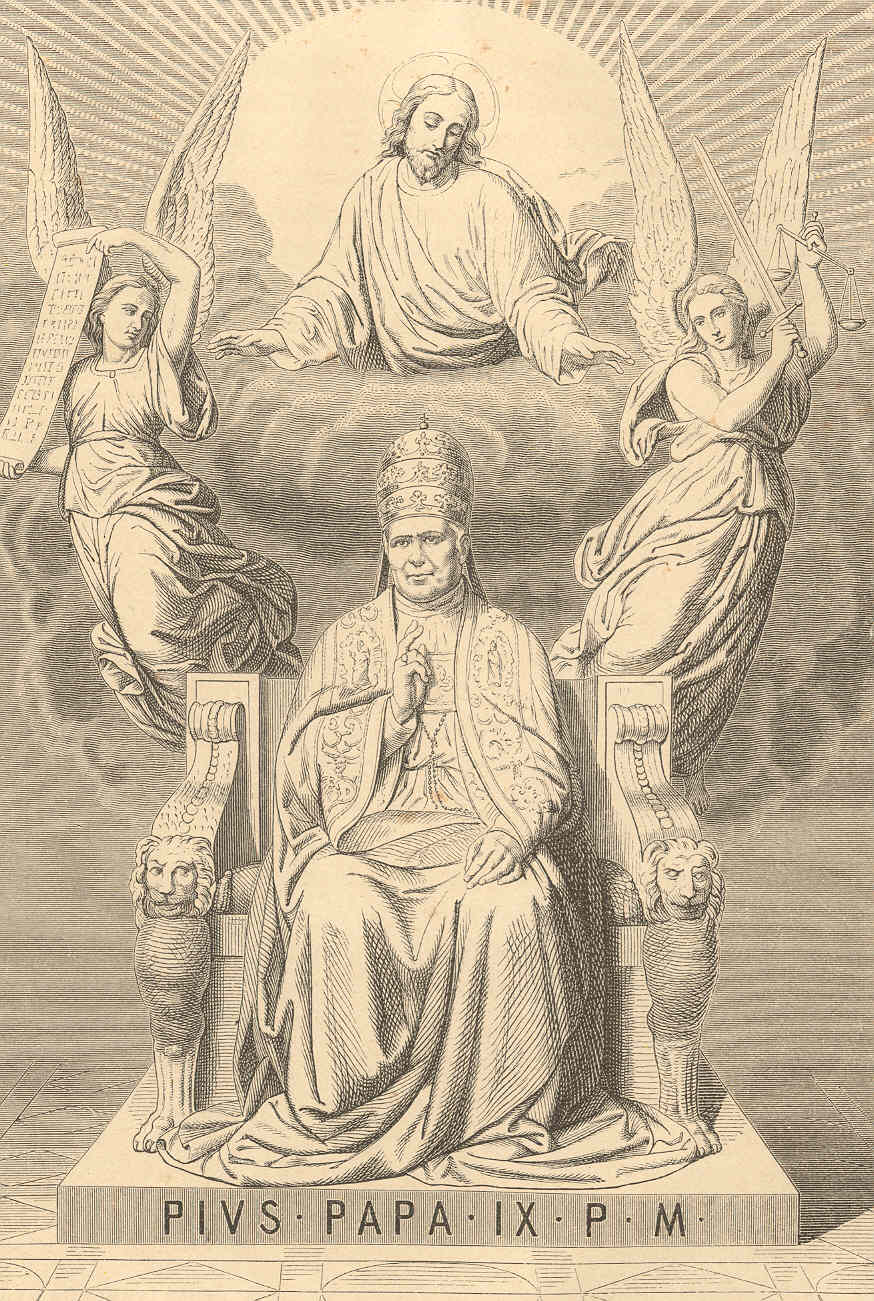
Blessed Pius IX
By Timothy S. Flanders
The Pian Magisterium refers to the period of the Church’s opposition to Modernism as contained especially in the French and other revolutions from Pius VI’s condemnation of the Synod of Pistoia (1794) to the death of Pius XII (1958). Thus it spans some 164 years. Taking a generation as roughly 25 years, this period encompasses 6.56 generations of the Church. So if you were the youngest generation at the twilight of Pius XII, that means your father knew it, your grandfather knew it, your great-grandfather knew it, and then his father and grandfather knew it as well, all the way to your great-great-great grandfather. For Americans, this goes all the way back to the beginning of the United States (the US Constitution was not in effect until 1789, the year of the French Revolution).
During the Pian Magisterium the Church was faced with global republican revolutions. But these were not simply changes from a Catholic monarchy to a Catholic republic, but these revolutions sought to reshape the very fabric of society. This movement became known as “Liberalism” from its common theme: “Freedom” (Latin libertas). The Pian Magisterium, however, identified all of these freedoms as being contrary to Christian order, since these “freedoms” were founded on a denial of the dogma of Original Sin–that without divine grace, man’s intellect was darkened, his will was weakened, and he was inclined to evil.
Thus, all of the freedoms the revolutions sought were solemnly condemned by the Pian Magisterium as being false freedoms, leading to slavery. Why is this? The concept of freedom as imagined by Liberalism was not the freedom as given by Christ—in other words, true freedom—but a cunning counterfeit masquerading as freedom. As a wise man once said, “The enemy of the good is not the evil, but the almost good.” Only the “almost good” can deceive good men away from the truly good.
As our Lord said, he who commits sin is a slave to sin (Jn. viii. 34) and again If the Son sets you free, you will be free indeed (Jn. viii. 36). Because of the dogma of Original Sin, the Church understood that freedom from sin was the only true freedom. Thus unless Original Sin was attacked and overcome, every other effort would turn out in vain, and worse, more slavery to sin. This is why in Christendom the momentum of culture flowed against Original Sin from the moment of birth to sorrow of death. And that is why the ideas of Liberalism were condemned—they sought to move the cultural momentum in the opposite direction: reinforcing Original Sin.
Thus came all the solemn condemnations of the Pian Magisterium:
- The State should be free from the Church: false freedom. If the state is not bound to submit to Christ the King and His Vicars in the Church, the state would only become another pagan emperor seeking its own self-aggrandizement. Thus the citizens were just yoked to further slavery. This had already been happening for some 3 centuries since the Protestant revolt in both Catholic and Protestant monarchies.
- Economics should be free from the moral order: false freedom. In every transaction, the stronger is tempted to take advantage of the weaker. Original Sin makes any system of men incline to evil, thus it needs the moral Christian order to check its excess. Otherwise, the excess of the richer classes simply gains more wage and debt slaves—this has only provoked widespread labor violence and the evil of Communism.
- Freedom of religion, freedom of the press: false freedom. The truth is what brings freedom. It is no freedom to have license to spread the slavery of error. By Original Sin, this only leads straight to indifferentism and relativism.
- A woman should be free from the headship of any man: false freedom. God created male-female order in a relationship of submission and headship. This is designed by God so that man could provide and protect women, and that women could become the maternal guardians of society. If women usurp the role of men in society, a new slavery is the only result, which ends up making women slaves to the wicked schemes of evil men.
- Spirituality should be free from suffering, since the purpose of religion is to cause positive emotions: false freedom. Christianity is not mere sentiment, but the carrying of the cross. Moreover, suffering frees us from attachments to creatures, in order that we may make spiritual progress in holiness.
These and other false freedoms were solemnly condemned by the Pian Magisterium. Instead, the Dogma of the Immaculate Conception was proclaimed—and confirmed by multiple visions of the Mother of God herself—showing that all men were under Original Sin but our Lady. The rights of Christ the King were defended in society as they had always been proclaimed by the Church especially since the conversion of Armenia in 301.
The difficulty with this period however, was untangling these false freedoms from the true natural freedoms fought for at that time:
- Freedom of the will: man was indeed endowed with a free will. But this had been denied by Protestantism and also by the heretical Jansenists.
- Freedom from economic exploitation: the poor in this age were herded into cities and forced to work as wage slaves in factories with horrible conditions (including children). This was a true injustice against their freedom.
- Freedom from physical slavery: the battle (led by the good Jesuits) against the transatlantic slave trade had been surrendered by the Church when Clement XIV suppressed the Jesuits in 1773, abandoning the slaves to the cruel injustice of absolute tyrants. The Church never fully recovered from this moral compromise, and together with the spread of wage slavery, much of the European mainland left the Church by 1900.
Due to these true freedoms the Church failed to adequately defend, the secularization of Europe was consummated in the First World War, during which our Lady of Fatima gave the world an ultimatum: repent or perish (Lk. xiii. 5). The world chose to perish and massacred millions more, eventually creating an entire industry to slaughter millions of innocent children for the sake of fleshly lusts.
Because of the failure of the Pian Magisterium, John XXIII and Paul VI believed that a new policy would work: instead of condemning the false freedoms, try to compromise with them. This was the pastoral Council of Vatican II, which revoked nothing of the Pian solemn condemnations, but instead tried the new policy of the “Medicine of Mercy.” It was believed this would bring about a new springtime of renewal of the faith Thus ended the era of the Pian Magisterium and thus began the era of the Springtime Magisterium.
But whereas the Pian Magisterium lasted nearly 7 generations but failed to keep Europe in the faith, the Springtime Magisterium oversaw an unprecedented collapse of every last vestige of faith in Euro-America. Thus after barely two and a half generations (1958-2020), the Springtime approach has proved a complete failure. Even worse, the enemies of Christ have gained greater power over the Church herself through widespread moral, doctrinal and spiritual corruption. The errors of Russia have now spread and gained dominion over the world.
It must be admitted that the Pian Magisterium failed to prevent secularization, and failed to consecrate Russia to the Immaculate Heart. But it still nevertheless refused to compromise with the errors of Russia, but condemned their false freedoms over and over with solemn authoritative decrees.
Not so with the Springtime Magisterium. The Pian was deeply imbued with the realism of man’s affliction of Original Sin. The Springtime Magisterium, heavily influenced by the heresies of Teilhard de Chardin, acted as if Original Sin could be overcome merely by men “dialoguing.” Thus the Springtime actually made a compromise with what Pius XI called the “satanic scourge” (Divini Redemptoris, 7)—socialism. The Springtime Magisterium, with unpardonable hubris, shook hands with the Devil with the Metz Agreement, and agreed to suppress any condemnation of the Satanic Scourge at Vatican II. Thus while the Pian Magisterium—despite its failures—at least fought directly against the errors of Russia, the Springtime Magisterium opened the door to demons to ravage the vineyard of the Lord to make it what Dietrich von Hildebrand could call even in 1973: “The Devastated Vineyard.”
What is the solution? All who have eyes to see know that the Springtime has failed far more than the failures of the Pian. We must repent and return to Fatima. Make your First Saturdays. Pray the daily Rosary. The Church must have the humility to admit that the Springtime failed. Let bishops confess the Declaration and return to the charity of anathema. Old Testament and Church history shows us a cycle which is summed up by the Prophet:
If my people had heard me: if Israel had walked in my ways: I should soon have humbled their enemies, and laid my hand on them that troubled them (Ps. lxxx. 14).
Every time the Church falls into sin and error, God punishes her by making her enemies rule over her. When she repents and turns again to the Lord, He once again humbles their enemies. Let us be free from slavery to false freedoms. Let us repent and turn to the truth, and the Son will make us free indeed.
Timothy S. Flanders
@meaningofcath

Strength and Weightlifting – Catholic Masculinity Pt. 2
K. Hall is releasing a new book later this month – Terror of Demons: Reclaiming Traditional Catholic Masculinity published by Meaning of Catholic’s own Our Lady of Victory Press.
This part 2 of a series of shows with Hall discussing his book and the many aspects of Catholic manhood both spiritual and practical. All St. Athanasius patrons and above will receive the new book for free.
In this episode we are joined by special guest Gene Zannetti and will discuss the importance of strength both physical, mental and spiritual.
Gene Zannetti @SpiritualStren1 Gene’s work and book
Fitbod (Body Weight App)

Spiritual Strength: Building Athletes for Christ
Invitation to the Spiritual Combat
By Gene Zannetti
It is not difficult to see that our world is facing a crisis of faith; people are poorly catechized and spiritually weak. And it is not all their fault; there are very few leaders who present the truth in a strong direct way. This is interesting because people generally admire personal trainers and sports coaches who are blunt and direct with their feedback. A part of us likes getting yelled at and chewed out by a coach because we know they are making us dig down deep to reach new levels of improvement. We might grow in physical strength, but as a society, we are weak in spiritual strength. People get soft and complain when they are confronted by orthodox teachers of Catholicism. We have learned how to become physical athletes, but have not yet become spiritual athletes, as the saints have always aspired to become.
Whether or not you ever played a sport, you are an athlete! In fact, everyone is. Our society holds sports and competition in very high regard. We love to watch and participate in the thrill of victory and the agony of defeat. Everyone wants to win. Most athletes put a tremendous amount of pressure on themselves to succeed in competition. But there is a bigger competition we are all participating in, and many of us are not even aware we are competing. The competition is for eternal life; the field of play is our soul. Our opponents are the world, the flesh, and the devil.
St. Paul tells us about our role as athletes, our opponents, and the importance of winning: For our struggle is not with flesh and blood but with the principalities, with the powers, with the world rulers of this present darkness, with the evil spirits in the heavens (Eph. vi. 12). Be sober and vigilant. Your opponent the devil is prowling around like a roaring lion looking for [someone] to devour (I Pt. v. 8). This is a real competition! St. Paul tells us, I do not fight as if I were shadowboxing (I Cor. ix. 26). This is not practice, someone else is punching us back!
St. Paul taught Timothy how to fight the good fight (I Tim. vi. 12). Train yourself for devotion, for, while physical training is of limited value, devotion is valuable in every respect, since it holds a promise of life both for the present and for the future (I Tim. iv. 8). There are many parallels between spiritual training and physical training for a competition.
As spiritual athletes we fight against the world, the flesh, and the devil. Our opponent, the world, includes all false ideologies of the world, all the “isms,” and especially Modernism which Pope St. Pius X called the “synthesis of all heresies.” We defeat our opponent, the world, by having a solid foundation of traditional Catholic teachings. This will require a tremendous amount of studying, especially from the spiritual classics and official Church documents written before 1958.
Our opponent, the flesh, includes the seven deadly sins, which we must learn to counter by developing the virtues. As with sports, our greatest challenge is usually winning the battle within.
Our opponent, the devil and demons are fought by understanding the demonic from Church teachings as well as expert advice from exorcists, who stand on the front line, fighting the demonic. To be victorious, we ultimately must be docile to the movements of the Holy Spirit, pray for grace, and become completely consecrated to the three hearts of Jesus, Mary, and Joseph.
St. Paul makes many sports analogies for us, using them interchangeably. We are runners, wrestlers, boxers and more. We are athletes for Christ. He wants us to understand the battle and the importance of training for it. Finally, draw your strength from the Lord and from his mighty power. Put on the armor of God so that you may be able to stand firm against the tactics of the devil (Eph. vi. 10). For we know the victory is guaranteed in Christ. If we fight the good fight, we will attain a crown of unfading glory .
St. Paul reminds us of several important lessons:
- You are in the middle of an ultimate competition, whether you like it or not, against the world, the flesh, and the devil.
- The devil and demons come to steal, kill, and destroy everyone and everything, including the people you love.
- You are called to TRAIN and WRESTLE.
- If you train and wrestle God’s way, you will WIN!
—
 Gene Zannetti owns Winning Mindset, a sport-performance mental training program. He has two Masters Degrees in Exercise Science and Sport Psychology and is a certified School Psychologist. He was a Nationally Ranked All-Ivy League wrestler at the University of Pennsylvania. After a strong “reversion” following the 33-day consecration to Jesus through Mary in 2015, he founded Spiritual Strength, conducting retreats, presentations, and an online apostolate spreading devotion to the three hearts and fighting against the world, flesh, and devil. His book Spiritual Strength: Building the Total Athlete for Christ was reviewed and endorsed by Cardinal Burke and bears an Imprimatur. He lives with his wife and son (with another son on the way) in New York City. Follow him @SpiritualStren1

Timeline of Vatican Finances

Editor’s note: the following timeline is provided with public facts as well as allegations which have not been confirmed. See also the broader timeline of the crisis here. The purpose of this timeline is to continue the investigation of the financial forces at work in the Vatican for decades which have contributed in no small part to the workings of our current crisis. If you have any points to correct or add, please comment. The reader must also take care to guard against the vices of curiosity and despair and to not read any of this if such vices tempt you. See also Five Things to Get You Through the Church Crisis and When the Gates of Hell Prevail over the Church. -T. S. F.
***
1894 Banco Ambrosiano founded by a priest in Milan
1929 Financially Struggling Vatican receives $92.1M in Lateran Treaty by former Milanese Archbishop, now Pius XI
-Finances managed by Bernardino Nogara – Pius XII investigates him and finds him clean (Williams)
1942 The Vatican Bank is founded (IOR) in order to achieve further independence since 1929 treaty (Williams)
-Allegedly involved in corrupt financial dealings involving the CIA, Masons and Mafia against the Italian Communists. Ven. Pius XII works closely with Spellman, who is later credibly accused of financial and moral corruption.
-Allegations of assisting Croatians committing Genocide against the Serbs (Williams)
-Funding for Christian Democratic Party under Alcide De Gasperi against the Communists
-Spellman leads anti-Communist Italian Americans in favor of Christian democrats – Mafia including Salvatore Giuliano commit murder for Christian Democrat allies (Williams)
1948 political Victory over Italian Communists – US Aid is given to Italy and ends up in Vatican Bank
1948-1958 Era of IOR-backed Christian Democratic Party power in Italy
1945-48 Allegations of helping Nazi war criminals move to South America – lawsuit filed 1999 atty Jonathan Levy supported by Ukrainian Union of Nazi Victims and Prisoners
1954 Montini exiled to Milan for Communist contacts (Godmother), meets Sindono who raises Mafia money for him (Williams)
1958 St. John XXIII refuses to fund Christian Democrat party, apertura a sinistra (“turn to the left”) Italian Christian Democrats begin to forge alliances with Italian leftists
-Sindona meets with head of IOR Massimo Spada (Cornwell, 37)
1967 or 68 Sindona meets Calvi (Cornwell, 38)
1968 The Italian state revokes the Vatican Bank tax exempt status, St. Paul VI brings in Freemason mafia banker Sindona to help, he switches IOR’s investments
-Taxes owed are $720M
1971-1989 Abp. Paul Marcinkus is President – works closely with Sindona and (later Mafia murdered) Calvi
-Also close collaborators is Cdl. Sergio Guerri, gov. Of Vatican City
1973-1984 Alleged Freemason Cardinal Baggio successfully creates Modernist bishops throughout the world (Murr, Godmother)
1974 -Vatican Bank experiences major financial losses due to Sindona’s mishandling.
1978 Cardinal Gagnon documents wholesale corruption of the curia for Paul VI. Pope refuses to act. Paul VI passes this information to John Paul I, who is allegedly murdered after attempting to remove Baggio. Information of wholesale corruption is given to St. John Paul II
-Gagnon tells Marini that “they will kill” John Paul I because he seeks to reform the IOR (remove Marcinkus which would cut off Banco Ambrosiano of Roberto Calvi and remove Villot as Sec or State). Three days later he’s dead (Kramer)
-John Paul II confirms all prior heads against John Paul I’s intentions–Villot, Marcinkus as well as ties with Calvi and Mason Gelli
-Calvi begins massive fraud operation with offshore accounts. Marcinkus continues IOR’s partnership with him. John Paul II will allegedly use this to fund Poland Solidary (Williams, 176).
1979 Vatican Bank financial chief Sindona’s lawyer Ambrosoli is murdered with top detective Guiliano investigating Sindona
1980 Vatican Bank financial chief Sindona is convicted on 65 counts of financial crime
1981 “Ambrosiano Affair” – Calvi is investigated on charges of fraud
-Marcinkus forges documents to cover Calvi’s fraud (Williams, 168)
-John Paul II is warned of corruption but elevates Marcinkus instead (Williams, 169)
1980s-1990s – McCarrick rises as major financial player with Vatican
1982 Close associate to IOR Roberto Calvi is murdered
-IOR pays settlement to his bank’s creditors
-John Paul II pledges full transparency in dealings with Ambrosiano – brings in German lay banker Hermann Abs
-John Paul II assassination attempt in Fatima, Marcinkus saves John Paul’s life
1986 Sindona is murdered in prison
1987 James Grein tells John Paul II in person about McCarrick’s abuse
-Italian court warrant against Paul Marcinkus who evades arrest by staying inside Vatican City until 1991
1992 Gelli convicted of financial crimes
1990s Martin Frankel (David Rosse) affair
-St. Gallen Mafia organizes against the pontificate of John Paul II
2007 Paulo Gabrielli hired as butler for Benedict XVI
2009 Vigano audits IOR, finding 55 million+ hidden away, changing IOR from deficit to surplus
– Benedict becomes aware of financial irregularities
2010 €23 million from the IOR seized by Italian government alleging laundering
-Benedict creates Vatican financial Watchdog for all including IOR
2012 Vatileaks scandal – published letters reveal sexual and financial corruption involving the Vatican Bank. Alleged plot to overthrow Benedict revealed by Butler Gabrielli.
-Moneyval report shows positive developments from Benedict reform
-Benedict completes investigative dossier on curia corruption but does not act on it before resignation.
-Chairman Ettore Gotti Tedeschi ousted amid laundering scandal – later acquitted of money laundering
2013 Francis IOR review begins. Appoints alleged active sodomite (“who am I to judge”) Ricca as head Vatican Bank
-Annual reports begin which are praised by secular media as transparent
-Ernst von Freyberg as new head
-Moneyval says Francis has brought some improvements
-Power of Italian Mafia Ndrangheta (also established in Victoria, Australia) threatened by IOR reform
2014 Promising reform, Francis creates Secretariat of Economy and names Pell (from Victoria) its head also Council for the Economy to work on analysis of Sec of Econ with its head Marx – acquires Patrimony of Holy See, also the office of the Auditor General Libero Milone
-Francis approves measures on IOR approved in Part by Pell
-Von Freyburg steps down and Jean-Baptiste de Franssu replaces him
-Pell finds 1.09 billion euros hidden away among Vatican finances
2015 Hospital Dermatopathic Institute of the Immaculate (IDI) purchased by Secretary of State
-Francis allegedly seeks loan to bail out IDI
2016 Secretary of State suspends external audit of Vatican finances without consulting Pell.
-Francis strips power from Pell’s Secretary of Economy and gives it to Administration of the Patrimony of the Apostolic See (APSA)
2017 McCarrick engineers bail out for IDI hospital via Papal Foundation with help from Parolin – Pell attempts to veto
-APSA forces different external auditors against Pell (and Vatican auditor general Libero Milone) who accuses APSA of “serious irregularities”
-Milone resigns and states later he was forced out by Vatican because he was uncovering corruption, implies that Pell’s conviction is connected to Pell’s uncovering corruption
2018 Vatican Bank joins Single Euro Payments Area (SEPA), which allows the Vatican bank to have its own IBAN code to facilitate wire transfers. – indication of improvements
2019 Pell convicted and no longer prefect
-London scandal buying luxury property with Peter’s Pence in association with shady-launder bank BSI (de Franssu points out it scandal broke due to IOR’s self-policing)
-Vatican-backed Maltese Centurion Global Fund helps fund sodomite film Rocketman
2020 Pell exonerated and freed
***
Paul Williams, The Vatican Exposed (Prometheus: 2003)
Rupert Cornwell, God’s Banker (Dodd, Mead: 1984)
Charles Murr, The Godmother (2017)
Taylor Marshall, Infiltration (Crisis: 2019)
Fr. Paul Kramer, The Mystery of Iniquity (Unmasking Iniquity: 2011)
David Yollop, In God’s Name (Basic Books: 2007)

Laymen or Women Must Baptize Their Children if Deprived of a Priest
Let the children come to me, do not hinder them.
By Timothy S. Flanders
This article as a podcast:
Water Baptism is Necessary for Salvation
The necessity of water Baptism is presented in stark terms by our Lord:
Amen, amen, I say to thee, unless a man be born again of water and the Holy Ghost, he cannot enter into the kingdom of God (Jn. iii. 5).
From this derives the constant teaching of the Church that water Baptism is necessary for salvation. This teaching is affirmed as recently as the New Catechism, which references this verse when it says “The Lord himself affirms that Baptism is necessary” (CCC 1257) and
The Church does not know of any means other than Baptism that assures entry into eternal beatitude; this is why she takes care not to neglect the mission she has received from the Lord to see that all who can be baptized are “reborn of water and the Spirit.” God has bound salvation to the sacrament of Baptism, but he himself is not bound by his sacraments (CCC 1257).
Baptism is the Most Necessary, Therefore it is the Most Accessible
Since it is necessary, God also ordained that it be the easiest Sacrament to receive both because of its matter (water) and its minister (anyone). This is summed up by St. Thomas:
It is due to the mercy of Him Who will have all men to be saved (I Tim. ii. 4) that in those things which are necessary for salvation, man can easily find the remedy. Now the most necessary among all the sacraments is Baptism, which is man’s regeneration unto spiritual life: since for children there is no substitute, while adults cannot otherwise than by Baptism receive a full remission both of guilt and of its punishment. Consequently, lest man should have to go without so necessary a remedy, it was ordained, both that the matter of Baptism should be something common that is easily obtainable by all, i.e. water; and that the minister of Baptism should be anyone, even not in orders, lest from lack of being baptized, man should suffer loss of his salvation (III q67 a3).
Thus since water Baptism is necessary for salvation, God instituted this Sacrament with the most common and readily available substance in daily life—water. Not only this, but anyone is able to validly baptize, even a layman or woman, and even a heretic or pagan.
It is a Sin to Unreasonably Delay Baptism
Given what is said above, the Catechism of the Council of Trent declares that delaying baptism is a sin:
Baptism Of Infants Should Not Be Delayed
The faithful are earnestly to be exhorted to take care that their children be brought to the church, as soon as it can be done with safety, to receive solemn Baptism. Since infant children have no other means of salvation except Baptism, we may easily understand how grievously those persons sin who permit them to remain without the grace of the Sacrament longer than necessity may require, particularly at an age so tender as to be exposed to numberless dangers of death (Roman Catechism 2.1).
Thus have recent popes Leo XIII and St. John Paul II admonished parents to not delay baptism. Thus the current code of canon law states:
Parents are obliged to take care that infants are baptized in the first few weeks; as soon as possible after the birth or even before it, they are to go to the pastor to request the sacrament for their child and to be prepared properly for it.
An infant in danger of death is to be baptized without delay (Can. 867 §1, 2).
A reasonable delay of “the first few weeks” is permitted so that the solemnity can be arranged to be celebrated by the priest. However, because of the necessity of this sacrament for salvation, in danger of death, the solemnity of the priest is dispensed and a layman or woman should perform the baptism immediately.
Justice and Charity
These provisions illustrate the principle virtues which bind the faithful regarding baptism. Justice is the virtue by which a man gives to another what is his due right. Charity is a higher virtue which simply wills the good of another for the sake of God, not in regards to any rights.
Now it is the right of the priest to celebrate the Sacraments, as he has been ordained for this purpose by God. However, because of the necessity of baptism and the higher duty of charity, in a time of necessity the priest’s right according to justice yields to the obligation of charity. In other words, it is a greater duty by charity to baptize a child in grave need than to protect the right of the priest by justice to baptize. The need of the child to be baptized is greater than the need of the priest to baptize. Thus parents are obliged to not delay baptism and, if there is no way for the priest to baptize (i.e. the child is likely to die), the parents themselves must baptize.
Thus in our time when priests are not available to baptize, the parents must baptize the child since the sacrament cannot be delayed in favor of a priest’s right, which could be delayed indefinitely. Make every effort to have the priest baptize, but in the case that he cannot, the child must still be baptized.
Doesn’t Baptism of Desire Suffice?
Fr. Spirago explains the context of the baptism of desire or blood:
If baptism by water is impossible, it may be replaced by the baptism of desire, or by the baptism of blood, as in the case of those who suffer martyrdom for the faith of Christ (Catechism Explained, Baptism).
The context in which these extraordinary means of baptism have been recognized by the Church is always in the context of water Baptism. The two examples referenced by Thomas from the Fathers is instructive about the extraordinary nature of these.
Regarding Baptism of Desire, the example is given when the Emperor Valentinian II was traveling to Milan in order to be baptized, he was assasinated. The Church recognized in this case that he had received the grace of baptism in an extraordinary case, since he was exerting the will to be baptized by water.
The other case is a catechumen preparing for water baptism who suffers martyrdom for Christ before he is able to be baptized. This is the “Baptism of Blood” or “Baptism of Fire” wherein the Church celebrates as martyrs those catechumens who died without baptism, since martyrdom “contains all the sacramental virtue of Baptism” (III q68 a2).
From these examples it should be self-evident that the Sacramental grace of baptism without water is exceedingly rare and extraordinary. Hence the stark words given at the beginning regarding the necessity of being “born again of water.” It is Jesus Christ Himself who made such an absolute statement.
The New Catechism elaborates that we do not utterly despair of salvation for unbaptized pagans with invincible ignorance, nor of unbaptized children who die. Nevertheless the Catechism continues, quoting our Lord Let the children come to me, do not hinder them, and concludes “All the more urgent is the Church’s call not to prevent little children coming to Christ through the gift of holy Baptism“ (CCC 1261).
Such hope for extraordinary graces are founded on God’s mercy, since it is true that “God has bound salvation to the sacrament of Baptism, but he himself is not bound by his sacraments” (CCC 1257). Nevertheless this is an uncertain hope. This is because God has not revealed these mysteries to us, nor can we say with any certainty that this child or that man will receive an extra-sacramental grace of baptism. But we can say with certainty that performing a valid baptism will confer the grace, because God has promised it and revealed it and commanded it. Therefore it is exceedingly foolish to hope in an extraordinary, rare and uncertain grace that God has not promised, instead of receiving the ordinary grace He has provided for our salvation. “The Church does not know of any means other than Baptism that assures entry into eternal beatitude” (CCC 1257). Therefore charity obliges parents to baptize their child who cannot be baptized by a priest within “the first few weeks.” Whenever a priest becomes available, the ordinary solemnities of the ceremony can be supplied.
How to Perform a Lay Baptism
A valid baptism can be performed by anyone intending what the Church intends, pouring water three times on the child’s head and saying this formula:
“[Name], I baptize you in the Name of the Father and of the Son and of the Holy Spirit.”
When you make contact with the priest at your parish, you will need to inform him of the private baptism and exactly how it was performed so that he can confirm it was valid. A lay baptism can only be performed in a case of necessity, when the child is in danger of death or the priest is not available to perform the Sacrament himself within a reasonable delay.
Timothy S. Flanders
@meaningofcath

Why I will Never Participate in a New Mass Again Pt. 2
By Kennedy Hall
Read part 1 here.
Part 2: The Faith of Our Fathers
Giuseppe Viani
Giuseppe “Joe” Viani was my Nonno (grandfather) who emigrated from Italy to Canada in 1967 with his wife, Silvana, and their three children. My mother was 11 years old when they came over, and grew up in a traditional Italian household. When I was younger, my mother brought me and my sister to live in her childhood village for a time, and it was an experience that played a strong role in my formation.
My Nonno was a man with great magnanimity of soul, and everyone who met him was attracted to his confident and outgoing personality. He was a tall man, especially for an Italian, and it was evident by the shape of his hands that he was strong as an ox. In Italy he was essentially a farmer, although in the feudal system of old he technically did not own any land, but instead oversaw orchards of fruit bearing trees. He had a “green thumb,” and in Canada he maintained an exquisite garden, with tomato and herb plants that seemed to yield relentless harvests every year.
He was a young teenager throughout the Second World War, and shared many stories about America soldiers coming through his village as they ousted Nazi forces. He once told me how one day he acted as navigator for a group of Allied soldiers during a mission to find Nazis in the area around his village. The recount of this escapade included ducking enemy fire as the Jeep took blows from villainous machine guns. Furthermore, as resources became scarce during the war, he told me how they would hide bags of flour in rafters of barns to ensure that their food supply could last. Needless to say, this man was not effeminate; he was a giant of a man, with shoulders strong enough to bear the Cross of forging a life for those he loved.
In Vino Veritas
Nonno was also a traditional winemaker. When he brought his family across the Atlantic, he brought with him the traditions of the vignaioli (winemakers) of his native Tuscany. With little money, and not a lot of space, he created a fully functional mini-winery in the basement of his newly acquired home in Stratford, Ontario. Much of the equipment he made himself, or he had made by other tradesmen in the area. Some people did not like the taste of his vintage, as they found it too rugged and unrefined. But people are often wrong about a lot of things.
In any case, years later when his health began to fail, it was unfortunately time for Nonno to go into a nursing home. I should add that I will do everything in my power to ensure my parents never spend their last days in one of these places. It isn’t that he did not receive good care, or that the staff was not lovely, but I believe it was an undignified way to live the last couple years of his life. The year prior to Nonno moving out of his house, I had the privilege of spending the better part of a few months with Nonno and Nonna. In a sense I was their caretaker, but really I was just fulfilling my duty as a grandson. I had spent a lot of time with him growing up, but this was an opportunity to spend weeks and months with him. I am very thankful to my mother for ensuring I learned Italian, because without it I would have missed so much.
As we moved what was left of his possessions out of his house, I noticed that all the wine equipment remained in the basement. No one in the family had use for his seemingly ancient artifacts, even those who continued the tradition of vino. Without hesitation, I decided to take the equipment and store it in my house. I have never used it, as I do not make wine, but I could not bear to see it cast aside or thrown into a dump. There was something “sacred” about these family heirlooms, although I understand that in reality they were not sacred in the truest sense of the word. Nonetheless, the idea that something so reminiscent of the traditions of my ancestors could be treated as disposable was a terrible thought. The items still sit in my basement to this day, and I have moved them to three different houses, and every time I see them my heartstrings are tugged by the memory of Joe Viani.
We eat, we drink and we go see God.
Eventually, Nonno died a year or so shy of his 90th birthday. It struck me as he passed away that not only did he die, but it seemed as if an entire world died with him. He was in his 40’s when the New Mass was introduced, and his traditions and piety were of another era in history. He had a saying: “Si mangia, si beve e si va a vedere il Signore,” which is Italian for “we eat, we drink and we go see God.” At his funeral I kept replaying that phrase in my mind, and could not help but notice that we sat in a very modern Novus Ordo setting, with a liturgy that barely resembled the one that sent all of his ancestors into the Afterlife. I was not attending the Latin Mass at this time, but I believe I received some sort of particular grace that moved my heart in a similar way as the Latin hymn in Mexico City.
Immediately after his death, I began to look into all things traditional. I started listening to sermons, reading books, watching videos, and looking for a Latin Mass. Throughout my search I realized that I had missed an entire chunk of Church history, namely the veritable destruction of the sacred artifacts and altars laboured over by generations of European peasants. I thought of my nonno’s nonno, and his nonno’s nonno, and so on. I realized that with the publishing of suspect conciliar documents and a post-Vatican II mania, the blood, sweat, and tears of a civilization of Catholic artisans had been deconsecrated and thrown into the trash.
I could not help but think of the winemaking equipment that sat in my basement, collecting dust. If someone tried to take away those family artifacts and dispose of them, or even if they told me they were going to replace them with something “modern,” I would have a hard time not throwing that person out of my house with all my strength. Once again, how much more important were the legitimately sacred items that were ripped out of the hearts of parishes all over the world?
I cannot imagine the sort of diabolical disorientation it would take to empower a universal movement of throwing away or “updating” all of our sacred family heirlooms, which is what the imposition of the New Mass and the accompanying aesthetic “renovation” truly was.
I could go on, but suffice it to say that I will never participate in the New Mass again, because I will never participate in the aftermath of the impious autodestruction of the sacred heirlooms of our fathers. We should be ashamed with what we did to their memory, and to what they left us. The Fourth Commandment requires us to honour our fathers, which includes those who are long dead. We do a great disservice to our ancestors by propping up a liturgy that would be unrecognizable to those who came before us.
***
 Kennedy Hall is a Catholic High School teacher, rugby coach, and part time writer on Catholic topics. He is the author of the forthcoming book Terror of Demons: Reclaiming Traditional Catholic Masculinity. He has written for the Kolbe Center for the Study of Creation, Serviam Ministries and the Fatima Center. He teaches Catholic Religion courses to French Immersion students and also speaks Spanish and Italian. Kennedy has spoken at various youth events, as well as on the topic of true Catholic masculinity. He has a passion for the Traditional Latin Mass and the restoration of traditional piety. A prodigal son, he was brought back into the Church with the help of Our Lady of Guadalupe, and prays for the day that all men depend on the Blessed Mother. He lives with his wife and 4 children in Stratford, Ontario. Follow him @kennedyhall.

Podcast: Holy Monday – Mental Prayer Continued
T. S. Flanders and K. Hall discuss the dearth of fatherhood in this crisis, mental prayer, and the duties of your state in life.
The Modern Catholic Liberal Disaster: Why Conservatives and Trads Must Unite – Table of Contents
This book is coming in 2021, published by TAN Books. Its central thesis: the division between so-called “Conservative” and “Traditionalist” Catholics hinges upon a disagreement about the rights of Christ the King following the global liberal revolution since 1776. This disagreement has broken the former alliance between these parties, allowing the Modernist heretics and other enemies of Christ to seize control of the Church and society, leading to our current crisis. This series will attempt to present an objective historical picture and argue for both parties to unite once more against the enemies of Holy Church, as they once did throughout history until the time of the Vatican Councils. Below are brief preview posts of the some of the areas which will be covered in the book.
Part I: Introduction – The Tridentine Alliance between Conservatives and Trads
Part II: The Liberal Revolutions and the Breakdown of the Alliance
Chapter 1: The Bloodshed Increases
Chapter 2: The Bloodshed Grows Still More and Pio Nonno Takes a Stand
Chapter 3: The Alliance and the False Spirit of Vatican I
Chapter 4: The Synthesis of All Heresies
Chapter 5: The Great War against Christ the King and the Ultimatum of Fatima
Chapter 6: The Papacy‘s Compromise with the Enemies of Christ
Chapter 7: God’s Punishing World War II and the Surrender of Pius XII
Part III: The Triumph of the New Iconoclasts
Conditions for Sedes and Eastern Orthodox
BRETHREN IN CHRIST:
To Sedes and polemical Eastern Orthodox [1] – your manner of disputing on the internet follows this general pattern:
1. You have not sufficiently studied the subject under dispute. Ex: Sedes, you have never read Torquemada or Cajetan on the central question, nor can you prove what theological note is the sententia of Bellarmine.
For Eastern Orthodox: you have never read, for example, the Imitation of Christ but simply believed Brianchaninov’s incredible bias against the spirituality of your own Latin saints, or, perhaps what is worse, you disparage St. Augustine more than Mark of Ephesus would ever presume himself worthy to speak.
2. Thus, you rely on straw men and ad hominem to prove your opinions. Therefore your disputes are unconvincing and, moreover, hazardous to your own eternal salvation. As it is written: Every idle word that men shall speak, they shall render an account for it on the day of judgment (Mt. xii. 36) or again whosoever shall say, Thou fool, shall be in danger of hell fire (Mt. v. 22).
3. Therefore I will ignore your comments unless you do the following:
First, tell me your full name. If we can’t interact like normal human beings do in disputes of this kind then we can stop now.
For sedes: list every primary source you have read on the question of a heretical pope besides Bellarmine.
For Eastern Orthodox: list Latin Saints you have read, the secondary Catholic sources you have read, and the Latin spiritual works you have read both pre- and post-1054. Confirm that you have read Soloviev and you can refute him.
The last time I gave such conditions, the Eastern Orthodox did not follow the directions and then attempted to ridicule me into disputing with them, proving my point exactly. Unless you follow these guidelines, your comments will be ignored. This is for your own sake and mine. If you think I’m trying to be arrogant or condescending to you, I suppose you can ignore me.
With respect,
Timothy Flanders
[1] Here I will distinguish between Eastern Orthodox who have questions of Catholics, or simply wish to have a civil disagreement (always happy to talk with such Orthodox), with those “polemical” Eastern Orthodox who seek to refute me. I am open to refutation, but only under the above conditions.

Holy Week Resources
Devotions
Holy Week Customs for the Whole Family (Quarantine Edition)
Maundy Thursday-Holy Saturday
Seven Last Words of Christ
Prayer to our Lady of Sorrows
40 Hours Devotion
Seven Mysteries of the Precious Blood
The Holy Hour
Mental Prayer
St. Francis de Sales: Introduction to Mental Prayer
Meditations from the Saints
The School of Jesus Crucified
Ancient Rite of Holy Week
Pre1955 Holy Week Website
Restorethe54.com
Full liturgies with Commentary from Bl. Adolph Schuster
Una Voce Paper on the 1955 Holy Week Reform Part I and Part II
Detailed Description of the 1955 Reform of Holy Week
Detailed Critique of 1955 Reform
Kwasniewski on the Ancient Rites
Background and Historical Overview of 1955 changes (Essay by Dr. Byrne on Active Participation and the Dialogue Mass)
Videos of the Ancient Rite
Palm Sunday
Maundy Thursday
Good Friday
Holy Saturday